
You already know you have a problem. The course title won't fix it.
A brilliant proposal gets shot down. A well-deserved promotion turns into a daily struggle. A team that should be high-performing splinters into silence and blame.
These are not "soft skills problems"; that label is too vague to be useful. They are specific, costly workplace failures.
Choosing the right soft skills courses can feel overwhelming, especially when a single challenge has multiple causes.
This guide helps working adults in Singapore, and those selecting training for them, identify the exact capability needed.
Whether you are looking for a communication skills course, a leadership skills course, or specific soft skills training for employees, this article explains how to diagnose recurring workplace difficulties and match them with the right programme.
The real task is to identify the behaviour that needs to change, determine whether training can change it, and then choose a course built around the right workplace outcome.
It doesn't start with a course catalogue. It starts with a diagnosis.
Start With the Workplace Challenge You Want to Solve
Course titles are an unreliable starting point because the same workplace symptom can have several causes.
Perhaps you rarely contribute in meetings; is it a lack of confidence? Difficulty organising your arguments? Fear of contradicting a senior colleague? Or do you simply believe that speaking up will make no difference?
Before enrolling in any workplace soft skills training, describe the problem as an observable situation. “I need better communication” is vague; “I cannot explain technical recommendations to non-technical decision-makers” is specific enough to guide a useful choice.
Ask four questions:
- What happens repeatedly?
- Who is involved, and what power does each person have?
- What do I currently do or avoid doing?
- What observable result would be different if I improved?
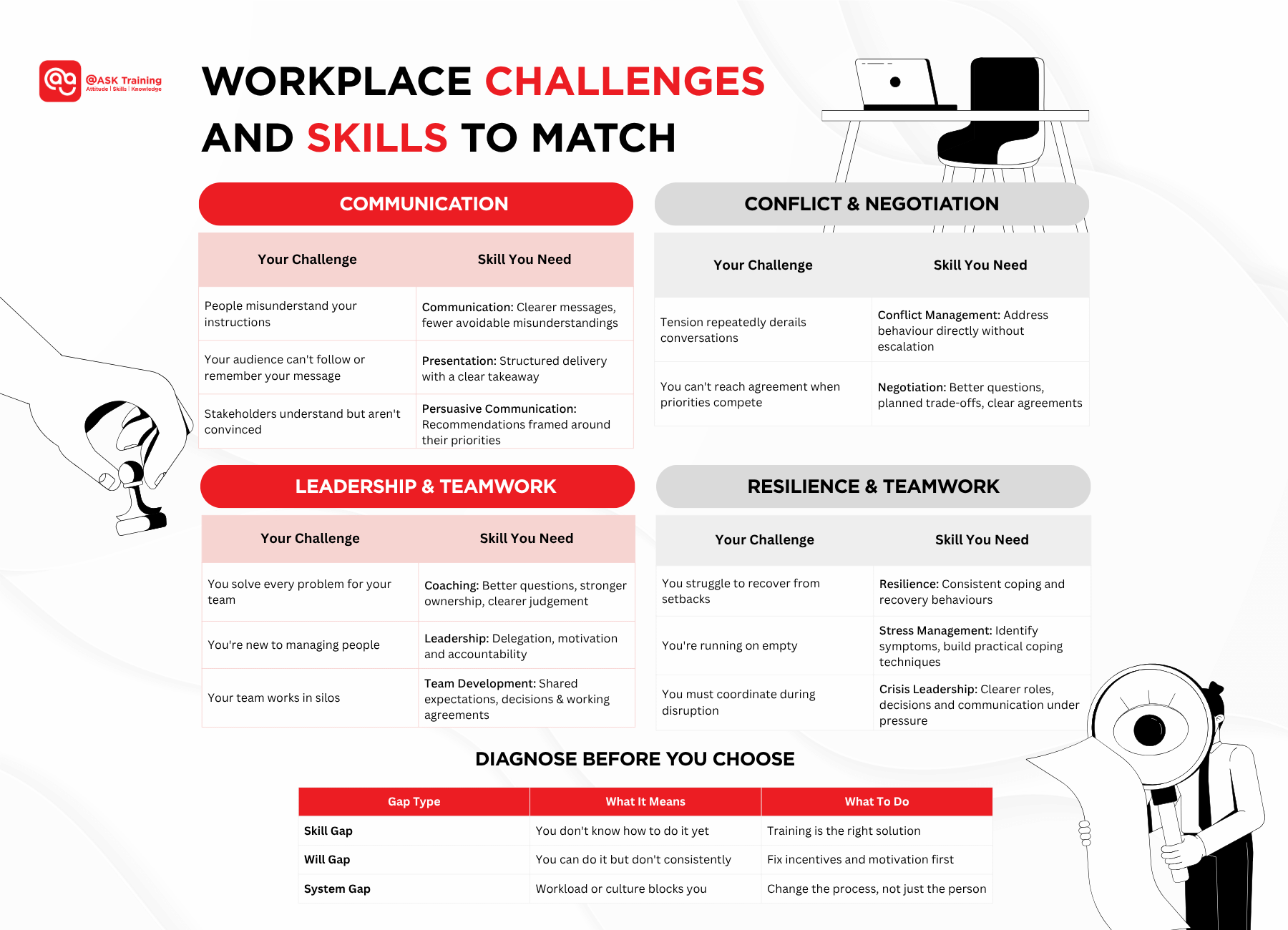
First Determine Whether It Is a Skill, Will or System Gap
Skill Gap
- You do not yet know how to perform the required behaviour.
- For example, you may not know how to uncover interests, plan concessions or respond to objections during a negotiation.
Will Gap
- You can perform the behaviour but do not consistently choose to do so.
- Attending another communication skills course will not solve incentives that reward speed over careful stakeholder consultation.
System Gap
- Workload, authority, process or culture obstructs the desired behaviour.
- You cannot resolve complaints effectively if every exception requires three approvals and supervisors penalise anyone who departs from the script.
Training is most defensible when the gap is genuinely about capability. When the cause is mixed, for example, when power dynamics or team norms discourage the behaviour, combine learning with:
- Manager support
- Clearer authority
- Revised processes
- Opportunities to practice
This distinction matters because effective learning and development should be linked to an identified performance gap, not simply to a popular course category.
McKinsey's 2025 Global L&D Survey shows that only 8% of organisations currently measure the business impact of their learning programmes.
The evidence is clear: learning only delivers value when it is tied to specific organisational objectives.
With a clear diagnosis in hand, the next step is to match the specific challenge to the right type of training. The following sections address the most common workplace difficulties and the courses designed to solve them.
Struggling to Communicate Ideas Clearly?
A communication problem exists when your intended meaning does not reliably reach the other person.
Common signs include rambling explanations, unclear requests, weak listening, messages pitched at the wrong level and conversations that end without agreed next steps.
Example:
A Singapore-based IT specialist presenting a cybersecurity recommendation to a finance director. More technical detail may demonstrate expertise, but it can also obscure the decision: what is at risk, what must be approved, what it will cost and what happens if action is delayed.
The specialist does not necessarily need more confidence. The likely need is:
- Audience analysis
- Message structure
- Active listening
- The ability to translate expertise into a clear business recommendation
General Communication vs. Persuasive Communication
General communication training focuses on mutual understanding. It is appropriate when you need to:
- Listen and clarify
- Adapt language
- Reduce misunderstandings
- Build more constructive working relationships
Persuasive communication goes further by seeking considered agreement or action. It should help you:
- Frame a case around stakeholder priorities
- Establish credibility
- Address resistance
- Make a clear recommendation without becoming manipulative
Understanding this distinction is key. If the primary challenge is navigating everyday workplace relationships, building rapport, managing interactions and fostering a more positive team dynamic, a general communication approach is more appropriate.
If the challenge involves winning support for ideas, gaining stakeholder buy-in or influencing decisions where interests diverge, persuasive communication provides the necessary tools.
Do not confuse persuasive communication with simply getting your way. If the proposal is weak, the evidence is incomplete, or the decision-maker has legitimate constraints, better persuasion cannot substitute for better thinking.
Of course, communication isn't always the core issue. Sometimes the problem isn't what you say, but how you say it, especially when you're standing in front of a room.
Nervous About Presentations or Speaking Up?
Presentation anxiety and presentation capability overlap, but they are not identical. You may understand the material yet become visibly unsettled in front of senior management, or you may sound confident but deliver an unstructured presentation with no clear decision or takeaway.
A useful presentation skills course should address at least three areas:
- Message structure: What your audience must understand, remember or decide
- Delivery: Your pace, voice, body language and use of notes
- Audience engagement: Relevance, questions, objections and time control
Imagine a project manager given seven minutes at a steering committee meeting. The weak response is to compress 30 slides and speak faster; the stronger response is to lead with the decision required, show only the evidence necessary and prepare for the two objections most likely to arise.
The distinction is practical.
If your presentations lack focus and impact, the gap is likely in message structure and audience analysis. If a reasonably structured message is undermined by hesitation, avoidance or delivery anxiety, the barrier is confidence and delivery technique.
Identifying which gap applies will point you toward the right training approach.
While presentations are about delivering your message to an audience, the real test often comes in one-on-one interactions, especially with colleagues who seem impossible to work with.
Finding Certain Colleagues Difficult to Work With?
“Difficult person” is a dangerous label because it turns a relationship problem into a personality verdict.
Your colleague may indeed behave aggressively or inconsistently, but recurring friction can also arise from:
- Unclear boundaries
- Incompatible expectations
- Status differences
- A process that forces people into conflict
Suppose a marketing executive repeatedly receives urgent requests from sales at 5 pm. The immediate temptation is to attend conflict management training, but the real problem may be the absence of a shared campaign calendar, service standards or an escalation process.
Training becomes relevant when you need to:
- Regulate your reactions
- Listen under pressure
- Set boundaries
- Address behaviour without attacking the person
- Move the conversation towards a workable agreement
Training should not teach you to tolerate bullying, harassment or unsafe conduct that requires formal escalation.
Conflict Training vs Interpersonal Training
Conflict training is appropriate when disagreement has already become tense or repetitive. It should cover:
- Difficult conversations
- Emotional regulation
- Assertiveness
- Reframing
- Boundaries
- Resolution options
Interpersonal training has a broader and often more preventive purpose. It may focus on:
- Rapport
- Empathy
- Communication preferences
- Adapting one’s approach before misunderstandings become entrenched
The contrarian point is simple: not every difficult colleague should be “managed” by you. When authority is abused or expectations are structurally unreasonable, the appropriate response may involve your manager, HR or a change in process.
This is also why a conflict management course should not be prescribed from a one-sided account alone.
If you are a manager or HR professional selecting training, examine the interaction, reporting relationship and operating conditions before deciding whether one person, both parties, or the wider team needs an intervention.
When difficult interactions involve competing priorities, whether with colleagues, clients or suppliers, the issue often moves beyond conflict into negotiation territory.
Struggling to Negotiate or Gain Agreement?
Negotiation is not simply persuasive speaking. It involves parties with different interests making decisions about priorities, conditions, resources or trade-offs.
Whether you are a procurement manager negotiating with a supplier, an employee discussing workload with a supervisor, or two department heads allocating a shared budget are all negotiating.
Each situation requires you to understand:
- Prepare objectives, limits and alternatives
- Ask questions that uncover underlying interests
- Separate positions from priorities
- Develop and evaluate trade-offs
- Manage concessions deliberately
- Confirm a workable agreement
For example, when your boss asks, “Can finish by Friday?” do not rely on the ambiguous reply, “Can try.”
A stronger response would clarify the trade-off: “Friday is possible if the client report moves to Monday; otherwise I can complete this by Tuesday. Which takes priority?”
That is not rudeness or resistance. It is a negotiation about capacity, priorities and consequences, expressed professionally within Singapore’s often hierarchy-conscious workplaces.
Negotiation skills are valuable at any level, but they become especially critical when you step into a leadership role and suddenly find yourself responsible for guiding others.
Newly Promoted and Unsure How to Lead Others?
Promotion rewards past performance, but it does not automatically produce management capability. You may be a strong individual contributor yet still struggle to:
- Delegate effectively
- Give constructive feedback
- Manage underperformance
- Motivate different employees
- Coach without taking over the work
The common failure is to select a broad leadership skills course when the manager has a specific behavioural gap.
If you cannot hold an accountable performance conversation, you need a different intervention from someone who struggles to set direction or develop employees.
Example: The Manager Who Calls Instruction “Coaching”
You ask a team member what they think, wait briefly and then supply the answer. The conversation feels efficient, but your employee learns to seek approval rather than diagnose problems independently.
Real coaching requires you to:
- Ask purposeful questions
- Listen to the reasoning
- Challenge assumptions
- Agree on action while leaving appropriate ownership with your employee
The right choice depends on whether your immediate need is role transition, motivation, communication or coaching.
If you cannot hold an accountable performance conversation, you need a different intervention than if you struggle to set direction or develop employees.
If you are a manager or HR professional selecting training for a new leader, match the course to the specific capability gap, not just the job title.
You also need conditions in which to apply the learning. A leadership course cannot compensate for impossible spans of control, contradictory senior instructions or a performance system that rewards individual output while demanding collaborative leadership.
Leadership challenges often extend beyond you as an individual. When your entire team struggles to collaborate, the problem is rarely confined to one person's capabilities.
Is Your Team Struggling to Work Together?
Poor teamwork may appear as weak trust, duplicated work, silent meetings, late handovers or departments protecting information.
Yet sending one person for soft skills training is unlikely to repair a problem created by unclear ownership, conflicting targets or incompatible systems.
Example:
Sales and operations teams that blame each other for fulfilment failures. If sales is rewarded only for closing deals while operations is measured only on cost control, both teams may behave rationally within a badly designed system.
Team-based training becomes useful when your team needs to:
- Build a shared language
- Surface assumptions
- Understand interdependencies
- Agree on new working behaviours together
It is particularly relevant when the problem exists between people who must continue collaborating.
The right approach depends on the nature of your challenge. When the issue is communication and interaction between team members, a collaborative team-building intervention is appropriate.
When you as a leader need to examine interconnected workplace problems, mapping patterns, causes and consequences across a system, a broader systems thinking approach is more relevant.
Whether you are working alone or as part of a team, your ability to handle pressure can make or break your performance, especially when change and uncertainty are constant companions.
Finding It Hard to Perform Under Pressure?
Resilience, stress management and crisis leadership are often grouped together, but they serve different needs.
The correct course depends on whether your challenge is personal recovery, sustained workload pressure, workplace change or responsibility for leading others during a serious disruption.
Different pressure-related challenges require different approaches:
- You have difficulty setting boundaries between work and personal life: Focus on personal routines, boundaries and recovery
- You struggle to recover from everyday setbacks: Focus on personal coping and resilience practices
- You face repeated pressure and stressful workplace interactions: Focus on applying resilience during demanding situations
- You feel anxious or disrupted by changing priorities: Focus on adapting to uncertainty and change
- You are leading teams through sustained pressure: Focus on leadership judgement and collective resilience
- You need to coordinate decisions and communication during disruption: Focus on crisis roles, response and communication
Resilience training should not become an excuse for avoidable organisational harm. If your department is permanently understaffed, priorities change daily and you are expected to remain available after hours, the intervention must include workload, staffing and management decisions.
If you are a manager or HR professional, do not use resilience training as a band-aid for poor work design.
This is the difference between helping people handle unavoidable pressure and teaching them to absorb preventable dysfunction.
A credible soft skills course Singapore employers use should strengthen capability without shifting all responsibility from the organisation to the individual.
You have diagnosed the challenge and identified the capability you need. The next step is to compare your options, not by title, but by what each course actually requires you to do.
How to Choose Between Similar Soft Skills Courses
Related courses should be compared by the behaviour they practise, not by whichever title sounds most impressive.
A course description that promises confidence, influence, leadership and resilience at once may be too broad to create meaningful improvement in any one area.
Match your challenge to the primary skill you need:
| If your recurring challenge is... | You likely need... |
| People misunderstand your instructions or explanations | Communication skills |
| Your audience cannot follow or remember your message | Presentation skills |
| Stakeholders understand but remain unconvinced | Persuasive communication |
| You need to exchange priorities or conditions with others | Negotiation skills |
| Tension repeatedly derails your conversations | Conflict management |
| You solve every problem for your employees | Coaching skills |
| Your team cannot align across roles | Team development |
| You struggle to recover from setbacks | Resilience |
| You must coordinate during disruption | Crisis leadership |
Once you have identified the skill you need, compare courses by asking:
- What will I actually do? A communication course should include communication practice. A presentation course should require you to present. A negotiation course should involve realistic negotiation, not passive listening.
- Who is this for? Check the intended audience. Is it for new managers or seasoned leaders? Individual contributors or team leads?
- What is the outcome? Look beyond the title. Does the course description specify what you will be able to do differently afterwards?
- How will I be assessed? Will you receive feedback on your performance, or is it purely content delivery?
A final word of caution: A course that promises confidence, influence, leadership and resilience all at once is likely too broad to create meaningful improvement in any one area.
Choose depth over breadth. A focused course that builds one capability well is more valuable than a general course that touches on everything without practising anything.
Match Your Workplace Challenge with the Right @ASK Training Course
By now, you have identified the workplace challenge that is holding you back. You have diagnosed whether it is a skill, will or system gap.
You know what capability you need to build. The next step is finding the course that gets you there.
The following guide maps your specific challenge to @ASK Training's current offerings.
Note: Availability and funding can change, so verify the latest details on our course schedule and relevant course pages before registering.
1. Communication and Presentation
Struggle to get your ideas across?
- Dynamic Communication and Collaboration with LEGO Serious Play: Build shared understanding and trust
- Persuasive Communication for Leaders: Influence decisions and gain stakeholder buy-in
Dread presenting or feel your message falls flat?
- Effective Presentation Skills: Structure your message for clarity and impact
- Speaking and Presenting with Confidence: Overcome nerves and deliver with assurance
2. Conflict and Negotiation
Dealing with a difficult colleague?
- Dealing with Difficult People at Work: Manage tension and navigate challenging conversations
- Connect, Engage and Influence with NLP Interpersonal Communication Techniques: Build rapport and prevent misunderstandings
Struggle to reach agreement?
- Strategies for Persuasive Negotiation: Prepare, question, trade off and close deals effectively
3. Leadership and Management
New to managing people?
- Step Up to Leadership: The New Leader's Mindset Shift: Navigate the transition from contributor to leader
- People-Centered Leadership: Motivate, inspire and engage your team
- Coaching for High Performance: Develop your team through better questioning and accountability
4. Teamwork and Collaboration
Your team works in silos?
- H.E.A.R.T. @ Work: Build better everyday workplace relationships and engagement
- System Thinking for Leaders with LEGO Serious Play: Map patterns, causes and consequences across your organisation
5. Resilience and Pressure Management
Running on empty?
- Work-Life Balance: Set boundaries and protect your personal time
- Building Personal Resilience and Wellbeing: Recover from everyday setbacks
- Managing Stress and Achieving Wellness: Identify stress symptoms, build coping techniques and create a personal wellness plan
Leading others through disruption?
- Leadership Resilience: Build collective resilience and judgement
- Crisis Management and Communication: Coordinate decisions and communication under pressure
This guide is a starting point, not a diagnosis. When several challenges overlap, begin with the one that causes the greatest current performance cost and can realistically be changed through learning.
Course Completion Is Not Behaviour Change
Attendance and satisfaction are weak measures of whether professional development courses Singapore employees attend have made a difference.
You may enjoy a workshop, understand the framework and still return to an environment where the new behaviour is never practised or supported.
The CIPD defines learning transfer as applying new knowledge and skills to real situations at work. Its research also warns that relatively few learning teams prioritise transfer, which is why course selection should include a post-course application plan.
Here’s what that looks like in practice:
Before training, define one or two behaviours that should change.
After training, create an immediate opportunity to:
- Practise your new behaviour
- Obtain specific feedback
- Review whether your workplace outcomes improved
For example:
If you complete persuasive communication training, prepare a real recommendation for an upcoming stakeholder meeting. Ask your manager to assess whether your message explains the decision, connects with stakeholder priorities, anticipates objections and ends with a clear request.
If you are a manager selecting training for your team, build this application plan into the programme from the start.
Measure what matters:
- Participation: Did you complete the course? (e.g., attendance recorded)
- Learning: Can you explain or demonstrate the method? (e.g., successful role-play or assessment)
- Behaviour: Do you use the method at work? (e.g., your manager observes a coaching conversation)
- Performance: Did a relevant workplace result improve? (e.g., fewer avoidable escalations or clearer project decisions)
Most training stops at the first two. The real value lies in the last two.
As workplace demands evolve, your human capabilities become even more valuable, not less. Here is why soft skills matter in an age of artificial intelligence.
Why These Skills Still Matter in an AI-Enabled Workplace
Generative AI can write your emails, structure your presentations and even suggest talking points. It can make you sound polished in seconds. But polish is not judgement.
AI cannot:
- Decide what truly matters in a complex situation
- Recognise unspoken stakeholder concerns
- Challenge weak assumptions buried in your own thinking
- Take responsibility for the consequences of your message
It can make your words look professional. It cannot make your decisions sound.
Imagine using AI to draft a polished rejection of a customer's request. The wording is flawless. But if you have misunderstood the policy, or if the situation requires escalation, fluent phrasing simply makes your wrong decision sound more professional. No amount of AI polish fixes flawed judgement.
The World Economic Forum's Future of Jobs Report 2025 identifies resilience, flexibility, leadership and social influence among the skills employers continue to value.
If you are a jobseeker looking to strengthen transferable skills, or a professional preparing for greater client-facing or leadership responsibilities, these are the capabilities that will set you apart. AI can assist. It cannot replace.
Your lasting advantage is not your ability to write. It is your judgement, empathy, policy interpretation, accountability and knowing when to seek authority. These are the skills that no algorithm can replicate.
So, what does this all mean for you?
Wrapping Up: Choose the Outcome, Not Merely the Course
The right course is not the one with the most impressive title. It is the one that changes how you show up at work, starting Monday.
You have done the work:
- Diagnosed your challenge
- Identified the capability you need
- Matched it to the right training
Now it is time to act.
Do not wait for the perfect time. There is only:
- The meeting you keep stumbling through
- The stakeholder you keep failing to convince
- The team you keep disappointing
That is your starting point.
Here’s a quick recap:
Choose one challenge. One behaviour to change. One course. Then commit to applying it, not just attending it.
Training works when it is tied to a specific outcome and followed by real practice. Sometimes the right solution is a course plus coaching, a process change or better management support, and sometimes it is not a course at all.
Explore the course that best matches your situation or speak to our course consultants to find out which suits you best! Check availability and funding before enrolling.
Verify that the outcomes align with the behaviour you actually need to change. Because the goal is not a certificate. The goal is a better you at work.
Related Courses
◆◆◆
Related Articles
Article Topics
- Start With the Challenge
- Communicating Ideas Clearly
- Presentations and Speaking Up
- Difficult Colleagues
- Negotiating and Gaining Agreement
- Leading as a New Manager
- Team Collaboration
- Performing Under Pressure
- Choosing Between Similar Courses
- Matching Your Challenge with @ASK Training
- Course Completion vs Behaviour Change
- Soft Skills in an AI Workplace
- Wrapping Up