
(SCTP) Diploma in Generative AI (Eligible for Part-Time TA)
Become a competent AI expert in 7 Modules and earn a Diploma in Generative AI
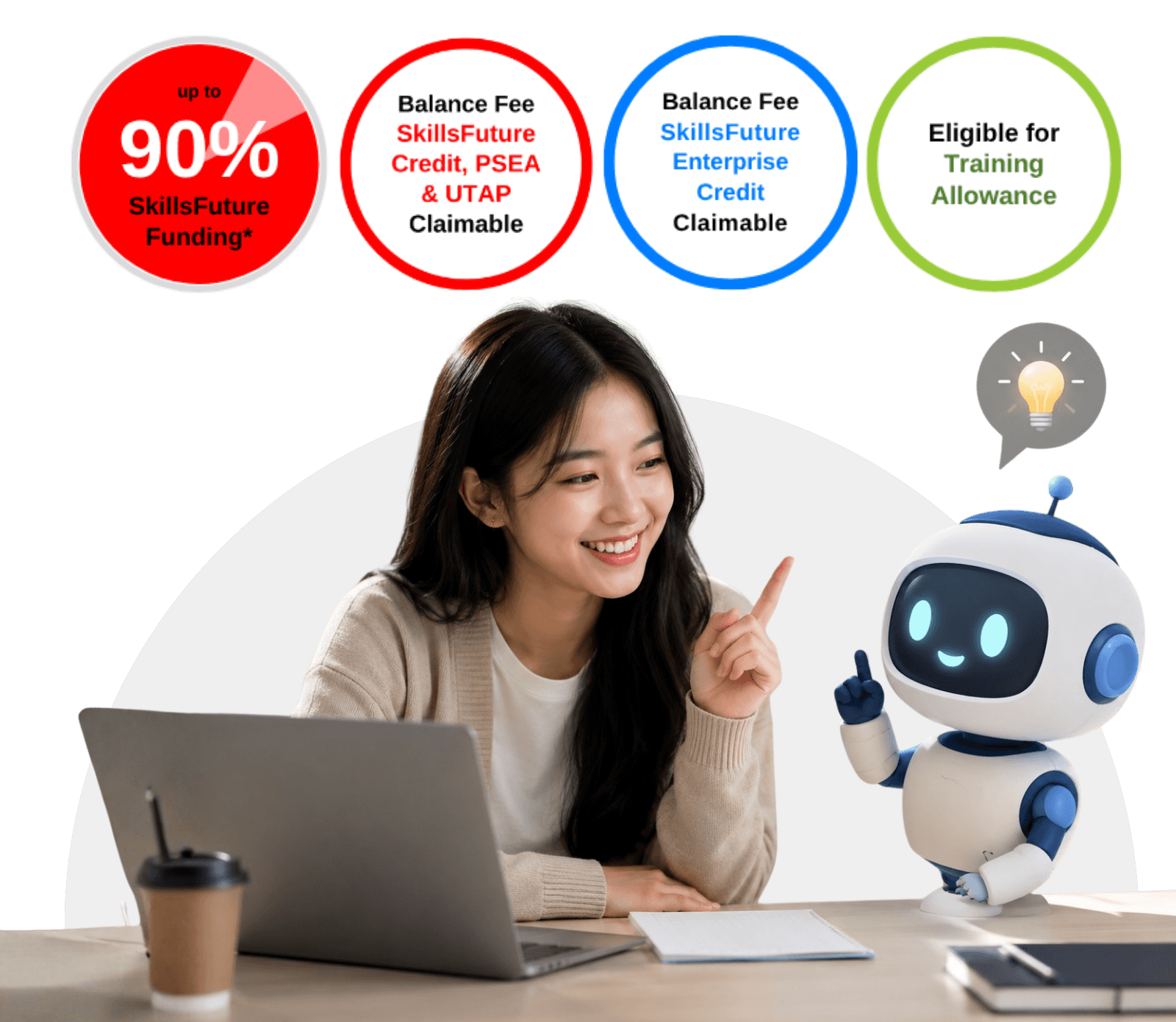
*Eligible for Singaporean Citizens, Permanent Residents, and Long-Term Visit Pass Plus Holders
This programme is eligible for the $4,000 SkillsFuture Level-Up Programme top-up
*For SCTP Participants only
WHY TAKE @ASK TRAINING'S DIPLOMA PROGRAMME
When you learn with us, you will acquire extensive knowledge from highly experienced industry practitioners in Singapore who develop and deliver top quality course content through experiential hands-on learning methodologies.
-
Real-world hands-on projects
-
Comprehensive, up-to-date curriculum and courseware
-
Post-course coaching and mentorship
-
Career advisory and resources support
Our Clients


What is the SkillsFuture Career Transition Programme (SCTP)?
The SkillsFuture Career Transition Programme (SCTP) is a government initiative in Singapore designed to assist mid-career individuals in acquiring new skills and knowledge to facilitate a career transition. This programme is geared towards individuals who wish to switch industries or occupations due to changes in the job market, technological advancements, or personal career goals.
Here are some key features and components of the SkillsFuture Career Transition Programme:
Skills Upgrading: The SCTP provides funding and support for mid-career individuals to undergo training and upskilling in new areas, helping them acquire the skills and knowledge necessary for their chosen career transition.
Career Guidance: The programme also provides career advisory services and guidance to help individuals get placed in job roles, such as interview preparation, resume tips and more.
Discover Your Path: SCTP vs. Non-SCTP
SCTP Pathway
For those aspiring to kickstart a career in generative AI.- Structured Learning: Dive into a comprehensive curriculum, equipping you with the latest industry knowledge and skills.
- Capstone Project: Complete a practical capstone project which serves as a portfolio, guided by our experts. It’s a chance to apply your newfound expertise to real-world scenarios.
- Coaching & mentorship: Benefit from post-course coaching and mentorship, fine-tuning your skills and helping you apply learnings to your project.
- Career Advisory and Resources Support: Our dedicated career services team will provide various assistance and resources to enhance your job search.
Non-SCTP Pathway
For those seeking knowledge without the commitment of a job transition.- Flexible Learning: Access the same six modules + capstone project with comprehensive curriculum, equipping you with the latest industry knowledge and skills but on your schedule. No need to follow set course intake dates; choose the course dates that suit you.
- Independent Journey: As a non-SCTP learner, you won’t receive post-course coaching or mentorship, and we won’t place you in a job. Your focus is solely on learning and applying these skills to real-world scenarios.
- Earn Your Diploma: Upon successful completion, you’ll still earn your accredited Diploma in Digital Marketing, a testament to your expertise in the field.
Need help? Contact us for more info
Generative AI Diploma Course Modules & Curriculum
The programme comprises 7 modules spanning 168 hours of training, including assessment hours.
Modules 1 to 6 are specialist domain modules that may be taken in any sequence. Module 7, the AI
Capstone Project, must be completed last.
Module 1: (32 hrs) AI-Driven Sales & Marketing: Boosting Engagement &
Conversions
Learning Units
-
LU 1: From Manual Drafting to AI-Powered Content Mastery
- AI-enhanced sales funnels
- High-conversion content generation
- Campaign optimisation
- Hyper-segmentation
- Marketing workflow automation
-
LU 2: Boosting Productivity and Closing Revenue Gaps
- Marketing Multiplier framework
- Data-to-decision conversion
- Precision personalisation
- High-velocity sales acceleration
- Brand safety and AI governance
-
LU 3: High-Value ABM and Regional Market Dominance
- AI-powered ABM for enterprise targets
- ASEAN market mapping
- B2B sales-cycle compression through journey mapping
-
LU 4: Predictable Data and the New Search Frontier
- CRM intelligence
- Predictable revenue forecasting
- Winning visibility in AI Answer Engines
-
LU 5: Protecting Margins and Designing the Revenue Engine
- Margin-protection strategies
- Unified omnichannel journeys
- Proactive pipeline risk management
- ESG trust
- Integrated Go-to-Market engine
Course Objectives
By the end of this module, participants will be able to:
- Design high-fidelity, structured AI workflows that transition from basic prompting to professional-grade output and brand consistency.
- Implement the Marketing Multiplier effect to accelerate multi-channel content production and regional ASEAN expansion without increasing headcount.
- Leverage AI-driven intelligence to identify high-value accounts, shorten B2B sales cycles and eliminate friction within the buyer journey.
- Harness predictive data analytics to isolate revenue leaks, protect profit margins and deliver high-impact executive reporting.
- Establish robust frameworks for brand safety, ESG compliance and responsible AI leadership to navigate the modern commercial frontier.
Assessment
- Written Assessment: 1 hour
- Practical Assessment: 1 hour
Module 2: (24hrs) AI in HR: Transforming Talent Acquisition & Workforce
Management
Learning Units
-
LU 1: Foundations of Smarter Hiring and Candidate Experience with AI
- AI-powered recruitment
- Strategic automation
- Zero-ghosting candidate journeys
- Time-to-hire compression
- Board-ready HR data narratives
-
LU 2: Understanding Workforce Trends and Ethical AI Practices
- Mastering meta-prompting for efficiency
- WFA readiness
- AI governance
-
LU 3: Techniques for Identifying Skills Gaps and Optimising Learning Paths
- Precision upskilling
- Green Skills Mapping for the Singapore Green Plan 2030
-
LU 4: Data-Driven Performance Reviews and Forecasting Accuracy
- Right-to-disconnect practices
- Burnout prevention
- HR Innovation Lab
- AI roadmap design
-
LU 5: Applying Statistical Analysis to Workforce Engagement and Capacity
- Meta-prompting for efficient workforce analysis
- Workforce engagement analysis
- Workforce capacity and capability analysis
-
LU 6: Strategic HR Planning through Elasticity and Workforce Flexibility
- Leveraging silver talent
- Age-inclusive job redesign
- Managing agile expansion
- SPL continuity planning
Course Objectives
By the end of this module, participants will be able to:
- Utilise AI to review and refine hiring-related workforce execution plans by aligning recruitment stages, role requirements, volumes and timelines with project or functional objectives.
- Review workforce execution plans by considering workforce-trend signals affecting future manpower demand, including market conditions, business direction, attrition, automation and ethical AI requirements.
- Adapt mathematical models using AI-supported analysis to conduct statistical analyses of manpower demand and identify projected skills gaps by role.
- Develop manpower forecasts for required job roles and positions using performance evidence such as KPIs, competencies and potential as parameters to assess role readiness and succession coverage.
- Adapt mathematical models for the statistical analysis of engagement, capacity and capability indicators within the existing workforce to identify patterns, outliers and trends.
- Review workforce execution plans and contractor productivity metrics, including RCs and CCs, to assess substitution options such as skills-mix changes, automation, redeployment and outsourcing. Apply elasticity principles to support project and functional objectives while enhancing workforce flexibility and resilience.
Assessment
- Written Assessment: 1 hour
- Practical Assessment: 1 hour
Module 3: (24hrs) AI-Powered Finance: Automating Insights & Risk Management
Learning Units
-
LU 1: Foundations of AI Models in Finance: Generative vs Discriminative
- Turning financial data into insights with AI
- Smarter risk and credit assessment with AI
-
LU 2: How Generative AI Models Work: Automating Finance Tasks and Workflows
- Automating reconciliation and transactions with AI
- Automating BEPS 2.0 tax and ISSB-aligned ESG reporting
- Creating self-service, board-ready insights
-
LU 3: Shaping AI Outputs: Mastering Prompt Engineering for Financial Insights
- Using prompt constraints and structured instructions for financial data interpretation
- Applying chain-of-thought prompting for budget forecast reasoning checks
- Evaluating prompt performance to produce fit-for-purpose reporting outputs
-
LU 4: Safeguarding Finance AI Systems: Data Quality, Bias and Compliance
- Using AI to detect fraud and maintain compliance
- Using AI responsibly within finance functions
-
LU 5: Strategic Innovation with AI: Brainstorming Practical Finance Applications
- Ethical implications of AI “black box” decisions in expense management
- Societal impacts and workforce shifts resulting from AI-driven procurement automation
- Ethical oversight for transparency and fairness in AI-enabled financial process optimisation
Course Objectives
By the end of this module, participants will be able to:
- Analyse generative and discriminative AI models to select appropriate approaches for common accounting use cases.
- Utilise generative AI models to produce outputs from training data and algorithms for automating accounting workflows such as summarisation, transformation, reasoning and content augmentation.
- Evaluate how prompt engineering influences generative AI outputs by testing prompt variations and analysing resulting performance and fitness for purpose for financial insights.
- Assess how data quality and model-pipeline factors can introduce limitations or bias in AI outputs by analysing risks to compliance and the integrity of financial decision-making.
- Propose practical Generative AI applications for finance by applying core principles of Generative AI while identifying ethical and societal implications and incorporating these considerations into the proposed solution.
Assessment
- Written Assessment: 1 hour
- Practical Assessment: 1 hour
Module 4: (24hrs) AI for Smart Inventory: Predictive Analytics & Optimisation
Learning Units
-
LU 1: Operational Efficiency & Data Automation
- AI Chief of Staff model
- Intelligent data cleaning and reconciliation
- Autonomous procurement workflows
- Precision logistics orchestration
-
LU 2: Predictive Intelligence & Risk Resilience
- Predictive demand and safety stock planning
- Supplier reliability scoring
- 360-degree supplier intelligence
- Data-backed negotiation strategies
-
LU 3: Governance, Compliance & Strategic Value
- Contract risk detection and PDPA compliance
- ESG reporting for the Singapore Green Plan 2030
- Executive strategic narratives
- Secure AI framework and data masking
-
LU 4: Operational Excellence & Value Scaling
- Custom AI agents trained on company SOPs
- Shared Master Prompt Library
- 90-Day Transformation Roadmap
Course Objectives
By the end of this module, participants will be able to:
- Master AI prompt engineering to automate data reconciliation and eliminate manual spreadsheet fatigue across regional supply chains.
- Implement Predictive Dynamics to forecast demand and mitigate the impact of global port congestion and freight volatility on local stock levels.
- Enhance procurement outcomes through AI-powered risk scorecards and data-backed negotiation strategies to protect profit margins.
- Operationalise sustainable logistics by optimising delivery sequences and verifying supplier claims in alignment with the Singapore Green Plan 2030.
- Scale organisational intelligence by building secure AI governance frameworks and a 90-day implementation roadmap to institutionalise AI workflows.
Assessment
- Written Assessment: 1 hour
- Practical Assessment: 1 hour
Module 5: (24hrs) AI in Operations: Enhancing Workflow Efficiency & Automation
Learning Units
-
LU 1: The Automation Engine
- AI mindset shift
- Zero-paperwork office
- Virtual AI assistant automation
- Lean 2.0 waste elimination and workflow auditing
-
LU 2: Intelligent Supply Chain & Logistics
- Risk-adjusted procurement
- Precision demand forecasting
- Optimised logistics and rostering
-
LU 3: Data-Driven Performance
- AI-driven root cause analysis
- Automated service recovery systems
- Operational dashboards
- Personalised BI assistants and KPI monitoring
-
LU 4: The Future-Ready Enterprise
- PDPA and ethical AI governance
- Automated quality assurance
- 90-Day Operational Roadmap for AI integration
Course Objectives
By the end of this module, participants will be able to:
- Leverage GenAI to automate the documentation lifecycle and administrative workflows to reclaim productivity hours and reduce manual errors.
- Transform raw operational data into actionable insights and predictive forecasts to optimise inventory resilience and supply chain agility.
- Apply AI-driven diagnostic frameworks and Lean audits to eliminate operational waste (Muda) and resolve complex logistical bottlenecks.
- Navigate Singapore’s PDPA landscape and ethical AI frameworks to ensure data privacy through robust Human-in-the-Loop oversight.
- Formulate a structured AI Strategy Canvas and a 90-day action plan to integrate AI tools into daily business-critical operations.
Assessment
- Written Assessment: 1 hour
- Practical Assessment: 1 hour
Module 6: (24hrs) AI-Driven Business Intelligence: Smarter Reporting & Analytics
Learning Units
-
LU 1: Foundations of Generative AI in Business Reporting
- Strategic Thinking Partner model
- Four-stage data pipeline for integrity
- No-code data engineering using plain English
- Specialist model selection
-
LU 2: Understanding AI Evaluation Metrics and Performance Indicators
- Tracking KPIs and business performance with assistance from AI
- Implementing a four-stage pipeline for data integrity and reliability
-
LU 3: Creating Visual Insights: Dashboards and Data Visualisation with AI
- Creating smart dashboards and visual reports with AI
- Optimising visual rationale for stakeholder cognitive speed
-
LU 4: Task-Specific Evaluation: Forecasting and Business Metrics
- Forecasting sales and business trends with AI
- Future-proofing predictive BI through Hybrid AI logic and statistical backbones
-
LU 5: Data Integrity, Fairness, and Explainability in AI Reporting
- Quantifying unstructured sentiment
- Statistical bias mitigation
-
LU 6: Adaptive and Personalised AI Insights for Business Decisions
- Synthesising competitor filings for real-time market intelligence
- Using AI to develop smarter business plans and growth strategies
-
LU 7: Responsible and Ethical AI Use in Business Reporting
- Navigating PDPA 2.0
- Applying FAT governance and building audit trails
- Brainstorming AI ideas to improve reporting and business strategy
Course Objectives
By the end of this module, participants will be able to:
- Analyse AI-generated business reports by synthesising multi-source data and ensuring alignment with data patterns and reporting goals.
- Analyse evaluation metrics and performance indicators to assess the quality and reliability of AI-assisted KPI reporting, identify performance gaps and suggest corrective actions.
- Develop dashboards that present AI-generated insights and evaluation signals by creating a pipeline to capture outputs, calculate evaluation indicators and display visual reports.
- Establish success metrics for AI-assisted forecasting aligned with business objectives and risk tolerance, validate forecasts and communicate their implications for decision-making.
- Validate data integrity for AI-assisted reporting through statistical checks, mitigation of bias risks arising from data-quality issues and documentation of explainability justifications.
- Analyse variations across customer and competitor segments to provide customised AI evaluation insights for stakeholder personas and improve planning effectiveness.
- Utilise ethical frameworks and governance controls to assess and justify the use of AI in business reporting and decision-making.
Assessment
- Written Assessment: 1 hour
- Practical Assessment: 1 hour
Module 7: (16hrs) AI Capstone Project: AI Solution for Enterprise
Learning Units
-
LU 1: Research, Design & Prototype Formation
- Project briefing and use-case identification
- Input material and data preparation
- Defining the desired output and model structure
- Building the initial prototype (Version 1)
-
LU 2: Workflow Expansion, Validation & Final Presentation
- Testing and iterative refinement (Version 2)
- Workflow integration and reliability
- User-experience finalisation
- Capstone presentation and review
- Deployment roadmap and integration planning
-
E-learning Module: Data Storytelling & Pitch Practice
- Introduction to data storytelling
- Problem > Solution > Impact framework
- Turning AI outputs into narratives
- Pitch practice
- Reflection quiz
Course Objectives
By the end of this module, participants will be able to:
- Identify high-value GenAI use cases within their specific work environment that offer clear opportunities for measurable ROI and process automation.
- Gather and prepare internal datasets or unstructured materials to ensure all input materials are high-quality, cleaned and AI-ready.
- Design professional output specifications and model-behaviour protocols to ensure consistent, high-quality results aligned with organisational standards.
- Build and iteratively refine functional AI prototypes using advanced prompt architectures to achieve peak operational performance.
- Validate, document and present the completed AI module using data storytelling to ensure reliability, responsible usage and clear communication of impact within existing departmental workflows.
Assessment
- Practical Assessment: 60 minutes
- Oral Assessment: 60 minutes
Programme Learning Outcomes
Upon successful completion of all modules, participants will be able to:
- Design and implement AI-powered workflows across sales, marketing, HR, finance, operations, inventory management and business intelligence functions.
- Apply Generative AI tools and structured prompt engineering to automate repetitive tasks, generate actionable insights and improve the speed and quality of business decisions.
- Navigate Singapore’s AI governance landscape, including MAS FEAT/AIRG guidelines, PDPA, the Workplace Fairness Act and the Singapore Green Plan 2030.
- Build responsible AI frameworks that incorporate Human-in-the-Loop (HITL) oversight, bias mitigation and ethical governance standards.
- Leverage predictive analytics, sentiment analysis and data storytelling to translate AI outputs into compelling executive narratives and board-ready reports.
- Develop domain-specific AI transformation roadmaps and implementation plans with clear milestones and measurable ROI.
- Design, build, validate and present a production-ready Generative AI module tailored to a real organisational context.
Instructional Approach
All modules are delivered using a blended instructional approach designed to build both theoretical understanding and practical competence. Key methods include:
- Interactive Lectures and Guided Demonstrations — Trainer-led instruction supported by live demonstrations and worked examples to connect AI concepts with real-world business applications.
- Hands-On Lab Sessions — Structured practical activities using live AI tools, including ChatGPT, Microsoft Copilot and DeepSeek, applied to authentic business tasks across each functional domain.
- Scenario-Based Learning — Participants engage with realistic business challenges requiring analysis, decision-making and the selection of appropriate AI-driven interventions.
- Case Study Discussions — Real-world examples drawn from industry contexts deepen understanding and support the evaluation of AI strategies, governance implications and business value.
- Collaborative Learning and Group Discussion — Peer interaction and group work broaden perspectives and encourage cross-functional thinking about AI adoption.
- Practical Application and Skills Mastery — Each module concludes with applied exercises and a structured deliverable that participants can bring directly into their workplace.
Assessment Overview
Each module is assessed through one or more of the following assessment types, selected to match the knowledge and skills being developed:
- Written Assessment — Tests conceptual understanding, regulatory frameworks, governance principles and analytical reasoning.
- Practical Assessment — Evaluates hands-on proficiency through task-based exercises using AI tools and structured workflows in realistic business scenarios.
- Oral Assessment — Used in the AI Capstone Project to assess communication, project reasoning, data storytelling and professional judgement.
Assessment hours are included within each module’s total training hours. Participants must achieve a passing mark in each module’s assessment to receive the relevant module certificate and progress to the Capstone Project.
Entry Requirements & Pre-enrolment Screening
Language Proficiency
Applicants must meet at least one of the following requirements:
- Attained at least WPLN Level 6; or
- Obtained at least Grade C6 for GCE O-Level English; or
- Possess other equivalent qualifications.
Academic Qualifications
Applicants must meet at least one of the following requirements:
- Obtained at least a pass or C6 in a minimum of three GCE O-Level subjects; or
- Possess other qualifications, which will be considered on a case-by-case basis; or
- Be a mature candidate aged 30 years or above with at least eight years of relevant working experience.
Course-Specific Prerequisites
The AI Capstone Project (Module 7) requires prior completion of all six specialist modules (Modules 1 to 6). Participants must have completed all prerequisite modules before enrolling in the Capstone Project.
Good computer literacy and advanced understanding of concepts are required’
All applicants will go through a pre-enrolment screening process.
Application Documents Required:
- Latest resume
- Highest qualification certificate and/or academic transcript
These documents will be reviewed as part of the screening process.
Post-Course Support and Outcomes
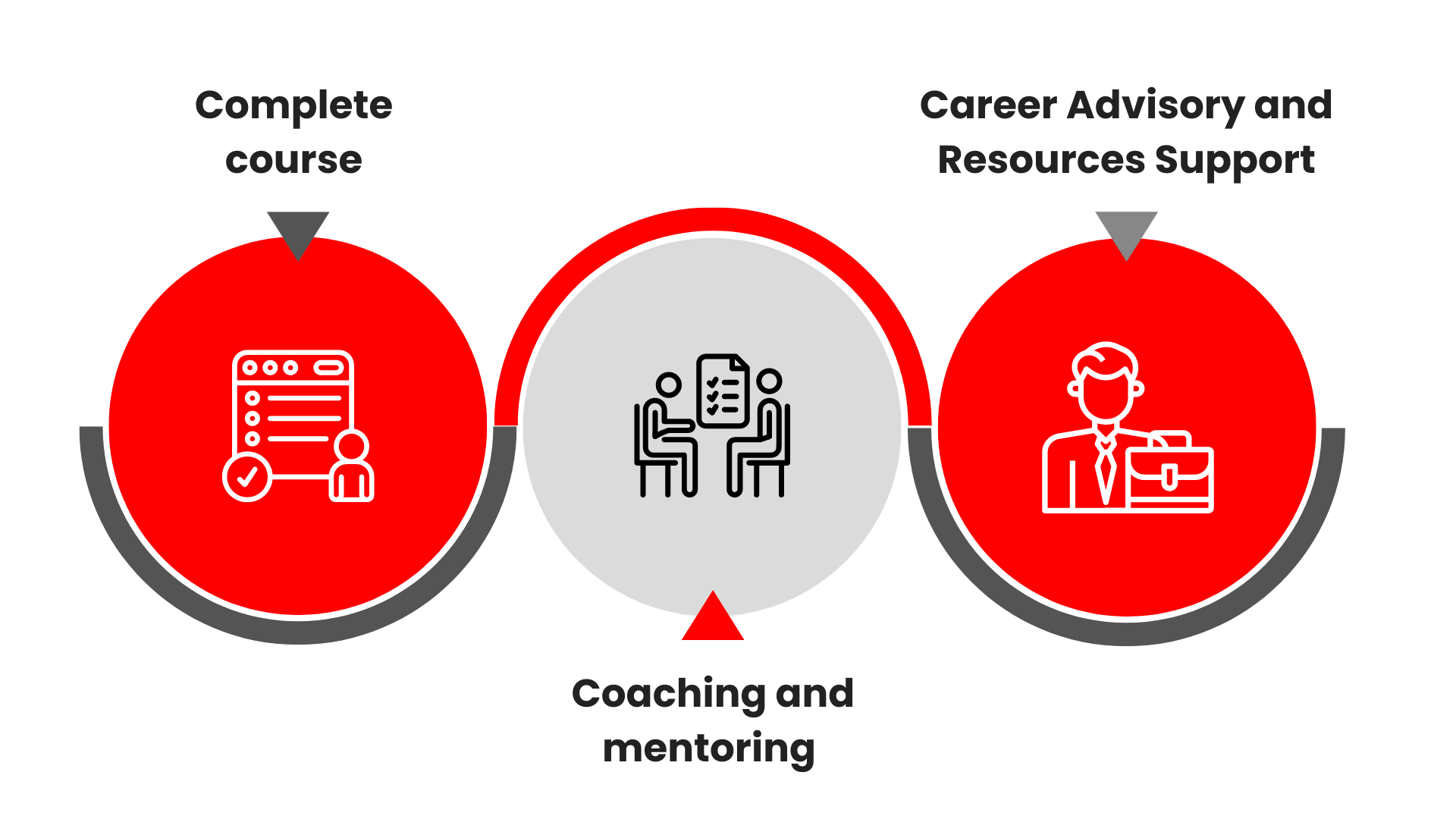
Upon completing this diploma programme, you will receive coaching and mentorship by our programme advisors to complete your capstone project. This capstone project also serves as your portfolio, showcasing your knowledge and skills.
Once the project is completed, you’ll gain access to our dedicated career advisory and resources support. Our career services team will be readily available to provide assistance to enhance your employability, such as Career Assistance Workshops, resume building and interview tips, and more.
Diploma in Generative AI Course Fees and Subsidies
Criteria and/or Requirements for Course Subsidies
Baseline Funding Criteria and/or Requirements
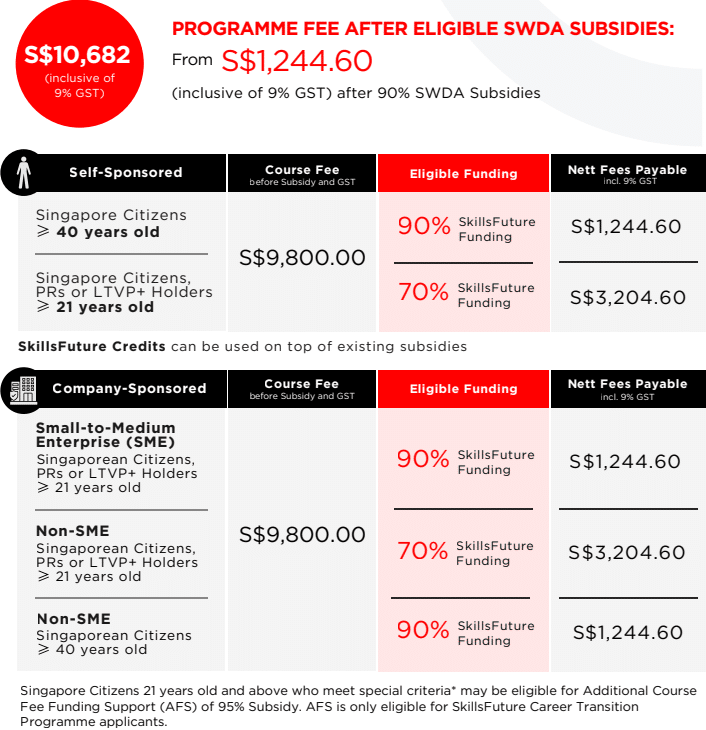
Trainee is 21 years old and above, and a
- Singaporean Citizen; or
- Permanent Resident; or
- Long Term Visitor Pass Plus (LTVP+) Holder
Course fees can be further offset by SkillsFuture Credit for Singapore Citizens aged 25 and above. Singapore Citizens aged 21 to 31 may also offset fees with the Post Secondary Education Account Funds.
Mid-Career Enhanced Subsidy (MCES) Criteria and/or Requirements
Trainee is 40 years old and above, and a Singaporean Citizen, will be eligible for 90% SkillsFuture Funding.
Nett course fee payable (including 9% GST): S$1,244.60
Course fees after subsidies can be further offset by SkillsFuture Credit.
Company-Sponsored (SMEs)
Enhanced Training Support for SMEs (ETSS) – 90% Funding
Eligible for SME Company-Sponsored, 21 years old and above, and a
- Singapore Citizen; or
- Permanent Resident; or
- Long-Term Visitor Pass Plus (LTVP+) Holder
Nett course fee payable (including 9% GST): S$1,244.60
Course fees after subsidies can be further offset by Skillsfuture Enterprise Credit (SFEC)
Company-Sponsored (Non-SMEs)
SkillsFuture Baseline Funding – 70% Funding
Eligible Non-SME Company-Sponsored, 21 years old and above, and a
- Singaporean Citizen; or
- Permanent Resident; or
- Long Term Visitor Pass Plus (LTVP+) Holder
Nett course fee payable (including 9% GST): S$3204.60
Course fees after subsidies can be further offset by Skillsfuture Enterprise Credit (SFEC)
SkillsFuture Mid-Career Enhanced Subsidy (MCES) – 90% Funding
Eligible for Non-SME Company-Sponsored, Singapore Citizens, aged 40 years old and above
Nett course fee payable (including 9% GST): S$1,244.60
Course fees after subsidies can be further offset by Skillsfuture Enterprise Credit (SFEC)
Additional Course Fee Funding Support (AFS) Criteria and/or Requirements
Trainee is 21 years old and above, a Singaporean Citzen, and
- Has been in long-term unemployment of 6 months or more*; or
- Recipient of ComCare Short-to-Medium Term Assistance (STMA)* or Workfare Income Supplement (WIS)*; or
- Person with Disabilities
Will be eligible for 95% SkillsFuture Funding.
Nett course fee payable (including 9% GST): S$754.60
Course fees can be further offset by SkillsFuture Credit for Singapore Citizens aged 25 and above. Singapore Citizens aged 21 to 31 may also offset fees with the Post Secondary Education Account Funds.
*Supporting documents such as CPF, approval letter, and/or payout letter is required to be submitted upon registration. You may request a copy from MSF Social Service Offices or via CPF’s Workfare Portal.
NOTE: Trainees are entitled to the SSG training grant when they meet 75% of the training attendance and pass the requisite assessment. If trainees fail the assessment, they are required to re-take it immediately without additional fee. For more details see Course Funding Information.
Important Reminder: Your PSEA claim needs to be submitted at least 1 month before the course’s commencement date. Should you miss this deadline, an alternative payment method must be used to secure your spot in the course. After the disbursement of your PSEA funds to us, we will reach out to initiate the refund process.
Course Schedule
- Nov Weekends Intake 1 (In-Person at IP)
- Nov Weekdays Intake 1 (In-Person at IP)
- Dec Weekdays Intake 1 (In-Person at IP)
- Dec Weekends Intake 1 (In-Person at IP)
Location:
International Plaza (Tanjong Pagar MRT)
10 Anson Road #06-11
Singapore 079903
(32 hrs) AI-Driven Sales & Marketing: Boosting Engagement & Conversions
01, 07, 14, 15 Nov 2026 (Sun, Sat, Sat, Sun) 9.00am - 6.00pm
(24 hrs) AI in HR: Transforming Talent Acquisition & Workforce Management
21, 22, 28 Nov 2026 (Sat, Sun, Sat) 9.00am - 6.00pm
(24 hrs) AI-Powered Finance: Automating Insights & Risk Management
29 Nov 2026, 05, 06 Dec 2026 (Sun, Sat, Sun) 9.00am - 6.00pm
(24 hrs) AI Smart Inventory: Predictive Analytics & Optimization
12, 13, 19 Dec 2026 (Sat, Sun, Sat) 9.00am - 6.00pm
(24 hrs) AI in Operations: Enhancing Workflow Efficiency & Automation
20, 26, 27 Dec 2026 (Sun, Sat, Sun) 9.00am - 6.00pm
(24 hrs) AI-Driven Business Intelligence: Smarter Reporting & Analytics
09, 10, 16 Jan 2027 (Sat, Sun, Sat) 9.00am - 6.00pm
(16 hrs) AI-Capstone Project: AI Solution for Enterprise
23 Jan 2027 (Sat)
20 Feb 2027 (Sat)
Location:
International Plaza (Tanjong Pagar MRT)
10 Anson Road #06-11
Singapore 079903
(32 hrs) AI-Driven Sales & Marketing: Boosting Engagement & Conversions
03, 04, 05, 06 Nov 2026 (Tue, Wed, Thu, Fri) 9.00am - 6.00pm
(24 hrs) AI in HR: Transforming Talent Acquisition & Workforce Management
11, 12, 13 Nov 2026 (Wed, Thu, Fri) 9.00am - 6.00pm
(24 hrs) AI-Powered Finance: Automating Insights & Risk Management
18, 19, 20 Nov 2026 (Wed, Thu, Fri) 9.00am - 6.00pm
(24 hrs) AI Smart Inventory: Predictive Analytics & Optimization
25, 26, 27 Nov 2026 (Wed, Thu, Fri) 9.00am - 6.00pm
(24 hrs) AI in Operations: Enhancing Workflow Efficiency & Automation
02, 03, 04 Dec 2026 (Wed, Thu, Fri) 9.00am - 6.00pm
(24 hrs) AI-Driven Business Intelligence: Smarter Reporting & Analytics
09, 10, 11 Dec 2026 (Wed, Thu, Fri) 9.00am - 6.00pm
(16 hrs) AI-Capstone Project: AI Solution for Enterprise
16 Dec 2026 (Wed)
13 Jan 2027 (Wed)
Location:
International Plaza (Tanjong Pagar MRT)
10 Anson Road #06-11
Singapore 079903
(32 hrs) AI-Driven Sales & Marketing: Boosting Engagement & Conversions
01, 02, 03, 04 Dec 2026 (Tue, Wed, Thu, Fri) 9.00am - 6.00pm
(24 hrs) AI in HR: Transforming Talent Acquisition & Workforce Management
07, 08, 09 Dec 2026 (Mon, Tue, Wed) 9.00am - 6.00pm
(24 hrs) AI-Powered Finance: Automating Insights & Risk Management
14, 15, 16 Dec 2026 (Mon, Tue, Wed) 9.00am - 6.00pm
(24 hrs) AI Smart Inventory: Predictive Analytics & Optimization
21, 22, 23 Dec 2026 (Mon, Tue, Wed) 9.00am - 6.00pm
(24 hrs) AI in Operations: Enhancing Workflow Efficiency & Automation
28, 29, 30 Dec 2026 (Mon, Tue, Wed) 9.00am - 6.00pm
(24 hrs) AI-Driven Business Intelligence: Smarter Reporting & Analytics
04, 05, 06 Jan 2027 (Mon, Tue, Wed) 9.00am - 6.00pm
(16 hrs) AI-Capstone Project: AI Solution for Enterprise
15 Jan 2027 (Fri)
12 Feb 2027 (Fri)
Location:
International Plaza (Tanjong Pagar MRT)
10 Anson Road #06-11
Singapore 079903
(32 hrs) AI-Driven Sales & Marketing: Boosting Engagement & Conversions
05, 06, 12, 13 Dec 2026 (Sat, Sun, Sat, Sun) 9.00am - 6.00pm
(24 hrs) AI in HR: Transforming Talent Acquisition & Workforce Management
19, 20, 26 Dec 2026 (Sat, Sun, Sat) 9.00am - 6.00pm
(24 hrs) AI-Powered Finance: Automating Insights & Risk Management
02, 03, 09 Jan 2027 (Sat, Sun, Sat) 9.00am - 6.00pm
(24 hrs) AI Smart Inventory: Predictive Analytics & Optimization
10, 16, 17 Jan 2027 (Sun, Sat, Sun) 9.00am - 6.00pm
(24 hrs) AI in Operations: Enhancing Workflow Efficiency & Automation
23, 24, 30 Jan 2027 (Sat, Sun, Sat) 9.00am - 6.00pm
(24 hrs) AI-Driven Business Intelligence: Smarter Reporting & Analytics
13, 14, 20 Feb 2027 (Sat, Sun, Sat) 9.00am - 6.00pm
(16 hrs) AI-Capstone Project: AI Solution for Enterprise
21 Feb 2027 (Sun)
21 Mar 2027 (Sun)
Frequently Asked Questions (FAQ)
What are the prerequisites to enrol in this course?
You’ll need to meet a language requirement (at least WPLN Level 6, or GCE O Level English C6) and an academic requirement (O-Level pass/C6 in at least 3 subjects, or 8 years’ experience if you’re 30+).
Each specialist module also requires 1 year of relevant work experience in that domain. See the Entry Requirements section above for the full breakdown.
What is the Diploma in Generative AI?
A hands-on, 168-hour programme that equips professionals to apply Generative AI, using tools like ChatGPT, Microsoft Copilot, and DeepSeek, across core business functions, with no programming background required.
What topics are covered in the Diploma in Generative AI curriculum?
7 modules covering Sales & Marketing, HR, Finance, Inventory Management, Operations, and Business Intelligence, culminating in a Capstone Project.
See the Programme Structure section above for the full module breakdown and hours.
What sets the Diploma in Generative AI apart from other programmes?
This diploma offers a cross-functional approach to Generative AI, covering six distinct business domains: Sales & Marketing, HR, Finance, Inventory Management, Operations, and Business Intelligence, all in one comprehensive programme.
You’ll gain practical, hands-on experience through scenario-based learning, case studies, and a final Capstone Project that demonstrates your ability to apply AI across multiple business functions, not just one specialised area.
The curriculum is also built around Singapore’s AI governance landscape, including PDPA, the Workplace Fairness Act, and Human-in-the-Loop oversight, so you graduate with both practical AI skills and responsible-AI judgement.
Who should join the Diploma in Generative AI?
The Diploma in Generative AI is ideal for:
- Mid-career and senior professionals seeking to future-proof their expertise and lead AI-driven transformation
- Sales, marketing, and business development professionals looking to scale revenue operations with AI
- HR and people leaders seeking to modernise talent acquisition and workforce planning through AI
- Finance and accounting professionals aiming to automate reporting and enhance risk intelligence
- Operations and supply chain managers wanting to improve inventory resilience and predictive systems
- Business analysts and BI professionals moving from static reporting to AI-powered analytics
- Business owners and entrepreneurs who want to build cross-functional AI literacy
What is the SkillsFuture Career Transition Programme (SCTP)?
The SkillsFuture Career Transition Programme (SCTP) supports mid-career individuals in acquiring industry-relevant skills to improve employability and pivot to new sectors or job roles.
You can choose to study part-time or full-time, depending on what suits you best, and the programme lasts between 3 to 12 months.
This ensures individuals like you have the opportunity to upskill or reskill while effectively preparing for successful career transitions.
For more information on SkillsFuture Career Transition Programmes (SCTP), visit the MySkillsFuture website.
How will the Capstone Project benefit me?
The Capstone Project lets you apply everything learned across the six specialist modules to build a functional Generative AI solution, from defining a high-value use case and preparing your data, to designing, testing, and refining a working prototype.
Guided by an expert trainer, you’ll also complete an e-learning track on Data Storytelling so you can present your AI solution’s impact and ROI clearly.
The result is a real, deployable AI module plus a portfolio piece you can showcase to employers or apply directly in your own workplace.
How will completing the Diploma in Generative AI empower me in the job market in Singapore?
Upon completion, you’ll have hands-on experience applying Generative AI across six business functions, along with a completed Capstone solution to showcase your capabilities.
As organisations across industries accelerate AI adoption, professionals who can bridge the gap between AI tools and practical business outcomes, in sales, HR, finance, operations, inventory, or BI, are increasingly sought after.
What career prospects can graduates expect after completing the Diploma in Generative AI?
Graduates can explore a range of hybrid, AI-augmented roles that combine domain expertise with AI capabilities.
For example, roles that blend sales/marketing leadership with AI-driven demand generation, HR roles focused on AI-supported workforce planning, finance roles centred on AI-automated reporting and risk management, and BI/analytics roles built around AI-powered reporting and forecasting.
The cross-functional nature of the diploma is designed to prepare you for AI-augmented responsibilities within your existing field, rather than a single narrow job title.
What are the available subsidies and eligibility criteria for the Diploma in Generative AI?
Eligible funding depends on your profile:
- Singapore Citizens aged 40 and above (self- or company-sponsored): 90% SkillsFuture Funding – nett fee from S$1,244.60 (incl. 9% GST)
- Singapore Citizens, PRs, or LTVP+ holders aged 21 and above: 70% SkillsFuture Funding – nett fee S$3,204.60 (incl. 9% GST), or 90% if company-sponsored under an SME
- Singapore Citizens aged 21 and above meeting special SCTP criteria may qualify for Additional Course Fee Funding Support (AFS) of up to 95%, available exclusively to SkillsFuture Career Transition Programme applicants
SkillsFuture Credit can be used on top of any of the above subsidies, and the balance fee may also be claimable via PSEA, UTAP, or SkillsFuture Enterprise Credit.
Contact our course consultants to confirm your exact funding tier.
What certification will I receive upon completion of the course?
You must achieve a passing mark in each module’s assessment to receive that module’s certificate.
Upon successfully completing all 7 modules, including the Capstone Project, you will receive the Diploma in Generative AI certification from @ASK Training.
Do you provide career support services to course graduates?
Yes, career support is available to SCTP-pathway graduates, including assistance with job search resources such as resume building, interview preparation, and job matching support through our career services team.
If you’re on the non-SCTP pathway, the focus is on completing the modules and Capstone Project rather than post-course job placement support.
How do I register for the Diploma in Generative AI?
You may sign up at our registration page to fill in your details and submit the course registration form. Upon submitting the form and making payment, your seat will be reserved, and we will contact you for confirmation.
If you encounter any difficulties during the registration process or have any questions, you can contact us, and our programme consultants will be happy to assist.
Is this Diploma in Generative AI recognised?
Yes. All modules in this diploma are developed by @ASK Training’s CET Centre together with a panel of subject matter experts, ensuring the curriculum stays industry-relevant and practically applicable.
The diploma is also eligible for Part-Time Training Allowance (TA) under the SkillsFuture Career Transition Programme (SCTP) framework.
What kind of job/career support services will I receive?
Yes. All graduates receive access to @ASK Training’s Career Advisory and Resources Support Programme, along with post-course coaching and mentorship. This includes guidance on job search resources such as resume building and interview preparation.
SCTP-pathway learners additionally receive job matching support through our career services team.
Speak with our programme consultants to confirm exactly what’s included for your intake.
I am not seeking employment following the completion of this programme. Can I still enrol in this diploma programme?
Absolutely. If your goal isn’t job placement after the programme, you can choose the non-SCTP pathway.
You’ll still complete all seven modules as outlined, but with the flexibility to select course dates that suit you rather than following fixed SCTP intake dates.
Is a Generative AI course worth it?
Yes, especially one that’s well-structured, practical, and cross-functional. The Diploma in Generative AI provides a solid foundation in applying AI across six key business functions, making it well-suited for professionals, SME owners, and managers looking to stay competitive as AI adoption accelerates across Singapore’s economy.
Is Generative AI difficult to learn?
Not at all. The diploma is designed for non-programmers, with hands-on lab sessions and guided demonstrations rather than technical coding work.
Some familiarity with a business function like Sales, HR, Finance, or Operations will help you better appreciate how AI applies to that domain, but no prior AI experience is required.
What is the hardest part of learning Generative AI?
The most challenging part for most learners is keeping up with how quickly AI tools and best practices evolve.
The Diploma in Generative AI addresses this through hands-on lab sessions with current tools like ChatGPT, Microsoft Copilot, and DeepSeek, plus a focus on transferable skills, like structured prompt engineering and AI governance, that stay relevant even as specific tools change.
Part-Time Training Allowance
I am 43 years old and currently working. Am I eligible for the Part-Time Training Allowance?
Yes, you are likely eligible if:
- You are a Singapore Citizen aged 40 and above.
- You are employed and have received income in the latest available 12-month period before your course start date or application date (whichever is later).
- You have not used up your 24-month lifetime allowance cap (combined full-time and part-time).
- You have a PayNow account linked to your NRIC.
Self-employed individuals with income declared to IRAS may also qualify. For more information on the eligibility criteria, visit the official SkillsFuture Service portal.
How much Training Allowance will I receive for part-time SCTP courses?
You will receive a flat rate of S$300 per month for each eligible month of training, provided you meet the minimum 75% monthly attendance requirement.
The total number of months you can claim is based on the approved duration of your course, rounded to the nearest half-month.
My part-time course runs from 15 February to 15 March. Will I receive the full $300 for both months?
Yes, SSG uses a front-loading approach. You will receive the full S$300 for the first month (February), and the remaining allowance will be paid for subsequent months based on attendance.
Always check your TA offer letter for your specific Maximum Eligible Period (MEP).
What happens if I miss the deadline to accept my Training Allowance offer?
You must accept your TA offer within 3 calendar days of receiving it. If you miss this deadline, your application will be cancelled, and you will need to submit a new application.
We recommend logging into the TA Portal regularly to check your application status.
Can I apply for Training Allowance if I am self-employed or have no CPF contributions?
Yes, if you are self-employed and have declared your trade income to IRAS, SSG will use the latest available IRAS data to assess your eligibility.
If you have no CPF contributions but have earned income in the last 12 months, you may still qualify. The best way to check is to log in to the TA Portal and submit an application; the system will determine your eligibility automatically.
If you encounter issues, you may contact SSG via their Service Portal.
Where can I find and search for courses that are eligible for the Part-Time Training Allowance?
You can search for all TA-eligible courses, including part-time ones, directly on the MySkillsFuture portal. This is the official course directory where you can filter for programmes that qualify for the Training Allowance.
Follow these simple steps:
- Login to www.myskillsfuture.gov.sg with your Singpass.
- Search for a course title or keyword related to your area of interest.
- Apply the filter: Under the "Featured Initiatives" filter, check the box for "SkillsFuture Mid-Career Training Allowance (Part-Time)" . This will show you only the courses that are eligible.
Tip: All our SCTP courses listed on the @ASK Training website are also PT TA-eligible. You can also find them on the MySkillsFuture portal by searching for our course titles or UEN.
Do I need to repay my Part-Time Training Allowance if I fail my course assessment?
No. The Training Allowance is not based on whether you pass your course assessment. It is paid based on your fulfilment of the minimum 75% monthly attendance requirement.
As long as you met the attendance criteria and provided truthful information in your application, you do not need to repay any disbursed allowance.
Still Have Questions?
The SkillsFuture Service Portal contains:
- Detailed FAQs on Part-Time Training Allowance
- Guides and resources
- Submit an enquiry if you have further questions
Speak to A Programme Consultant
"*" indicates required fields