
(SCTP) Diploma in Digital Marketing (Eligible for Full-Time TA)
Become a competent digital marketer in 15 Modules

*Eligible for Singaporean Citizens, Permanent Residents, and Long-Term Visit Pass Plus Holders
This programme is eligible for the $4,000 SkillsFuture Level-Up Programme top-up
*For SCTP Participants only
WHY TAKE @ASK TRAINING'S DIPLOMA PROGRAMME
When you learn with us, you will acquire extensive knowledge from highly experienced industry practitioners in Singapore who develop and deliver top quality course content through experiential hands-on learning methodologies.
-
Real-world hands-on projects
-
Comprehensive, up-to-date curriculum and courseware
-
Post-course coaching and mentorship
-
Career advisory and resources support
Earn Your Diploma in Digital Marketing
Are you a Career Seeker, Business Owner, or a Marketer?
CAREER SEEKER

Entry-level roles, such as Digital Marketing Executives, start at SGD 42,000–57,600 annually (SGD 3,500–4,800 monthly), while experienced Digital Marketing Managers earn SGD 55,000–110,000. (Source: Glassdoor, 2026)
Yet breaking in remains competitive, as employers demand proven portfolios and hands-on experience.
In this Digital Marketing Diploma programme, you will work on real-world projects, gaining the experience that employers value.
Experienced mentors will guide you through your capstone project with our industry partners, providing first-hand experience working with clients and helping you build a strong portfolio.
BUSINESS OWNER

Understanding digital marketing is crucial for business owners to effectively manage their teams and drive growth.
Navigating the complexities of hiring, managing, and retaining digital marketing talent, along with managing your marketing budget and business ROI, can be particularly challenging.
Completing the 15 digital marketing modules in this Digital Marketing Diploma programme equips you with the skills to execute campaigns independently or manage your team more effectively.
This programme enables you to streamline your operations and empowers you to provide strong leadership and support to your employees, ensuring your business thrives in the digital space.
MARKETER

Many marketers continue facing challenges staying ahead of evolving platforms, algorithms, and privacy regulations in this fast-shifting landscape.
This comprehensive Diploma in Digital Marketing programme will enhance your skillset and bolster your resume with essential, industry-relevant expertise.
These skills will enable you to significantly improve marketing conversion rates and achieve a higher return on investment, ultimately boosting both your professional profile and your organisation’s success.
What is the SkillsFuture Career Transition Programme (SCTP)?
The SkillsFuture Career Transition Programme (SCTP) is a government initiative in Singapore designed to assist mid-career individuals in acquiring new skills and knowledge to facilitate a career transition. This programme is geared towards individuals who wish to switch industries or occupations due to changes in the job market, technological advancements, or personal career goals.
Here are some key features and components of the SkillsFuture Career Transition Programme:
Skills Upgrading: The SCTP provides funding and support for mid-career individuals to undergo training and upskilling in new areas, helping them acquire the skills and knowledge necessary for their chosen career transition.
Career Guidance: The programme also provides career advisory services and guidance to help individuals get placed in job roles, such as interview preparation, resume tips and more.
Discover Your Path: SCTP vs. Non-SCTP
SCTP Pathway
For those aspiring to kickstart a career in digital marketing.- Structured Learning: Dive into a comprehensive curriculum, equipping you with the latest industry knowledge and skills.
- Capstone Project: Complete a practical capstone project which serves as a portfolio, guided by our experts. It’s a chance to apply your newfound expertise to real-world scenarios.
- Coaching & mentorship: Benefit from post-course coaching and mentorship, fine-tuning your skills and helping you apply learnings to your project.
- Career Advisory and Resources Support: Our dedicated career services team will provide various assistance and resources to enhance your job search.
Non-SCTP Pathway
For those seeking knowledge without the commitment of a job transition.- Flexible Learning: Access the same modules + capstone project with comprehensive curriculum, equipping you with the latest industry knowledge and skills but on your schedule. No need to follow set course intake dates; choose the course dates that suit you.
- Independent Journey: As a non-SCTP learner, you won’t receive post-course coaching or mentorship, and we won’t place you in a job. Your focus is solely on learning and applying these skills to real-world scenarios.
- Earn Your Diploma: Upon successful completion, you’ll still earn your accredited Diploma in Digital Marketing, a testament to your expertise in the field.
Need help? Contact us for more info
Digital Marketing Diploma Course Modules & Curriculum
The programme comprises 15 modules spanning 307 hours of training, including assessment hours.
Modules 1 to 14 are SCTP modules that may be taken in any sequence. Module 15, the Capstone Project
(Digital Marketing Campaign), must be completed last.
Module 1: (16 hrs) Digital Marketing Essentials
Learning Units
-
LU 1: The Digital Customer
- Retail trends and evolving customer expectations
- PESTLE analysis for digital retail
- Customer personas and segmentation
- End-to-end customer journey mapping
- Digital touchpoints
-
LU 2: Digital Marketing & the Marketing Mix
- Application of the 4Ps in digital content
- Strategic versus operational marketing mix decisions
- Digital marketing funnel stages
- Alignment of content across the funnel
-
LU 3: Digital Marketing Analytics & Performance
- Fundamentals of digital marketing analytics
- Use of analytics tools
- Google Analytics 4 essentials
- Return on investment tracking
- Marketing KPIs
-
LU 4: Emerging Trends & Digital Strategy
- Identification of emerging digital trends
- New retail opportunities through trends
- Trend-to-action frameworks
- Strategic positioning and realignment
Course Objectives
By the end of this module, participants will be able to:
- Differentiate customer needs to build a persona and map their digital buying journey.
- Evaluate how the marketing mix meets the needs of different customer types.
- Deconstruct each element of the marketing mix in relation to the business context.
- Determine which part of the marketing mix needs adjustment for different retail formats.
- Assess analytics tools to choose those best suited to business needs.
- Interpret campaign performance using key digital metrics and Return on Investment (ROI).
- Examine how an emerging digital trend can improve one part of the marketing mix.
Assessment
- Written Assessment: 2 hours
Module 2: (16 hrs) Digital Advertising
Learning Units
-
LU 1: What is Digital Advertising
- Differences between organic and paid advertising
- Role of advertising in brand building
- Consumer behaviour and psychological triggers
- Alignment of digital advertising with brand strategy
- Alignment of digital advertising with the customer journey
-
LU 2: Media Channels & Formats
- Types of digital media channels and placements
- Advertisement design and messaging formats
- Platform usage trends marketers must know
- Selecting the appropriate channel using the PESO framework
-
LU 3: Media Trends & Targeting
- Short-form video for rapid attention capture
- User-generated content for authenticity
- Personalisation in digital advertising
- Evaluating effectiveness using the 3R test: Reach, Relevance and Results
-
LU 4: Planning Budget & Choosing Platforms
- Importance of strategic digital media planning
- Matching platforms to target audiences
- Allocating and managing digital advertising budgets
- Media-planning frameworks for platform selection
-
LU 5: Evaluating Channel Effectiveness
- Measuring replies, reach and response rates
- Comparing platform performance
- Interpreting channel-effectiveness metrics
- Data-driven optimisation decisions
-
LU 6: Cross-Platform Integration & Improvement
- Cross-platform channel integration strategies
- Integrated campaign planning using SCOPE
- Media integration funnel and sequencing
- Post-campaign evaluation and improvement
- Governance and compliance
Course Objectives
By the end of this module, participants will be able to:
- Analyse how digital advertising supports business branding and customer engagement across different media types.
- Determine the suitability of different digital media channels for displaying advertisements based on audience behaviour and message clarity.
- Differentiate between current digital media trends to determine their effectiveness for targeting specific customer groups.
- Develop a media budget plan by selecting platforms based on cost, reach, audience needs and campaign goals.
- Interpret advertising performance results to determine which digital media platform delivered higher engagement and cost-effectiveness.
- Examine the strategic integration of multiple media platforms to determine their influence on campaign reach and compare past campaign outcomes to suggest refinements.
Assessment
- Written Assessment: 2 hours
Module 3: (16 hrs) Social Media Marketing
Learning Units
-
LU 1: Concept of Social Media in Digital Marketing
- Role and significance of social media in modern marketing
- Overview of key social media platforms
- Audience segmentation principles
- Targeting strategies for digital outreach
-
LU 2: Planning & Development of a Social Media Strategy
- Fundamentals of social media strategy
- Six-step social media marketing framework
- Aligning objectives with platforms and audiences
- Translating strategy into actionable plans
-
LU 3: Implementation of a Social Media Strategy
- Content scheduling and publishing practices
- Audience engagement techniques
- Use of paid advertising on social media
- Compliance with platform policies and guidelines
-
LU 4: Evaluation of a Social Media Strategy
- Defining success metrics for social media
- Use of analytical tools and techniques
- Content and audience performance analysis
- Campaign evaluation
- Competitive benchmarking
-
LU 5: Handling Escalated Complaints, Conflicts and Crisis Situations in Social Media
- Understanding social media crises
- Types and nature of online complaints
- Conflict-resolution techniques
- Managing escalations
- Managing reputation risks
Course Objectives
By the end of this module, participants will be able to:
- Choose the appropriate combination of social media channels for a company to interact with distinctly identified audiences to attain specific marketing goals.
- Develop an all-encompassing social media plan that includes crafting a customer profile and aligning social media marketing aims with client objectives.
- Implement a social media strategy, managing content scheduling, audience engagement and community interactions across selected platforms while using management tools to ensure alignment with marketing objectives and maintain a consistent brand presence.
- Select relevant key performance indicators to evaluate the effectiveness of the social media strategy.
- Categorise and identify the severity of complaints, including responding to different types of complaints.
Assessment
- Written Assessment: 2 hours
Module 4: (24 hrs) Search Engine Optimisation
Learning Units
-
LU 1: Search Engine Optimisation (SEO) vs Search Engine Marketing (SEM)
- Fundamentals of SEO and SEM
- Comparative advantages and limitations of SEO and SEM
- Use of search marketing tools
- Aligning SEO and SEM with overall marketing objectives
-
LU 2: Keyword Research & On-Page SEO
- Principles of keyword research
- Keyword research strategies and tools
- On-page SEO optimisation techniques
- Content curation aligned with search intent
-
LU 3: Link Building (Off-Page SEO)
- Fundamentals of link building
- Content marketing for link acquisition
- Backlink types and quality evaluation
- Outreach strategies
- Measurement of link-building success
-
LU 4: SEO Analytics
- Importance of SEO analytics
- Selection of relevant SEO metrics
- Measuring SEO performance and results
- Integrating Google Search Console with Google Analytics 4
Course Objectives
By the end of this module, participants will be able to:
- Assess the advantages and disadvantages of SEO and SEM and propose suitable search marketing tools and SEO activities to address marketing objectives and target customers.
- Conduct extensive keyword research to curate relevant content that reinforces the organisation’s competitive advantage, key messages and brand, and implement on-page SEO to increase organic search engine rankings.
- Develop content marketing and link-building plans to rank various types of content on organic search engine results pages.
- Measure and analyse the effectiveness of SEO campaigns and determine factors that can improve keyword rankings and SEO-related KPIs and metrics.
Assessment
- Written Assessment: 2 hours
Module 5: (24 hrs) Digital Marketing Analytics (Google Analytics)
Learning Units
-
LU 1: Introduction to Digital Marketing Analytics
- Core concepts of digital marketing analytics
- Mapping and defining relevant KPIs
- Application of digital marketing analytics frameworks
- Aligning analytics insights with business and marketing objectives
-
LU 2: Data Sources in Digital Marketing
- Types and roles of data in digital marketing
- Qualitative analytics tools and techniques
- Quantitative analytics tools and techniques
- Use of AI-driven analysis for marketing insights
- Competitive landscape analysis
- Market performance analysis
-
LU 3: Using Google Analytics for Digital Marketing Analysis
- Setting up Google Analytics 4
- Navigating Google Analytics 4
- Understanding metrics and dimensions
- Interpreting standard and predefined GA4 reports
- Analysing acquisition and engagement
- Analysing e-commerce and user behaviour across platforms
Course Objectives
By the end of this module, participants will be able to:
- Analyse diverse digital and market data types, discern their intrinsic value and strategically determine the required data sources to craft and enhance data-driven marketing strategies using marketing analytics and insights.
- Assess diverse data sources relating to market, competitor, customer and product or service performance, including employing forecasting methods to predict forthcoming market and consumer tendencies.
- Utilise Google Analytics to gather data for analysis, including extracting strategic insights to enhance digital marketing initiatives.
Assessment
- Written Assessment: 2 hours
Module 6: (24 hrs) WordPress Website Creation
Learning Units
-
LU 1: WordPress Website Planning and Setup
- Fundamentals of WordPress websites
- WordPress installation and setup processes
- Use of page builders for website creation
- Website planning
- Configuration of basic WordPress settings
-
LU 2: Development and Digital Marketing Integration
- Creating and managing posts, pages and menus
- Page editing and design using Divi
- Theme customisation
- Use and configuration of plugins
- Responsive website design
- Integration of forms, maps and media for marketing effectiveness
-
LU 3: Design Documentation – WordPress Website
- Importance of design documentation
- Parameters and structure of effective documentation
- Capturing essential website and design information
- Supporting website maintenance and future enhancements
Course Objectives
By the end of this module, participants will be able to:
- Create a WordPress website design blueprint that meets business and user requirements.
- Review and recommend appropriate standards, methods and tools for the design of a WordPress website in line with the organisation’s practices and design principles.
- Customise a WordPress theme, including configuring plugins for digital marketing to address business and user needs.
- Examine the trade-offs resulting from the integration of different elements into the design and analyse how these trade-offs influence the overall functionality, interoperability, efficiency and costs of WordPress website creation.
- Plan, document and communicate the design and functionality effectively, aligning with the project’s goals and audience needs.
Assessment
- Written Assessment: 2 hours
Module 7: (24 hrs) Copywriting & Contents Writing
Learning Units
-
LU 1: Digital Storytelling, Copywriting, and Content Writing
- Role of content as the foundation of digital marketing
- Principles of digital storytelling
- Evolving content preferences and audience expectations
- Conceptualising content ideas through copywriting
- Conceptualising content ideas through content-writing principles
-
LU 2: Storyboard Creation & Content Strategy Plan
- Identifying content requirements and delivery parameters
- Digital storyboard creation and mapping
- Content strategy planning
- Content execution guidelines
- Integration of SEO
- Ethical considerations and copywriting laws
Course Objectives
By the end of this module, participants will be able to:
- Apply the principles of digital storytelling to conceptualise and create content ideas that effectively meet marketing objectives, engage audiences and drive desired actions in the online landscape.
- Create a digital storyboard as an integral component of a content strategy plan, including applying multichannel content strategies that adhere to the parameters of delivering content for marketing purposes, incorporate the essential features of marketing content and employ various modes of content delivery to achieve marketing objectives.
Assessment
- Written Assessment: 2 hours
Module 8: (24 hrs) Digital Content Creation
Learning Units
-
LU 1: Content Governance Policies and Guidelines
- Concept and purpose of content governance
- Commonly adopted content governance models
- Development of editorial guidelines
- Ensuring consistency and quality of published content
-
LU 2: Managing Content and Content Management System
- Understanding web platforms and content management systems
- Managing and organising digital content
- Maintaining organisational web assets
- Ensuring content accuracy and currency
-
LU 3: Publishing Web Content
- Preparing content for deployment using the 5Ws and 1H framework
- Editing and formatting content
- Uploading content within a content management system
- Ensuring readiness for live publication
-
LU 4: Troubleshooting Content Management System Problems
- Identifying common content-system issues
- Understanding typical CMS problems
- Applying basic troubleshooting practices
- Minimising content and system disruptions
-
LU 5: Measuring Content Performance & Improving User Experience
- Understanding key content-performance metrics
- Evaluating content effectiveness
- Analysing user-experience insights
- Recommending data-driven improvements
Course Objectives
By the end of this module, participants will be able to:
- Structure content governance rules and guidelines by breaking down existing policy constraints.
- Organise web assets and Content Management System settings to maintain consistent and reliable content updates.
- Arrange and refine content components to prepare web pages for Content Management System deployment.
- Deconstruct Content Management System issues to identify, isolate and document causes affecting content display.
- Interpret performance data to improve content design and user experience.
Assessment
- Written Assessment: 2 hours
Module 9: (24 hrs) Facebook & Instagram Marketing
Learning Units
-
LU 1: Meta (Facebook and Instagram) Marketing
- Overview of Meta media trends
- Role of Facebook and Instagram in digital marketing
- Principles of organic marketing on Meta platforms
- Aligning content with platform behaviours
- Aligning content with audience engagement
-
LU 2: Meta Marketing Plan and Ads Campaign
- Using Facebook Page Insights for strategy development
- Competitor analysis
- Performance analysis
- Building a structured Meta advertising plan
- Designing and setting up Meta advertising campaigns
-
LU 3: Launch and Evaluate Meta Ads Campaign
- Campaign launch
- Audience-targeting strategies
- Use of Meta’s AI and automation features
- Use of Meta Advantage+
- Creative best practices for advertising effectiveness
- Evaluation and optimisation based on performance insights
-
LU 4: Crisis Communication Plan
- Understanding and protecting brand equity
- Principles of crisis communication planning
- Development of crisis-response strategies
- Application of crisis communication skills in digital environments
Course Objectives
By the end of this module, participants will be able to:
- Utilise media platforms for marketing and media management while aligning platform selection with audience, content, goals and resources to enhance social media strategy effectiveness.
- Create a comprehensive marketing plan that involves developing and facilitating the content and integration of media platforms for Meta, including defining activities, timeline targets and responsibilities.
- Demonstrate proficiency in refining advertising strategy, optimising advertising creatives and making data-driven decisions for improved campaign results and Return on Investment.
- Develop crisis communication skills to effectively manage and resolve conflicts and complaints in Meta advertising campaigns.
Assessment
- Written Assessment: 2 hours
Module 10: (24 hrs) Google Ads
Learning Units
-
LU 1: Introduction to Google Ads and Strategic Planning
- Role of Google Ads within the marketing mix
- Fundamentals of how Google Ads works
- Key components of campaign structure
- Strategic considerations for effective campaign planning
-
LU 2: Campaign Setup
- Audience targeting techniques
- Keyword research techniques
- Google Ads account structure
- Campaign objectives
- Creation of advertising formats
- Bidding and automation strategies
- Copywriting and creative execution for search, display and video advertisements
-
LU 3: Measuring a Google Ads Campaign
- Budget setting
- Campaign measurement
- Key metrics and calculations for performance evaluation
- Role of Quality Score in optimisation
- Analysing Return on Investment
- Analysing Return on Advertising Spend
- Customised performance reports
-
LU 4: Testing & Optimisation
- Improving advertising relevance
- Improving landing-page experience
- Techniques for creating high-converting landing pages
- Performance optimisation through testing
- Using experiments to drive continuous improvement
Course Objectives
By the end of this module, participants will be able to:
- Examine the integration of the Google Ads platform within a comprehensive marketing strategy.
- Develop a thorough understanding of the foundational principles and processes of the Google Ads platform.
- Master the intricacies of Google Ads campaign setup by progressing through each crucial stage to define clear campaign objectives, employ effective bidding strategies, target audiences, conduct strategic keyword research, craft compelling advertising copy, explore diverse advertising formats and skilfully manage budgets.
- Develop proficiency in Google Ads by selecting and interpreting relevant metrics to gauge campaign success, including analysing Return on Investment, reviewing and understanding various attribution models, scrutinising conversion paths and customising reports to evaluate advertising performance comprehensively.
- Evaluate a Google Ads campaign to ensure the activity effectively reaches target markets, aligns with performance measures and is optimised based on testing, advertising relevance and targeting.
Assessment
- Written Assessment: 2 hours
Module 11: (24 hrs) Website & Landing Page Conversion Optimisation
Learning Units
-
LU 1: Introduction to Conversion Optimisation
- Core concepts and importance of conversion rate optimisation
- Role of CRO within the marketing funnel
- Differences between websites and landing pages
- Aligning conversion goals with page purpose
- Landing-page types
-
LU 2: Consumer Psychology and the User Experience
- Application of psychology in conversion optimisation
- Cialdini’s Principles of Persuasion
- Fogg’s Behaviour Model
- Eisenberg’s Buyer Modalities
- Structuring pages based on user motivations and decision styles
-
LU 3: Fundamentals of Design (UX/UI)
- Identifying friction and designing user-centred journeys
- Layout and visual hierarchy for flow and clarity
- Crafting value propositions
- Using trust signals and calls to action
- Applying the LIFT model
- Wireframing purposeful landing pages
-
LU 4: Effective Content & Messaging
- Importance of copy and messaging in conversion
- Writing impactful headlines and calls to action
- Optimising microcopy
- Optimising form user experience
- Using visual and video content to build trust
- Supporting conversion goals through content
-
LU 5: Optimisation Tools
- Overview of no-code landing-page tools
- Building pages using Unbounce, Leadpages or HubSpot
- Applying CRO-focused page structures
- Best practices for effective use of page builders
-
LU 6: Measurement and Reporting
- Importance of measurement in CRO
- Key CRO metrics and analytics
- Use of Google Analytics
- Behaviour tracking using heatmaps and session recordings
- A/B testing
- Multivariate testing
- Data-driven optimisation and improvement
Course Objectives
By the end of this module, participants will be able to:
- Gain an understanding of the role that websites and landing pages play in the overall marketing mix, including using the conversion optimisation framework to conduct deeper analysis and establish goals for improving website and landing-page conversion rates.
- Acquire a deep understanding of the user journey and the critical skills required for effective website-flow analysis.
- Apply heuristic analysis to evaluate interfaces, highlight common usage patterns and identify areas for optimisation.
- Evaluate and reengineer a website or landing-page layout, including improving its navigation, visual hierarchy and mobile responsiveness to enhance user engagement and facilitate a smoother journey towards conversion goals.
- Craft compelling, targeted content strategies that effectively communicate the value proposition, incorporate persuasive copywriting techniques and integrate social proof to increase the credibility and conversion potential of a website or landing page.
- Integrate ethical psychological triggers and ensure adherence to relevant privacy regulations within digital content, including creating a sense of urgency and trust that complies with legal standards to motivate user action and increase conversion rates effectively.
- Develop and implement a data-driven conversion rate optimisation strategy by using A/B testing, SEO best practices and key performance indicators to systematically enhance website functionality and user experience and ultimately improve conversion rates.
- Assess and select relevant key performance indicators to measure the impact of optimisation techniques and determine whether the goals have been achieved.
- Set up reports to consistently track these metrics and use the resulting data and marketing insights to improve website and landing-page performance.
Assessment
- Written Assessment: 2 hours
Module 12: (16 hrs) Generative AI for Digital Marketing
Learning Units
-
LU 1: GenAI in Context of Digital Marketing
- Role and relevance of Generative AI in marketing
- Aligning GenAI use with marketing objectives
- Differentiating GenAI tools and applications in digital marketing
- Understanding GenAI limitations and risks
- Ethical considerations when using GenAI
-
LU 2: AI Copywriting Based on Campaign Needs
- Fundamentals of copywriting
- AI-assisted copy creation
- Prompting for fit-for-purpose marketing content
- Editing and refining AI-generated copy
- Selecting appropriate platforms for content deployment
-
LU 3: Visuals with GenAI Tools
- Aligning visual identity with campaign tone
- Applications of common GenAI visual tools
- Platform-specific principles for visual engagement
- Refining visuals through data-driven feedback loops
-
LU 4: AI for Campaign Strategy, Planning and Variation
- Applying GenAI to campaign strategy and planning
- Using the 4Ps framework with AI use cases
- Prompting for campaign variations based on platform features
- Adapting campaigns to audience behaviour
- Building and optimising a multichannel mix strategy
-
LU 5: Cross-Channel Execution and Ethical Checks
- Managing campaigns from launch to learning
- Tracking essential digital marketing KPIs
- Evaluating channel-mix effectiveness using tools and dashboards
- Applying GenAI to performance analysis
- Campaign optimisation
- Ethical assessment of GenAI-supported campaigns
Course Objectives
By the end of this module, participants will be able to:
- Determine appropriate marketing objectives where GenAI improves channel productivity.
- Differentiate between GenAI tools and their applications in digital marketing.
- Analyse the risks and limitations of applying GenAI within a marketing mix.
- Apply prompting techniques to produce fit-for-purpose marketing content.
- Modify AI-generated content to align with platform constraints and audience needs.
- Select suitable digital platforms for content distribution based on message type.
- Construct GenAI-powered visuals aligned with campaign tone and layout principles.
- Examine how visual design impacts user engagement across marketing platforms.
- Develop a GenAI-assisted 4Ps marketing mix tailored to a specific offer.
- Customise campaign content based on platform features and audience behaviour.
- Recommend a marketing channel mix that meets defined campaign goals.
- Apply KPI-tracking tools to monitor campaign and channel performance.
- Assess campaign outcomes using GenAI insights and digital metrics.
- Propose improvements to marketing integration based on performance findings.
Assessment
- Written Assessment: 2 hours
Module 13: (16 hrs) Video Marketing
Learning Units
-
LU 1: Video Marketing Content Design and Quality Fundamentals
- Video marketing strategy and the G.A.C.E. framework
- Emerging video marketing trends
- Video quality expectations
- Identification and rectification of common video quality issues
- Application of video production and quality guidelines
-
LU 2: Storytelling Enhancement in Editing
- Role of storytelling in effective video marketing
- Storytelling structures and arcs for content planning
- Editing techniques for pacing
- Editing techniques for emotional engagement
- Translating scripts into shot lists and storyboards
- Purposeful video editing
-
LU 3: Post-Production Workflows and Compliance
- Importance of standards and quality-control checks
- Post-production workflows
- Video editing standards
- Platform-specific publishing requirements
- Platform-specific aspect ratios
- Legal compliance
- Branding considerations
- Performance analytics
-
LU 4: Technical Quality Control and Platform Standards
- Core technical parameters for video review
- Technical quality standards for publishing
- Editing standards for platform compatibility
- Ensuring screen fit
- Ensuring presentation consistency
-
LU 5: AI and Technology Adoption in Video Editing
- Fundamentals of video editing workflows
- Organising and importing media assets
- Application of AI-powered editing tools
- Video editing using CapCut and Descript
- Using AI to improve video-marketing efficiency
- Using AI to improve video-marketing effectiveness
Course Objectives
By the end of this module, participants will be able to:
- Analyse types of quality issues in video content.
- Develop solutions to rectify identified video quality issues.
- Develop remedial actions to resolve issues that do not comply with industry standards.
- Evaluate edited footage to recommend improvements to storytelling and emotional engagement.
- Design scripts and conceptualise edits that achieve the intended creative vision.
- Develop editing standards and guidelines aligned with legal, branding and broadcasting requirements.
- Plan post-production workflows, outlining processes and timelines.
- Develop technical parameters to assess video quality.
- Evaluate industry and platform quality standards.
- Determine comprehensive quality and compliance reviews for publishing.
- Evaluate editing technologies that enhance efficiency and output quality.
- Apply and facilitate the adoption of relevant editing tools into post-production workflows.
Assessment
- Written Assessment: 2 hours
Module 14: (16 hrs) TikTok Marketing
Learning Units
-
LU 1: Introduction to TikTok Marketing
- Overview of the TikTok platform and ecosystem
- Understanding audience demographics
- Analysis of TikTok content formats
- Analysis of TikTok content trends
- Positioning TikTok within a digital marketing strategy
-
LU 2: Creating Engaging TikTok Content
- Best practices for TikTok content creation
- Leveraging TikTok features for engagement
- Use of TikTok Shop
- Use of TikTok affiliate tools
- Applying hashtags to drive visibility
- Using editing features and in-platform tools
- Driving engagement and conversions
-
LU 3: TikTok Campaign Strategy
- TikTok campaign planning
- TikTok campaign execution
- Aligning content with campaign objectives
- Content scheduling approaches
- Using analytics to guide campaign decisions
-
LU 4: Analysing and Optimising TikTok Campaigns
- Analysing campaign performance data
- Evaluating content effectiveness
- Evaluating channel effectiveness
- Optimising strategy based on insights
- Continuous improvement of TikTok marketing outcomes
Course Objectives
By the end of this module, participants will be able to:
- Distinguish user demographics and content trends to tailor marketing strategies effectively.
- Develop creative strategies and engaging content using TikTok.
- Administer the planning and execution of TikTok marketing campaigns that align with market requirements and user behaviour.
- Analyse performance data from a TikTok campaign.
- Recommend possible design solutions to optimise a TikTok campaign.
Assessment
- Practical Assessment: 90 minutes
- Written Assessment: 30 minutes
Module 15: (19 hrs) Capstone Project (Digital Marketing Campaign)
Learning Units
-
LU 1: Scope Digital Marketing Campaign
- Campaign purpose and role
- Setting SMART objectives
- Setting campaign KPIs
- Understanding digital marketing objectives
- Overview of a campaign-planning template
-
LU 2: Create Landing Pages
- Competitor SWOT analysis for landing pages
- Evaluating landing-page effectiveness
- Applying marketing analytics tools
- Using insights to inform optimisation
-
LU 3: Content Creation for Web and Social
- Content formats for web platforms
- Content formats for social media platforms
- Principles of engaging content creation
- Using content-creation tools such as Canva
- Adapting content for platform requirements
-
LU 4: Campaigns Copywriting & Content Writing
- Best practices for search advertising copy
- Best practices for display advertising copy
- Writing SEO-optimised content using AI tools
- Producing blog articles
- Producing lead magnets
- Responsible AI-assisted content creation
-
LU 5: Google Ads
- Campaign budget setting
- Campaign scheduling
- Search campaign setup
- Display campaign setup
- Fundamentals of Google Ads execution
- Managing paid search campaigns
-
LU 6: Facebook & Instagram Marketing
- Campaign budget planning
- Campaign scheduling
- Fundamentals of social advertising campaigns
- Setting up Facebook advertisements
- Setting up Instagram advertisements
- Managing paid social media execution
-
LU 7: Website & Landing Page Conversion Optimisation
- Conversion rate optimisation principles
- Heuristic evaluation techniques
- Identifying optimisation opportunities
- Improving conversion performance
Course Objectives
By the end of this module, participants will be able to:
- Scope the purpose and objectives of a digital marketing campaign in accordance with a company’s requirements.
- Conduct a SWOT analysis of competitor landing pages and create a conversion-focused landing page that stands out from the competition.
- Create highly engaging content for web and social media platforms.
- Write advertising copy for search, display and/or social media.
- Produce an SEO-optimised blog article or lead magnet for content marketing.
- Set up Google Ads Search and Display campaigns to market a company’s products and services.
- Set up a social marketing campaign mock-up to drive awareness and conversions for a company’s products and services.
- Evaluate digital marketing campaigns using various conversion optimisation models to meet a company’s requirements and objectives.
Assessment
- Written Assessment: 60 minutes
- Oral Assessment: 60 minutes
Entry Requirements & Pre-enrolment Screening
Language Proficiency
- Attained at least WPLN Level 6; or
- Obtained Grade C6 for GCE O-Level English; or
- Possess other equivalent qualifications.
Academic Qualifications
- Obtained at least a pass or C6 at GCE O-Levels in at least three subjects; or
- Candidates with other qualifications will be considered on a case-by-case basis; or
- Mature candidates (30 years old and above) with at least eight years of relevant working experience.
Course-Specific Prerequisites
The Capstone Project (Digital Marketing Campaign) (Module 15) requires prior completion of all fourteen SCTP modules (Modules 1 to 14).
Participants must have completed all prerequisite modules before enrolling in the Capstone Project.
Good computer literacy and an advanced understanding of sales and marketing concepts are required.
All applicants will go through a pre-enrolment screening process.
Application Documents Required:
- Latest resume
- Highest qualification certificate and/or academic transcript
These documents will be reviewed as part of the screening process.
Programme Structure
The programme comprises 15 modules spanning 307 hours of training, including assessment hours. Modules 1 to 14 are SCTP modules that may be taken in any sequence. Module 15, the Capstone Project (Digital Marketing Campaign), must be completed last.
| Module | Module Title | Hours | Assessment |
|---|---|---|---|
| 1 | Digital Marketing Essentials | 16 | Written |
| 2 | Digital Advertising | 16 | Written |
| 3 | Social Media Marketing | 16 | Written |
| 4 | Search Engine Optimisation | 24 | Written |
| 5 | Digital Marketing Analytics (Google Analytics) | 24 | Written |
| 6 | WordPress Website Creation | 24 | Written |
| 7 | Copywriting & Contents Writing | 24 | Written |
| 8 | Digital Content Creation | 24 | Written |
| 9 | Facebook & Instagram Marketing | 24 | Written |
| 10 | Google Ads | 24 | Written |
| 11 | Website & Landing Page Conversion Optimisation | 24 | Written |
| 12 | Generative AI for Digital Marketing | 16 | Written |
| 13 | Video Marketing | 16 | Written |
| 14 | TikTok Marketing | 16 | Written + Practical |
| 15 | Capstone Project (Digital Marketing Campaign) | 19 | Written + Oral |
Total Programme Hours: 307 hours
Programme Learning Outcomes
Upon successful completion of all modules, participants will be able to:
- Apply digital marketing fundamentals to business contexts by analysing customer behaviour, mapping end-to-end digital customer journeys and aligning marketing objectives with organisational goals across multiple channels.
- Plan and execute integrated digital marketing campaigns that combine content marketing, social media, search, paid advertising and website optimisation to achieve defined marketing objectives and KPIs.
- Create and optimise digital content by applying principles of digital storytelling, copywriting, visual design and video marketing to meet platform-specific requirements and audience-engagement expectations.
- Design, build and evaluate digital platforms by developing websites and landing pages using content management systems and applying UX/UI and conversion optimisation principles to improve user experience and conversion outcomes.
- Leverage data and analytics for decision-making by interpreting digital marketing metrics and using tools such as Google Analytics 4, platform analytics and campaign dashboards to evaluate performance, ROI and optimisation opportunities.
- Plan and manage paid digital advertising initiatives by selecting appropriate platforms, setting budgets, deploying campaigns through platforms such as Google Ads, Meta Ads and TikTok, and refining performance through testing and data-driven optimisation.
- Apply Generative AI responsibly in digital marketing workflows to enhance productivity in campaign planning, content creation, visual development and performance analysis while adhering to ethical, legal and brand-governance considerations.
- Evaluate emerging trends and technologies in digital marketing to propose relevant enhancements to marketing strategies, including the adoption of new platforms, formats, automation tools and AI-enabled capabilities.
- Demonstrate professional and workplace-ready competencies by collaborating effectively, communicating marketing ideas clearly and managing campaign tasks in alignment with industry practices and stakeholder expectations.
- Execute an end-to-end digital marketing project through a Capstone Project that integrates strategy, content, paid media, analytics and conversion optimisation to deliver a coherent, business-aligned digital marketing campaign.
Instructional Approach
All modules are delivered using a blended instructional approach designed to build both theoretical understanding and practical competence. Key methods include:
- Interactive Lectures and Guided Demonstrations — Trainer-led sessions introduce core digital marketing concepts, frameworks, platforms and tools using real campaign examples, platform walkthroughs and current industry practices to connect theory with application.
- Hands-On Lab Sessions — Participants engage in structured practical exercises such as setting up digital campaign mock-ups, creating content assets, configuring analytics tools, building websites or landing pages and experimenting with AI tools to reinforce applied learning.
- Scenario-Based Learning — Learning activities are anchored in realistic business scenarios where participants analyse customer needs, select channels, plan campaigns and make optimisation decisions based on constraints, objectives and performance data.
- Case Study Discussions — Real-world campaign case studies are used to examine effective and ineffective digital marketing decisions, encouraging participants to evaluate strategies, platforms, creative approaches and results within different business contexts.
- Problem-Based Learning — Participants work individually and in groups to diagnose campaign challenges, interpret analytics findings, identify friction points and propose data-driven optimisation recommendations.
- Collaborative Learning and Group Discussion — Group discussions, peer feedback and collaborative campaign-planning activities are used to develop critical thinking, communication skills and exposure to diverse perspectives and ideas.
- Practical Application and Skills Mastery — Repeated practice across tasks and assessments builds confidence, accuracy and workplace readiness.
Assessment Overview
Each module is assessed through one or more of the following assessment types, selected to match the knowledge and skills being developed:
- Written Assessment — Tests conceptual understanding, terminology, frameworks and analytical reasoning.
- Practical Assessment — Evaluates hands-on technical proficiency through task-based exercises in laboratory or simulated environments.
- Oral Assessment — Used in the Capstone Project to assess communication, project reasoning and professional judgement.
Assessment hours are included within each module’s total training hours. Participants must achieve a passing mark in each module’s assessment to receive the relevant module certificate and progress to subsequent modules where prerequisites apply.
Hear from our Diploma Programme Alumni
"Trainers here are knowledgeable and patient"
Xie Jing Hui, Sole Proprietor, Amazon Products
"I'm a content creator myself, I want to upskill and [be able to] adapt to the changes."
Jannah, Content Creator
"Trainers are professional, there's a good mix of students coming from all walks of life"
Philip Lee, Marketing Associate, One Heart Cleaning
"Trainer is very engaging and shares his past experiences and case studies"
Muhammad Aizudyn, Associate Engineer, ST Engineering
Post-Course Support and Outcomes
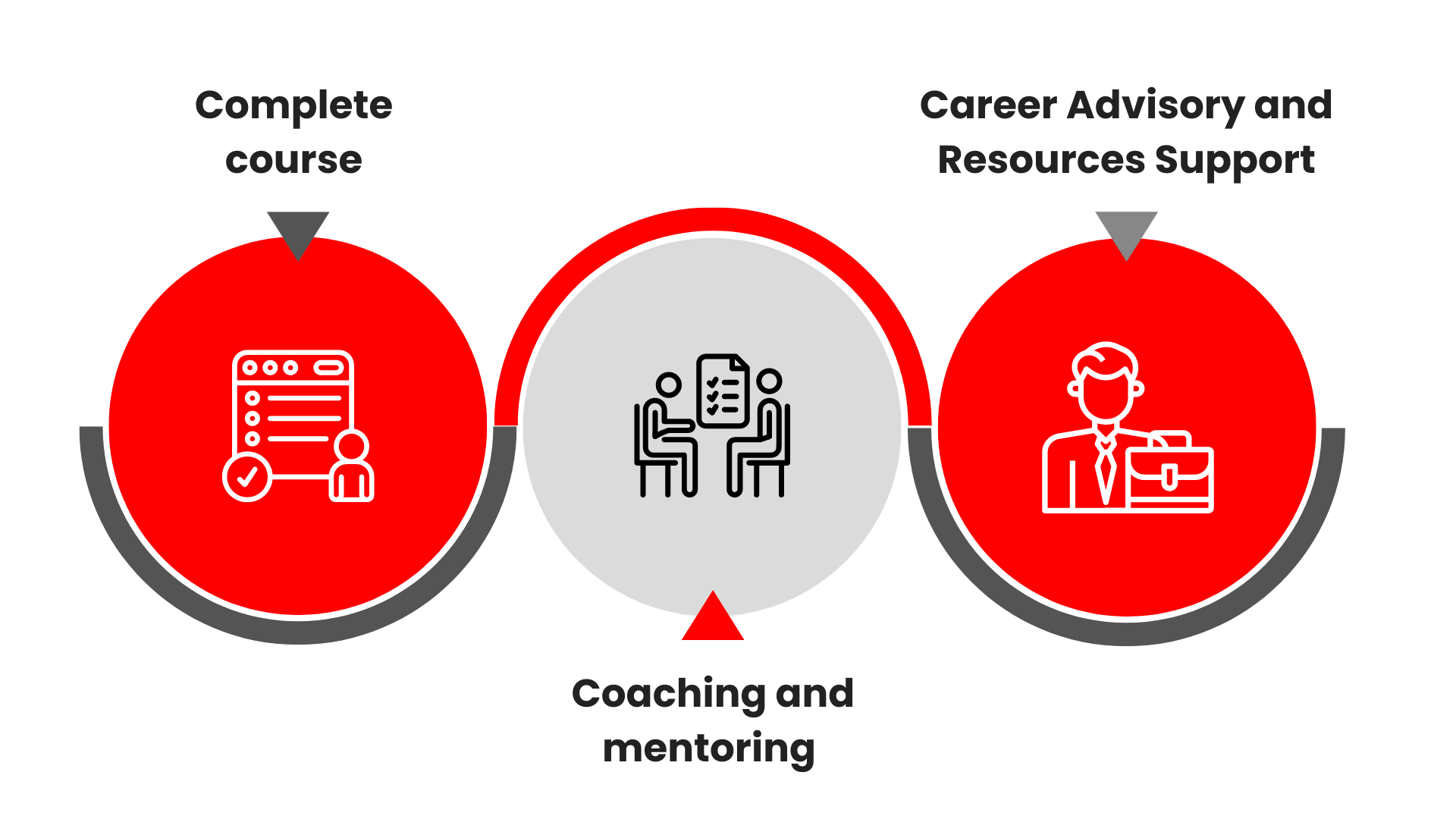
Upon completing this digital marketing diploma programme, you will receive coaching and mentorship by our programme advisors to complete your capstone project. This capstone project also serves as your portfolio, showcasing your knowledge and skills.
Once the project is completed, you’ll gain access to our dedicated career advisory and resources support. Our career services team will be readily available to provide assistance to enhance your employability, such as Career Assistance Workshops, resume building and interview tips, and more.
Diploma in Digital Marketing Course Fees and Subsidies
Criteria and/or Requirements for Course Subsidies
Baseline Funding Criteria and/or Requirements
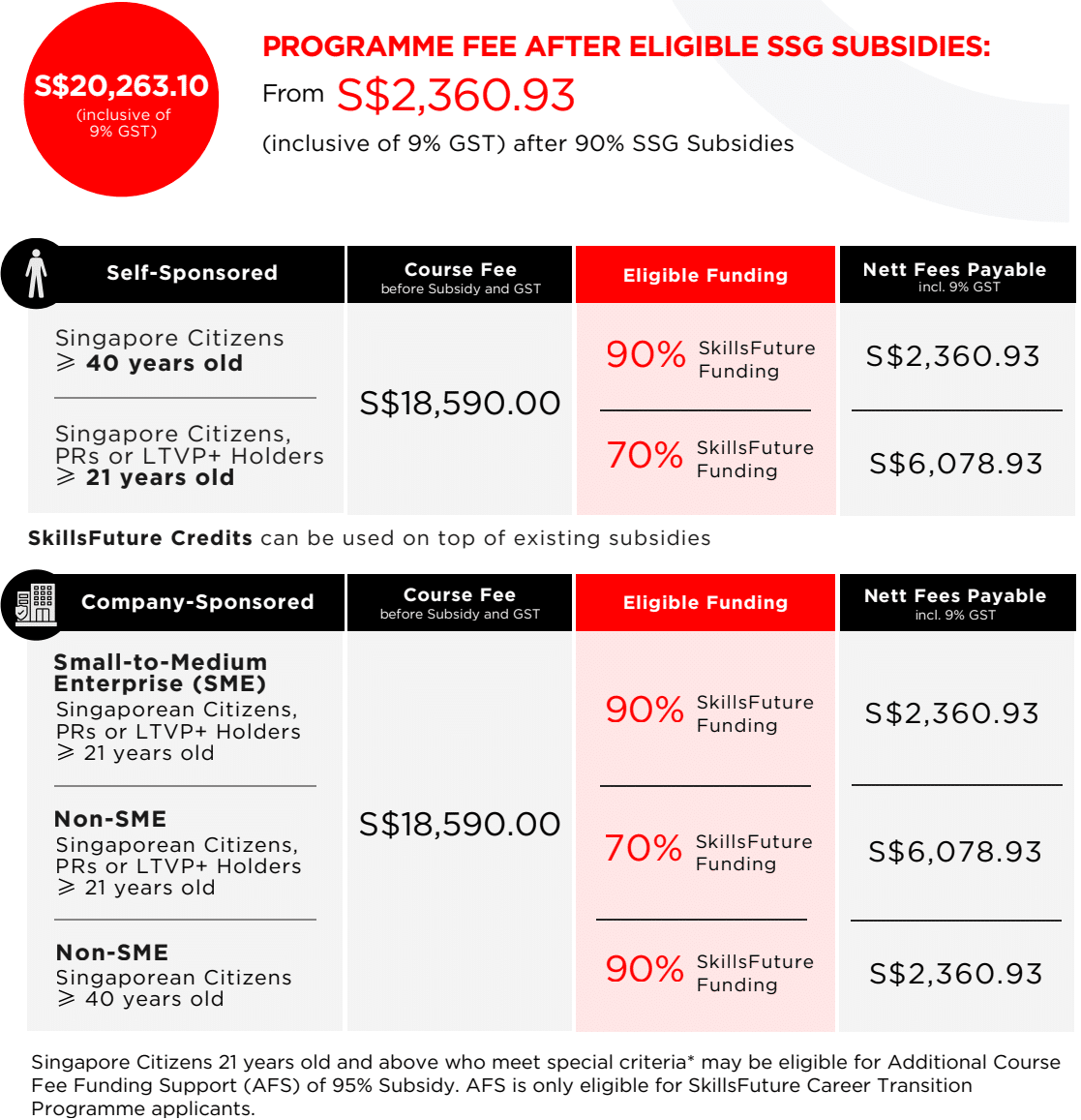
Trainee is 21 years old and above, and a
- Singaporean Citizen; or
- Permanent Resident; or
- Long Term Visitor Pass Plus (LTVP+) Holder
Will be eligible for 70% SkillsFuture Funding.
Nett course fee payable (including 9% GST): S$6,078.93
Course fees can be further offset by SkillsFuture Credit for Singapore Citizens aged 25 and above. Singapore Citizens aged 21 to 31 may also offset fees with the Post Secondary Education Account Funds.
Mid-Career Enhanced Subsidy (MCES) Criteria and/or Requirements
Trainee is 40 years old and above, and a Singaporean Citizen, will be eligible for 90% SkillsFuture Funding.
Nett course fee payable (including 9% GST): S$2,360.93
Course fees after subsidies can be further offset by SkillsFuture Credit.
Company-Sponsored (SMEs)
Enhanced Training Support for SMEs (ETSS) – 90% Funding
Eligible for SME Company-Sponsored, 21 years old and above, and a
- Singapore Citizen; or
- Permanent Resident; or
- Long-Term Visitor Pass Plus (LTVP+) Holder
Nett course fee payable (including 9% GST): S$2,360.93
Course fees after subsidies can be further offset by Skillsfuture Enterprise Credit (SFEC)
Company-Sponsored (Non-SMEs)
SkillsFuture Baseline Funding – 70% Funding
Eligible Non-SME Company-Sponsored, 21 years old and above, and a
- Singaporean Citizen; or
- Permanent Resident; or
- Long Term Visitor Pass Plus (LTVP+) Holder
Nett course fee payable (including 9% GST): S$6,078.93
Course fees after subsidies can be further offset by Skillsfuture Enterprise Credit (SFEC)
SkillsFuture Mid-Career Enhanced Subsidy (MCES) – 90% Funding
Eligible for Non-SME Company-Sponsored, Singapore Citizens, aged 40 years old and above
Nett course fee payable (including 9% GST): S$2,360.93
Course fees after subsidies can be further offset by Skillsfuture Enterprise Credit (SFEC)
Additional Course Fee Funding Support (AFS) Criteria and/or Requirements
Trainee is 21 years old and above, a Singaporean Citzen, and
- Has been in long-term unemployment of 6 months or more*; or
- Recipient of ComCare Short-to-Medium Term Assistance (STMA)* or Workfare Income Supplement (WIS)*; or
- Person with Disabilities
Will be eligible for 95% SkillsFuture Funding.
Nett course fee payable (including 9% GST): S$1,431.43
Course fees can be further offset by SkillsFuture Credit for Singapore Citizens aged 25 and above. Singapore Citizens aged 21 to 31 may also offset fees with the Post Secondary Education Account Funds.
*Supporting documents such as CPF, approval letter, and/or payout letter is required to be submitted upon registration. You may request a copy from MSF Social Service Offices or via CPF’s Workfare Portal.
NOTE: Trainees are entitled to the SSG training grant when they meet 75% of the training attendance and pass the requisite assessment. If trainees fail the assessment, they are required to re-take it immediately without additional fee. For more details see Course Funding Information.
Important Reminder: Your PSEA claim needs to be submitted at least 1 month before the course’s commencement date. Should you miss this deadline, an alternative payment method must be used to secure your spot in the course. After the disbursement of your PSEA funds to us, we will reach out to initiate the refund process.
Course Schedule
- Nov Weekdays Intake 1 (In-Person at IP)
- Dec Weekdays Intake 1 (In-Person at IP)
Location:
International Plaza (Tanjong Pagar MRT)
10 Anson Road #06-11
Singapore 079903
(16 hrs) Digital Marketing Essentials
02, 03 Nov 2026 (Mon, Tue) 9.00am - 6.00pm
(16 hrs) Generative AI for Digital Marketing
05, 06 Nov 2026 (Thu, Fri) 9.00am - 6.00pm
(24 hrs) Copywriting & Contents Writing
11, 12, 13 Nov 2026 (Wed, Thu, Fri) 9.00am - 6.00pm
(24 hrs) Digital Content Creation
18, 19, 20 Nov 2026 (Wed, Thu, Fri) 9.00am - 6.00pm
(16 hrs) Video Marketing
26, 27 Nov 2026 (Thu, Fri) 9.00am - 6.00pm
(24 hrs) WordPress Website Creation
02, 03, 04 Dec 2026 (Wed, Thu, Fri) 9.00am - 6.00pm
(24 hrs) Website & Landing Page Conversion Optimisation
09, 10, 11 Dec 2026 (Wed, Thu, Fri) 9.00am - 6.00pm
(16 hrs) Social Media Marketing
14, 15 Dec 2026 (Mon, Tue) 9.00am - 6.00pm
(16 hrs) TikTok Marketing
17, 18 Dec 2026 (Thu, Fri) 9.00am - 6.00pm
(24 hrs) Search Engine Optimisation
22, 23, 24 Dec 2026 (Tue, Wed, Thu) 9.00am - 6.00pm
(19 hrs) Capstone Project (Digital Marketing Campaign)
28 Dec 2026 (Mon)
29 Jan 2027 (Fri)
(16 hrs) Digital Advertising
04, 05 Jan 2027 (Mon, Tue) 9.00am - 6.00pm
(24 hrs) Facebook & Instagram Marketing
07, 08, 11 Jan 2027 (Thu, Fri, Mon) 9.00am - 6.00pm
(24 hrs) Google Ads
13, 14, 15 Jan 2027 (Wed, Thu, Fri) 9.00am - 6.00pm
(24 hrs) Digital Marketing Analytics (Google Analytics)
18, 19, 20 Jan 2027 (Mon, Tue, Wed) 9.00am - 6.00pm
Location:
International Plaza (Tanjong Pagar MRT)
10 Anson Road #06-11
Singapore 079903
(16 hrs) Digital Marketing Essentials
01, 02 Dec 2026 (Tue, Wed) 9.00am - 6.00pm
(16 hrs) Generative AI for Digital Marketing
07, 08 Dec 2026 (Mon, Tue) 9.00am - 6.00pm
(24 hrs) Copywriting & Contents Writing
14, 16 Dec 2026 (Mon, Wed) 9.00am - 6.00pm
(24 hrs) Digital Content Creation
21, 23 Dec 2026 (Mon, Wed) 9.00am - 6.00pm
(16 hrs) Video Marketing
28, 29 Dec 2026 (Mon, Tue) 9.00am - 6.00pm
(24 hrs) WordPress Website Creation
04, 06 Jan 2027 (Mon, Wed) 9.00am - 6.00pm
(24 hrs) Website & Landing Page Conversion Optimisation
11, 13 Jan 2027 (Mon, Wed) 9.00am - 6.00pm
(16 hrs) Social Media Marketing
18, 19 Jan 2027 (Mon, Tue) 9.00am - 6.00pm
(16 hrs) TikTok Marketing
21, 22 Jan 2027 (Thu, Fri) 9.00am - 6.00pm
(24 hrs) Search Engine Optimisation
25, 27 Jan 2027 (Mon, Wed) 9.00am - 6.00pm
(19 hrs) Capstone Project (Digital Marketing Campaign)
28 Jan 2027 (Thu)
25 Feb 2027 (Thu)
(16 hrs) Digital Advertising
01, 02 Feb 2027 (Mon, Tue) 9.00am - 6.00pm
(24 hrs) Facebook & Instagram Marketing
03, 05 Feb 2027 (Wed, Fri) 9.00am - 6.00pm
(24 hrs) Google Ads
10, 12 Feb 2027 (Wed, Fri) 9.00am - 6.00pm
(24 hrs) Digital Marketing Analytics (Google Analytics)
15, 17 Feb 2027 (Mon, Wed) 9.00am - 6.00pm
Frequently Asked Questions (FAQ)
What are the entry requirements for the Diploma in Digital Marketing?
To enrol, you need WPLN Level 6 or a C6 in GCE O-Level English. Academically, you need at least 3 O-Level passes, or you may be considered on a case-by-case basis.
Mature candidates (30+ years old) with 8+ years of relevant work experience are also welcome.
See the Entry Requirements section above for the full breakdown.
What are the available subsidies and eligibility criteria for the Diploma in Digital Marketing?
Eligible funding depends on your profile:
- Singapore Citizens, PRs, or LTVP+ holders aged 21 and above (self- or company-sponsored under a non-SME): 70% SkillsFuture Funding — nett fee S$6,078.93 (incl. 9% GST)
- Singapore Citizens aged 40 and above, or company-sponsored under an SME (SC/PR/LTVP+ aged 21+): 90% SkillsFuture Funding — nett fee S$2,360.93 (incl. 9% GST)
- Singapore Citizens aged 21 and above meeting special criteria (e.g. long-term unemployment, ComCare/Workfare recipients, Persons with Disabilities) may qualify for Additional Course Fee Funding Support (AFS) of up to 95%, available exclusively to SCTP applicants
SkillsFuture Credit can be used on top of any of the above subsidies, and the balance fee may also be claimable via PSEA, UTAP, or SkillsFuture Enterprise Credit.
Contact our course consultants to confirm your exact funding tier.
How many modules are in this programme?
The diploma consists of 15 modules, totalling 307 training hours. Modules 1 to 14 can be taken in any sequence, but Module 15 (the Capstone Project) must be completed last after finishing all other modules.
Is this Diploma in Digital Marketing recognised?
Yes. All modules in this diploma are developed by @ASK Training’s CET Centre together with a panel of subject matter experts, ensuring the curriculum stays industry-relevant and practically applicable.
The diploma is also eligible for Full-Time Training Allowance (TA) under the SkillsFuture Career Transition Programme (SCTP) framework.
I have no marketing experience. Will I struggle?
Not at all. This programme is specifically designed for career switchers and beginners. We start with foundational modules like Digital Marketing Essentials before moving to advanced topics. The hands-on, scenario-based approach ensures you build confidence step-by-step, regardless of your background.
Can I take this diploma while working a full-time job?
Yes. Our SCTP programmes are structured for working professionals, with classes typically held on weekday evenings and/or Saturdays.
Please check the registration page or contact our programme consultant for the exact schedule of the upcoming intake.
Do I need to find my own client for the Capstone Project?
No. @ASK Training provides the partner enterprise and business case for your Capstone Project. You will focus entirely on executing the campaign strategy without the stress of sourcing a client.
What happens if I fail an assessment?
Each module requires a passing mark to progress. If you do not pass on your first attempt, re-assessment opportunities are available. Our trainers also provide additional support if you are struggling with any concept; just reach out early.
How is this different from a short 1-day workshop?
Short workshops teach isolated tactics (e.g., “How to run one Facebook Ad”). This Diploma teaches the full ecosystem: strategy, content, paid ads, SEO, analytics, and conversion.
More importantly, the 307-hour curriculum and Capstone Project give you a portfolio piece that proves to employers you can manage an end-to-end campaign, not just execute a single task.
What does the Career Advisory and Resources Support Programme include?
Our Career Advisory programme supports your career preparation with:
- Resume and portfolio reviews to showcase your digital marketing skills
- Interview preparation including mock sessions
- Job search strategies and market guidance
- Access to industry connections where available
Please note: Career support is provided to complement your learning. Job placement is not guaranteed and depends on individual performance and market conditions.
Is digital marketing difficult to learn?
Not for someone willing to put in hands-on practice. The diploma is built around structured, practical exercises, platform simulations, campaign mock-ups, and real case studies, rather than theory-heavy lectures, so participants build confidence by doing rather than just reading.
No prior marketing background is required for the entry-level modules.
Is it too late to start a career in digital marketing?
Not at all; digital marketing skills like AI-driven analytics, SEO, and performance marketing remain among Singapore’s fastest-growing demands as the digital economy expands.
Employers continue to look for professionals who can demonstrate hands-on campaign experience, which is exactly what the Capstone Project is designed to provide.
What is the hardest part of learning digital marketing?
The most challenging part for most learners is keeping up with how quickly platforms, algorithms, and privacy regulations change. The Diploma in Digital Marketing addresses this directly; the curriculum includes a dedicated Generative AI for Digital Marketing module and an Emerging Trends & Digital Strategy unit, so you leave with both current platform skills and a framework for adapting as things change.
Full-Time Training Allowance
I am currently working and mid-career. Am I eligible for the Full-Time Training Allowance?
Per the SkillsFuture Service Portal (administered by SWDA), to qualify for Full-Time TA you must meet both:
- Be a Singapore Citizen aged 40 and above (as of 2025); and
- Be enrolled in a full-time TA-eligible course.
Contact our programme consultants or check the TA Portal directly to confirm your specific eligibility and payout amount.
How much will I receive under the Full-Time Training Allowance?
You’ll receive 50% of your average monthly income over the latest available 12-month period, subject to a minimum of S$300 and a maximum of S$3,000 per month, for each eligible month of full-time training.
Does full-time training allowance share the same lifetime cap as part-time?
Yes. Eligible individuals can tap a maximum of 24 months of Mid-Career Training Allowance across both full-time and part-time training combined over their lifetime.
If you use several months on full-time training, that reduces the months available should you pursue part-time training allowance in future.
What happens if I miss the deadline to accept my Training Allowance offer?
Per SWDA’s official Terms and Conditions for TA applicants, you must accept your TA offer by the deadline stated in your offer notification email. If you miss it, your application will be cancelled and the offer revoked; you may then submit a new application.
We recommend logging into the TA Portal regularly to check your application status, and watching for the notification email (including your spam/junk folder).
Do I need to repay my Training Allowance if I fail a module assessment?
No. The Training Allowance is not tied to whether you pass your module assessments; it’s paid based on meeting the training programme’s attendance requirements.
As long as you met the attendance criteria and provided accurate information in your application, you won’t need to repay any disbursed allowance.
Where can I check if the Diploma in Digital Marketing is eligible for the Full-Time Training Allowance?
You can search for all TA-eligible courses, including this diploma, directly on the MySkillsFuture portal.
Login with Singpass, search for the course title, then filter by “Featured Initiatives” and select “SkillsFuture Mid-Career Training Allowance (Full-Time).”
Tip: All @ASK Training’s SCTP courses, including the Diploma in Digital Marketing, can also be found by searching our course title or UEN on the portal.
Still have questions?
The SkillsFuture Service Portal contains detailed FAQs on the Training Allowance, guides and resources, and an option to submit an enquiry directly.
Visit the SkillsFuture Service Portal.
Part-Time Training Allowance
I am 43 years old and currently working. Am I eligible for the Part-Time Training Allowance?
Yes, you are likely eligible if:
- You are a Singapore Citizen aged 40 and above.
- You are employed and have received income in the latest available 12-month period before your course start date or application date (whichever is later).
- You have not used up your 24-month lifetime allowance cap (combined full-time and part-time).
- You have a PayNow account linked to your NRIC.
Self-employed individuals with income declared to IRAS may also qualify. For more information on the eligibility criteria, visit the official SkillsFuture Service portal.
How much Training Allowance will I receive for part-time SCTP courses?
You will receive a flat rate of S$300 per month for each eligible month of training, provided you meet the minimum 75% monthly attendance requirement.
The total number of months you can claim is based on the approved duration of your course, rounded to the nearest half-month.
My part-time course runs from 15 February to 15 March. Will I receive the full $300 for both months?
Yes, SSG uses a front-loading approach. You will receive the full S$300 for the first month (February), and the remaining allowance will be paid for subsequent months based on attendance.
Always check your TA offer letter for your specific Maximum Eligible Period (MEP).
What happens if I miss the deadline to accept my Training Allowance offer?
You must accept your TA offer within 3 calendar days of receiving it. If you miss this deadline, your application will be cancelled, and you will need to submit a new application.
We recommend logging into the TA Portal regularly to check your application status.
Can I apply for Training Allowance if I am self-employed or have no CPF contributions?
Yes, if you are self-employed and have declared your trade income to IRAS, SSG will use the latest available IRAS data to assess your eligibility.
If you have no CPF contributions but have earned income in the last 12 months, you may still qualify. The best way to check is to log in to the TA Portal and submit an application; the system will determine your eligibility automatically.
If you encounter issues, you may contact SSG via their Service Portal.
Where can I find and search for courses that are eligible for the Part-Time Training Allowance?
You can search for all TA-eligible courses, including part-time ones, directly on the MySkillsFuture portal. This is the official course directory where you can filter for programmes that qualify for the Training Allowance.
Follow these simple steps:
- Login to www.myskillsfuture.gov.sg with your Singpass.
- Search for a course title or keyword related to your area of interest.
- Apply the filter: Under the "Featured Initiatives" filter, check the box for "SkillsFuture Mid-Career Training Allowance (Part-Time)" . This will show you only the courses that are eligible.
Tip: All our SCTP courses listed on the @ASK Training website are also PT TA-eligible. You can also find them on the MySkillsFuture portal by searching for our course titles or UEN.
Do I need to repay my Part-Time Training Allowance if I fail my course assessment?
No. The Training Allowance is not based on whether you pass your course assessment. It is paid based on your fulfilment of the minimum 75% monthly attendance requirement.
As long as you met the attendance criteria and provided truthful information in your application, you do not need to repay any disbursed allowance.
Still Have Questions?
The SkillsFuture Service Portal contains:
- Detailed FAQs on Part-Time Training Allowance
- Guides and resources
- Submit an enquiry if you have further questions
Speak to A Programme Consultant
"*" indicates required fields