
In many Singapore organisations, from SMEs to multinational headquarters, reporting lines are no longer straightforward.
You might find yourself leading a project with team members from three different departments, none of whom report to you.
Or you could be an individual contributor expected to secure buy-in from senior stakeholders across the region.
This is the reality of today’s cross-functional and matrixed workplace. Your job title often does not give you full control over resources or people. Yet you are still expected to deliver outcomes, meet deadlines, and drive decisions.
That is where influence without authority becomes essential. It is the ability to shape actions and priorities without relying on formal power.
For mid-level professionals in Singapore, whether in product, marketing, operations, or HR, this skill often determines who succeeds and who simply struggles.
In this article, we will look at practical ways to build workplace influence skills through credibility, relationships, strategic communication, and stakeholder alignment.
These are not abstract ideas. They are behaviours you can apply in your next cross-functional meeting.
Before we dive into the "how," let us first clarify what influencing without authority actually looks like in a modern Singapore workplace.
What Influence Without Authority Means in the Modern Workplace
Influence without authority means getting things done through persuasion, trust, and competence rather than through formal power. In practical terms, you are not the boss, but you still move the needle.
Consider these familiar scenarios in Singapore offices:
- You are a project lead managing a cross-functional team from finance, IT, and operations. You have no hiring or firing power over them.
- You are an individual contributor in a matrixed organisation where you report to both a local manager and a regional director with different priorities.
- You are in a support function like HR or marketing, trying to get sales or product teams to adopt a new process.
In all these cases, waiting for permission or demanding compliance will not work. Instead, you need stakeholder influencing skills that help peers and managers choose to support you.
Why is this increasingly important in Singapore? Many local organisations have adopted matrix structures, especially in sectors like tech, finance, and logistics.
Reporting lines are indirect. Teams are distributed across Southeast Asia. And career progression now depends heavily on your ability to lead without a title.
Now that we have defined the concept, let us explore where real influence actually comes from when you have no formal authority.
The Real Sources of Influence at Work
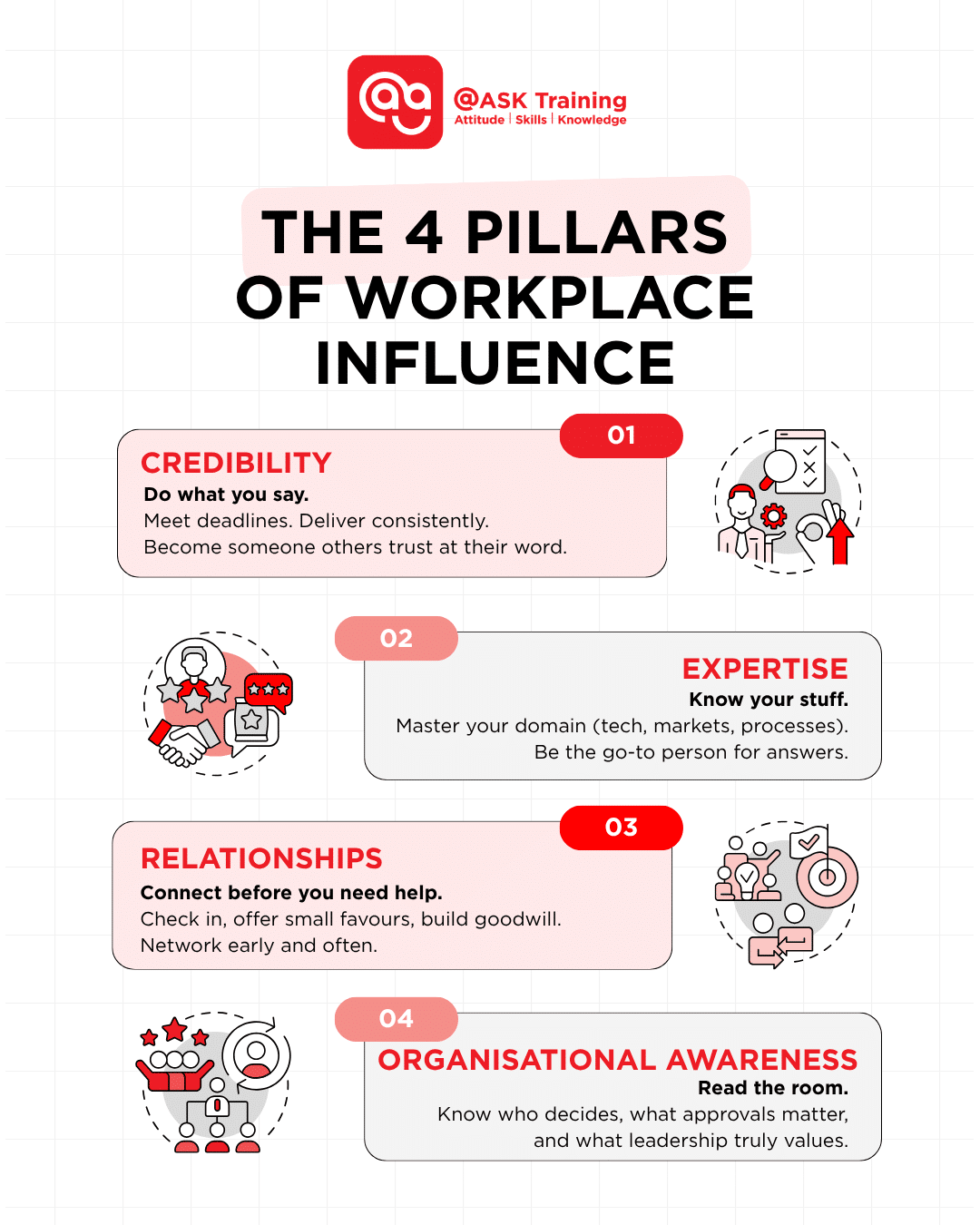
Influence does not come from a corner office. It comes from four practical sources that anyone can develop over time.
1. Credibility
- This is your reputation for delivering on promises. When you say a report will be ready by Wednesday, it is ready.
- When you commit to a deadline, you meet it. Over time, colleagues learn that your word is reliable.
2. Expertise
- This is the depth of knowledge you bring to the table. It could be technical skills, market insights, or process mastery.
- When people know you understand the subject better than anyone else, they naturally turn to you for direction.
3. Relationships
- These are the professional connections you build before you need a favour.
- Simple actions like checking in on a colleague’s priorities or offering help on a small task create goodwill that pays off later.
4. Organisational Awareness
- This means understanding how decisions get made in your company.
- Who are the informal gatekeepers? What approvals are truly necessary? What business priorities carry real weight with leadership?
In practice, this looks like:
- Being recognised as the go-to person for data analysis on your team.
- Consistently following through so others trust your recommendations without second-guessing.
- Knowing that a certain director cares more about cost control than speed, and framing your proposal accordingly.
These four sources form the foundation of leadership without authority. The good news is that none of them requires a promotion. They only require consistency.
With those foundations in place, the next question is how to turn them into actual influence over stakeholders. That is where relationships and alignment become critical.
Relationships and Stakeholder Alignment Make Influence Easier
You can have perfect expertise and strong credibility, but if you ignore stakeholder priorities, your ideas will still stall.
Influencing stakeholders without authority starts with understanding what actually matters to them.
In Singapore workplaces, where teams are often lean and targets are demanding, every stakeholder is managing their own pressures.
A finance manager is worried about budget overruns. An operations lead is measured on delivery speed. A regional director cares about quarterly numbers.
Your job is to connect your request to their goals.
For example, instead of asking an IT stakeholder for extra development time because “it would be nice to have,” you might say: “Allocating two more days to testing will reduce post-launch bugs by an estimated 30%, which lowers your team’s support tickets.”
Notice how the framing shifted from your need to their benefit.
Practical ways to build stakeholder alignment:
- Map your stakeholders early. Before presenting any idea, list everyone whose approval or cooperation you need.
- Understand their pressures. Ask yourself: What is their boss measuring them on? What keeps them up at night?
- Reframe your proposal. Show how your idea supports their team or company objectives, not just your own.
When you take this approach, you stop being seen as someone who creates extra work. Instead, you become a partner who helps others achieve their targets.
But alignment alone is not enough. You also need to communicate in a way that earns buy-in across different audiences. Let us look at how to adjust your style for each stakeholder group.
Communicating for Buy-In Across Different Stakeholders
The way you speak to a peer is different from how you present to a senior director. Soft skills influence requires adapting your message based on who is listening.
For Peers and Teammates
Focus on collaboration and shared goals. Use “we” language. Ask for their input early. People support what they help create.
For Managers and Department Heads
Focus on options and trade-offs. Present two or three paths forward, along with the pros and cons of each. Let them feel they are making the decision with your guidance.
For Senior Leaders and Executives
Focus on outcomes, risks, and business impact. They care less about process details and more about results. State your recommendation clearly, then back it up with data.
Practical Communication Strategies That Work in Singapore Offices
- Present data, not just opinions. Saying “I believe this will work” is weak. Saying “Based on last quarter’s data, this approach improved efficiency by 12%” carries weight.
- Ask strategic questions. Instead of pushing your idea, try: “What would need to be true for this to work for your team?” This brings stakeholders into the problem-solving process.
- Adjust your timing. Pushing an idea right before a major deadline or during a busy reporting period is a recipe for rejection. Choose your moment carefully.
These communication habits separate professionals who simply talk from those who truly influence.
But even well-intentioned efforts can fail. Let us look at common mistakes that weaken influence at work, so you can avoid them.
Common Mistakes That Undermine Influence Without Authority
Even experienced professionals in Singapore make avoidable errors when trying to influence others. Recognising these patterns is the first step to fixing them.
Mistake #1: Pushing Ideas Before Building Context
You have a great solution. You present it confidently in a meeting. Then silence. Why? Because you did not sound out key stakeholders beforehand.
Always have informal conversations first. Test your idea with one or two trusted colleagues. Let them poke holes in it privately. Then refine before going wide.
Mistake #2: Ignoring What Stakeholders Care About
Your proposal might be perfect on paper, but if it does not address the other person’s priorities, it will fail.
A finance stakeholder focused on cost reduction will not champion a project that increases spending, no matter how innovative it is.
Mistake #3: Overpromising and Underdelivering
Nothing destroys workplace influence skills faster than missed deadlines and broken commitments.
If you say you will send a document by Tuesday, send it by Tuesday. Every broken promise chips away at your credibility.
Mistake #4: Trying to Win Every Argument
Influence is not about being right. It is about moving things forward.
Sometimes that means accepting a small loss to preserve a relationship for a bigger win later.
A Real Example from Singapore Workplaces
You present a well-researched idea to improve a workflow. It stalls because you did not realise the operations team leader needed to be consulted first.
Your credibility takes a hit, not because the idea was bad, but because you missed the organisational dynamics.
The fix is simple: Before any major proposal, ask yourself, “Who else needs to be in the room before this room?”
Now that you know what to avoid, let us focus on positive actions. Here are practical ways to strengthen your influence over time.
Practical Ways to Strengthen Your Influence at Work
Influence is not built in a single conversation. It is the result of small, consistent actions repeated over weeks and months. Here are specific behaviours you can start today.
1. Prepare Thoroughly Before Stakeholder Conversations
- Write down possible objections in advance.
- Prepare a one-paragraph summary of your ask.
- Anticipate what each stakeholder needs to hear to feel comfortable saying yes.
2. Follow Up Consistently
- After a decision is made, send a short recap email: “Here is what we agreed. Here are the next steps. Here are the deadlines.”
- This makes you the person who keeps things moving. Over time, people trust you to manage the process.
3. Contribute Useful Insights in Meetings
- You do not need to speak the most. But when you speak, add value.
- Connect dots others missed. Share a relevant data point. Ask a question that moves the discussion forward.
4. Build Visibility Through Expertise
- Volunteer to document a shared process.
- Offer to present a quick update on a topic you know well.
- Share helpful resources with your team without being asked.
5. Give Credit Generously
- Say “That was Sarah’s idea” or “The data came from Jun Wei’s team.”
- When you share credit, people remember. And they are far more willing to help you next time.
These actions are not dramatic. They are practical. And they work in any Singapore organisation, from small local firms to large regional headquarters.
Let us now bring everything together.
Wrapping Up: Influence is Built, Not Given
In modern workplaces across Singapore, your ability to drive outcomes depends less on your job title and more on your credibility, relationships, and communication skills.
Influence without authority is not a nice-to-have. It is a core competency for mid-level professionals, individual contributors, and project leads.
Remember the key sources of influence: credibility, expertise, relationships, and organisational awareness.
Build them steadily. Align your proposals with stakeholder priorities. Communicate differently for different audiences.
Avoid common mistakes like pushing ideas too early or ignoring organisational dynamics. And practice the small, consistent actions that strengthen your reputation over time.
Your next step: Reflect on one recent situation where you struggled to gain buy-in. Ask yourself which of the four influence sources was weakest. Then focus on strengthening that specific area over the next 30 days.
When you do that consistently, you will find that people start listening, supporting, and following, not because they have to, but because you have earned the right to lead.
Take Your Influencing Skills Further with @ASK Training
If you are ready to move beyond reading and start practising, @ASK Training offers practical, hands-on courses designed for Singapore professionals.
Explore our Leadership & Management Courses to build the exact skills covered in this article.
Here are three courses most relevant to mastering influence without authority:
- Connect, Engage and Influence with NLP Interpersonal Communication Techniques: Learn proven NLP methods to build rapport and influence others effectively.
- Strategies for Persuasive Negotiation: Master negotiation techniques to gain buy-in without damaging working relationships.
- The Five Behaviours of a Cohesive Team: Build trust and foster collaboration when leading cross-functional teams without formal authority.
Contact our course consultant to see what suits you best. Your ability to influence without authority starts here. Let's build it together!
Related Courses
- People Centred Leadership – Motivating, Inspiring and Engaging Others
- Persuasive Communication for Leaders
- Sun Tzu’s Art of War for Modern Leaders
◆◆◆