
Many beginners believe that “good” content is born from talent or a sudden spark of inspiration. In reality, the most successful, high-ranking articles are built using a repeatable system rather than creative guesswork.
A structured content writing framework removes the uncertainty from your process. It helps you move logically, from identifying a reader’s problem to publishing an article that solves it clearly and completely.
If you’re a beginner writer, a freelancer building a portfolio, or a small business owner managing your own blog, the challenge isn’t usually writing — it’s knowing what to write and how to structure it so it performs in search.
This beginner content writing guide walks you through a simple 7-step process used by professional writers and SEO specialists to create high-quality, “people-first” content.
By following these steps sequentially, you will learn how to consistently produce articles that are as useful to your readers as they are friendly to search engines.
To understand why this system works so well, let’s first define what a content writing framework actually looks like in practice.
What a Real Content Writing Framework Looks Like
A content writing framework is more than a set of tips or a writing style; it’s a repeatable system that guides your process from the first draft to the final hit of the “publish” button.
Think of it as a blueprint for your article: it tells you what to include, in what order, and the logic behind every section, so you don’t rely on guesswork or inspiration alone.
Why Intentional Structure Matters
Many beginners start writing immediately, which often results in scattered content that jumps between unrelated ideas. Without a clear framework, even polished writing can fail to rank because it lacks direction or focus.
A framework ensures each section of your article has a purpose and aligns your expertise with what readers and search engines expect.
The Difference a Framework Makes
To understand the impact of a structured approach, consider these two paths:
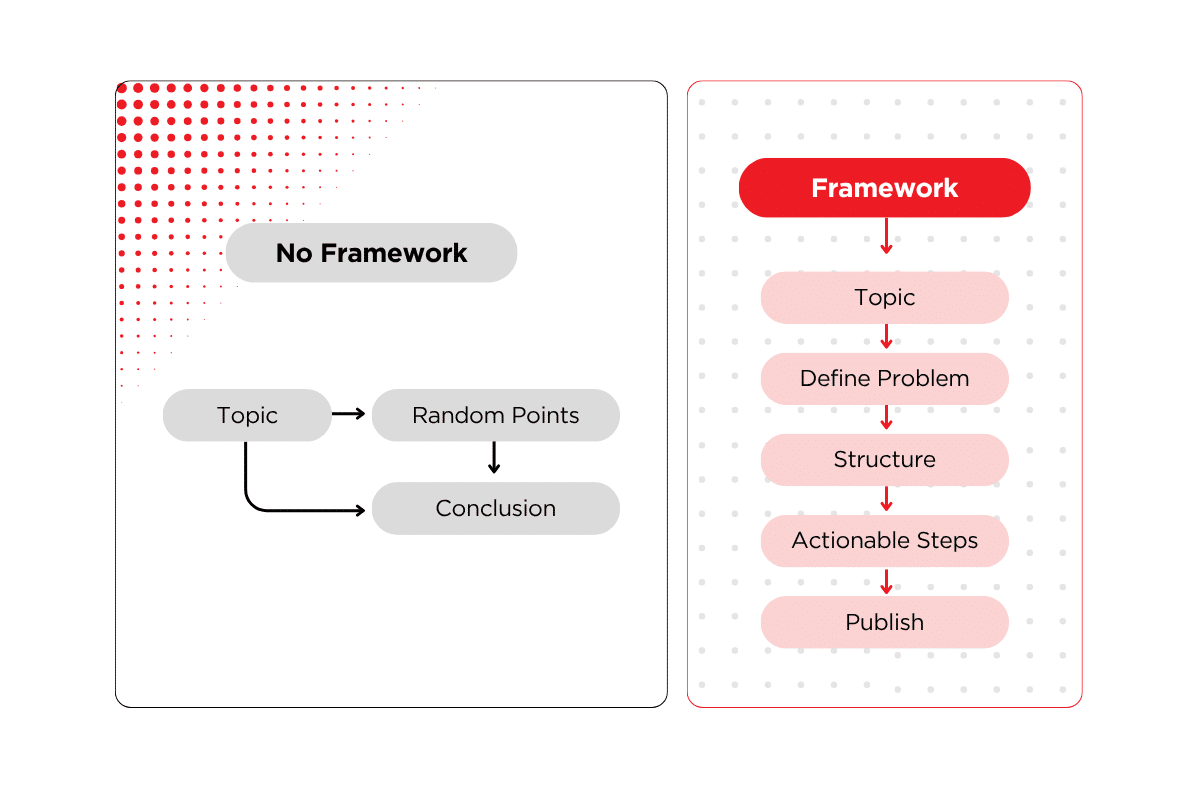
Writing Without a Framework
You might choose a broad topic like “SEO Tips.” Without a plan, the article jumps from keyword research to link building and then suddenly to social media promotion. The sections feel disconnected, and the reader is left feeling overwhelmed and lost.
Writing With a Framework
You narrow your focus to “How to Structure a Blog Post for SEO as a Beginner.” You follow a logical sequence: defining the reader's specific problem, matching their search intent, and building a step-by-step solution.
This flow makes the article easier for readers to digest and far easier for search engines to index.
Key Benefits for Developing Writers
Implementing a beginner content writing guide or framework provides several professional advantages:
- Consistency: You can apply the same process to every article.
- Clarity: Every paragraph answers a clear sub-question or solves part of the reader’s problem.
- Efficiency: Planning becomes faster because the framework shows you exactly what to focus on.
- Confidence: You write with purpose, reducing the anxiety of staring at a blank page.
Strong content is rarely accidental. It is designed deliberately. By adopting this seven-step system, you move closer to mastering an SEO content structure that is easy to read, simple to scan, and optimised for long-term results.
Before we dive into the specific steps, let’s look at the first, and perhaps most important, foundation: identifying the problem you are actually solving.
#1 Define the Exact Problem You’re Solving
The foundation of every high-performing article is absolute clarity. A common mistake beginners make is attempting to tackle broad, “umbrella” topics like “SEO tips” or “digital marketing.”
These subjects are too vast, often resulting in vague, scattered content that fails to provide real value. Instead, your first task is to isolate one precise problem your reader is currently facing.
Why Precision Wins
- Search engines prioritise people-first content that directly answers a specific query.
- Audiences stay on the page when they feel their exact "pain point" is being addressed within the first few sentences.
- A narrow focus acts as a North Star, ensuring your article flows logically from the introduction to the conclusion.
How to Narrow Your Focus
To move from a vague idea to a professional-grade topic, follow these three steps:
1. Identify A Single Specific Pain Point
Ask yourself, “What is the one specific challenge my reader is struggling with right now?”
- Weak (Too Broad): “SEO tips.”
- Strong (Precise): “How beginners can structure a blog post for SEO to rank on Google.”
2. Define The Desired Outcome
Before drafting a simple paragraph, clarify what the reader should be able to do after finishing your piece.
- Example: “After reading this article, a beginner will be able to plan and draft a fully structured blog post that is ready for SEO.”
3. Perform a “Relevance Check” on Every Section
As you write, audit every paragraph. Ask: “Does this sentence help solve the core problem identified in Step 1?”
If a section doesn’t directly contribute to the solution, it likely doesn’t belong in the article.
Pro Tip for Better Angles
Use tools like Google’s “People Also Ask” or “Related Searches” to see the actual questions people are typing into search engines. If your article tries to answer too many unrelated questions, you risk confusing both your readers and search engine algorithms.
By mastering this level of focus, you ensure your work stands out as high-quality content that serves a clear, singular purpose.
Once you have defined the problem, the next step is ensuring your format matches exactly what the reader is looking for.
#2 Match Search Intent Before You Outline
Before you draft a single paragraph, you must understand exactly what your audience is actually looking for. This is the core of search intent in content writing.
Writing without considering it is like planning a trip without knowing the destination: you might end up anywhere, and your readers – and search engine - won’t follow.
Why Search Intent is Non-Negotiable
- Ranking Power: Google prioritises "people-first content" that satisfies the reader’s underlying goal, not just pages that repeat a keyword.
- Format Alignment: Understanding intent ensures you provide the right type of content, whether it’s a tutorial, a list, or a deep-dive explanation.
- Engagement: When your content matches what a user expects to find, they stay longer, reducing bounce rates and building trust in your brand.
A. How To Identify and Categorise Intent
To ensure your SEO content structure hits the mark, classify your target query into one of these four primary categories:
- Informational Intent: The reader wants to learn or discover something (e.g., “How to start blogging”). Your response should be step-by-step guides, tutorials, or explainer posts.
- Commercial Intent: The reader is researching options before a purchase (e.g., “Best SEO tools”). Use comparison tables, reviews, or pros-and-cons lists.
- Transactional Intent: The user is ready to buy or sign up (e.g., “Enrol in a copywriting course”). Focus on product pages or clear, checkout-ready landing pages.
- Navigational Intent: The user is trying to reach a specific website (e.g., “@ASK Training login”). These are direct brand or platform-specific pages.
B. Analysing the Competition
Don’t guess what format works; verify it:
- Check the first page of Google for your target keyword.
- Observe format, length, headings, and content type. Are the top results listicles, long-form guides, videos, or quick tips?
- Note the common subtopics these high-ranking pages cover; these are the "entry stakes" for your own article.
C. Mirror Intent, Then Improve the Depth
Your goal isn’t to copy your competitors, but to satisfy the same intent more effectively.
- Example: If most “SEO beginner guides” are generic lists, you can stand out by creating a high-quality content example that offers more structure, better formatting, and more actionable advice.
By identifying search intent early, you eliminate the frustration of creating content that fails to meet reader expectations.
Once you know what your reader wants, you can begin building the skeleton of your article: the logical structure.
#3 Build a Structure That Makes the Answer Easy to Find
Think of your article as a roadmap for your reader. In digital copywriting, your goal is to lead the reader to the solution as efficiently as possible.
Before writing full paragraphs, you must plan a logical flow that walks the reader step-by-step toward their desired outcome.
Why Structure is a Ranking Factor
Most online readers scan content rather than reading word-for-word. If your article buries key points or lacks a clear hierarchy, users will bounce back to the search results.
A professional structure ensures:
- Immediate Value: The reader finds the answer to their specific sub-question within seconds.
- Sustained Engagement: Logical transitions keep the reader moving from the introduction to the final CTA.
- Search Visibility: Clear H2 and H3 tags signal to search engines that your content is organised and authoritative.
How To Build A Reader-Friendly Skeleton
To create high-quality content that is easy to digest, implement these four structural rules:
1. Draft a Logical H2 Flow
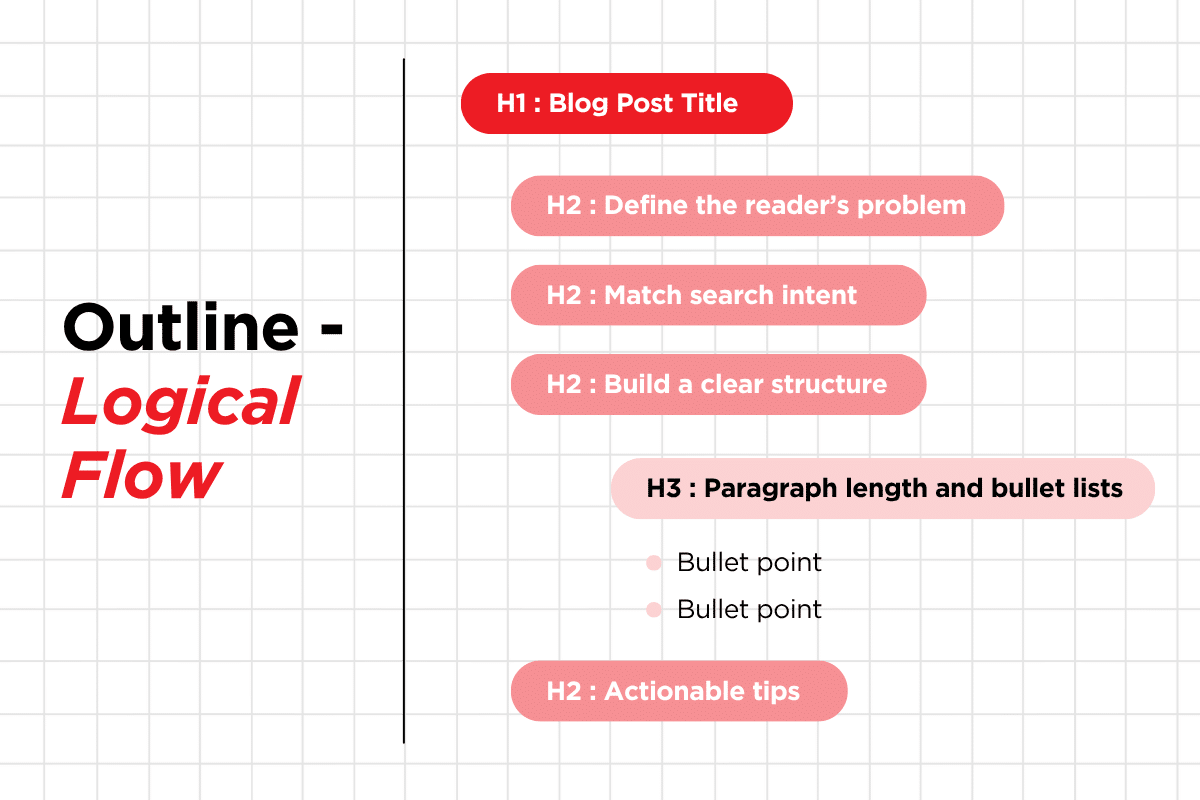
Break the main problem into smaller, sequential sub-questions and assign each one a heading.
- Example: If your topic is “How to Structure a Blog Post,” your H2s should follow the actual workflow: Define the Problem → Match Intent → Build the Outline → Write Actionable Steps.
2. Master the “Micro-Paragraph”
- Stick to 1–3 sentences per paragraph. Short blocks of text improve readability on both desktop and mobile.
- Avoid large blocks of text, which discourage scanning.
3. Simplify with Bulleted Lists
- Whenever you present a list of tools, steps, or benefits, use bullet points.
- Lists break up the visual monotony of an article and make complex ideas instantly accessible.
4. Write “Descriptive” Headings
- Your headings should act as labels. A reader should be able to understand the entire "story" of your article just by reading the H2s.
- Instead of a vague heading like “Tips,” use an active one like “How to Write Actionable SEO Tips.”
Practical Tip For Beginners
- Start with a bare-bones outline consisting only of your H2s.
- Once the logic is solid, flesh out subheadings with one or two action points.
- This prevents "content drift" and ensures every section remains strictly focused on solving the core problem.
By prioritising clarity over “clever” formatting, you create an environment where the reader feels supported and informed.
Now that the skeleton is built, it’s time to fill it with substance by replacing vague advice with actionable instructions.
#4 Replace Vague Advice With Clear, Actionable Steps
The hallmark of high-quality content is its utility.
Many new writers make the mistake of producing content that sounds helpful but doesn’t actually tell the reader what to do next.
Abstract phrases like “create engaging content” or “write valuable posts” offer no real guidance. To truly help your audience, you must translate these concepts into specific, repeatable actions.
Why Actionable Instructions Matter
- Operational Clarity: When instructions are concrete, readers can implement them without second-guessing.
- Reduced Friction: Clear steps prevent the frustration that leads readers to abandon an article.
- Search Intent Satisfaction: Google rewards people-first content that provides immediate solutions. Precise steps are easier for both humans and search algorithms to scan and index.
How to Transform Abstract Ideas into Specific Actions
Follow this four-step process to ensure your writing is practical, not just theoretical:
1. Audit for “Empty Phrases”
Scan your draft for vague advice such as “focus on quality” or “make it interesting.” These are goals, not instructions.
2. Rewrite with Concrete Instructions
- Vague: “Write a compelling introduction.”
- Actionable: “State the reader’s problem in the first two sentences, then explain what they will achieve by reading your article.”
3. Define What “Success” Looks Like
Don’t just give a task; specify the standard.
- Instead of: “Add visuals to your post.”
- Write: “Include at least one relevant chart or annotated screenshot in every H2 section to clarify complex technical points.”
4. Use “Before vs. After” Examples
Show the reader the difference between surface-level advice and a professional-grade execution.
For instance, instead of saying “use headings wisely,” demonstrate a logical hierarchy:
- H2: How to Narrow Your Topic
- H3: Identifying the Core Pain Point
- H3: Using 'People Also Ask' for Precision
The “Immediate Action” Test
Before finalising a section, ask yourself: “Could a complete beginner follow this instruction right now without needing further explanation?”
If the answer is no, break the step down into smaller, more manageable pieces.
Pro Tip: Create a “Definition of Done” Checklist
For every section you write, ensure it meets these three criteria:
- [ ] Does it identify a problem?
- [ ] Does it provide a step-by-step solution?
- [ ] Does it include a real-world example?
By replacing generic advice with a beginner content writing guide that actually works, you move beyond surface-level writing.
Once your steps are actionable, the next phase is to ensure your content provides more value than what is already available online.
#5 Go Deeper Than Competitors Without Adding Fluff
Once your article has a clear structure and actionable steps, the next step is depth. Many writers fall into the trap of increasing word count without increasing value — a practise commonly known as “adding fluff.”
In a professional content writing framework, depth isn’t about how much you write; it’s how thoroughly you solve the reader’s problem.
Why Completeness Beats Word Count
- Search Engine Preference: Google prioritises content that fully satisfies a user's query. An 800-word article that answers every sub-question will often outrank a 2,000-word article filled with filler.
- Building Authority: When you provide detailed, well-explained points, you demonstrate the E-E-A-T content guidelines (Experience, Expertise, Authoritativeness, Trustworthiness) that readers and search engines look for.
- Competitive Edge: Most competitors skim the surface. By going deeper into the "how" and "why," you position your content as the definitive resource.
How To Add Meaningful Depth
To move beyond surface-level writing, use these four strategies to ensure your content is comprehensive:
1. Expand on Sections That Competitors Skim
- Look at the top-ranking articles in the SERP for your keyword.
- Identify areas they mention briefly or skip entirely.
- Add detailed explanations, practical tips, or mini case studies.
2. Use Practical and Local Examples
Include scenarios or statistics relevant to Singapore.
Example: Instead of simply saying “optimise your Google Business Profile,” show:
“For a small business in Singapore, add local keywords in your service descriptions, ensure your opening hours are accurate, and post weekly updates to improve local SEO visibility.”
3. Break Complex Ideas into Digestible Parts
- Use numbered steps, bullet points, or small visuals.
- Avoid long paragraphs that overwhelm readers; clarity is more important than length.
4. Eliminate Filler Content
- Every sentence should serve the reader’s problem.
- Remove generic phrases like “make your content valuable” unless you immediately follow with how to make it valuable.
The “So What?” Test
Read every paragraph and ask: "So what? How does this help the reader solve their problem?" If you can't answer that question immediately, tighten the section or remove it entirely.
By focusing on completeness rather than length, you ensure your article is both respectful of the reader's time and highly competitive in search rankings.
#6 Add Authority Signals That Build Trust
In an era of AI-generated filler, search engines and readers alike are hungry for one thing: trust. To rank well, your article must demonstrate that it is written by someone with genuine insight.
Google evaluates credibility using principles known as E-E-A-T content guidelines —Experience, Expertise, Authoritativeness, and Trustworthiness.
Why Authority is Your Best SEO Strategy
Providing authority signals proves to your reader that your advice is safe to follow. When you support your claims with data and industry insights, you transform a simple blog post into a professional resource.
This shift is the hallmark of high-quality content that stands the test of time.
How to Build Authority into Your Writing
To strengthen authority in your articles and align with E-E-A-T content guidelines, focus on the following practices:
1. Demonstrate First-Hand Experience
- Move beyond theory. Share specific scenarios or “lessons learned” that show you have actually performed the tasks you are describing.
- For example, instead of saying “SEO is important,” explain how a specific content writing framework helped a local SME increase their organic traffic by 20% over six months.
2. Showcase Subject Matter Expertise
Use precise industry terminology correctly and provide clear, simple explanations for complex concepts.
This shows you aren’t just repeating surface-level advice you found on the first page of Google.
3. Cite Reputable Sources
Support your statements with data from recognised organisations.
- Industry Data: For instance, a study by HubSpot found that businesses publishing consistent blog content generate significantly more website traffic than those that do not.
- Local Context: In Singapore, government agencies such as Infocomm Media Development Authority (IMDA) report that digital marketing and content strategies are increasingly important for SMEs building online visibility.
4. Prioritise Trustworthiness
Avoid “clickbait” titles or exaggerated claims that you cannot back up with evidence. Ensure your information is accurate, up-to-date, and balanced.
The “Expert” Check
Before moving to the final optimisation, read through your draft and ask: "Why should the reader believe me?" If a paragraph feels like a generic opinion, add a statistic, a link to a government report, or a real-world example to ground it in reality.
By consistently adding these signals, your work naturally becomes people-first content, valuable to the reader first and optimised for the search engine second.
With your authority established, the final step is to polish your technical SEO without losing your personal touch.
#7 Optimise for SEO Without Compromising Readability
SEO optimisation is the final technical layer of your content writing framework, not the starting point. Its purpose is to make your article discoverable for search engines while ensuring the text remains fluid and engaging for your audience.
When done correctly, SEO works invisibly in the background, helping search engines categorise your topic without interrupting the reader’s experience.
Prioritising Clarity Over Density
A common mistake is “keyword stuffing”, forcing phrases into sentences where they don’t naturally belong.
If your article solves a problem and is easy to read, it already satisfies the most critical ranking factors. Your goal here is to integrate your target terms so seamlessly that a human reader wouldn’t even notice them.
The Professional Optimisation Workflow
1. Including the Primary Keyword in the Title and Introduction
- Place your primary keyword, "content writing framework", in your H1 title, your introduction, and at least one H2 subheading.
- This provides a clear "thematic anchor" for search crawlers while setting immediate expectations for the reader.
2. Semantic Integration of Secondary Keywords
- Instead of repeating the same phrase, weave in related terms like "how to write good content" or "beginner content writing guide" where they naturally fit the context.
- This "semantic" approach helps search engines understand the full depth of your topic without the text feeling repetitive.
3. Functional Internal Linking
- Connect this article to other relevant resources on your site. For example, if you mention "high-quality content examples," link to a gallery of your best work.
- Internal links do more than just pass "SEO juice"; they provide a pathway for the reader to explore deeper, which signals to Google that your site is a comprehensive authority.
The Readability Litmus Test
Before finalising, read your optimised sections out loud. If a sentence feels clunky or unnatural because of a keyword, rewrite it immediately. High-performing content always favours the human reader over technical density.
By following this final step, you ensure your article is both a technical success and a pleasure to read.
Now that the writing is complete, let’s look at why even "polished" content can fail, and how to prevent it.
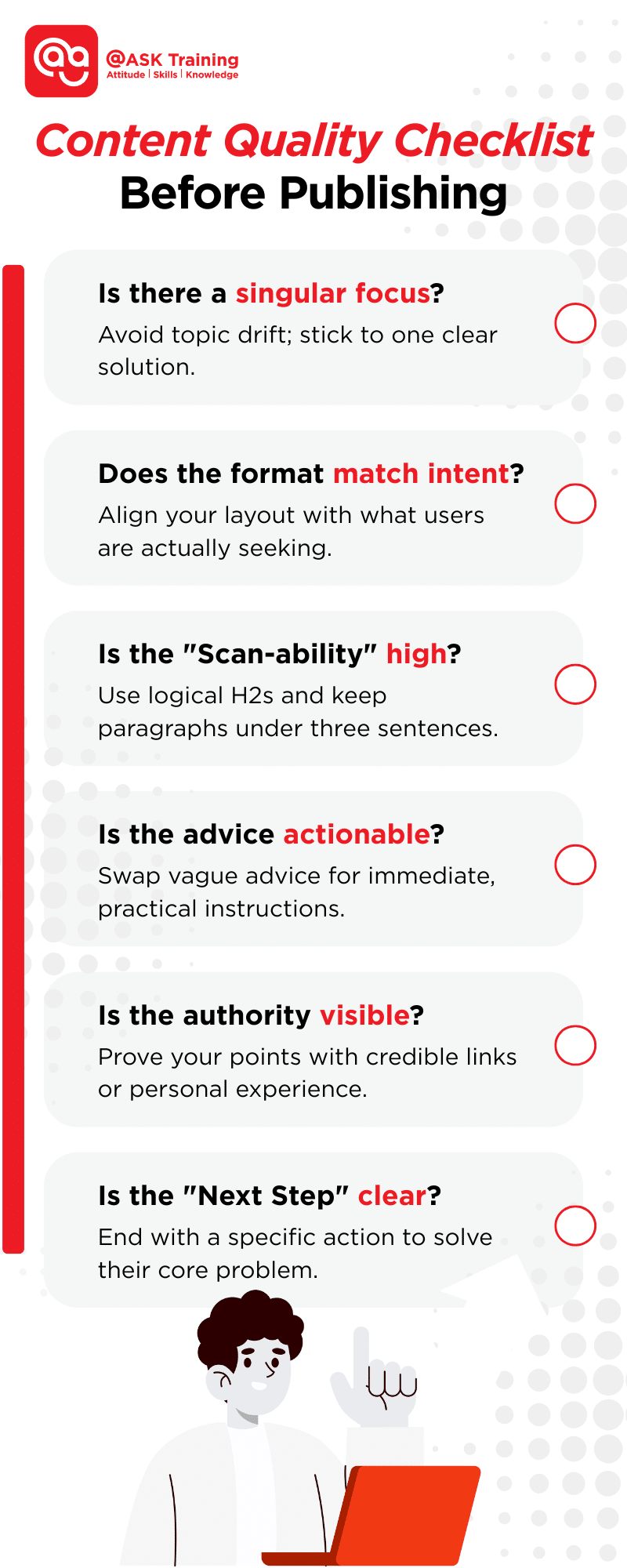
A Simple Content Quality Checklist Before You Publish
Before hitting that “Publish” button, you must audit your work against a professional standard. This content quality checklist ensures that your article isn’t just finished, but is strategically ready to perform.
Run through these six points to verify your draft:
Why Most Content Fails (Even When It Looks Polished)
It is a common frustration for writers like you and me. You’ve written a “beautiful” article with perfect grammar and sophisticated vocabulary, yet it fails to rank or engage.
In the world of professional content writing, “polished” does not always mean “effective.” Most content fails because it lacks the underlying bones of a content writing framework.
The Four Most Common Failure Points
1. The "A-Mile-Wide-and-an-Inch-Deep" Problem
Many articles try to cover too much. When you fail to isolate a specific problem, search engines struggle to categorise your page, and readers leave feeling overwhelmed rather than helped.
2. The Intent Mismatch
You might write a brilliant philosophical essay when the reader was actually looking for a "how-to" tutorial. If you ignore search intent in content writing, your bounce rate will remain high regardless of how good the prose is.
3. Structural Friction
Even the best insights are lost if they are buried in a "wall of text." Weak structure, long paragraphs and vague headings force the reader to work too hard to find the answer. Most will simply find a different article.
4. The "Echo Chamber" Effect
Repeating generic advice that is already available on a dozen other sites adds zero value. Without high-quality content examples or unique depth, your article becomes "digital noise."
By having a systematic framework, you move from “writing for the sake of writing” to “writing for results.” This approach prevents these common mistakes by ensuring every sentence is anchored in purpose, structure, and proof.
Wrapping Up
High-quality content is the result of a deliberate, step-by-step process that guides every decision from topic selection to final publication.
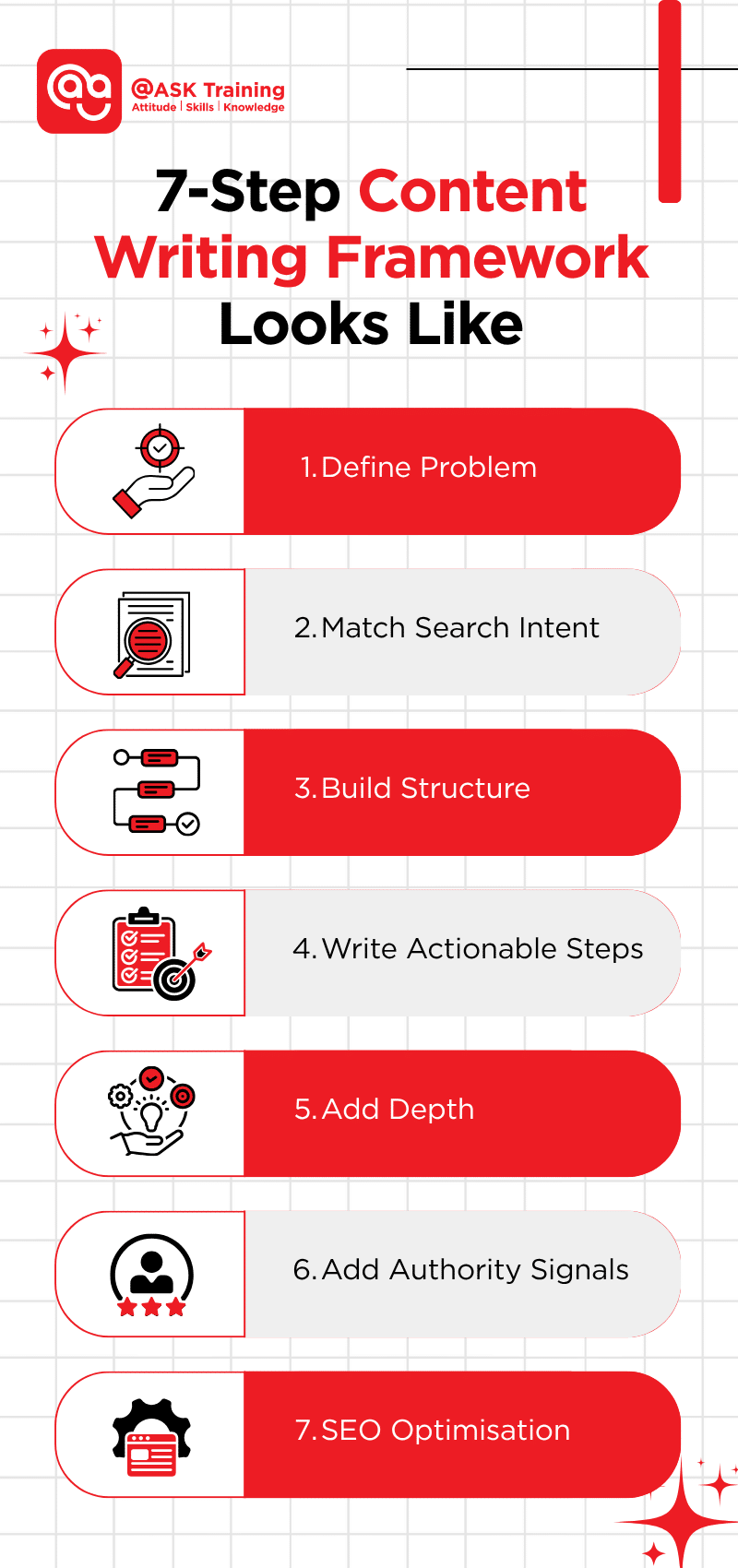
To recap, your path to ranking starts with this 7-step system:
- Define the exact problem to stay focused
- Match search intent to meet reader expectations
- Build a logical structure for maximum scannability
- Replace vague advice with actionable steps to provide immediate value
- Go deeper than competitors to eliminate fluff
- Add authority signals to build trust through E-E-A-T
- Optimise for SEO carefully while keeping the human reader first
When you follow this system consistently, the act of writing becomes significantly easier, and your articles become far more useful to your audience.
Before you publish your next piece, run through the content quality checklist provided in this guide to ensure no step has been overlooked.
Over time, this structured approach will help you produce content that is authoritative, clear, and far more likely to claim the top spot in search results.
Ready to Level Up Your Content Skills?
For those seeking structured, hands-on training beyond this framework, @ASK Training offers SkillsFuture-accredited courses in Digital Marketing, such as:
- (24 hrs) Copywriting & Contents Writing
- (24 hrs) Digital Content Creation
- (24 hrs) Search Engine Optimisation
Our courses are designed to help you apply these systematic writing approaches to real-world business contexts, ensuring your content doesn't just look polished, it delivers results.
Enrol with us today and start crafting articles that deliver measurable results!
Related Courses
◆◆◆
Related Articles
Article Topics
- What a Real Content Writing Framework Looks Like
- Define the Exact Problem You’re Solving
- Match Search Intent Before You Outline
- Build a Structure That Makes the Answer Easy to Find
- Replace Vague Advice With Clear, Actionable Steps
- Go Deeper Than Competitors Without Adding Fluff
- Add Authority Signals That Build Trust
- Optimise for SEO Without Compromising Readability
- A Simple Content Quality Checklist Before You Publish
- Why Most Content Fails
- Wrapping Up