
 You know that feeling. You're staring at a blank screen, wondering what to post today. You scroll through your feed for "inspiration," only to end up feeling more lost. You post something random, hope for the best, and then… crickets. If this sounds familiar, you're not alone. Most beginners approach social media this way. But there's a much better approach.
Social media planning is the difference between just posting and actually marketing. A plan transforms scattered effort into a system that builds your brand, saves you time, and gets real results.
Let's walk through a step-by-step framework you can apply this week, from setting goals to building a working content calendar.
Why a Content Plan Beats Random Posting
Posting without a plan comes with a hidden cost. Your brand voice becomes inconsistent, confusing your audience.
You waste precious time every day deciding what to post. And when something works, you can't replicate it because you don't know why it worked.
Planning isn't extra work; it's a time-saver. When you batch your content creation and follow a structure, you eliminate daily decision fatigue. You post with purpose, not panic.
Think of it this way: you wouldn't run a business without a budget. Why would you run your social media without a plan? A beginner social media strategy gives you direction, consistency, and a way to measure what's actually working.
Step 1: Set a Goal and Know Your Audience
Before you create a single post, ask yourself two questions:
- What is this content for? Awareness? Leads? Community building? Sales? Be specific.
- Who is it for? What does your ideal customer care about? What problems do they need solved?
This is the step beginners skip most often. And it's the most important one.
You don't need expensive market research to define your audience. Start with these simple approaches:
- Customer conversations: What questions do your current customers ask?
- Competitor audiences: Who follows your competitors, and what do they engage with?
- Platform insights: If you already have a presence, check your existing analytics for demographic data.
Once you know who you're talking to and why, everything else becomes easier. Your content pillars, platform choices, and posting schedule all flow from this foundation.
Step 2: Choose Your Content Pillars
Content pillars social media experts swear by are simple: they're 3–5 recurring themes that keep your content focused and easy to plan.
Think of them as the main categories your content will cover. For a small business, these might look like:
- Educational: Tips, how-tos, industry insights
- Behind-the-scenes: Your process, team, workspace
- Product/Service: What you offer and why it solves problems
- Community: Customer stories, user-generated content, Q&As
- Promotional: Special offers, events, launches
Here's a worked example for a Singapore-based bakery:
- Recipe tips (educational)
- Behind-the-scenes baking (BTS)
- Customer favourites (community)
- New menu announcements (promotional)
With pillars in place, you'll never stare at a blank screen again; you'll know exactly what categories to fill each week.
Step 3: Pick the Right Platforms (Don't Try to Be Everywhere)
This is where many beginners go wrong: they try to be everywhere at once. The result? They do a mediocre job on five platforms instead of a great job on one or two.
Here's a brief platform overview to help you choose:
| Platform | Best For |
| Visual storytelling, lifestyle brands, younger audiences | |
| TikTok | Short-form video, reaching Gen Z, viral potential |
| Community groups, older demographics, detailed targeting | |
| B2B, professional services, thought leadership |
As a beginner, focus on 1–2 platforms where your target audience actually spends their time. Master those before expanding. A focused social media posting schedule for beginners is far more effective than spreading yourself thin.
Want to dive deeper into platform-specific tactics? Our Beginner's Guide to Marketing on Facebook and Instagram in 2026 covers each platform in detail, from setting up business accounts to creating platform-optimised content.
Step 4: Build a Simple Content Calendar
Now it's time to put everything together. How to plan social media content comes down to one practical tool: a content calendar.
Start with a basic weekly structure. For example:
| Day | Content Theme |
| Monday | Educational post (tip or how-to) |
| Wednesday | Behind-the-scenes |
| Friday | Promotional or community highlight |
The key to consistency is batching. Set aside one block of time each week to plan and create multiple posts at once. Instead of scrambling daily, you'll have everything ready to go.
Here’s an example:
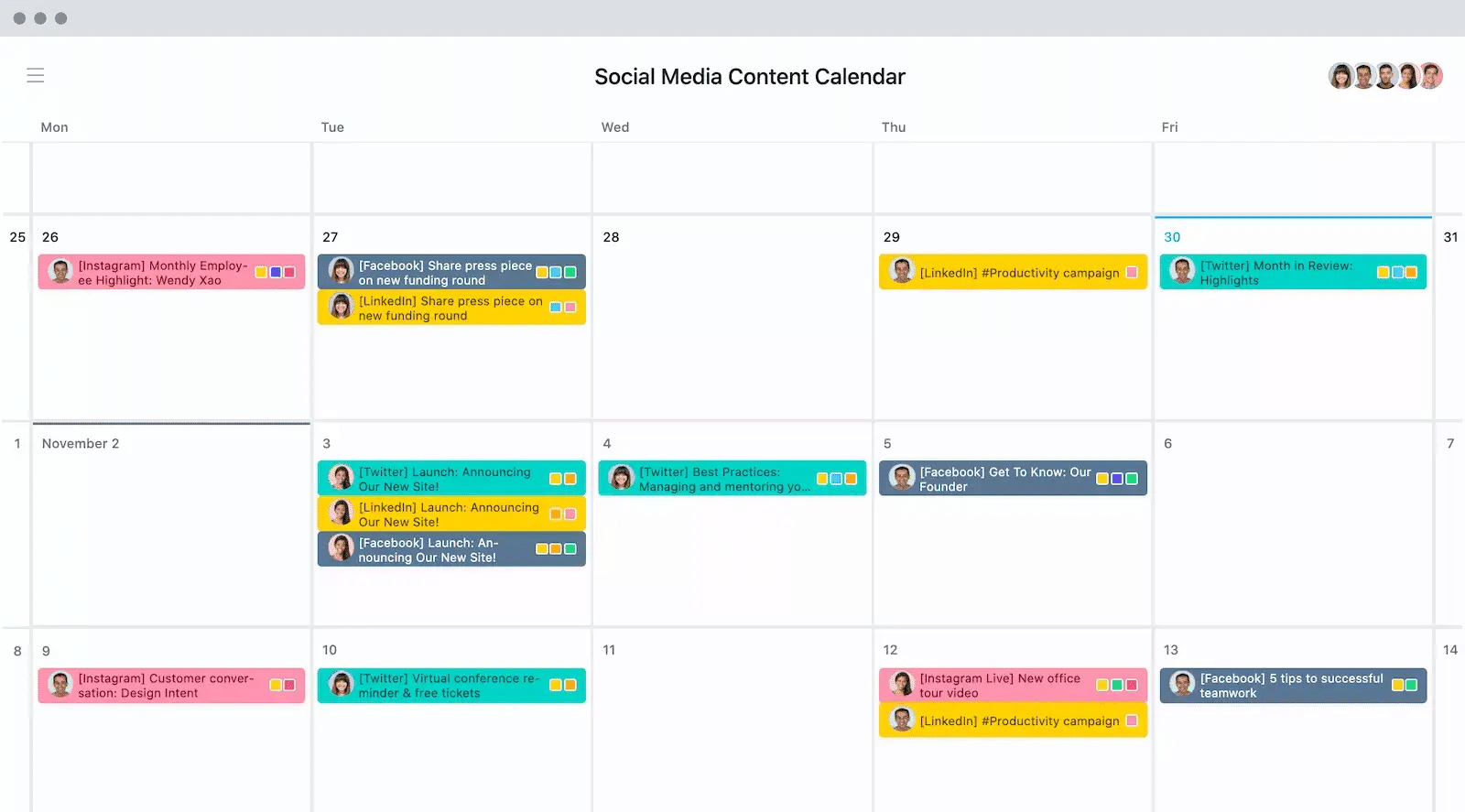
Example of Content Calendar (Source: Asana)
For tools, beginners can start with:
- Canva: Design visuals easily
- Meta Business Suite: Schedule Facebook and Instagram posts
- Notion orTrello: Build a simple calendar
- Google Sheets: Flexible template option
Your social media content calendar for beginners doesn't need to be fancy; it just needs to exist and be used.
Step 5: Plan for Engagement, Not Just Publishing
Here's a mistake many beginners make: they think the job is done when the post goes live. It's not.
A complete social media planning framework includes community management. Your audience expects you to respond to comments and DMs. Engagement signals to the algorithm that your content is valuable.
Build these simple habits:
- Set aside 15 minutes daily to reply to comments
- Monitor mentions and DMs
- Engage with similar accounts in your niche
When you respond to every comment, you turn passive followers into active community members. That's how you build real relationships and loyalty.
Step 6: Track a Few Simple Metrics
Don't overwhelm yourself with analytics. As a beginner, focus on these basic metrics:
| Metric | What It Tells You |
| Engagement rate | How much your audience interacts with your content |
| Reach | How many unique users saw your post |
| Follower growth | Whether your audience is expanding |
| Saves and shares | How valuable your content is to your audience |
Use these numbers to adjust your pillars and posting cadence over time. If educational posts get more saves, create more of them. If videos get more reach than photos, lean into video.
Measuring what matters helps you improve without getting lost in data.
Common Beginner Mistakes to Avoid
Learn from others' missteps:
- Posting without a clear goal: If you don't know why you're posting, neither will your audience.
- Jumping on trends with no relevance: Not every trend fits your brand. Authenticity beats chasing virality.
- Inconsistent posting: Irregular scheduling confuses followers and hurts algorithm performance.
- Ignoring comments and DMs: This signals you don't care about your audience.
- Trying to be on every platform at once: Start small, then expand.
Turning This into a Structured Skill
You've now got a solid beginner framework for planning and scheduling your social media content. But there's a difference between a self-taught approach and a professional, repeatable system.
While this article focuses on the planning and calendar system that sits on top of your content strategy, you might also want to explore the actual creation side, crafting the visuals, captions, and formats that bring your plan to life.
Our guide on Content Creation for Beginners: A Complete Guide for New Marketers covers that in detail, from choosing content formats to writing compelling copy.
And if you're ready to move beyond the basics, @ASK Training's (16hrs) Social Media Marketing course is your natural next step.
The course builds directly on the planning fundamentals covered here: content scheduling, audience engagement, community interaction, and KPI selection, all taught with hands-on application.
The course's 6-Step Social Media Marketing Framework turns theory into practice. You'll leave with a ready-to-implement social media strategy and the analytical proficiency to prove its success.
- Who it's for: Complete beginners with no prior social media marketing experience. That's you, the exact reader of this article.
- Funding: Eligible learners may receive up to 90% SkillsFuture (SWDA) subsidy, with SkillsFuture Credit usable on top. For example, Singapore Citizens ≥40 years old pay just S$114.30 (including GST) after 90% funding.
So where does that leave you? You've got the framework. You've seen how planning beats random posting.
The only question left is whether you'll keep figuring it out alone, or fast-track your progress with a structured, beginner-friendly course designed for people exactly where you are right now.
Wrapping Up: Your Next Step
A content plan turns random posting into a system. Start with goals, define your pillars, choose your platforms, build a calendar, plan for engagement, and track a few simple metrics.
But here's the most important tip: don't try to do everything at once.
Pick just one step: defining 3 content pillars, for example, and apply it this week. Small, consistent action beats a grand plan that never gets executed.
You've got the framework. Now it's time to build your system.
Ready to Go Deeper?
Explore our Digital Marketing courses at @ASK Training. Whether you're starting with social media marketing or building a broader digital marketing skill set, our beginner-friendly courses give you the structured, certified training to take your skills further!
Related Courses
- (16hrs) Social Media Marketing
- (24hrs) Facebook and Instagram Marketing
- (24hrs) Digital Content Creation
- (16hrs) TikTok Marketing
◆◆◆
Related Articles
Article Topics
- Why a Content Plan Beats Random Posting
- Step 1: Set a Goal and Know Your Audience
- Step 2: Choose Your Content Pillars
- Step 3: Pick the Right Platforms (Don't Try to Be Everywhere)
- Step 4: Build a Simple Content Calendar
- Step 5: Plan for Engagement, Not Just Publishing
- Step 6: Track a Few Simple Metrics
- Common Beginner Mistakes to Avoid
- Turning This into a Structured Skill
- Wrapping Up: Your Next Step