
You have a message to share, a brand to grow, or a career to build. But every time you sit down to create content, you draw a blank. What should I post? Where do I even begin?
If you’re asking, "How do I start learning content creation?”, you’re already on the right path. Have you ever felt that way? You’re not alone, and you do not need to be an expert to start.
Content creation has become one of the most valuable skills in modern digital marketing. For those exploring content marketing for beginners, it serves as the foundation for understanding how brands build visibility and engagement online.
Whether you are building a personal brand, growing a small business, or advancing your career, content drives online visibility, engagement, and trust.
From blog and social media posts to videos and email campaigns, effective content helps you connect with your audience, position yourself as an authority, and turn attention into measurable results.
This guide walks you through the exact steps to start learning content creation, from understanding your audience to building a strategy, creating content, and improving performance over time.
TL;DR – Key Takeaways for Busy Readers
- Start with clear goals and a deep understanding of your target audience.
- Choose content formats (blogs, video, social) based on your goals, not trends.
- Publish on 1–2 platforms where your audience actually spends time.
- Build a content calendar + workflow to publish consistently, not randomly.
- Learn basic SEO (keywords, headings, search intent) so people can find you.
- Use AI tools to draft faster, but always add your own human insight.
- Track performance (traffic, engagement, conversions) and refine over time.
- Structured courses compress months of trial-and-error into weeks.
Now let us dive into the details.
What is Content Creation and Why Does It Matter in Marketing
Before you write a headline or record a video, know this: content creation is the backbone of modern marketing.
What is Content Creation?
Developing and publishing digital material that informs, educates, entertains, or persuades a specific audience.
You probably encounter it daily:
- Blog posts
- Social media content
- Videos
- Infographics
- Email newsletters
Why this matters to you:
What makes content powerful is not the format, but the value it brings. Effective content answers real questions, solves problems, and helps your audience make better decisions.
In doing so, it builds trust, and trust drives customer action today.
In Singapore’s highly digital economy, content plays a central role in how businesses compete.
According to DataReportal, internet penetration in Singapore exceeded 98% by the end of 2025, reinforcing the importance of digital content in reaching and influencing consumers in a highly connected market.
Where content fits in marketing:
- Awareness: Helping people discover your brand through search or social media
- Consideration: Educating your audience with useful, in-depth information
- Conversion: Building confidence that leads to action
For those starting out, understanding the fundamentals of content creation for beginners is essential, as content is no longer optional; it underpins how modern digital marketing works.
Next up: Now that you know what content creation is, let us get clear on what you want it to achieve.
#1 Start With Clear Goals for Your Content
Here is a mistake many beginners make: They start creating without asking, “Why am I making this?”
Why this matters:
Without defined goals, your content becomes inconsistent. You might post regularly, but you will have no direction and no measurable results.
The rule to remember:
In digital marketing, content must serve a specific purpose. That purpose can change depending on your situation, but it must be intentional.
Common Content Goals
- Increasing brand awareness
- Driving traffic to a website or landing page
- Generating leads or enquiries
- Educating an audience to build trust
- Supporting sales or conversions
How Your Goal Shapes Everything
- Goal = website traffic → Write SEO articles targeting search queries like "how to start content creation"
- Goal = brand awareness → Short-form social media content on Instagram or LinkedIn
A Simple Goal-Setting Framework You Can Use Today
1. Define The Outcome
What do you want the content to achieve? (e.g. more website visits, more followers, more enquiries)
2. Identify The Audience Action
What should the reader or viewer do after consuming your content? (e.g. click a link, sign up, follow, download)
3. Choose The Success Metric
How will you measure performance? (e.g. traffic, engagement rate, conversion rate)
Example:
A small business owner in Singapore might set a goal to attract more local customers. They could create educational blog content that answers common questions about their service, helping them rank on search results and build trust before a customer even contacts them.
Bottom line:
When your goals are clear, your content becomes focused, measurable, and significantly more effective.
Next up: Goals are useless if you don’t know who you are talking to. Let us figure out your audience.
#2 Understand Your Target Audience Before Creating Content
Here is a hard truth: Content that is not tailored to a specific audience usually fails. It becomes generic. It does not capture attention. It does not inspire action.
Effective content only works when it resonates directly with the intended audience.
What you need to identify about your audience:
- Their demographics (age, profession, location, income level)
- Their goals and motivations
- Their pain points and challenges
- The type of content they consume regularly
- Where they spend time online
A common beginner mistake:
Avoid broad categories like "young professionals."
Do this instead:
Create specific profiles. For example: "Young marketing executives who want to improve their digital skills but have limited time for formal learning."
Why this level of detail matters:
When you know your audience this clearly, your content becomes:
- More relevant → Speaks directly to their needs
- More engaging → Feels personal, not generic
- More effective → Higher chances of clicks, shares, and conversions
Real-life example (Singapore home bakery)
The wrong approach:
Assuming the audience is "anyone who likes cakes." Too broad. Useless for content creation.
The right approach after research:
The bakery discovers their strongest audience segment is:
- Working professionals aged 25–40
- Living in Tanjong Pagar, Jurong, and Tampines
- Ordering cakes for birthdays and office events
- Active on Instagram and WhatsApp
- Motivated by convenience, quality, and aesthetics
What content can they now create?
- Instagram posts showcasing custom cake designs
- Short behind-the-scenes baking videos
- Posts about "last-minute birthday cake delivery in Singapore"
- Customer testimonials from corporate clients
The result? Engagement increases significantly because the content reflects what the audience actually cares about.
Why is This Step Critical? (Quick Recap)
Without audience understanding:
- Your content feels generic
- You guess what to post
- You waste time and energy
With audience understanding:
- You know exactly what to create
- Your message connects immediately
- You build trust faster
In short, audience understanding is the foundation of every successful content strategy. Without it, even the most creative content risks missing its mark.
Now that you know who you are talking to, let us figure out what format your content should take. Because different audiences prefer different ways of consuming information.
#3 Choose the Right Type of Content to Create
Not all content formats are created equal.
Different formats achieve different goals. Choosing the right one determines how effectively your message reaches and influences your audience.
The golden rule:
A strong content strategy is not about using every format available, but about matching the format to the intent, platform, and audience behaviour.
1. Written Content (Blogs, Articles)
Best for: SEO, thought leadership, structured education
Why it works: You can explore topics in depth, provide frameworks, and rank in search engines over time.
Real-life example:
A digital marketing trainer in Singapore publishes a blog titled "How SMEs in Singapore Can Start With SEO on a Limited Budget."
What happens next:
This content attracts organic traffic from business owners actively searching for solutions. Over time, the trainer becomes seen as an authority.
2. Video Content
Best for: Engagement, storytelling, demonstrations
Where it works best: YouTube, YouTube Shorts, TikTok, Instagram Reels, RedNote (Xiaohongshu)
Why it works:
Video captures attention quickly. It is especially useful for showing "how-to" processes that are difficult to explain in text alone.
Real-life example:
A software instructor creates a short video demonstrating how to set up a Google Ads campaign in 5 minutes.
Why viewers love it:
Instead of reading instructions, they watch each step. Easier to understand. Easier to remember.
3. Social Media Posts
Best for: Visibility, interaction, community engagement
What works: Concise, timely, and tailored content for LinkedIn, Facebook, Instagram, or TikTok
Real-life example:
A career coach posts on LinkedIn:
"One mistake I see junior marketers make in interviews: they talk about tools, not impact."
The result? Comments, shares, and discussion — not deep reading, but real engagement.
4. Infographics
Best for: Simplifying complex or data-heavy information
Why it works: Audiences quickly grasp comparisons, processes, or statistics without reading long explanations.
Real-life example:
A finance educator designs an infographic showing "The difference between CPF, SRS, and investment accounts in Singapore."
The payoff: Users understand key differences at a glance. No long article needed.
5. Experimentation and iteration
Here is what you should not do: Assume you already know what will perform best.
Why not?
Different audiences consume content differently. Some prefer detailed reading. Others respond better to short-form video or visual summaries.
A real scenario:
A content creator starts with articles. Later, they discover their audience engages far more with short videos on TikTok or discussion posts on LinkedIn.
What do they do? They reshape their entire content strategy based on that insight.
The mindset to adopt: Not perfection at the beginning. Continuous testing, learning, and refinement.
Over time, your content mix should evolve based on real audience behaviour, not assumptions.
You have chosen your format. Now, where do you put it? Different platforms serve different purposes. Let us find the right home for your content.
#4 Decide Where to Publish Your Content
Creating content is only half the job — distribution determines whether your content is seen, trusted, and acted upon.
Why this matters in Singapore:
We live in a highly connected, mobile-first environment. Choosing the right platform is a strategic decision that directly impacts your reach, engagement, and conversion outcomes.
Global research, including insights from Sprout Social, shows that social and video platforms are playing a growing role in content discovery and early-stage engagement. In Singapore, however, this trend operates within a hybrid decision-making model.
While social platforms capture attention, users often turn to search engines and long-form content to validate information before making decisions. This is especially true in high-stakes areas such as finance, education, and professional services.
Three Platform Roles
1. Discovery → Social And Short-Form Platforms
Best for: Visibility, awareness, initial engagement
Examples: Instagram, TikTok, LinkedIn
Real-life example (Singapore fitness coach):
A trainer shares short workout tips on TikTok. These videos reach busy professionals who were not actively searching for fitness solutions, but become interested after exposure.
Why this works: You reach people before they know they need you.
2. Evaluation → Search And Long-Form Platforms
Best for: In-depth learning, comparison, credibility check
Examples: Google, YouTube
Real-life example:
After discovering a course on LinkedIn, a user searches Google for reviews. Then they watch YouTube videos explaining the course content. Only then do they decide whether to enrol.
Why this works:
Singapore users especially value research before committing. They do not decide on the first click.
3. Conversion → Direct And Owned Channels
Best for: Final decision-making, personalised communication
Examples: Email, website, WhatsApp
Real-life example:
A career coach offers a free downloadable guide. Visitors sign up via email. Over several weeks, subscribers receive structured guidance. Eventually, some convert into paid clients.
Why this works:
Direct channels give you control. You are not at the mercy of algorithm changes.
How to Choose Your Platforms
Rather than trying to be present everywhere, focus on platforms that align with your audience and objectives:
- Professionals / B2B: LinkedIn + blog or email
- Lifestyle / F&B / retail: Instagram + short-form video
- Educators / trainers: YouTube + email + SEO-driven blog
- Service providers: Search (via Google) + content marketing + lead capture
Start Focused, Then Scale Strategically
A common beginner mistake: Trying to manage multiple platforms from day one.
Why that fails: You spread yourself thin. Quality drops. You burn out.
A better approach: Start with one or two core platforms. Build a repeatable content system. Then expand through content repurposing.
Examples of repurposing:
- Turn a LinkedIn post into an article
- Convert a blog into a YouTube video
- Break a video into short-form clips for Instagram or TikTok
Key Takeaway
Effective content distribution is not about being everywhere.
It is about aligning each platform with its strongest role in the customer journey:
- Social platforms → discovery
- Search and long-form content → trust
- Direct channels → conversion
Success comes from integrating these channels into a cohesive system, and refining your approach based on real audience behaviour.
Now, how do you stop posting randomly and start posting with purpose? Let us build a content strategy and plan ahead.
#5 Build a Content Strategy and Plan Ahead
Here is what happens without a plan:
Inconsistency. Duplicated effort. Weak results. Random posting.
Here is what a plan gives you:
Every piece of content serves a purpose. Every post contributes to a larger marketing objective.
A content strategy for beginners is essentially a roadmap that connects your goals, audience insights, and content ideas into a clear, repeatable system.
At a minimum, your content strategy should define:
- Content goals (what you want to achieve)
- Target audience (who you are speaking to)
- Content themes or topics (what you will talk about consistently)
- Formats (blog, video, social media, email)
- Distribution channels (where content will be published)
- Publishing frequency (how often you post)
Without these elements, content tends to be reactive — created only when there is time or inspiration — which makes it difficult to build momentum or measure progress.
Turning Strategy into A Practical Plan
Once your strategy is defined, the next step is planning your content in advance.
The tool you need: A content calendar.
What a content calendar helps you do:
- Maintain consistency
- Balance different types of content
- Align content with campaigns, promotions, or seasonal trends
- Reduce last-minute stress
Example of a simple weekly plan:
- Monday: Educational article
- Wednesday: LinkedIn or Instagram post
- Friday: Short-form video
Real-life example: Singapore SME (service-based business)
A tuition centre in Singapore wants to attract more parents looking for secondary school maths support.
Instead of posting randomly, they build a simple strategy:
- Goal: Generate enquiries from parents
- Audience: Parents of secondary school students
- Content themes: Exam tips, study strategies, common mistakes
- Platforms: Blog + Facebook
- Frequency: 2–3 posts per week
Planned content calendar:
- Week 1: "Top 5 Mistakes Students Make in Algebra" (blog)
- Week 1: Short tip post summarising key mistakes (Facebook)
- Week 2: "How to Prepare for O-Level Maths Effectively" (blog)
By planning ahead, the centre ensures all content consistently supports its goal, attracting and educating parents before converting them into enquiries.
Real-life example: Individual content creator
A beginner who wants to learn content marketing and build a personal brand on LinkedIn may create a simple monthly plan:
- Goal: Build authority and grow followers
- Audience: Early-career professionals
- Content themes: Marketing tips, career insights, learning journey
- Frequency: 3 posts per week
Content plan:
- Monday: Educational post (marketing concept)
- Wednesday: Personal insight or lesson learned
- Friday: Practical tip or tool recommendation
Over time, this consistency helps the creator build credibility and visibility, something that random posting cannot achieve.
Why Planning Matters
When you plan ahead, you:
- Create more thoughtful, higher-quality content
- Ensure alignment with your overall marketing goals
- Maintain consistency, which builds audience trust
- Save time by batching content creation
Most importantly, it shifts your approach from reactive to strategic, which is what separates beginners from effective content creators.
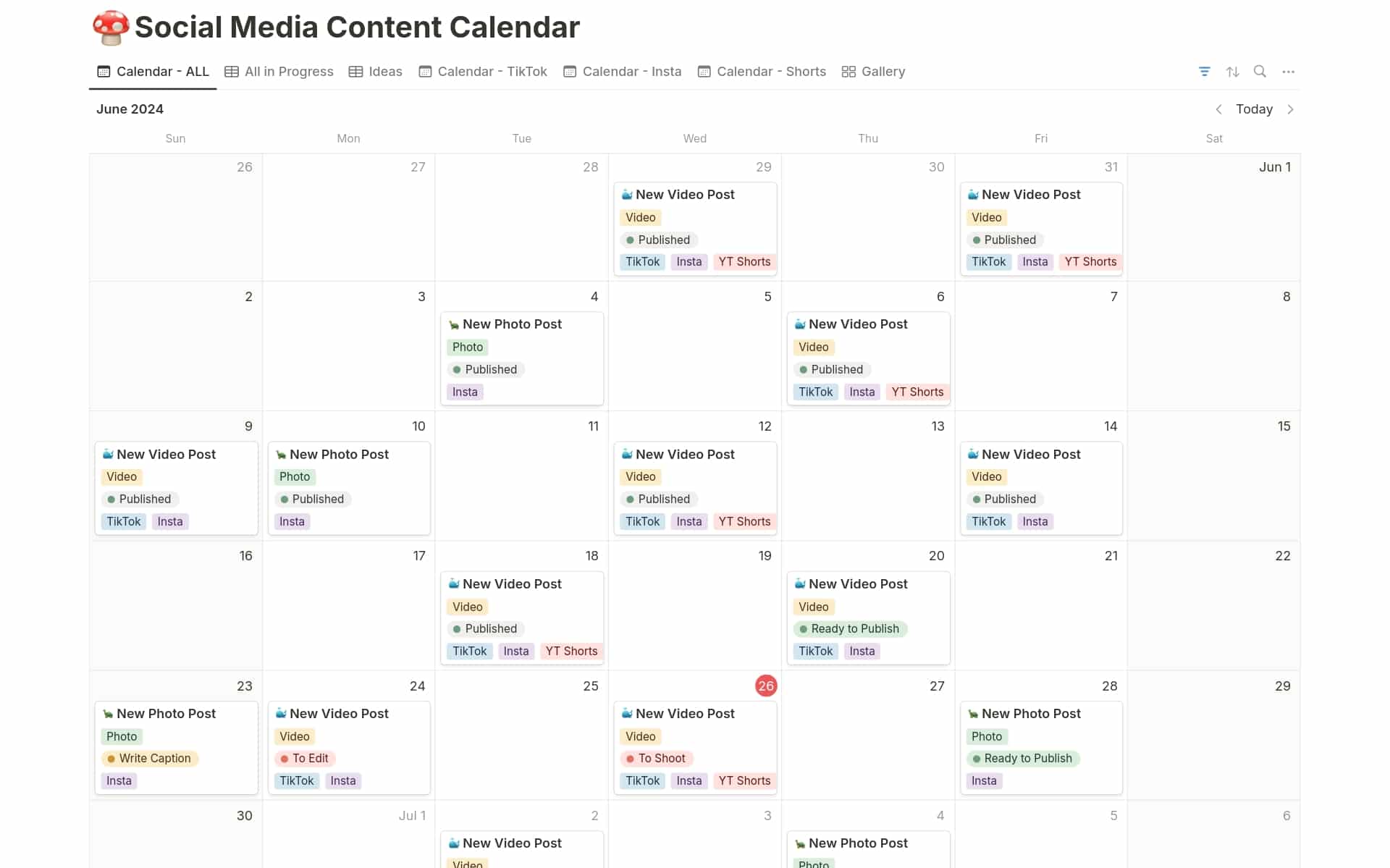
Content Calendar Example (Source: Notion)
A strategy and calendar give you direction, but you also need a repeatable workflow, the step-by-step process that turns an idea into a published post without wasting time.
#6 Build a Content Creation Workflow to Save Time
A content workflow is the step-by-step process you follow to turn an idea into a published asset. Without a workflow, beginners waste time deciding what to do next at every stage.
A simple 5-step workflow for beginners includes:
- Idea Backlog: Keep a running list of topics based on audience questions.
- Brief Creation: Define the goal, format, and keywords for one piece.
- Drafting: Write or record the raw content without over-editing.
- Review & SEO: Check for clarity, add headings, and insert keywords naturally.
- Schedule & Publish: Load the content into your calendar with a specific date.
Real-life example:
A Singapore freelance writer uses a Trello board with three columns: Ideas, Writing, and Published. Every Monday, they move one card from Ideas to Writing. By Friday, it moves to Published. This simple content workflow prevents procrastination and ensures weekly output without stress.
Pair this workflow with a content calendar (using Google Sheets or Notion) to visualise what goes live when. The calendar stops you from posting three blogs in one day and nothing for the next two weeks.
With a workflow and calendar in place, you are ready to create content. But if no one can find it, all that effort goes to waste. That is where SEO comes in.
#7 Learn the Fundamentals of SEO for Content
You can create the most valuable content in the world. But if people cannot find it, it might as well not exist.
That is where SEO comes in.
SEO (Search Engine Optimisation) is the process of improving your content so it appears in search results when users look for information.
Good news for beginners:
You do not need technical expertise. You just need to understand how people search — and create content that answers their questions.
At its core, SEO for content focuses on three key areas:
- Relevance — Does your content match what users are searching for?
- Structure — Is your content organised in a way that search engines can understand?
- Quality — Does your content provide clear, useful, and trustworthy information?
1. Start with search intent
Search intent refers to the reason behind a user’s search.
For example:
- “What is content creation?” → informational intent
- “Best content marketing course Singapore” → commercial intent
- “Sign up for content course” → transactional intent
When your content matches the user’s intent, it is more likely to rank well and keep readers engaged.
2. Use keywords naturally
Keywords are the phrases people type into search engines.
Instead of forcing keywords into your content, focus on:
- Using them in headings
- Including them naturally in your introduction
- Writing in a way that directly answers the query
For example, targeting a query like how do I start learning content creation works best when your article clearly and directly answers that question, not when the keyword is repeated excessively.
3. Structure your content for readability
Search engines favour content that is easy to read and navigate.
Use:
- Clear headings (H2, H3)
- Short paragraphs
- Bullet points where appropriate
- Logical flow between sections
This not only helps SEO but also improves user experience.
4. Optimise titles and headings
Your title is one of the most important SEO elements.
A strong title should:
- Reflect what the user is searching for
- Be clear and specific
- Avoid vague or overly creative phrasing
For example:
- Weak: “A Guide to Content”
- Strong: “How to Start Learning Content Creation: A Beginner’s Guide”
Real-life example
Imagine a freelance marketer in Singapore who wants to attract clients by writing blog content.
Instead of writing a general article like “Marketing Tips for Businesses”, they take an SEO-focused approach:
Step 1: Identify a search query
They notice people are searching for “how to promote small business in Singapore.”
Step 2: Create targeted content
They write a blog titled:
“How to Promote a Small Business in Singapore: A Step-by-Step Guide”
Step 3: Structure the article
- Introduction, answering the query directly
- Sections on social media, SEO, and paid ads
- Practical examples relevant to Singapore businesses
Step 4: Optimise readability
Clear headings, bullet points, and actionable advice
As a result, their content is more likely to rank on search engines and attract business owners actively looking for solutions, increasing both traffic and potential client enquiries.
Why SEO matters for beginners
For those starting out, SEO is one of the most powerful ways to generate consistent, long-term results.
Unlike social media posts that have a short lifespan, SEO-driven content can:
- Attract traffic over time
- Reach users actively searching for solutions
- Build authority and credibility
By understanding these fundamentals early, you set a strong foundation for creating content that is not only valuable but also discoverable.
You know how to make content findable. Now, how do you create it faster and better? Let us talk about tools and AI.
#8 Use Tools and AI to Improve Content Creation
Content creation today is no longer a purely manual process. Modern tools — especially those powered by AI — can help you work faster, generate ideas more efficiently, and improve the overall quality of your content.
However, the goal is not to rely entirely on tools, but to use them strategically. The most effective content creators combine technology with human judgment, creativity, and audience understanding.
At a practical level, content creation tools fall into four main categories:
1. Writing Assistants
Writing tools help you generate ideas, draft content, improve clarity, and refine tone.
Common use cases:
- Generating blog outlines
- Rewriting sentences for clarity
- Checking grammar and readability
- Adapting tone for different audiences
Examples include:
- Grammarly — improves grammar, clarity, and tone
- ChatGPT — useful for brainstorming ideas, drafting, and structuring content
- Jasper — designed for marketing-focused content creation
How beginners should use this:
Start by using writing assistants to create a first draft, then refine it with your own insights to ensure it remains authentic and relevant.
2. Keyword Research Tools
Keyword tools help you understand what your audience is searching for, which is essential for SEO-driven content.
They allow you to:
- Discover search queries
- Identify keyword popularity
- Understand competition levels
- Generate content ideas based on real demand
Examples include:
- Google Keyword Planner — a free tool for basic keyword research
- Ubersuggest — beginner-friendly keyword insights
- Ahrefs — an advanced tool for keyword and competitor analysis
Practical example:
A Singapore-based fitness coach might use these tools to discover searches like “home workout Singapore” or “beginner fitness plan,” then create content around those topics.
3. Video Editing Software
Video content continues to grow in importance, especially on platforms like Instagram, TikTok, and YouTube.
Video editing tools help you:
- Trim and organise clips
- Add captions and subtitles
- Include music, transitions, and effects
- Optimise videos for different platforms
Examples include:
- CapCut — popular for short-form video editing
- Adobe Premiere Pro — advanced editing for high-quality production
- Canva — beginner-friendly for simple video content
How beginners should use this:
Start with simple edits and short-form videos. Focus on clarity and messaging rather than complex effects.
4. Analytics Platforms
Analytics tools help you measure performance and understand what is working.
They allow you to track:
- Website traffic
- User behaviour
- Engagement rates
- Conversion performance
Examples include:
- Google Analytics — tracks website traffic and user behaviour
- Google Search Console — monitors search visibility and keyword performance
- Meta Business Suite — tracks Facebook and Instagram performance
Practical example:
A small business owner in Singapore may notice that blog posts drive more website traffic, while Instagram videos generate higher engagement — helping them refine their content strategy accordingly.
How AI fits into modern content workflows
AI is increasingly embedded across all these tools. It can help you:
- Generate content ideas quickly
- Draft articles or captions
- Suggest keywords and topics
- Analyse performance trends
This is why understanding content creation tools and AI is becoming essential for beginners.
However, AI should support, not replace, your thinking. The most effective content still comes from:
- Real audience understanding
- Clear messaging
- Relevant, practical insights
Key takeaway
Tools can significantly improve your efficiency and output quality, but they are only as effective as the strategy behind them.
Start simple:
- Use writing tools to draft
- Use keyword tools to guide topics
- Use editing tools to enhance content
- Use analytics to improve over time
As you gain experience, you can expand your toolkit — but the fundamentals of good content remain the same.
#9 Maintain Consistency and a Strong Brand Voice
Consistency is one of the most important but underestimated drivers of content performance. In Singapore’s highly saturated digital environment, audiences are constantly exposed to content across multiple platforms.
Trust is not built through a single post, but through repeated and recognisable patterns over time.
A consistent brand presence helps your audience quickly understand:
- who you are,
- what you stand for,
- and why they should pay attention to your content.
1. Consistency Builds Recognition And Trust
When you post regularly and keep your tone and message consistent, your audience can quickly recognise and understand your content. Over time, they begin to associate your style, opinions, and visuals with your brand.
Real-life example:
A Singapore-based career coach posts weekly LinkedIn insights on job search strategy. Even without seeing the name, followers begin to recognise the structure: short hook, practical advice, and a reflective closing.
This consistency leads to higher engagement and stronger personal branding over time.
2. Maintain A Predictable Publishing Rhythm
A regular publishing schedule signals reliability and professionalism. It does not need to be daily — but it must be sustainable and consistent.
In practice:
- 2–3 posts per week on LinkedIn for B2B professionals
- 3–5 short-form videos per week on Instagram or TikTok for consumer-facing brands
- 1–2 long-form videos per month on YouTube for education-focused creators
Real-life example:
A Singapore tuition centre consistently posts study tips every Monday and Friday on Instagram. Parents and students begin to anticipate the posts, which improves repeat engagement and saves/shares.
3. Maintain A Consistent Tone Across Platforms
Your tone of voice is a core part of your brand identity. Whether you are:
- professional and analytical
- conversational and relatable
- or educational and structured
…it should remain recognisable even when adapted for different platforms.
Real-life example:
A fintech educator in Singapore uses a “simple, no-jargon explanation” style across LinkedIn posts, articles, and YouTube videos. Even when the content format changes, the tone remains consistent, reinforcing authority and approachability.
4. Align Visuals, Messaging, And Positioning
Consistency is not just about writing style — it also includes:
- visual identity (colours, templates, formatting)
- content themes (what you repeatedly talk about)
- positioning (what you are known for)
Real-life example:
A Singapore lifestyle brand consistently uses minimal, clean visuals with muted colours across Instagram and its website. This makes its content instantly recognisable even before users read the caption.
5. Cross-Platform Consistency (Without Duplication)
In Singapore’s multi-platform ecosystem, audiences often encounter the same brand across different channels.
The goal is not to copy-paste content, but to maintain a unified voice while adapting format:
- LinkedIn → insight-driven commentary
- Instagram → visual storytelling
- YouTube → in-depth explanations
- Blog → structured SEO content
Real-life example:
A Singapore HR consultancy publishes a LinkedIn post on hiring trends, expands it into a blog article with data, and then creates a short Instagram Reel summarising key insights — all maintaining the same core message and tone.
6. Why Consistency Compounds Over Time
Consistency creates a compounding effect:
- early stage: low visibility, experimentation
- mid stage: recognition begins to form
- long term: audience trust and recall increase significantly
At this stage, audiences no longer evaluate each piece of content in isolation — they recognise the brand behind the content, which significantly increases engagement and conversion likelihood.
Key takeaway
In a crowded digital space, consistency is not repetition, it is structured repetition with intent. A strong, consistent brand voice ensures that every piece of content reinforces your identity, builds familiarity, and strengthens trust over time.
#10 Track Content Performance and Improve Over Time
Content creation should not be treated as a one-off activity, it is an iterative process of continuous improvement.
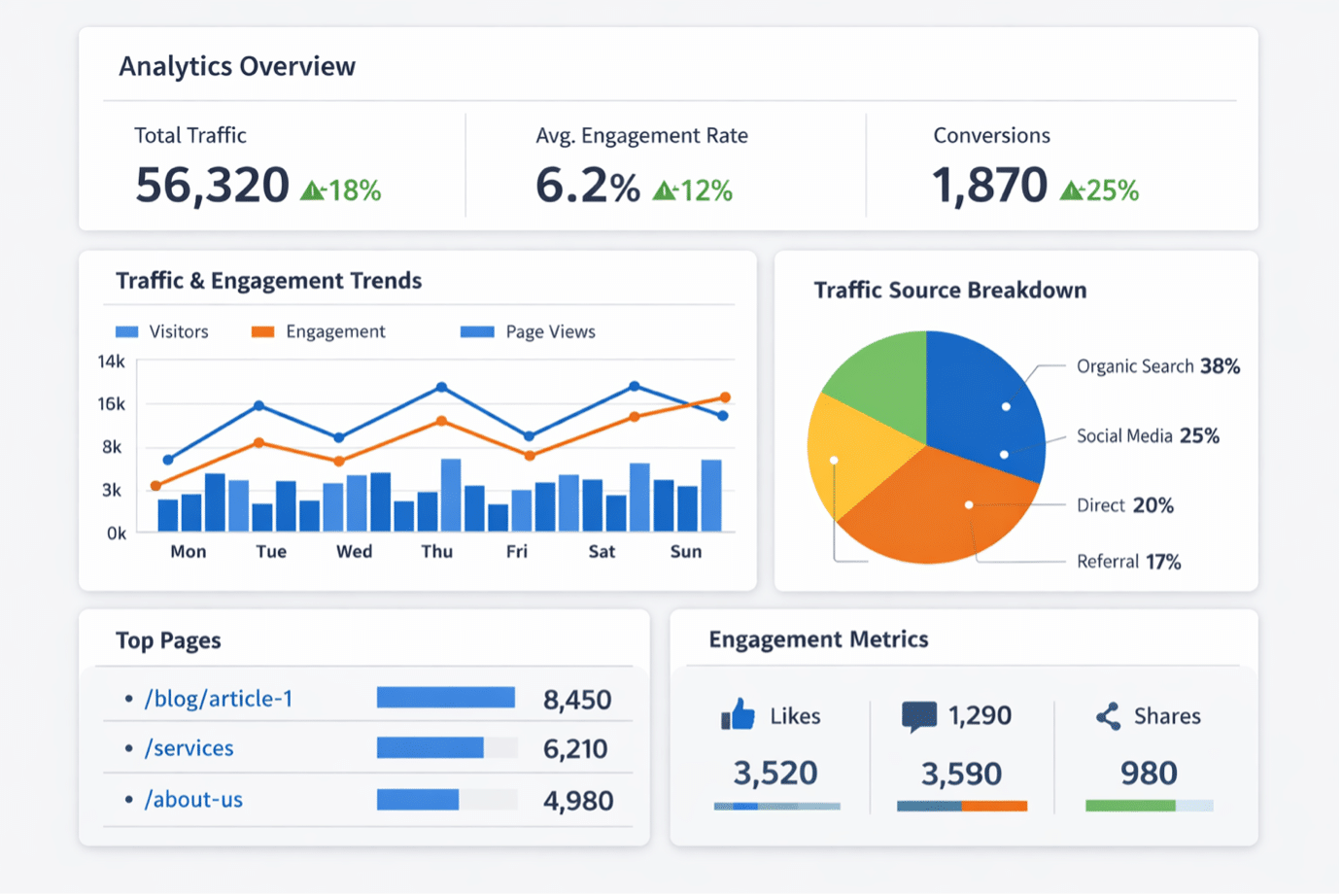
In today’s competitive digital environment, where audiences are highly active across multiple platforms, performance tracking is essential to ensure your content remains relevant, effective, and aligned with audience behaviour.
1. Focus On The Right Performance Metrics
To understand whether your content is working, you need to track metrics that reflect both visibility and impact, not just vanity numbers.
Key metrics include:
- Website traffic → how many users are discovering your content via search or referrals
- Engagement rates → likes, comments, shares, saves (indicates relevance and resonance)
- Click-through rates (CTR) → measure how effectively your content drives action
- Conversions → sign-ups, enquiries, purchases, or any defined business outcome
Real-life example:
A Singapore-based training provider notices that blog posts generate high traffic but low sign-ups. This indicates strong SEO performance but weak conversion messaging, prompting them to refine their call-to-action strategy.
2. Use Platform Analytics Tools Effectively
Most marketers rely on a combination of analytics tools to monitor performance across channels:
- Google Analytics → tracks website behaviour, traffic sources, and conversion funnels
- Built-in insights on platforms like LinkedIn, Instagram, and TikTok → measure reach, engagement, and audience demographics
- Email marketing dashboards → track open rates, click rates, and subscriber growth
Real-life example:
A Singapore consultant uses Google Analytics to discover that most traffic comes from LinkedIn posts rather than organic search. This insight shifts their strategy toward more LinkedIn-focused content production.
3. Identify Patterns, Not Just Individual Results
Isolated data points are less useful than trend analysis over time. The goal is to understand what consistently performs well across formats, topics, and platforms.
Look for patterns such as:
- Topics that consistently generate higher engagement
- Content formats that outperform others (e.g. video vs text)
- Posting times that result in higher visibility
- Platforms that drive the most qualified traffic
Real-life example:
A Singapore-based career coach notices that posts about interview preparation consistently outperform general career advice. They then shift their content strategy to focus more heavily on interview-related content.
4. Refine And Iterate Your Content Strategy
Once patterns are identified, the next step is optimisation. This may involve:
- Doubling down on high-performing content themes
- Adjusting tone or format based on engagement data
- Removing or redesigning underperforming content types
- Repurposing successful content across multiple platforms
Agility is a competitive advantage — the ability to adjust quickly based on data often matters more than initial perfection.
Key Takeaway
By continuously tracking performance using tools like Google Analytics and social platform insights, analysing behavioural patterns, and refining your approach, you gradually improve both reach and conversion outcomes over time.
You now know the entire process, from strategy to creation to measurement. But what is the fastest way to actually learn these skills without years of trial and error?
The Fastest Way to Learn Content Creation Skills
Content creation is a multidisciplinary capability that combines strategy, writing, SEO, visual communication, and platform management into a single integrated workflow.
At a practical level, it is not just about producing content, but about understanding how content functions across the entire digital ecosystem—from attracting attention to driving engagement and conversion.
The core skill areas include:
- Strategy – defining goals, audiences, and content direction
- Writing – developing clear, engaging, and persuasive messaging
- SEO – ensuring content is discoverable through search intent and optimisation
- Platform management – publishing and adapting content across digital channels
A common challenge for beginners exploring how to become a content creator is attempting to learn these areas separately, which often leads to fragmented understanding and slow progress.
A more effective approach is to learn content creation as a structured system, where each skill builds on the next in a clear sequence.
Self-learning through random tutorials can work, but structured training compresses the learning curve dramatically. Here is how a digital content course helps.
Learn Content Creation Through a Structured Digital Content Course
A structured digital content creation course replaces fragmented self-learning with a guided, end-to-end workflow.
Instead of learning strategy, writing, SEO, and analytics separately, a good course sequences each skill so one builds on the last.
Most programmes in Singapore include hands-on projects that let you immediately apply what you learn. This applied approach compresses months of trial-and-error into a structured pathway.
Structured learning vs self-learning:
- Self-learning (random tutorials) → fragmented knowledge, slow progress
- Structured course (hands-on projects) → integrated skills, faster job readiness
Build Your Skills with @ASK Training’s Content Creation Bundle
For learners who want a complete content education, the following courses work as a progressive system:
- (24hrs) Digital Content Creation: Plan, produce, and publish SEO-driven content using AI tools.
- (24hrs) Copywriting & Content Writing: Master persuasive, audience-first writing that converts readers.
- (16hrs) Video Marketing: Plan, shoot, and edit video content that earns attention across platforms.
Now that you have the complete roadmap, let us bring everything together with a clear summary.
Wrapping Up
Starting your content creation journey does not require perfection; it requires clear direction and consistent execution.
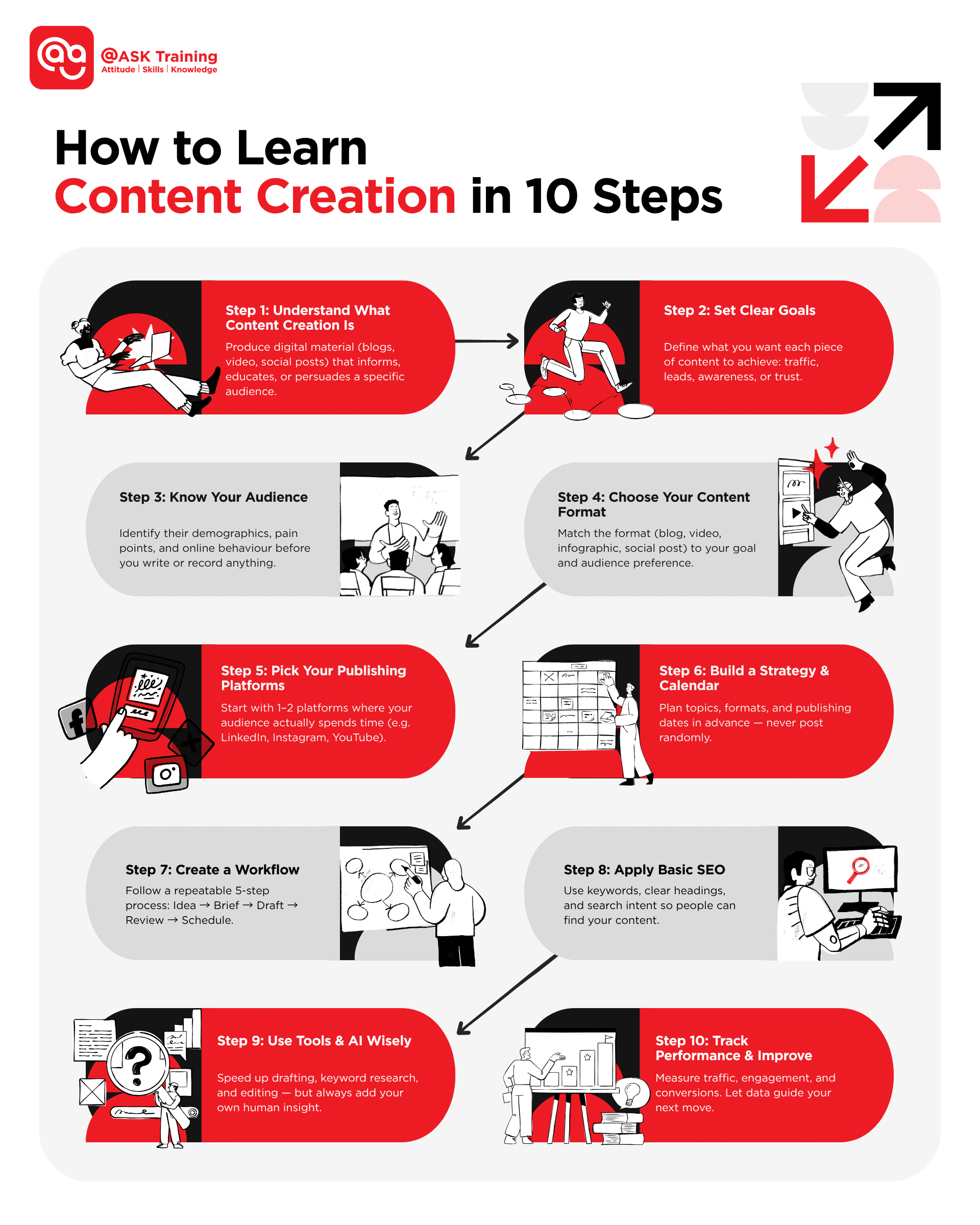
To summarise the key foundations you have learned in this guide:
- Understand your audience: Know their needs, challenges, and where they spend time online.
- Set clear goals: Define what you want each piece of content to achieve.
- Choose the right formats and platforms: Match your content type to your audience's preferences.
- Build a strategy, workflow, and calendar: Plan ahead so you publish with purpose, not randomness.
- Apply SEO fundamentals: Help people find your content through search.
- Use tools and AI wisely: Speed up your workflow without losing authenticity.
- Track performance and iterate: Let data guide your next move.
Save this to keep your flow in check:
Content creation improves through repetition, feedback, and continuous refinement. The most effective creators are not those who get it right immediately, but those who build systems to improve consistently.
Whichever path you choose, start today. Publish something. Learn from it. Then publish again. That is how every successful content creator began!
Related Courses
◆◆◆
Related Articles
Article Topics
- What is Content Creation
- #1 Start With Clear Goals for Your Content
- #2 Understand Your Target Audience
- #3 Choose the Right Type of Content to Create
- #4 Decide Where to Publish Your Content
- #5 Build a Content Strategy and Plan Ahead
- #6 Build a Content Creation Workflow to Save Time
- #7 Learn the Fundamentals of SEO for Content
- #8 Use Tools and AI to Improve Content Creation
- #9 Maintain Consistency and a Strong Brand Voice
- #10 Track Content Performance and Improve Over Time
- The Fastest Way to Learn Content Creation Skills
- Learn Content Creation Through a Structured Digital Content Course
- Wrapping Up