
Cybersecurity Doesn't Have to Be Overwhelming
Cybersecurity is one of the fastest-growing technology fields in the world, yet many aspiring learners delay getting started because they simply don't know where to begin.
It's easy to feel overwhelmed by the sheer number of certifications, specialisations, and technical terms. Many people assume they need advanced coding skills or years of IT experience before they can enrol in their first course.
The reality is much simpler.
Everyone starts somewhere. A well-designed cybersecurity course in Singapore should equip beginners with the foundational knowledge, practical skills, and confidence needed to understand today's digital threats before progressing to more advanced topics.
Whether you're a student exploring future career options, a fresh graduate looking to improve your employability, or a working professional considering a career change, cybersecurity offers opportunities at every stage of your career.
Building a solid foundation is far more valuable than jumping straight into advanced ethical hacking or penetration testing.
This handbook explains what cybersecurity really involves, what you should know before enrolling, the skills you'll develop as a beginner, and how a structured learning pathway can help you progress confidently.
You'll also discover how @ASK Training supports learners through practical, instructor-led courses designed to bridge the gap between theory and real-world application.
Who This Beginner's Handbook Is For
Is This Guide Right for You?
If you're interested in learning cybersecurity in Singapore, you've probably already started exploring course options or thinking about how cybersecurity could fit into your future career.
You may even be wondering:
- Where should I begin?
- Do I need programming experience?
- Which beginner course is right for me?
- Is cybersecurity all about hacking?
- What can I do after completing my first course?
These are some of the most common questions new learners ask, and they're exactly what this handbook is designed to answer.
This Handbook Is Designed For
This guide is suitable for anyone who wants a clear, practical introduction to cybersecurity before enrolling in a course. It is especially helpful if you are:
- Polytechnic or university students exploring cybersecurity as a potential career and looking for a cybersecurity course for students in Singapore that provides structured, hands-on learning.
- Fresh graduates looking to strengthen employability with in-demand digital skills.
- Early-career professionals looking to transition into IT or cybersecurity.
- Beginners preparing to enrol in their first cybersecurity programme.
- Learners comparing different cybersecurity training options before making a decision.
Do You Need an IT Background?
The good news is that you do not need to be an experienced IT professional before taking your first cybersecurity course.
While having basic computer literacy is helpful, beginner-level training is specifically designed to introduce fundamental concepts in a structured and approachable way.
Rather than expecting learners to understand complex network architecture or advanced programming, quality beginner courses focus on developing confidence through guided learning and practical exercises.
The National Institute of Standards and Technology (NIST) Cybersecurity Basics provides a useful overview of these foundational concepts.
Here’s why cybersecurity skills are worth investing in:
- Singapore's digital economy continues to expand rapidly, increasing demand for professionals who understand how to protect systems, data and organisations against evolving cyber threats.
- According to the Cyber Security Agency of Singapore (CSA), cyber resilience remains a national priority as businesses across every industry continue their digital transformation.
- For learners entering the workforce today, cybersecurity knowledge is becoming valuable not only for specialist roles but also across IT support, cloud computing, software development, digital operations, finance, healthcare and even marketing.
What Cybersecurity Actually Involves
Forget the Hollywood image of hackers in hoodies. Real-world cybersecurity is much broader, more practical, and far less dramatic.
At its core, cybersecurity is about protecting people, systems, devices, applications and information from cyber threats that can disrupt operations or compromise sensitive data. It's about safeguarding the confidentiality, integrity, and availability of information.
According to the National Institute of Standards and Technology (NIST) Cybersecurity Basics, cybersecurity combines technology, processes and people to reduce cyber risks while protecting the confidentiality, integrity and availability of information.
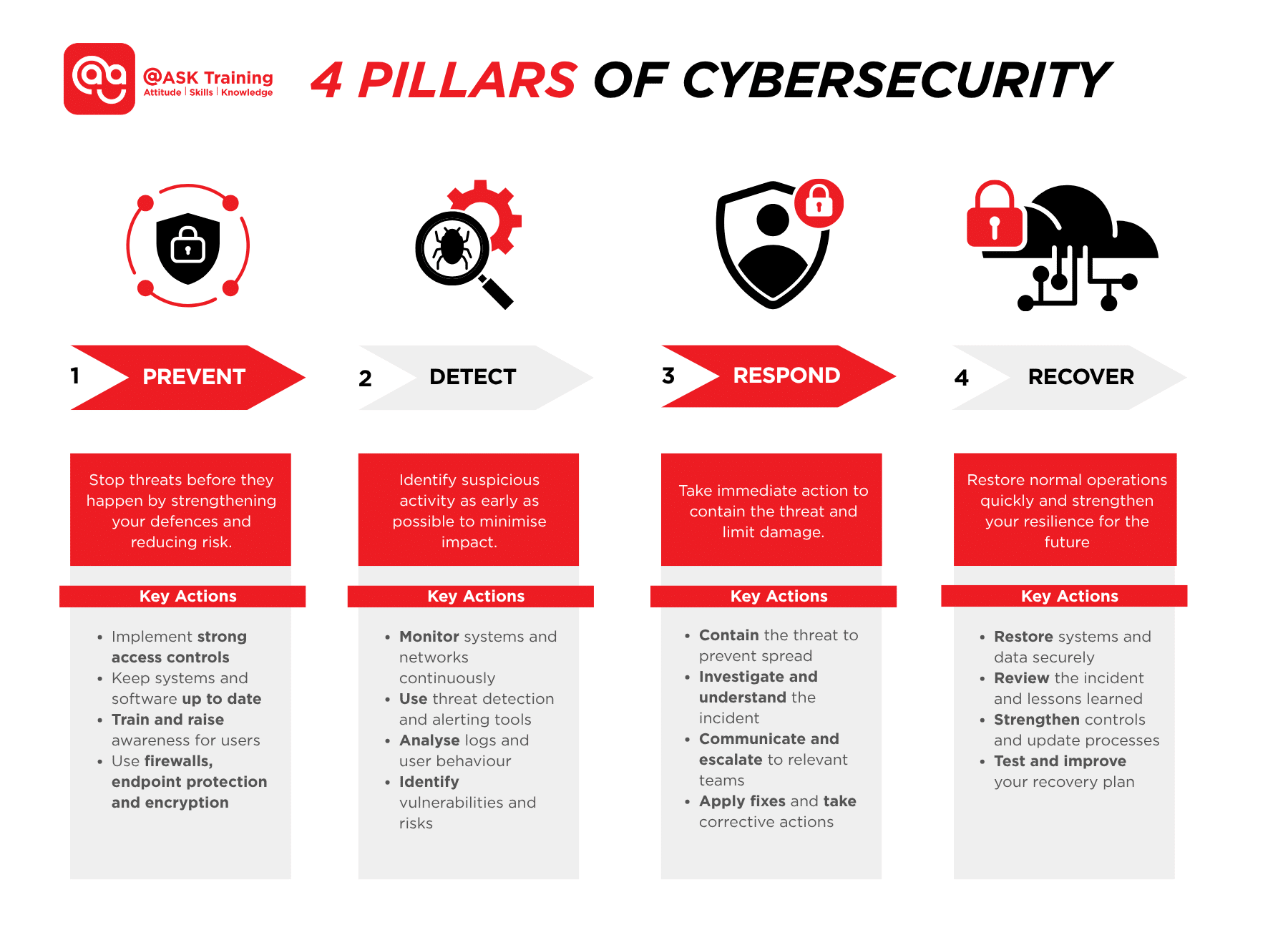
Cybersecurity professionals work to:
- Prevent cyber-attacks before they happen.
- Detect suspicious activity quickly.
- Respond effectively when incidents occur.
- Reduce future risks through continuous improvement.
This means cybersecurity involves much more than simply "stopping hackers."
Common examples include:
1. Phishing Attacks
- Fraudulent emails, text messages or websites designed to trick users into revealing passwords, financial information or other sensitive data.
- Phishing remains one of the most common cyber threats because it exploits human behaviour rather than technical vulnerabilities.
Learn more from the Cyber Security Agency of Singapore (CSA) – Report a Phishing Email, which explains how to recognise phishing emails, what attackers are trying to steal, and the steps to take if you receive a suspicious message.
2. Malware
- Malicious software that can steal information, monitor activity, encrypt files or damage computer systems.
- Malware can spread through infected downloads, malicious email attachments or compromised websites.
The CISA Cybersecurity Best Practices provide guidance on protecting against common malware threats.
3. Ransomware
- A form of malware that encrypts an organisation's data until a ransom payment is demanded.
- Ransomware attacks can disrupt business operations and result in significant financial and reputational damage.
The CISA Stop Ransomware Initiative offers practical guidance on prevention and response.
4. Social Engineering
- Manipulating individuals into revealing confidential information by exploiting trust rather than technical weaknesses.
- Social engineering attacks often involve impersonation, urgency or deception to persuade users to take unsafe actions.
5. Weak Authentication
- Poor password practices or the absence of multi-factor authentication can significantly increase organisational risk.
- Using strong, unique passwords together with multi-factor authentication is one of the simplest and most effective ways to improve cybersecurity.
Network Vulnerabilities
- Misconfigured systems, outdated software and unsecured devices can all become entry points for attackers.
- Regular software updates, security patches and vulnerability management help reduce these risks.
Rather than focusing only on technical tools, cybersecurity professionals also help organisations develop safer processes, improve employee awareness, strengthen security policies and reduce human error.
For example, a phishing simulation exercise may reveal that employees frequently click suspicious email links. Instead of blaming users, cybersecurity teams improve awareness training, strengthen email filtering and implement additional authentication measures to reduce future risk.
Cybersecurity is more than stopping attacks. It also helps organisations manage risks, recover from incidents and become more resilient.
What You Should Know Before Your First Cybersecurity Course
One of the biggest misconceptions about cybersecurity is that beginners need extensive technical knowledge before attending their first class.
In reality, most introductory programmes are designed to build these foundations gradually.
Before starting your first course, it helps if you're comfortable with everyday digital activities such as:
- Using Windows or macOS.
- Managing files and folders.
- Installing software.
- Creating online accounts.
- Browsing the internet safely.
- Understanding basic email usage.
Having some awareness of common IT concepts can also make learning easier.
Examples include:
- Password managers.
- Cloud storage services.
- Wi-Fi and internet connections.
- Operating systems.
- Web browsers.
- Basic networking concepts such as IP addresses and routers.
Many beginners also worry about programming.
While coding becomes increasingly useful in specialised cybersecurity disciplines, it is rarely a prerequisite for introductory training.
Most beginner courses prioritise understanding cyber risks, security principles, common attack methods, and defensive techniques before introducing more technical skills later.
Learners should also set realistic expectations.
Cybersecurity is not something you master in a weekend course. Like learning a new language or musical instrument, it develops progressively through study, practice, and continuous learning.
A good beginner course provides a strong foundation—not instant expertise.
Quick Tip
Before your course begins, try identifying examples of cybersecurity in your daily life. Look out for suspicious emails, two-factor authentication prompts, password strength indicators, software updates, or browser security warnings. You'll begin recognising concepts that your course will later explain in greater depth.
The Core Skills You Will Build as a Beginner
A beginner cybersecurity course in Singapore is designed to build a strong foundation, not turn you into an expert overnight.
You'll learn the essential concepts, practical skills, and security mindset needed to identify cyber threats, protect digital assets, and apply cybersecurity best practices with confidence.
If you're searching for cybersecurity training in Singapore, you can expect your first course to combine theory with hands-on learning.
These foundational skills will also prepare you for more advanced areas such as ethical hacking, cloud security, and IT security as you progress.
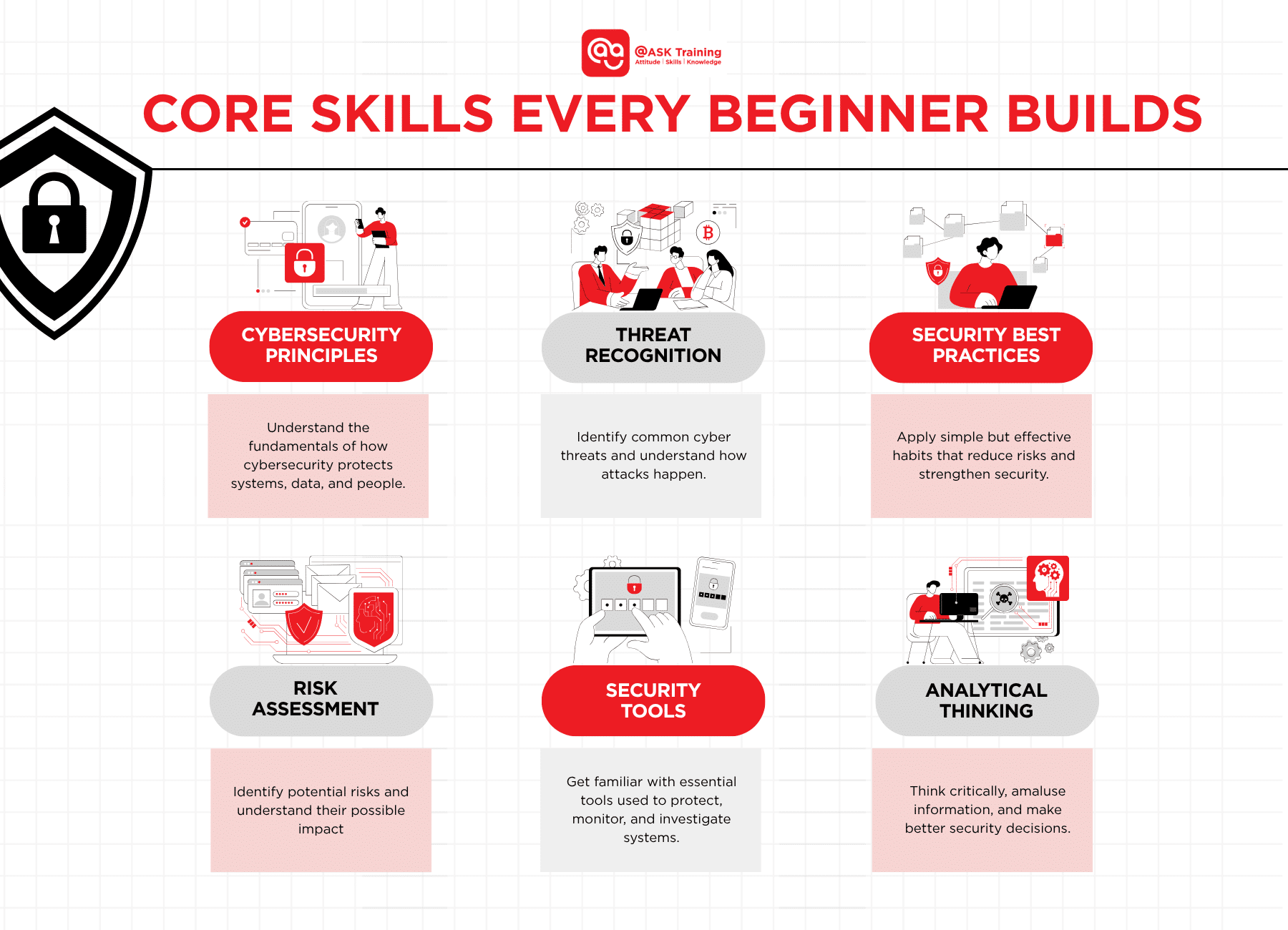
Here are the core skills you will develop:
1. Understanding Cybersecurity Principles
- Learn why organisations implement security controls, how cyber-attacks occur, and the different strategies used to reduce digital risks.
- In addition to understanding technical terminology, you'll also learn how these concepts apply in real-world business environments.
2. Recognising Common Cyber Threats
- Learn how to identify phishing attempts, malware behaviour, suspicious websites, weak passwords, and common social engineering techniques.
- These skills are valuable not only in the workplace but also in protecting your own digital life.
3. Learning Security Best Practices
Beginner learners develop good habits such as:
- Creating stronger passwords.
- Using multi-factor authentication.
- Updating software promptly.
- Protecting sensitive information.
- Securing devices.
- Recognising suspicious online behaviour.
4. Understanding Vulnerabilities, Risk and Security Tools
- Every organisation has vulnerabilities that could be exploited by cybercriminals if left unaddressed.
- A beginner cybersecurity course introduces you to the process of identifying common security weaknesses, understanding the risks they pose and learning how organisations prioritise and reduce those risks.
- You'll also become familiar with the role of common security tools used to monitor systems, identify vulnerabilities and investigate suspicious activity.
5. Developing Analytical Thinking
- Perhaps the most valuable skill isn't technical at all.
- Cybersecurity professionals constantly analyse information, investigate unusual activity, ask questions, and solve problems logically.
- Developing this investigative mindset is just as important as learning any individual security tool.
As you progress, these core skills become the building blocks for more advanced areas such as ethical hacking, incident response, digital forensics, cloud security, and security operations.
Why Hands-On Practice Matters in Cybersecurity
Cybersecurity is a practical discipline. While understanding concepts is important, the best way to build confidence is by applying what you've learnt in a safe, guided environment.
A well-designed beginner course should give you opportunities to put theory into practice through hands-on exercises.
This helps you understand how cyber threats work, how security tools are used and how to respond to common security scenarios.
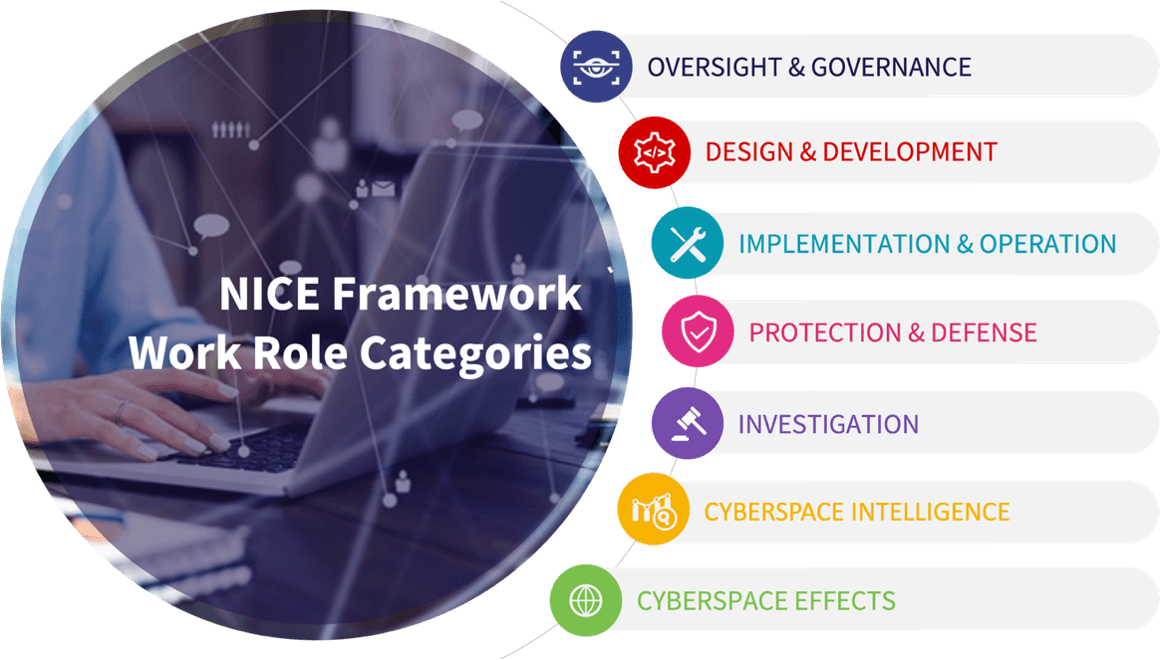
The NIST NICE Workforce Framework for Cybersecurity highlights the importance of developing practical knowledge, skills and abilities alongside technical understanding.
Learning by Doing Builds Confidence
Hands-on practice allows you to apply cybersecurity concepts in realistic situations without putting real systems or data at risk.
Working through practical exercises reinforces what you've learned and develops essential problem-solving skills.
In a beginner course, you might work with:
- Virtual lab or sandbox environments: Safe, isolated environments where you can explore cybersecurity concepts, test tools and practise responding to threats without affecting real systems.
- Basic security and monitoring tools: Learn how common security software helps detect suspicious activity, monitor systems and support day-to-day cybersecurity operations.
- Vulnerability scanning exercises: Discover how automated tools identify potential security weaknesses so they can be addressed before attackers exploit them.
- Network traffic analysis: Learn how to observe and interpret network activity to identify unusual behaviour that could indicate a cyber threat.
- Simulated phishing or malware scenarios: Practise recognising and responding to common cyber-attacks in a controlled environment, helping you understand how to react safely and effectively.
These activities help bridge the gap between theory and real-world application, making it easier to understand how cybersecurity concepts are used in practice.
Quick Tip
Making mistakes in a controlled training environment is part of the learning process. Guided practice helps you develop confidence before applying your skills in the workplace.
Learning Through Structured Practice with @ASK Training
For beginners, structured guidance is just as important as practical experience.
@ASK Training's Cybersecurity Essentials course combines instructor-led lessons with practical exercises designed to help learners apply fundamental cybersecurity concepts.
Rather than simply learning definitions, you'll gain experience identifying common threats, understanding security controls and applying best practices through guided activities before progressing to more advanced cybersecurity topics.
Cybersecurity Essentials vs Ethical Hacking: Which Should You Start With?
This is one of the most common questions beginners ask. While ethical hacking is exciting, the answer for most learners is to start with the fundamentals.
Ethical hacking builds on cybersecurity fundamentals. Without first understanding how systems, networks, and security controls work, it's much harder to appreciate how vulnerabilities are identified and tested.
Start with the Fundamentals
If you're new to cybersecurity, a cybersecurity essentials course provides the knowledge needed to understand how organisations protect their systems and information.
It covers core topics including:
- Cybersecurity principles and terminology.
- Common cyber threats and attack methods.
- Identity and access management.
- Network and cloud security fundamentals.
- Security controls and risk management.
- Basic vulnerability assessment.
- Cybersecurity best practices.
This foundation prepares learners to progress confidently into more specialised cybersecurity disciplines.
Progress to Ethical Hacking
Once you've built a solid understanding of cybersecurity fundamentals, you can explore an ethical hacking course in Singapore to deepen your technical skills.
Ethical hacking involves testing systems for security weaknesses with the owner's permission. It follows structured methodologies and legal frameworks to help organisations identify vulnerabilities before malicious attackers can exploit them.
The EC-Council – What Is Ethical Hacking? explains how ethical hackers use authorised penetration testing to improve an organisation's security posture.
At this stage, learners are introduced to areas such as:
- Penetration testing methodologies.
- Vulnerability identification.
- Incident response.
- Digital forensics.
- Hands-on ethical hacking exercises.
Rather than teaching learners how to "hack", ethical hacking focuses on understanding how attackers operate so organisations can strengthen their defences.
Advance Your Skills with IT Security
After gaining practical cybersecurity knowledge and ethical hacking experience, learners who wish to specialise further can consider an IT security course in Singapore.
Advanced training explores more complex topics such as:
- Advanced threat detection.
- Security frameworks and governance.
- Threat intelligence.
- Vulnerability management.
- Enterprise security strategies.
- Advanced security operations.
These courses are generally better suited to learners who already have a strong understanding of cybersecurity principles or relevant industry experience.
Choosing the Right Starting Point
Choosing a course should be based on your current knowledge rather than the course title.
If you're completely new to cybersecurity, begin with the fundamentals. Building a strong foundation first will make advanced topics easier to understand and help you develop your skills with greater confidence.
Comparison table showing the progression from Cybersecurity Essentials to Ethical Hacking and Advanced IT Security:
| Course | Best suited for | What you'll learn | Recommended next step |
| Cybersecurity Essentials | Beginners with little or no cybersecurity experience | Cybersecurity fundamentals, common threats, security controls, risk management and security best practices | Cybersecurity & Ethical Hacking |
| Cybersecurity & Ethical Hacking | Learners with foundational cybersecurity knowledge | Penetration testing, ethical hacking methodologies, vulnerability assessment, incident response and digital forensics | Advanced IT Security & Cybersecurity |
| Advanced IT Security & Cybersecurity | Learners with stronger IT or cybersecurity foundations | Advanced threat detection, security frameworks, vulnerability management and enterprise security practices | Professional certifications or specialised cybersecurity roles |
How to Prepare Before the Course Starts
You don't need to spend months studying before your first cybersecurity class, but a little preparation can help you get more out of the course.
Refresh Your Basic IT Knowledge
Take some time to familiarise yourself with:
- Password and multi-factor authentication practices.
- Operating systems such as Windows or macOS.
- Basic networking concepts.
- Cloud storage and online accounts.
- Common cybersecurity terminology.
Don't worry if you're unfamiliar with everything. Your course will cover these concepts in greater detail.
The Cybersecurity and Infrastructure Security Agency (CISA) Cybersecurity Best Practices provides useful guidance on many of these fundamental security concepts.
Pay Attention to Everyday Cybersecurity
One of the best ways to prepare is to become more aware of the cyber threats you encounter every day.
For example, consider:
- Why did that email end up in your spam folder?
- Why does your bank require multi-factor authentication?
- Why are software updates so important?
- How can you tell if a website is legitimate?
Observing these situations will make the concepts you learn in class easier to relate to.
Come Prepared to Ask Questions
Think about the cybersecurity challenges you've encountered at school, at work, or in your personal life.
Perhaps you've received a suspicious email, experienced an account lockout, or wondered why certain websites trigger browser security warnings. Bringing these questions to class helps make your learning more practical and relevant.
Quick Tip
Curiosity is one of the most valuable qualities in cybersecurity. Asking questions and understanding why something happens is often more important than memorising technical terms.
What to Do After Completing a Beginner Cybersecurity Course
Completing your first cybersecurity course is an important milestone, but it's only the beginning of your learning journey.
Cybersecurity is constantly evolving, and developing your skills over time will open the door to a wider range of career opportunities.
Continue Building Your Skills
Depending on your interests, you may choose to progress into areas such as:
- Ethical hacking.
- Advanced IT security.
- Cloud security.
- Security operations.
- IT support with a cybersecurity focus.
- Incident response.
Each new course builds on the knowledge you've already gained, allowing you to deepen your expertise gradually.
Reinforce What You've Learnt
One of the best ways to retain new knowledge is to apply it regularly.
You could:
- Keep notes on important concepts.
- Document your lab exercises.
- Create simple cybersecurity checklists.
- Practise using security tools introduced during your course.
- Follow cybersecurity news and emerging threats.
Building these habits will strengthen your understanding and prepare you for more advanced learning.
Continue Your Learning Journey with a Structured Pathway
If you've completed a beginner programme and are ready to take the next step, consider a structured pathway that takes you from Cybersecurity Essentials to Cybersecurity & Ethical Hacking, and on to Advanced IT Security.
For eligible learners, selected courses may also be claimable under SkillsFuture, making it more affordable to continue developing your cybersecurity skills through recognised training pathways.
Remember, cybersecurity isn't about completing one course; it's about continuously building your knowledge, gaining practical experience and developing the confidence to tackle increasingly complex security challenges.
Conclusion
Starting a career in cybersecurity may seem daunting at first, but every cybersecurity professional begins by learning the same core principles.
You don't need advanced technical knowledge or programming skills to get started, just the willingness to learn and a course that builds your confidence step by step.
As you've seen throughout this handbook, cybersecurity is much more than ethical hacking. It involves understanding how to protect systems, data, and users from evolving cyber threats while developing the practical skills needed to identify risks and respond effectively.
Remember, learning cybersecurity is a journey. Start by understanding the fundamentals, practise your skills in safe, hands-on environments, and choose a course that matches your current level of knowledge.
As your confidence grows, you can progressively explore areas such as ethical hacking, advanced IT security, cloud security, or security operations.
The most important decision isn't choosing the course with the most advanced title, it's choosing the one that's right for you today.
Build your foundation first, keep learning, and you'll be well positioned to take advantage of the growing opportunities in Singapore's cybersecurity industry.
Ready to Start Your Cybersecurity Journey?
If you’re looking for a structured pathway, @ASK Training is your ally in this journey! We offer beginner-friendly cybersecurity courses that combine instructor-led learning with practical exercises.
Whether you're taking your first step or preparing to build on your existing skills, a clear learning pathway will support your progress at every stage.
Related Courses
◆◆◆