
(32 hrs) Cybersecurity and Ethical Hacking
Cybersecurity and Ethical Hacking Course in Singapore: Learn vulnerability management, security monitoring, incident response, and ethical hacking practices aligned with CompTIA Security+.
Course Synopsis
This course equips participants with advanced knowledge and practical skills to identify, assess, and mitigate cybersecurity threats across organisational systems, networks, and applications. It focuses on vulnerability management, network security, endpoint protection, and application security to strengthen organisational defence capabilities.
Participants will apply vulnerability assessment techniques, analyse threat intelligence, and implement remediation strategies such as patching, configuration hardening, and compensating controls. The course also develops competencies in incident response, digital forensics, and security monitoring, enabling participants to detect and respond to cyber incidents effectively.
Participants will further analyse indicators of malicious activity across malware, network, and application attacks, and apply security governance, risk management, and compliance practices to support secure operations.
Aligned with the CompTIA Security+ syllabus, this course aims to prepare participants for the CompTIA Security+ certification examination and equips them with skills to perform cybersecurity and ethical hacking functions in enterprise environments.
Prerequisites
Completed the Cybersecurity Essentials course awarded by @ASK Training
Language
- Attained at least WPLN level 5; or
- Obtained Grade C6 for GCE O-Level English; or
- Other equivalent qualifications.
Academic
- Obtained at least a pass or C6 at GCE O-Level in at least 3 subjects; or
- Candidates with other qualifications will be considered on a case-by-case basis; or
- Mature candidates aged ≥ 30 years old with 8 years of relevant working experience.
Learning Units
LU 1: Explain Vulnerability Management
- Device and OS Vulnerabilities
- Application and Cloud Vulnerabilities
- Vulnerability Identification Methods
- Vulnerability Analysis and Remediation
LU 2: Evaluate Network Security Capabilities
- Network Security Baselines
- Network Security Capability Enhancement
LU 3: Assess Endpoint Security Capabilities
- Implement Endpoint Security
- Mobile Device Hardening
LU 4: Enhance Application Security Capabilities
- Application Protocol Security Baselines
- Cloud and Web Application Security Concepts
LU 5: Explain Alerting and Monitoring Concepts
- Incident Response
- Digital Forensics
- Data Sources
- Alerting and Monitoring Tools
LU 6: Analyse Indicators of Malicious Activity
- Malware Attack Indicators
- Physical and Network Attack Indicators
- Application Attack Indicators
LU 7: Summarize Security Governance Concepts
- Policies, Standards, and Procedures
- Change Management
- Automation and Orchestration
LU 8: Explain Risk Management Processes
- Risk Management Processes and Concepts
- Vendor Management Concepts
- Audits and Assessments
LU 9: Summarize Data Protection and Compliance Concepts
- Data Classification and Compliance
- Personnel Policies
Course Objectives
By the end of this course, you should be able to:
- Apply the CVE framework and vulnerability assessment tools.
- Differentiate false positives vs. false negatives in scan results.
- Conduct structured log reviews to detect anomalies and indicators of compromise.
- Select appropriate remediation strategies, including patching, configuration, and compensating controls.
- Configure and apply ACLs, IDS/IPS, and web filtering.
- Use detection methods to protect against unauthorized access and malicious activity and strengthen network infrastructure against web-based threats.
- Implement mobile device hardening, including encryption, external media controls, and location restrictions.
- Secure mobile connectivity, including Wi-Fi, Bluetooth, NFC, GPS, cellular, tethering, and mobile payments.
- Apply endpoint security alignment with organizational requirements.
- Configure secure application protocols, including TLS, secure directory services, SNMP, and DNS filtering.
- Apply secure coding techniques and application protection mechanisms.
- Use sandboxing to reduce vulnerabilities and strengthen application resilience.
- Apply incident response procedures, including preparation, detection, containment, eradication, and recovery.
- Conduct digital forensics using appropriate data sources.
- Use SIEM, IDS/IPS, and log analysis to monitor and investigate incidents.
- Identify indicators of compromise across malware, physical, network, and application attacks.
- Correlate evidence to detect malicious activity and support investigations.
- Apply organizational governance requirements, including policies, procedures, and standards.
- Describe legal environment, accountability, and compliance frameworks.
- Apply secure, compliant, and accountable practices.
- Identify organizational risks and apply risk management strategies.
- Conduct business impact analysis to support continuity planning.
- Apply vendor assessment methods and review legal agreements.
- Validate security controls through attestation, assessments, and penetration testing.
- Apply data governance principles, including classification, sovereignty, privacy, and compliance.
- Implement data protection controls, including monitoring, reporting, DLP, and breach response.
- Deliver security awareness training programs to promote responsible workplace behavior.
Training Hours & Assessment
Total Training Hours: 32 hours, including a 2-hour assessment
Assessment
- Written Assessment
- Practical Assessment
Fees and Subsidies
*Eligible for Singaporean Citizens, Permanent Residents, and Long-Term Visit Pass Plus Holders
Course Fee:
S$1,200 (exclusive of 9% GST)
Course Fee After Eligible SWDA Subsidies:
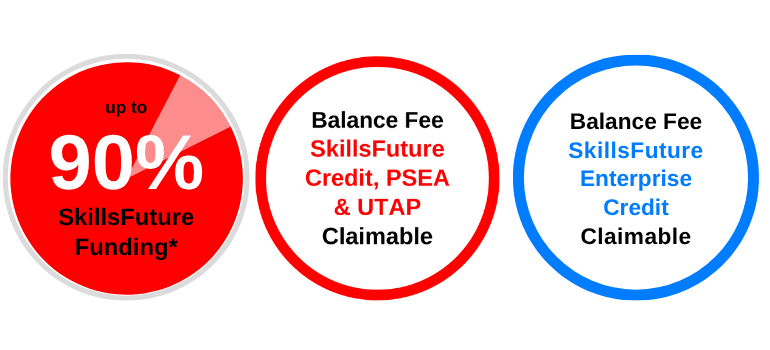
From S$152.40 (inclusive of 9% GST) after 90% SWDA Subsidies
| Learners | |
| Singaporean Citizens ≥ 40 years old | S$152.40 (after SWDA 90% Funding) SkillsFuture Credits can be used on top of existing subsidies |
| Singaporean Citizens, PRs or LTVP+ Holders ≥ 21 years old | S$392.40 (after SWDA 70% Funding) For Singapore Citizens learners aged ≥ 25 years old SkillsFuture Credits can be used on top of existing subsidies. For Singapore Citizens aged 21-31 Post Secondary Education Account Funds can be used. |
| Learners | SMEs | Non-SMEs |
| Singaporean Citizens ≥ 40 years old | S$152.40 (after SWDA 90% Funding) SkillsFuture Enterprise Credits (SFEC) can be used on top of existing subsidies |
S$152.40 (after SWDA 90% Funding) SkillsFuture Enterprise Credits (SFEC) can be used on top of existing subsidies |
| Singaporean Citizens, PRs or LTVP+ Holders ≥ 21 years old | S$392.40 (after SWDA 70% Funding) SkillsFuture Enterprise Credits (SFEC) can be used on top of existing subsidies |
Singaporean Citizens ≥ 40 years old
After SWDA 90% Funding
SkillsFuture Credits can be used on top of existing subsidies
After SWDA 90% Funding
SkillsFuture Enterprise Credits (SFEC) can be used on top of existing subsidies
Singaporean Citizens, PRs or LTVP+ Holders ≥ 21 years old
After SWDA 70% Funding
For Singapore Citizens learners aged ≥ 25 years old SkillsFuture Credits can be used on top of existing subsidies.
For Singapore Citizens aged 21-31 Post Secondary Education Account Funds can be used.
After SWDA 90% Funding
SkillsFuture Enterprise Credits (SFEC) can be used on top of existing subsidies
After SWDA 70% Funding
SkillsFuture Enterprise Credits (SFEC) can be used on top of existing subsidies
All prices are inclusive of 9% GST.
(32 hrs) Cybersecurity and Ethical Hacking
Up to 90% SkillsFuture Subsidy. Enrol today.
Course Schedule
Course Name: (32 hrs) Cybersecurity and Ethical Hacking
Course Code: TGS-2026064504
Course Duration: 4 Days (9:00am – 6:00pm)
| Course Name | Duration | Month | Date | Venue | Remarks |
|---|---|---|---|---|---|
| (32 hrs) Cybersecurity and Ethical Hacking TGS-2026064504 | 4 days (9:00am - 6:00pm) | October 2026 | 08,09,12,13 | International Plaza | Weekdays |
| 18,24,25,31 | International Plaza | Weekends | |||
| November 2026 | 21,22,28,29 | JTC Summit | Weekends | ||
| 22,28,29 Nov, 05 Dec | International Plaza | Weekends | |||
| 23,24,25,26 | International Plaza | Weekdays | |||
| December 2026 | 08,09,10,11 | International Plaza | Weekdays | ||
| 19,20,26,27 | International Plaza | Weekends | |||
| January 2027 | 11,12,13,14 | International Plaza | Weekends | ||
| February 2027 | 11,12,15,16 | International Plaza | Weekdays | ||
| March 2027 | 11,12,15,16 | International Plaza | Weekdays |
Related Courses
Have some questions? Contact us.
Up to 90%
SkillsFuture Subsidy