
If you run a business, agency, or consultancy, you have likely heard the panic by now. “SEO is dead.” “Google’s AI is taking our traffic.” “Nobody clicks links anymore.”
Take a deep breath. The truth is far less dramatic and far more actionable.
Google’s AI-powered search experiences, including AI Overviews and conversational search modes, are changing how people discover information and how often they click through to websites. But they are not killing SEO. They are raising the standard.
Here is what is actually happening: Google AI search is not the death of SEO. It is the enforcement of better SEO. The businesses losing ground right now are not victims of an algorithm change. They are victims of their own vague messaging.
This article explains what has changed, what has not changed, and, most importantly, what you need to fix first.
First, let’s take a look at their recent announcements and what businesses need to know.
Google I/O 2026: What You Need to Know
At Google’s annual I/O conference (May 19, 2026), the company unveiled sweeping changes to AI Search. Here are the key announcements that affect your business:
1. AI Mode: 1B+ Monthly Users
What it means for you: Your customers are already using AI search. If your website is vague, they will never see you.
2. Gemini 3.5 Flash as Default
What it means for you: Google is making AI search faster and smarter. Generic content will be filtered out more aggressively.
3. Intelligent Search Box
What it means for you: Users can now search with images, files, and videos. Your content must be optimised for multiple formats, not just text.
4. Search Agents (24/7)
What it means for you: AI agents scan the web continuously for users. Your brand needs to be cited consistently across blogs, news, social, and reviews or agents will never surface you.
5. Generative UI
What it means for you: Search now builds custom visuals, tables, and dashboards from your content. If your information is not structured and citable, you will be excluded from these rich answers.
6. Personal Intelligence
What it means for you: Search connects to Gmail, Photos, and Calendar. Your brand may be recommended based on a user’s personal data. Inconsistent external signals will hurt you.
Read more at: Google Official Blog
The bottom line? Clarity, specificity, and credibility are no longer optional. They are survival requirements.
These updates might feel sudden, but the truth is, Google has been heading in this direction for a long time. Let us look at how we got here.
Google Has Been Moving Toward This for Years
Let us rewind for a moment. Before AI Overviews, before AI Mode, Google spent over a decade telling website owners the same thing: create useful content, answer real search intent, demonstrate trust, and make your pages easy to crawl.
Google’s own SEO Starter Guide still emphasises clear writing, useful structure, and crawlable, indexable content. Major updates like:
- Hummingbird (semantic search)
- RankBrain (machine learning for intent)
- BERT and MUM (natural language understanding)
They all point to the same goal: understanding meaning, not just keywords.
Google AI search did not appear out of nowhere. It is the logical next stage of the same mission: rewarding clarity, usefulness, and credibility.
The only difference now is that the test is harder. Generic, low-effort content that used to rank simply because it contained the right keywords is no longer good enough.
Google’s AI can now read, summarise, and compare information across dozens of sources in seconds. If your website is vague, the AI will simply ignore it and cite someone clearer.
So if Google has been heading in this direction for years, what actually changes when search becomes AI-led? Let us break it down.
What Actually Changes When Search Becomes AI-Led
To understand why vague websites struggle, you first need to understand how the game has changed.
Traditional search returns a list of blue links. AI Mode Google and AI Overviews do something very different.
They generate answers. They summarise information, interpret context, compare options, and pull from multiple sources to give the user a complete response without leaving the search page.
This changes where your business needs to appear:
- Ranking number one is no longer the only goal.
- You now need to be understood, cited, or recommended inside the AI-generated answer.
- Visibility increasingly depends on being included in the answer itself, not just ranking for it.
Industry coverage from Search Engine Land and NPR has shown that AI Overviews can reduce click-through rates to traditional results.
This shift in visibility explains exactly why vague, generic websites are losing ground fast.
Why Vague Websites Struggle in AI Search
Here is the hard truth that many business owners do not want to hear: broad, generic positioning does not work in AI-driven search.
Why? Because generative AI search systems match specific user questions against specific information.
Vague positioning fails because it lacks what SEO professionals call “retrievable meaning.”
Compare these two approaches:
Weak Positioning: “We help businesses grow”
- The AI has almost nothing concrete to hold onto.
- What does “grow” mean? More revenue? More customers? Better retention? Lower costs?
- Cannot be reliably matched to specific user queries
Strong Positioning: “We help B2B SaaS companies improve demo-to-customer conversion through landing page testing and lifecycle email sequencing.”
- Audience: B2B SaaS companies
- Problem: Low demo-to-customer conversion
- Method: Landing page testing + lifecycle email sequencing
- Outcome: Improved conversion rates
Which one is easier for an AI to match against a query like “how to improve demo conversion for B2B SaaS”? The second one, every time.
AI search visibility depends on specificity.
The more clearly you state:
- Who you help
- What problem do you solve
- What outcome do you deliver
…the easier it becomes for AI systems to find, trust, and cite you.
So how do you actually get clearer? It starts with fixing your positioning first.
Better SEO Starts with Clearer Positioning
Here is a shift in thinking that will save you years of frustration: positioning is not just a branding problem anymore. It is a search problem.
What You Need to Know
- Entity SEO, the practice of helping search engines understand who you are, what you do, and who you serve, requires clear, consistent, repeated signals.
- This aligns directly with Google’s E-E-A-T framework (Experience, Expertise, Authoritativeness, Trustworthiness).
- Your homepage, your service pages, your about page, your LinkedIn company profile, your Google Business Profile, and even your customer reviews all need to tell the same specific story.
Do not hide your specialisation. Shout it.
For Singapore businesses, adding local qualifiers significantly improves relevance signals:
- “Singapore GST compliance” or
- “B2B SaaS in Southeast Asia”
If you are an accountant, do not say “we help with taxes.” Say “we help e-commerce sellers in Singapore file GST and optimise tax deductions for cross-border sales.”
That level of specificity does not limit your audience. It signals to both humans and AI exactly who you are for.
Once your positioning is sharp, the next question is: what kind of content actually wins in AI search?
Helpful Content Still Matters, But It Needs to Be More Specific
Some marketers have misinterpreted “helpful content” as simply writing long, detailed articles. That was never quite right, and it is definitely wrong now.
SEO for AI search demands content that answers real, specific questions; not just keyword-stuffed generalities.
Stop writing about “digital marketing strategies.” Start writing about:
- “How to reduce paid ad spend without losing leads for home renovation companies”
- “What to do when your Shopify store has traffic but zero sales”
- “Best accounting software for freelancers with multiple income streams in Singapore”
Notice the difference? These titles address specific situations, objections, and outcomes. They sound like something a real person would type or ask an AI assistant.
That is answer engine optimisation in action. Structure your content around the actual questions your customers ask during their decision-making process.
Use clear headers, bullet points, and short paragraphs so AI systems can easily extract and cite your answers.
But even the best content is useless if Google’s AI cannot access your website. That is where technical SEO comes back in.
Technical SEO Still Matters Because AI Search Needs Access
Before you get carried away with positioning and content strategy, do not forget the basics.
If Google cannot access your website, nothing else matters.
Google search AI still relies on crawlability, indexing, site structure, page speed, internal linking, and structured data.
Google’s structured data documentation states that valid structured data can make pages eligible for enhanced search features.
The good news is that the technical bar has not risen dramatically. Clean, fast, well-structured websites that follow basic SEO best practices are still perfectly fine.
The issue is that vague positioning often sits on top of neglected technical foundations, and that combination is deadly.
However, technical access and clear content are still not enough. AI also needs proof that you are trustworthy.
Proof is Becoming Harder to Ignore
Here is something most SEO guides miss: brand visibility in AI search depends heavily on what other people say about you, not just what you say about yourself.
AI systems draw confidence from consensus. If multiple trusted sources describe your business the same way, the AI is far more likely to adopt that description as fact.
This means your proof matters more than ever.
- Collect specific reviews
- Publish detailed case studies
- Get mentioned in industry publications, directories, partner pages, and even forums like Reddit and LinkedIn.
A review that says “great service” is fine. A review that says “we tried three agencies before finding X. They reduced our cost per lead by 40% within 60 days” is gold.
That specific, measurable outcome is exactly what AI systems look for when deciding which sources to trust
But even great proof loses power if your brand story is inconsistent across the web. Let us talk about consistency.
Brand Consistency Matters Across the Wider Web
Here is a mistake that catches many businesses off guard.
Your website says one thing. Your LinkedIn company page says something slightly different. Your Google Business Profile describes your services using different words. And your customer reviews mention a third set of capabilities.
To a human, these differences might seem minor. To an AI system scanning the web to understand your brand, they look like confusion.
AI search rewards consistency. Your brand name, service descriptions, industries served, locations, founder bios, credentials, and external profiles should all tell the same coherent story across every public surface.
If the AI cannot figure out who you are, it will not cite you. Simple as that.
Once you have made those fixes, how do you measure whether they are actually working?
What Businesses Should Fix First
Overwhelmed? Do not be. You do not need to fix everything at once. Start here.
1. Your Homepage Description
In one or two sentences, clearly state who you help, what problem you solve, and what outcome you deliver. No fluff. No jargon. No “world-class innovative solutions.”
2. Your Service Pages
Each service page should target one specific need or situation. Do not list ten broad capabilities on one page. Create separate pages for separate problems.
3. Your Proof
Add at least one detailed case study or specific customer review. Show the starting problem, the process, and the measurable outcome.
4. Your External Profiles
Spend one hour updating your LinkedIn, Google Business Profile, and any industry directories so they match your website exactly.
These four fixes alone will put you ahead of most competitors.
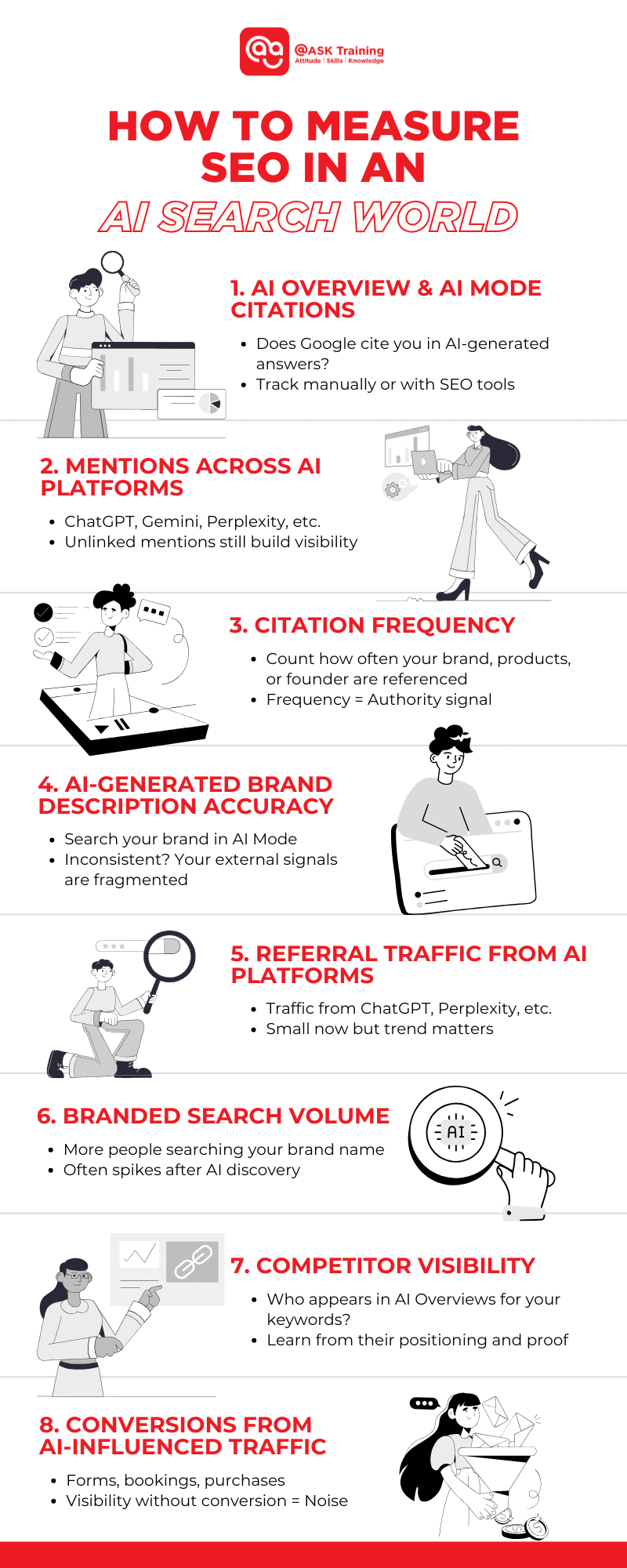
How to Measure SEO in an AI Search World
Old-school ranking reports are no longer enough. In an AI-driven search environment, visibility can take many forms. You need to track new metrics that go beyond just “position one.”
Here is what to measure instead:
1. AI Overview & AI Mode citations
- Monitor whether your brand appears inside AI-generated answers for your core search terms.
- Use tools or manual searches to track where Google cites you as a source.
2. Mentions Across AI Platforms
- Track brand mentions in ChatGPT, Gemini, Perplexity, and other answer engines.
- Even unlinked mentions build brand visibility in AI search.
3. Citation Frequency
- Count how often your business name, products, or founder appear as referenced sources.
- Frequency signals authority to AI systems.
4. Accuracy of AI-Generated Brand Descriptions
- Search for your brand in AI Mode Google and check what the AI says about you.
- If it is wrong or vague, your external signals are inconsistent.
5. Referral Traffic from AI Platforms
- Watch your analytics for traffic labelled from ChatGPT, Perplexity, or other AI tools.
- Volumes may be small now, but the trend matters.
6. Branded Search Volume
- Track how many people search for your brand name directly.
- This often spikes when someone discovers you inside an AI answer and comes looking for you.
7. Competitor Visibility
- Monitor which competitors appear in AI Overviews for your target queries.
- Their positioning and proof offer clues for your own strategy.
8. Conversions from AI-Influenced Traffic
- Look at whether visitors who discover you through AI search take action: contact forms, demo bookings, or purchases.
- Visibility without conversion is just noise.
The goal is not just clicks anymore. The goal is to be the source that AI trusts. Measure accordingly.
AI Search Readiness Checklist
Use this checklist to audit your website and online presence today.
- Is your business clearly described in one specific sentence?
- Are your services tied to specific audiences, problems, and outcomes?
- Do your key pages answer real decision-stage questions?
- Is your site technically crawlable and indexable?
- Are your reviews and case studies specific rather than generic?
- Is your business described consistently across third-party platforms?
- Are your important claims supported with evidence from multiple sources?
If you answered “no” to any of these, you have a clear next step.
Now, let’s bring it all together.
Wrapping Up
Here is the bottom line.
Google AI search is not killing SEO. It is killing vague, generic, unfocused websites that never deserved to rank in the first place.
The businesses most likely to benefit from this shift are not the ones chasing AI hacks or trying to game the system. They are the ones that are clear, useful, credible, technically accessible, and consistently represented across the web.
Here’s a quick recap on what to measure in an AI search world:
The fastest win for most businesses is simple: make your positioning sharper, your content more useful, and your proof easier for both humans and search engines to understand.
Do that, and you will not just survive the AI search era. You will thrive in it.
Don’t Get Left Behind: Master SEO for the AI Era Today
Your competitors are already figuring out AI Mode Google, and AI Overviews SEO. Can you afford to be the last one in your industry to adapt?
@ASK Training can get you and your team up to speed fast. Our SEO, Website Analytics and Optimisation Courses turn theory into hands-on skills.
Three courses to get you started:
- (24 hrs) Search Engine Optimisation: A hands-on SEO course covering technical and creative SEO to improve your search rankings.
- (16 hrs) Generative AI for Digital Marketing: Leverage AI to execute marketing campaigns faster while maintaining quality, brand consistency, and ethical standards.
- (24 hrs) Website & Landing Page Conversion Optimisation: Learn to design high-converting landing pages using consumer psychology and persuasive messaging.
Get in touch with us today and future-proof your digital presence!
Related Courses
- (24hrs) Search Engine Optimisation (SEO)
- (16hrs) Generative AI for Digital Marketing
- (32hrs) AI Driven Sales & Marketing: Boosting Engagement & Conversions
◆◆◆
Related Articles
Article Topics
- Google I/O 2026: What You Need to Know”
- Google Has Been Moving Toward This for Years”
- What Actually Changes When Search Becomes AI-Led
- Why Vague Websites Struggle in AI Search
- Better SEO Starts with Clearer Positioning
- Helpful Content Still Matters, But It Needs to Be More Specific
- Technical SEO Still Matters Because AI Search Needs Access
- Proof is Becoming Harder to Ignore
- Brand Consistency Matters Across the Wider Web
- What Businesses Should Fix First
- How to Measure SEO in an AI Search World
- AI Search Readiness Checklist
- Wrapping Up