
It is a significant move to consider a career pivot after 40. It requires courage, foresight, and a clear plan.
While the desire to stay relevant in a fast-changing economy is strong, the reality of financial commitments often creates hesitation to hit “pause” on work.
The 2026 expansion of the SkillsFuture Mid-Career Training Allowance is designed specifically to help mid-career Singaporeans manage the costs of staying skilled in an ever-evolving economy.
A major update has arrived in early 2026, extending support to part-time training allowance that Singapore residents can access while staying employed.
In this guide, we’ll break down exactly who is eligible, how much you can receive, and the steps to help you navigate your next professional chapter with clarity.
Let’s dive in.
What is the SkillsFuture Mid-Career Training Allowance 2026?
The SkillsFuture Mid-Career Training Allowance 2026 is a monthly income support scheme for Singapore Citizens aged 40 and above who are pursuing eligible long-form training.
As a core pillar of the SkillsFuture Level-Up Programme, this initiative acknowledges the value of your experience while providing the financial space to transition into new roles.
By offsetting potential income loss, it empowers you to focus on the rigours of reskilling without compromising your stability.
Who Is Eligible for the 2026 Training Allowance?
To ensure this support is channelled effectively toward serious career shifts, the SkillsFuture Mid-Career Training Allowance eligibility is defined by a few key parameters:
- Citizenship & Age: You must be a Singapore Citizen aged 40 or older.
- Course Selection: Support is reserved for selected long-form courses rather than short, standalone workshops.
- Income Assessment: Your eligibility is determined by your average monthly earned income over the 12 months immediately preceding your course start date.
- Verification: The government verifies your income through official records. While salaried employees typically use their CPF contribution history, self-employed individuals without CPF contributions can use their IRAS Notice of Assessment or IR8A forms to verify their earned income for this purpose.
Example: If you earned an average of $4,000 monthly over the past year, this figure serves as the basis for your eligibility and payout calculation.
With eligibility confirmed, the next step is evaluating which training mode – full-time or part-time – aligns with your current lifestyle.
Full-Time Training Allowance – How Much Will You Receive?
For those ready to commit to a full-time transition, the full-time training allowance offers a structured 50% income replacement formula:
- Income Support: You may receive up to 50% of your average monthly earned income (calculated from the last 12 months).
- Minimum Payout: The floor for this support is set at $300 per month.
- Maximum Cap: Payouts are capped at $3,000 per month.
- Cushioning the Shift: This allowance is specifically intended to reduce the financial pressure when taking dedicated time off work.
- Example: If your average monthly income was $6,500, 50% would be S$3,250. However, the payout is capped at a maximum of $3,000 per month.
While a full-time commitment is powerful, many professionals prefer a gradual shift, which is why the 2026 update for part-time learners is a game-changer.
Part-Time Training Allowance – What Changes in March 2026?
Starting early 2026, the Part-Time Training Allowance introduces more flexibility for those who choose to learn while they earn.
- Flat Monthly Support: Eligible learners in selected part-time long-form programmes will receive a flat $300 training allowance.
- Maintain Your Career: Unlike the full-time track, you can continue working while receiving this monthly support.
- Greater Flexibility: This option is designed for professionals who need to manage existing financial obligations while pursuing a qualification.
Applications for part-time training allowance are now open. Regardless of the path you choose, it is important to be aware of the lifetime limits attached to this support.
How Long Can You Receive the Training Allowance?
Lifelong learning is a continuous journey, but the allowance is structured around a 24-month lifetime cap:
- Total Duration: You can receive support for up to 24 months in total throughout your career.
- Combined Limit: This 24-month cap includes both full-time and part-time training periods.
- Strategic Planning: We recommend planning your training pathways carefully to ensure you have support available for your most critical reskilling milestones.
To maximise this 24-month window, you’ll want to ensure you are selecting a course that qualifies for the scheme.
What Courses Qualify for the Training Allowance?
The scheme focuses on high-impact, structured education that drives real career movement:
- SCTP: This includes SkillsFuture Career Transition Programme allowance-eligible courses.
- Qualifications: Full-time and part-time long-form qualifications up to the undergraduate level at approved Institutes of Higher Learning (IHLs) are covered.
- Exclusions: Short, standalone courses do not qualify for this specific income support.
We strongly encourage you to verify a course’s eligibility on the MySkillsFuture portal before finalising your enrolment.
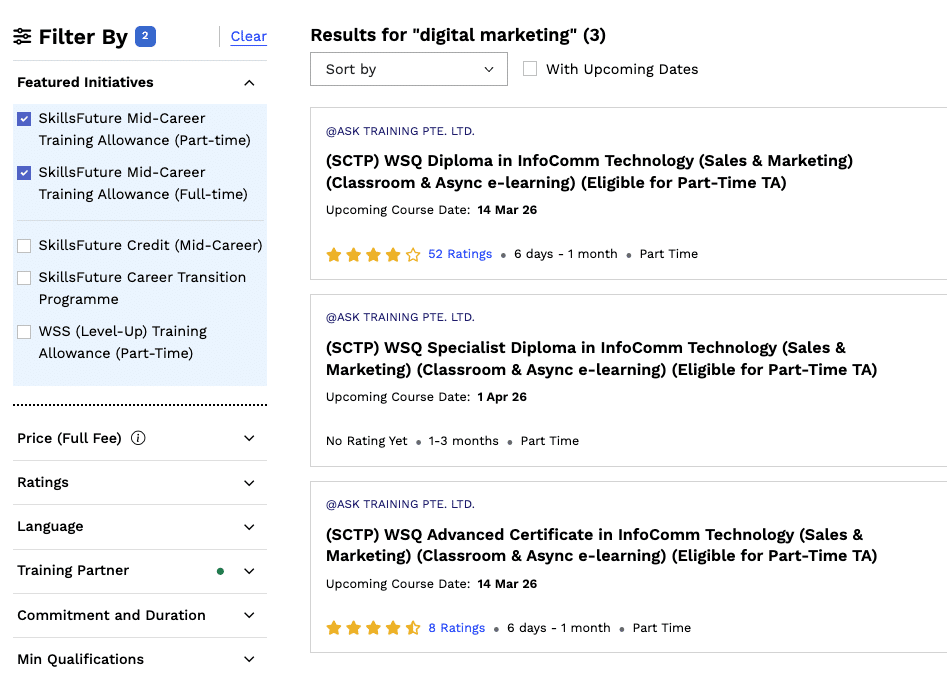
You can also use the ‘Filter By’ function to see which course is eligible.
How to Apply for the SkillsFuture Mid-Career Training Allowance
The process for applying the SkillsFuture training allowance is designed to be straightforward:
- Enrolment: You must first be officially enrolled in an eligible course.
- Portal Access: The application is completed through the MySkillsFuture portal using your Singpass login.
- Proactive Timing: Check the application timelines well before your course commences to ensure a smooth transition.
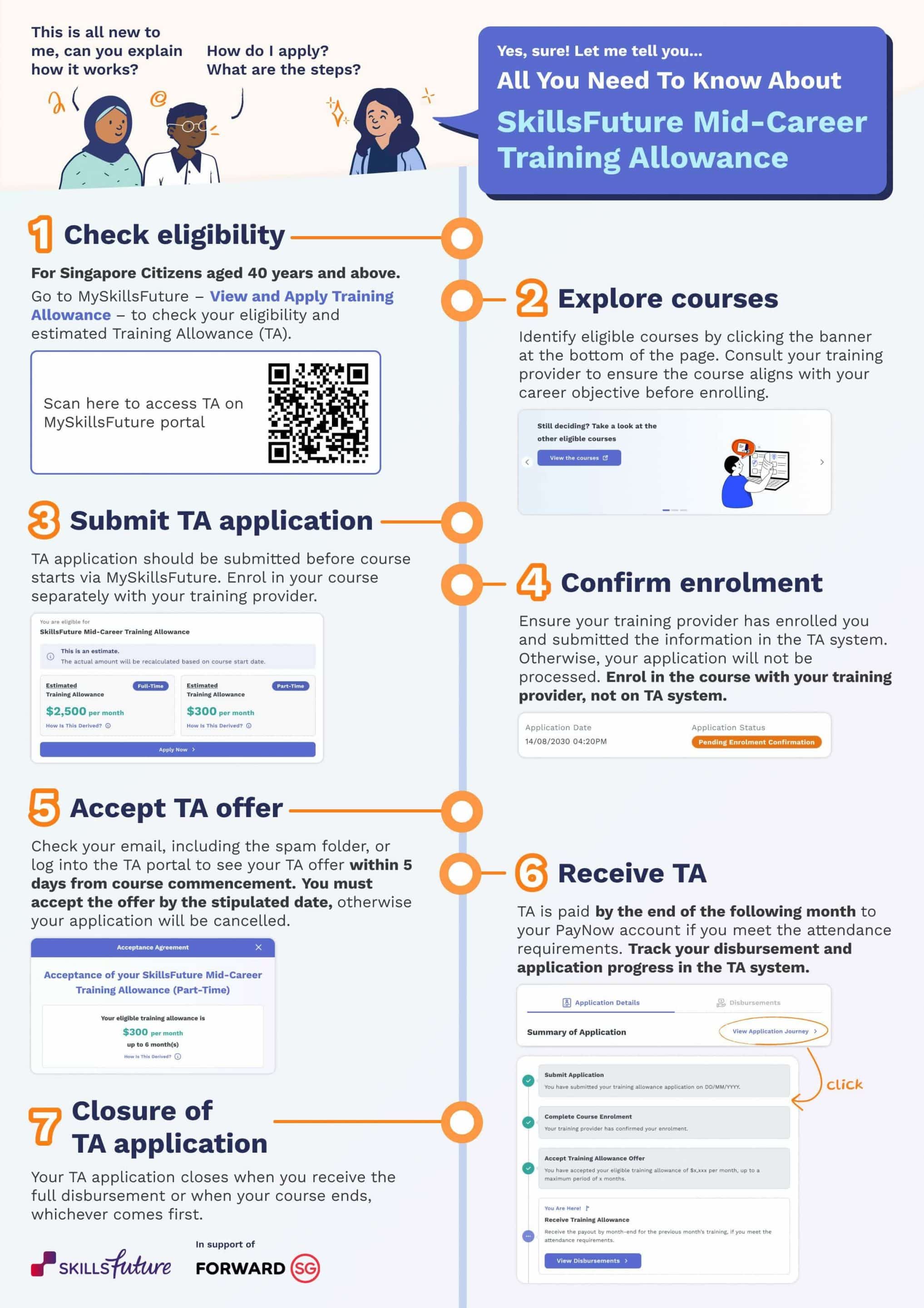
Application Journey (Source: SkillsFuture Singapore)
As you prepare your application, keep in mind a few essential conditions that govern these payouts.
Important Rules and Conditions You Should Know
- Income Support vs. Tuition: This allowance provides personal income support; it is not a replacement for your existing tuition subsidies.
- Attendance-Based: Consistent payouts depend on your active course attendance and continued eligibility.
- Scope: The programme is targeted at long-form qualifications rather than short-term upskilling workshops.
Deciding between a full-time or part-time commitment is a personal choice that involves weighing your career goals against your financial needs.
Full-Time vs Part-Time Training – Which Option Makes Sense?
To help you decide which path aligns with your current life stage, here is a breakdown of the two options to compare:
Full-Time vs. Part-Time: A Side-by-Side Comparison
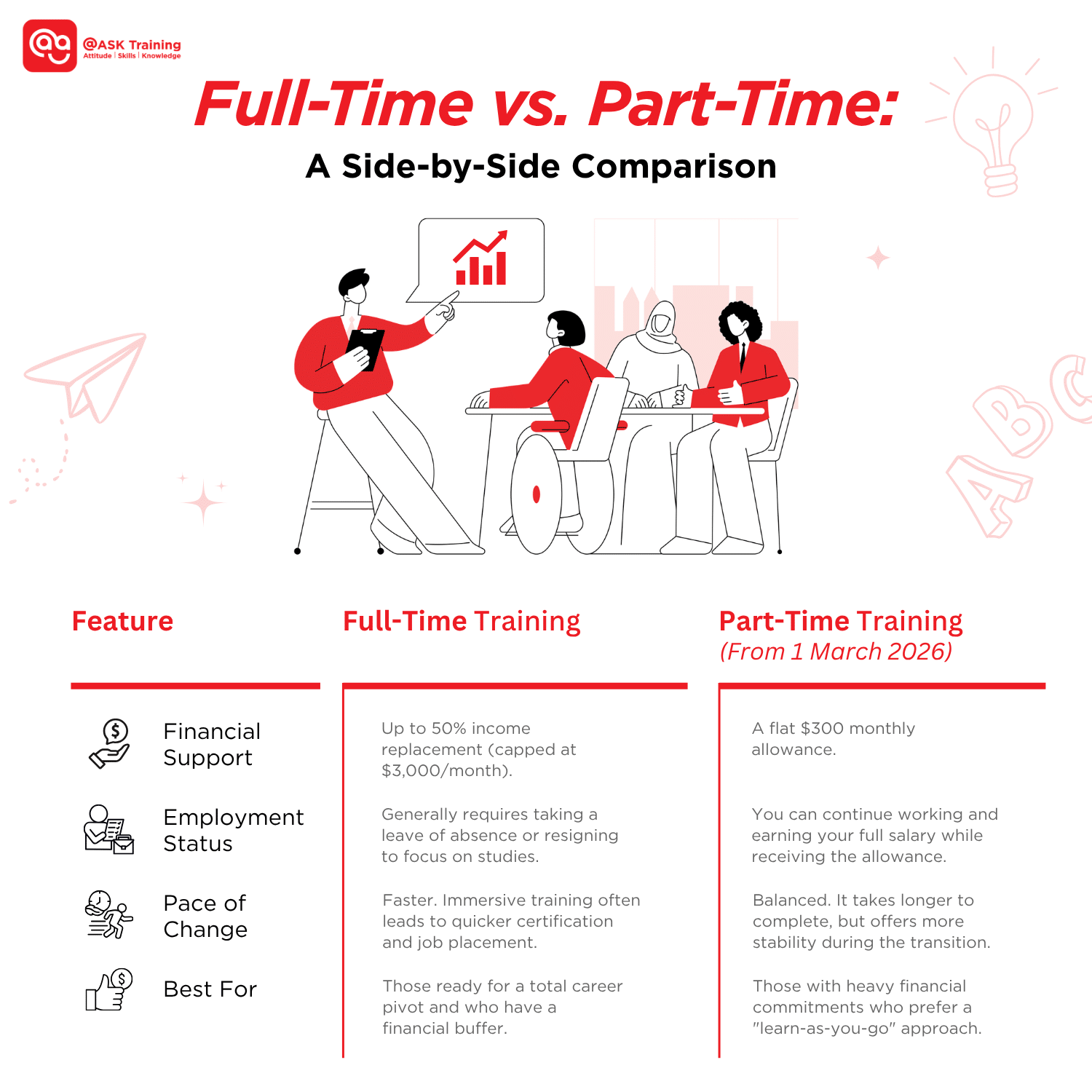
Which Option Makes Sense for You?
Choosing the right mode of study depends on the urgency of your career transition and your current financial “runway.”
Choose Full-Time if:
- You are looking for a complete and rapid career change, and your average monthly income over the last 12 months allows you to maximise the Singapore training allowance 2026 cap of $3,000.
- This is ideal if you have enough savings to supplement the 50% income replacement.
Choose Part-Time if:
- You need the security of your current monthly salary but want to start building skills for the future.
- The $300 training allowance Singapore provides is a helpful supplement for course-related costs like transport or materials without requiring you to step away from your livelihood.
Regardless of which path you take, remember that both draw from the same 24-month lifetime cap.
It is often worth consulting with a career coach to evaluate the transition urgency of your specific industry before committing to a study mode.
Wrapping Up
The SkillsFuture Mid-Career Training Allowance 2026 updates are a significant step toward supporting the career resilience of Singaporeans over 40.
Whether you choose the 50% income support (up to $3,000) of full-time study or the new $300 monthly part-time allowance, the goal is to make your professional growth sustainable.
Before taking your next step, we recommend verifying your course eligibility and income calculations on the MySkillsFuture portal.
Your experience is an asset; reskilling simply gives it a new stage to shine on.
Take the Next Step with @ASK Training
Ready to pivot into the high-growth sectors of the future? At @ASK Training, we offer long-form, full qualification programmes that are now eligible for the part-time training allowance.
Explore our full qualification programmes in:
1. Digital Marketing
- (SCTP) Diploma in Digital Marketing (Eligible for Full-Time TA)
- WSQ Specialist Diploma in Infocomm Technology (Sales and Marketing)
2. Information Technology (IT)
- (SCTP) Advanced Certificate in IT Infrastructure and Operations (Eligible for Full-Time TA)
- Diploma in Infocomm Technology (Infrastructure and Operations)
Contact our career consultants today to find out how you can utilise your SkillsFuture Mid-Career Training Allowance while upskilling with @ASK Training!
Frequently Asked Questions
1. Can I use both allowance types?
Yes, both can be used across different periods as long as the total does not exceed the 24-month lifetime cap.
2. What if I withdraw?
Payouts are generally linked to active participation; withdrawal may result in the cessation of the allowance.
3. Is the allowance taxable?
While there is currently no official guidance, we expect the allowance to be non-taxable, similar to the government support schemes seen during the COVID-19 era.
We recommend keeping an eye on official IRAS updates as the scheme progresses.
4. Are self-employed individuals eligible?
Yes, self-employed Singaporeans who have declared income in the last 12 months are eligible.
5. Does this affect other subsidies?
While you can use SkillsFuture Credits for fees, you cannot receive the Training Allowance concurrently with any other government-provided training allowance, salary support, or absentee payroll applied for by your employer (as per SSG Clause 8.2).
If you have further questions or require more information, visit the SkillsFuture Service Portal to learn more.
Related Courses
◆◆◆