
You post consistently. You engage with comments. You experiment with Reels, carousels, and Stories.
Then your business partner, your manager, or that little voice in your head, asks: so... is it working?
And you hesitate. Because honestly? You are not entirely sure.
If that sounds familiar, you are not alone. Many Singapore small business owners, solo marketers, and founders pour time and energy into social media without a clear way to tell if it is paying off.
The good news? You do not need expensive dashboards, complex attribution software, or a data science degree to measure social media ROI.
Here is the reality: You need a free spreadsheet, the analytics already built into your social apps, and about one hour a month. That is it. No fancy tools.
No six-figure software budgets. Just a simple, consistent system that connects your social media activity to actual business outcomes.
This guide walks you through that exact process – step by step, with zero jargon and practical examples you can apply immediately.
Before we dive into tracking tactics, though, we need to get crystal clear on what "return" actually means for your specific business because that definition changes everything.
What Social Media ROI Means for Your Business Goal
Before diving into numbers, let us clarify what social media ROI actually means.
At its core, social media ROI is the value you gain from your social media activities compared to the time, money, and resources you invest. The formula itself is straightforward, but the tricky part is defining value.
For different businesses, "return" looks completely different:
- A home baker on Instagram may measure ROI as orders placed via WhatsApp DMs – every "can I order?" message that converts into a cake sale
- A hawker stall might track how many customers say "I saw you on TikTok" when they queue up at the stall, turning views into actual bowls sold
- A tuition teacher could count enquiry messages from parents who found them through Facebook or Instagram posts, with each enquiry representing a potential long-term student
- An online seller may measure direct sales attributed to social traffic, whether those purchases happen on Shopee, Lazada, or their own website
The key is choosing one clear business goal before you start measuring. ROI becomes meaningful only when you define what a successful outcome looks like for your specific business – whether that is a sale, a lead, a booking, or even just a meaningful conversation that moves a potential customer closer to buying.
When you connect social media ROI to a specific business outcome, the measurement process becomes far more manageable.
Once your goal is locked in, the next step is choosing which metrics actually move the needle toward that goal, and which ones are just noise.
Match Each Goal to Simple Metrics You Can Track
Once you have defined your goal, you need to track the right social media ROI metrics. The metrics you choose should directly reflect progress toward that goal.
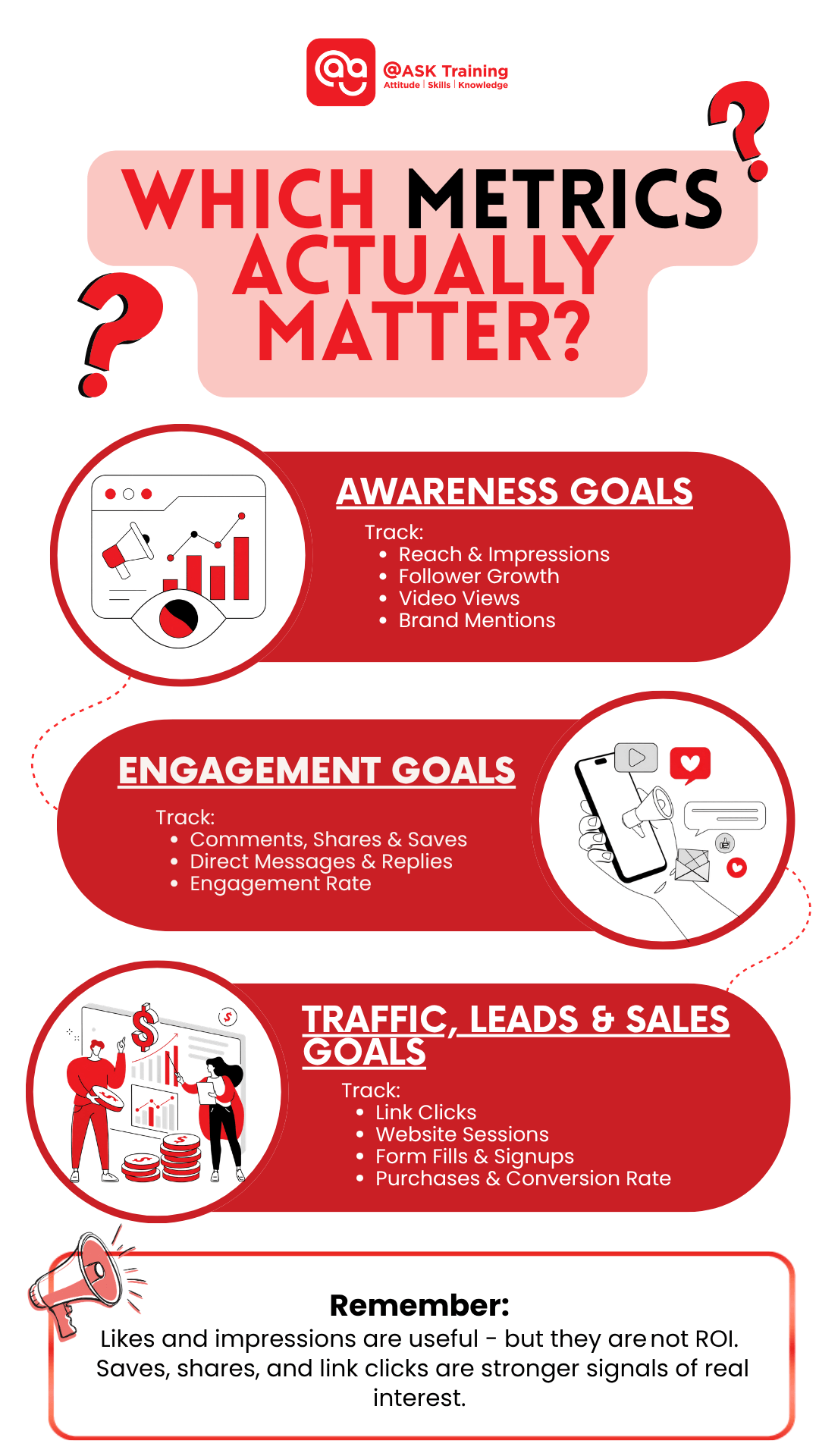
For Awareness Goals
If your objective is to get more eyes on your brand, track:
- Reach and impressions
- Follower growth rate
- Video views
- Brand mentions
- Share of voice compared to competitors
For Engagement Goals
When you want to build relationships and community, monitor:
- Comments, shares, and saves
- Direct messages and replies
- Engagement rate (engagement ÷ reach × 100)
- Quality of comments (meaningful questions versus generic "great post!" responses)
For Traffic, Leads, and Sales Goals
This is where measure social media ROI becomes most concrete:
- Link clicks and click-through rate
- Website sessions from social channels
- Form fills and email signups
- Bookings, purchases, and revenue
- Conversion rate
A critical distinction: likes and impressions are useful for understanding reach, but they should never be treated as social media ROI on their own.
As experts note, "Saves, shares, and link clicks predict revenue far better than passive likes and impressions".
Saves and shares indicate genuine interest, people bookmarking your content for later or staking their reputation on sharing it with others.
Knowing which metrics to watch is half the battle, but you also need to know exactly where to pull that data from, and spoiler alert: you probably already have access to everything you need.
Use Basic Tools to Collect Your ROI Data
Here is the reassuring truth: you can measure social media ROI with tools you already have access to. No expensive subscriptions required.
Native Platform Analytics
Every major social platform provides built-in analytics:
- Instagram Insights shows reach, engagement, follower demographics, and link clicks
- LinkedIn Analytics reveals post performance, follower growth, and click data
- Facebook Page Insights tracks reach, engagement, and page actions
- TikTok Analytics displays video views, follower growth, and traffic sources
These native dashboards are your starting point for collecting platform-specific social media analytics.
Website Analytics
Google Analytics (or similar tools) helps you understand what happens after someone clicks through from social media. You can see:
- How much traffic comes from each social channel
- Which social platforms generate the highest conversion rates
- What visitors do on your site after arriving
- Revenue per social channel (if e-commerce tracking is set up)
UTM Tracking
UTM tracking solves a common frustration: when someone clicks your link, how do you know exactly which post, platform, or campaign sent them?
UTM parameters are simple text tags you add to the end of your URLs. They tell your analytics tool precisely where the traffic came from – so you can see which social post actually drove the sale, signup, or booking.
The main UTM tags are:
- utm_source – where the traffic came from (e.g., Instagram, LinkedIn)
- utm_medium – the channel type (e.g., social, email, cpc)
- utm_campaign – your campaign name
- utm_content – differentiate similar links within the same campaign
Here is an example of what a UTM-tagged URL looks like:
https://yourwebsite.com/shop?utm_source=instagram&utm_medium=social&utm_campaign=summer_sale
When someone clicks that link, your analytics will show that this visitor came specifically from your Instagram summer sale campaign – not just "social media" in general.
You can create UTM links manually or use a free UTM builder tool to speed up the process and reduce errors.
Once you start using UTMs, you will never have to guess which post is actually performing again.
A Simple Spreadsheet
Your most powerful social media ROI tracking tool is a basic spreadsheet. Create columns for:
- Month
- Platform and campaign
- Total costs
- Key metrics (link clicks, conversions, leads)
- Estimated value generated
- Calculated ROI
This simple system gives you a consistent view of performance over time without relying on complicated dashboards.
Add Up Costs and Calculate ROI With a Simple Formula
To accurately calculate social media ROI, you need to know your true costs. Many businesses make the mistake of only counting ad spend.
What to Include in Your Social Media Costs
Your total social media ROI investment includes:
- Time: Hours spent creating content, engaging with followers, and managing campaigns. Value your time at a reasonable hourly rate
- Staff salaries: Wages for anyone involved in social media work
- Freelancers and agencies: Fees for designers, copywriters, videographers, or external managers
- Tools and subscriptions: Scheduling platforms, design software, and analytics tools
- Ad spend: Money spent on paid campaigns and boosted posts
- Influencer fees: Payments or free products for partnerships
- Giveaways: Product costs and shipping for promotional campaigns
Most ROI calculations ignore 60-80% of actual costs because they only count ad spend. Including all these elements gives you a realistic picture.
The Social Media ROI Formula
Once you have total costs and estimated value, use this social media ROI formula:
Social Media ROI = (Value Generated – Social Media Cost) ÷ Social Media Cost × 100
Here is a simple example:
An e-commerce business runs a campaign that generates $5,000 in sales. The total investment is $1,500 (including ad spend, content creation time, and tools).
ROI = ($5,000 – $1,500) ÷ $1,500 × 100 = 233%
A 233% social media ROI means you earned $3.33 for every dollar invested.
For lead-based businesses, assign an estimated value to each lead. If a typical client is worth $2,000 and you generate 10 qualified leads from social media, the estimated value is $20,000, even if the sales close next month
Look Beyond Immediate Sales and Review Patterns Monthly
Social media rarely generates instant sales. Most customers discover your brand, engage with content, and convert weeks or months later.
This is why measuring social media ROI requires looking beyond immediate transactions.
Include Indirect Value
When you measure social media ROI, consider these less direct but valuable outcomes:
- Repeat exposure: Each interaction builds familiarity and trust
- Email list growth: New subscribers represent future revenue opportunities
- Qualified inquiries: DMs and messages from potential customers
- Returning visitors: People who discover you on social and come back later
- Brand lift: Increased searches for your brand name
Review Monthly, Not Daily
Instead of reacting to daily fluctuations, review your social media ROI on a monthly basis. Compare:
- Which platforms generate the most value
- Which content types drive the best results
- Which offers or calls to action convert most effectively
- Whether your ROI is improving month over month
Monthly reviews reveal patterns that daily data can obscure. They also prevent you from making knee-jerk decisions based on one bad week.
Once you have a clear picture of your current ROI and the indirect value you are generating, the next logical question is: how do I actually improve this number without buying yet another tool?
Improve ROI Without Adding More Tools
Measuring social media ROI is only valuable if you use the data to make better decisions. Here are simple ways to improve your results without adding new tools.
Improve What You Already Have
- Refine your calls to action: Replace vague "check us out" with specific next steps like "book a call" or "shop the collection"
- Optimise landing pages: Ensure the page visitors land on matches what your social post promised
- Update profile links: Make sure your bio link takes people to your most important offer
- Test content formats: Compare videos, carousels, and static images to see what performs best
Focus Your Effort
Not all platforms deserve equal attention. If LinkedIn generates fewer clicks than Instagram but more booked calls, prioritise LinkedIn for lead generation. Social media ROI is about business results, not vanity metrics.
As one guide advises from HootSuite, "If your social media ROI is below zero, you're spending more than you're getting back, which is your cue to adjust the strategy".
Reuse What Works
High-performing content deserves a second life. Repurpose your best posts, turn popular videos into new formats, and share your most effective offers again.
The platforms that do not support your business goal should receive less effort, or none at all.
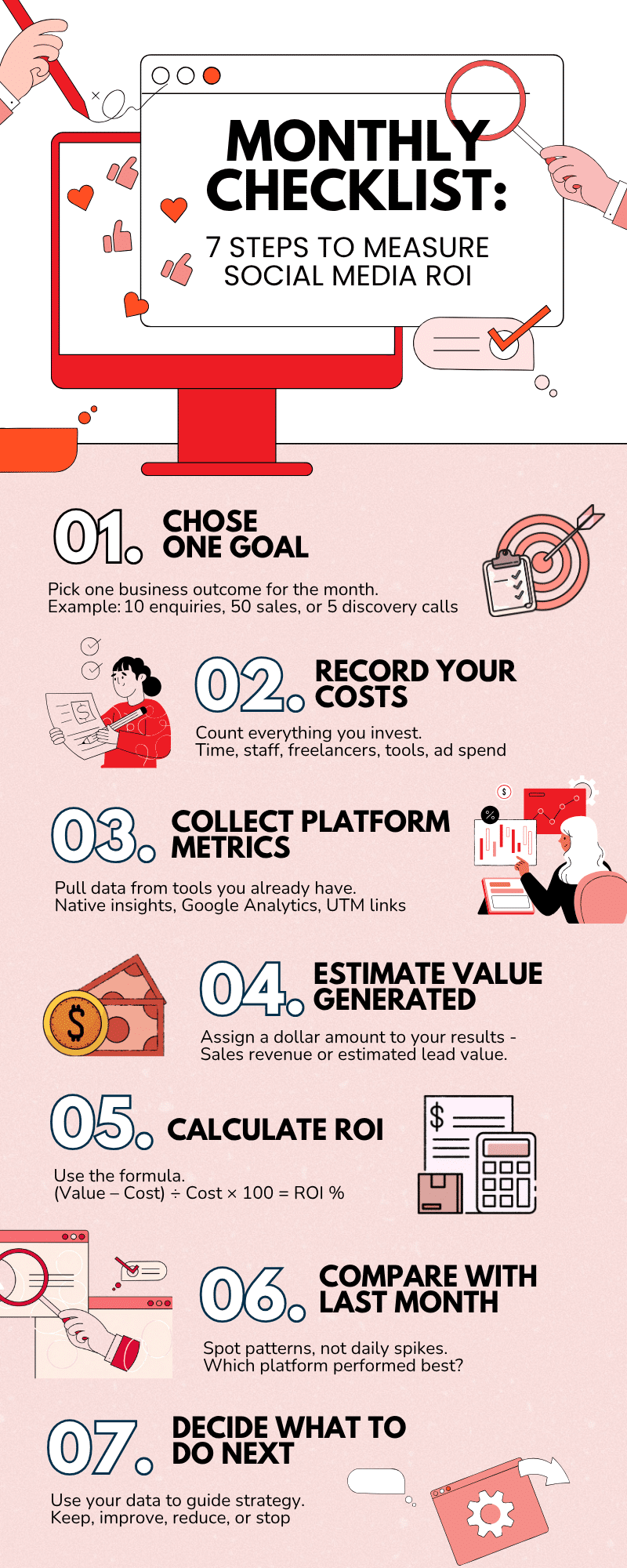
Simple Monthly Social Media ROI Checklist
Use this checklist to keep your social media ROI measurement consistent and actionable:
- Choose one main goal for the month (e.g., generate 20 leads, make 50 sales, get 100 email signups)
- Record social media costs – include time, tools, staff, freelancers, and ad spend
- Collect platform metrics – use native analytics, UTM data, and website analytics
- Estimate value generated – assign monetary value to leads, sales, signups, and bookings
- Calculate ROI using the formula: (Value – Cost) ÷ Cost × 100
- Compare with last month – identify what improved, declined, or stayed the same
- Decide what to keep, improve, reduce, or stop – use your data to guide next month's strategy
With that checklist in hand, let us bring everything together and remind you why this whole process is simpler and more powerful than you think.
Wrapping Up
Measuring social media ROI does not require complicated tools. It requires clarity about your business goal, consistent tracking of the right metrics, honest accounting of costs, and a willingness to review patterns rather than daily spikes.
Define your goal. Track what matters. Calculate your costs. Estimate your value. Review monthly. And use what you learn to make smarter decisions.
Simple, consistent measurement is always better than guessing.
Ready to Master Your Social Media ROI?
You now have the framework to measure your social media performance with confidence. But knowing the theory is one thing; applying it consistently and strategically is where the real growth happens.
If you are ready to go deeper and build a systematic approach to social media that delivers measurable results, @ASK Training's Digital Marketing courses are designed exactly for professionals like you.
Explore our hands-on programmes to sharpen your skills and drive real business outcomes:
- (16hrs) Social Media Marketing: Build a strong foundation in organic social media strategy, content planning, and community management.
- (16hrs) Generative AI for Digital Marketing: Learn how to apply Generative AI to support digital marketing tasks from campaign planning to audience engagement and marketing optimisation.
- (16hrs) Digital Advertising: Learn to plan, execute, and measure paid campaigns across platforms with confidence.
Enrol with us today and start measuring success!
Related Courses
◆◆◆