
Artificial intelligence (AI) is no longer reserved for software engineers and data scientists.
Across Singapore, business owners, managers, executives, and mid-career professionals are using AI tools to improve productivity, automate repetitive tasks, and make better business decisions.
If you have searched for an AI course in Singapore recently, you have probably discovered hundreds of options. The challenge is that not every AI course is designed for your role, business needs, or level of experience.
Some courses focus heavily on coding and machine learning. Others teach practical workplace applications that can help you save time, improve reporting, strengthen marketing campaigns, or streamline operations.
This guide will help you choose the right AI course based on your role, business goals, available funding, and desired outcomes. Whether you work in HR, finance, operations, inventory management, marketing, or business leadership, you’ll learn how to identify the training that delivers real workplace value.
Why AI Skills Matter for Mid-Career Professionals, Business Owners, and Teams in Singapore
AI is rapidly becoming a core workplace skill. In Singapore, organisations across industries are investing in AI adoption to improve productivity, reduce manual work, and support better decision-making.
AI is now being used for reporting, customer service, content creation, recruitment, forecasting, workflow automation, and business analysis.
The good news? Most professionals do not need to become AI engineers. Instead, they need practical skills that help them apply AI tools to solve everyday business problems.
For example:
- A finance manager can use AI to automate monthly reporting and identify unusual spending patterns.
- An HR manager can use AI to screen resumes and draft job descriptions.
- A marketing executive can generate campaign ideas and create content faster.
- An operations manager can use AI to identify workflow bottlenecks and improve efficiency.
For mid-career professionals, AI skills provide a powerful way to augment your current domain expertise, future-proof your employability, and increase your value without needing to execute a full technical career transition.
Now that you understand why AI skills matter, the next step is to identify the specific business challenge you want AI to solve.
Decide What Business Problem You Want AI to Solve
One of the biggest mistakes learners make is choosing a course based on hype rather than business needs. Before comparing providers, start by identifying the problem you want AI to solve.
Ask yourself:
- Do you want to improve productivity?
- Do you want to automate repetitive tasks?
- Do you want better reporting and forecasting?
- Do you want more leads and sales?
- Do you want stronger customer engagement?
- Do you want to improve inventory management?
Your answer should guide your course selection. Common AI training directions include:
- AI in HR and talent management
- AI-powered finance and reporting
- AI-driven business intelligence
- AI sales and marketing
- AI operations and workflow automation
- AI smart inventory management
- AI-powered digital marketing
- AI workplace productivity
For example, an SME owner focused on lead generation will likely gain more value from a sales and marketing-focused AI programme than from a technical machine learning course that focuses on algorithms and coding.
The right course should align directly with the work you perform every day.
With your business problem clearly defined, you’ll now be better equipped to navigate the different types of AI courses available.
Understand the Main Types of AI Courses in Singapore
One reason many learners feel overwhelmed is that AI courses can look very similar at first glance. However, they are often designed for very different outcomes.
Understanding these categories will help you avoid investing time and money in a course that does not match your career or business goals.
1. General AI Awareness Courses
These courses are ideal for learners who are completely new to AI and want to understand how the technology is being used across different industries.
Topics typically include AI fundamentals, common business applications, limitations, risks, governance, and responsible AI usage. The focus is on understanding opportunities rather than using advanced tools.
Best for: Beginners, managers, business owners, team leaders who need a broad overview before diving deeper.
2. Generative AI course Singapore Programmes
These are among the most popular and practical options for professionals today. Generative AI courses focus on tools that create content, analyse information, and assist with everyday work tasks. Popular platforms include ChatGPT, Microsoft Copilot, DeepSeek, Claude, and Gemini.
Learners are typically taught how to:
- Write effective structured prompts to get better responses from AI tools
- Build AI agentic workflows and automated custom GPTs
- Apply enterprise data privacy and PDPA safeguards when querying LLMs
- Summarise and analyse data safely while maintaining data governance standards
For example, a marketing manager may use AI to draft campaign ideas, while a finance executive may use AI to summarise reports or analyse trends.
These programmes often provide immediate workplace benefits, sometimes within the first few hours of training.
3. Business Function AI Courses
Business-function AI courses focus on applying AI to a specific department or business activity.
Instead of teaching AI in general, these programmes show learners how AI can solve real challenges within their area of responsibility.
For example:
- HR professionals may learn how AI supports recruitment and workforce planning.
- Finance teams may learn how AI improves reporting and forecasting.
- Marketing teams may use AI for content creation and customer engagement.
- Operations teams may explore workflow automation and process optimisation.
For many professionals and SME leaders, this category offers the fastest route to measurable workplace improvements.
4. Technical AI Courses
Technical AI programmes are designed for learners who want to build, develop, or manage AI systems. Topics may include machine learning, programming, data science, model training, and AI development frameworks.
These programmes are often longer and more intensive than business-focused AI courses. They are typically suited to individuals pursuing a technical career transition rather than professionals looking for immediate workplace productivity gains.
For most non-technical professionals, an AI course in Singapore focused on practical workplace application may provide faster and more relevant results.
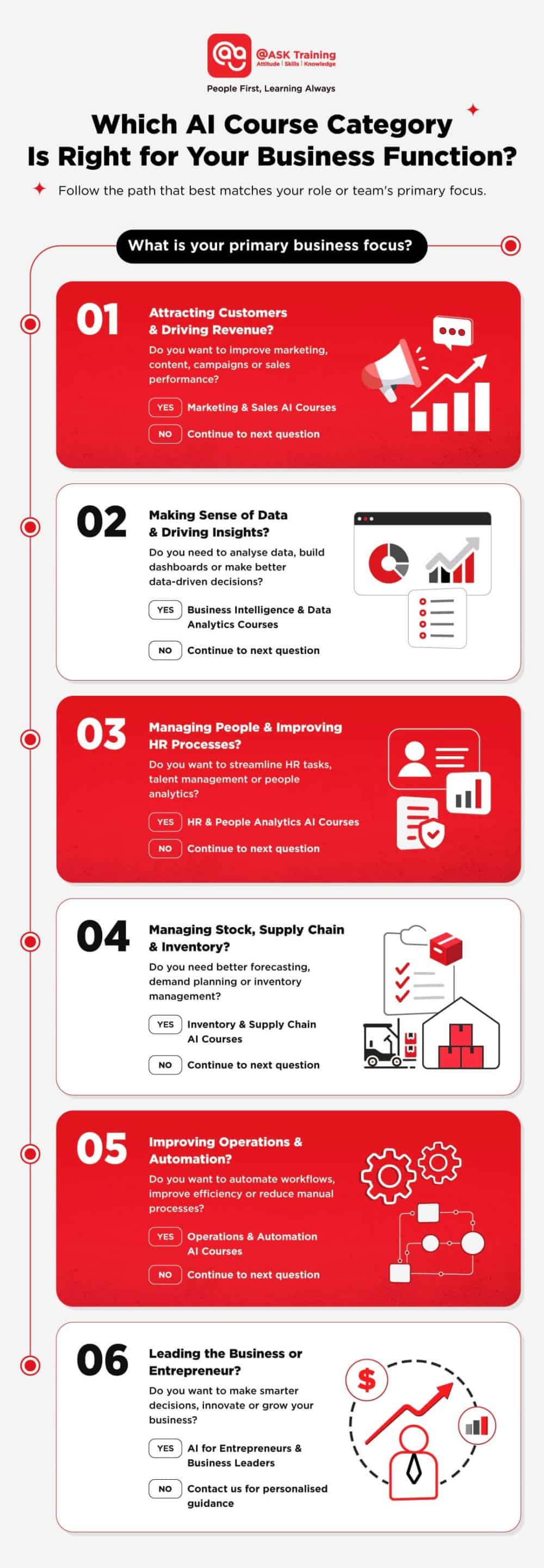
Use this visual guide to quickly match your business function with the right AI course category, whether you’re in HR, finance, marketing, or operations.
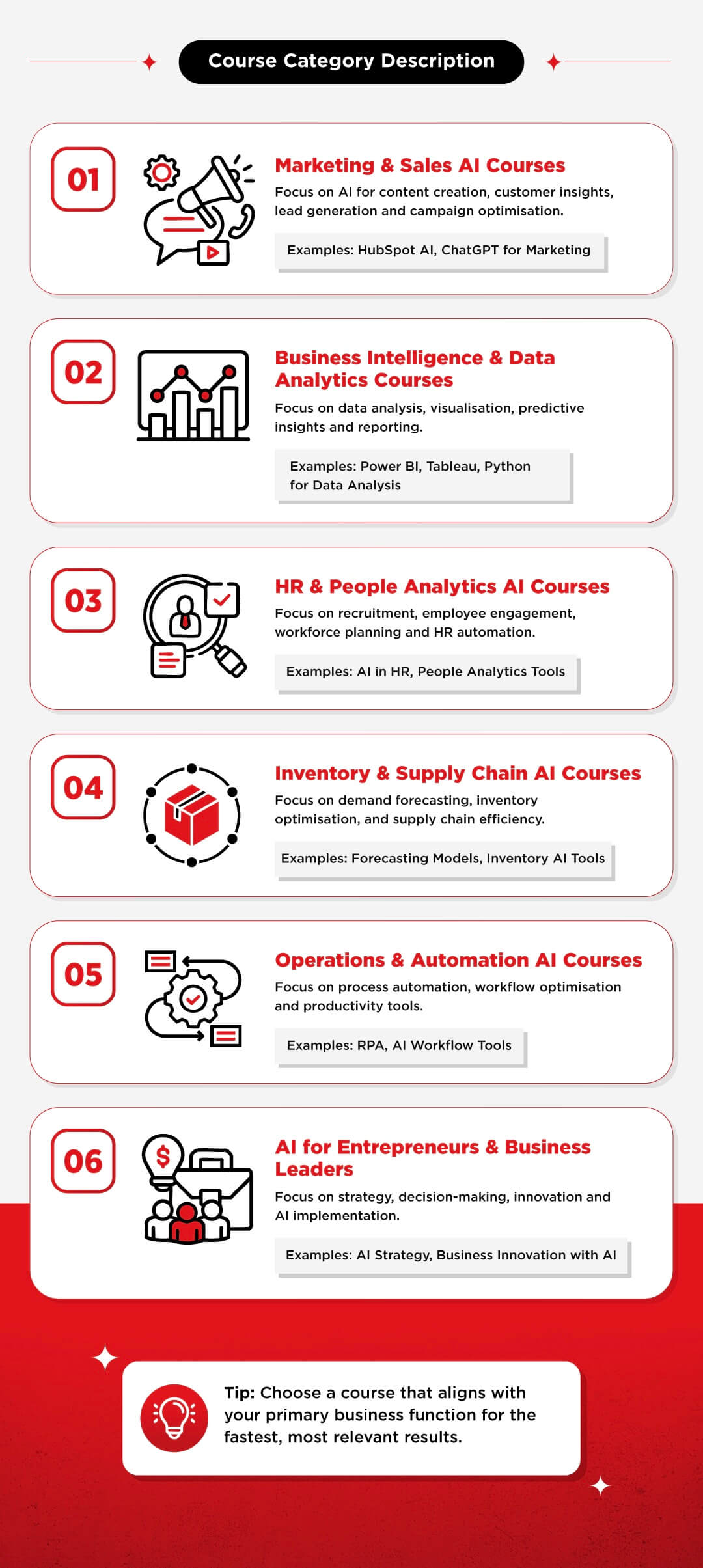
Now that you understand the different course categories, let’s drill down into which specific type of training makes the most sense for your particular role or department.
Match the AI Course to Your Role, Team, or Business Function
One of the fastest ways to narrow your options is to choose an AI course that aligns with your role or business function.
While many AI tools can be used across departments, the challenges faced by HR teams, finance professionals, marketers, operations managers, and business owners are very different.
A course that focuses on your specific area of responsibility is more likely to deliver immediate workplace benefits and measurable results.
The following examples illustrate how different business functions can apply AI and the types of courses that may be most relevant.
1. HR Professionals
An AI programme focused on HR can help improve:
- Recruitment workflows
- Resume screening
- Workforce planning
- Employee engagement
- Learning and development
For example: An HR manager hiring for multiple positions may use AI tools to summarise resumes, identify key skills, draft interview questions, and create onboarding materials. This can reduce administrative workload and allow HR teams to spend more time on strategic workforce planning and employee development.
2. Finance and Business Intelligence Teams
Finance professionals can benefit from AI applications that support:
- Reporting automation
- Financial forecasting
- Risk management
- Dashboard creation
- Data analysis
For example: A finance manager may use AI to automate recurring reports, identify unusual spending patterns, summarise financial data, and generate insights that support faster decision-making. Similarly, business intelligence teams can use AI to uncover trends and visualise data more efficiently.
3. Marketing and Sales Teams
Marketing and sales teams can use AI to improve:
- Content creation
- Campaign planning
- Customer segmentation
- Lead generation
- Customer engagement
- Marketing analytics
For example: A marketing manager may use AI to generate campaign concepts, draft social media content, personalise customer communications, and analyse campaign performance. Sales teams can use AI to identify qualified leads and prepare outreach messages. The results? More leads, better engagement, and less busywork.
4. Operations and Inventory Teams
Operations-focused AI training can help organisations:
- Reduce repetitive manual work
- Improve process efficiency
- Optimise inventory levels
- Forecast demand
- Enhance workflow visibility
For example:
- An operations manager may use AI to identify workflow bottlenecks, automate routine administrative tasks, forecast resource requirements, or improve production planning.
- Inventory teams can use AI to analyse purchasing patterns, predict demand fluctuations, and reduce overstocking or stock shortages.
AI helps operations run leaner and smarter.
Once you’ve identified the right course category for your role, the next critical factor is ensuring the training is hands-on and practical.
Look for Hands-On Training With Tools You Can Use at Work
Theory alone rarely delivers workplace transformation. When evaluating courses, prioritise programmes that provide hands-on exercises and practical implementation.
Look for courses that include:
- Guided prompts for real-world scenarios
- Business case studies relevant to your industry
- Workflow templates you can adapt immediately
- Dashboards and reporting tools for data-driven decisions
- Practical assignments that simulate actual workplace challenges
Many learners specifically seek an AI productivity course in Singapore because they want techniques they can implement immediately after training. The most valuable courses teach repeatable workflows rather than isolated demonstrations.
Useful workplace tools may include:
- ChatGPT
- Microsoft Copilot
- DeepSeek
- Claude
- Gemini
For example: A business intelligence programme should help you build actionable dashboards and reports rather than simply explaining analytics concepts. Similarly, an AI course for business owners in Singapore should demonstrate how AI can improve decision-making, customer engagement, and operational efficiency within a real business environment.
Here’s what can look like:
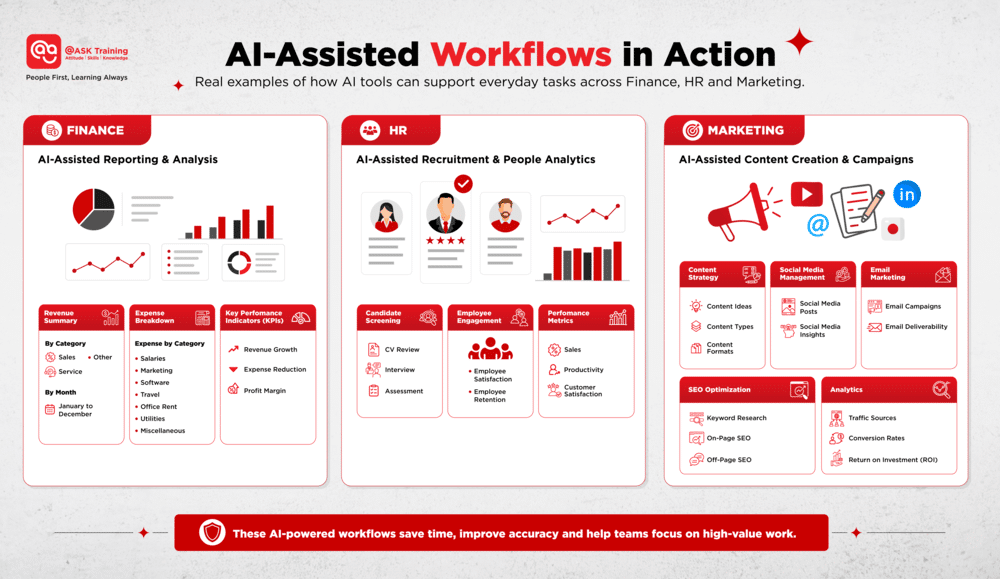
Ask yourself: Will I walk out of this course with something I can use tomorrow? If the answer is no, keep looking.
With practical training identified, you’ll also need to consider practical logistics. Let’s explore more next.
Compare Duration, Funding, and Workplace Applicability
Choosing the right AI course is not only about the topics covered. You also need to determine whether the programme fits your schedule, budget, and learning objectives.
More importantly, consider how quickly you can apply the skills in your day-to-day work.
You should consider:
- Course duration and intensity
- Delivery format (in-person, virtual, or hybrid)
- Schedule flexibility (weekday, weekend, or self-paced)
- Funding eligibility and subsidies
- Final payable fees after funding
Singapore offers several funding schemes that may help reduce training costs for both individuals and employers. Before enrolling, check whether the course is eligible for government-supported funding, as subsidies and credits can significantly lower the out-of-pocket cost of training.
This is particularly valuable for mid-career professionals looking to upskill and businesses planning to train multiple employees.
These can include:
- SkillsFuture Credit
- Skills and Workforce Development Agency (SWDA) subsidies
- Post-Secondary Education Account (PSEA) claims where applicable
- SkillsFuture Enterprise Credit (SFEC) for businesses
As a general guideline:
1. One-Day Programmes
Best suited for:
- AI awareness and introduction
- Productivity improvement with AI tools
- Understanding generative AI fundamentals
2. Two- to Four-Day Programmes
Best suited for:
- Department-specific AI implementation
- Business function training (HR, Finance, Marketing, etc.)
- Workflow redesign and process optimisation
- Practical application projects with measurable outcomes
Business owners should also consider team-wide training rather than focusing solely on individual upskilling.
While training one employee can help introduce AI into the organisation, broader adoption often happens more effectively when multiple team members share a common understanding of the tools, workflows, and best practices.
This can improve collaboration, encourage knowledge sharing, and increase the likelihood of AI being integrated into daily operations.
With all these factors in mind, let’s bring everything together into a simple framework for making your final decision.
How to Choose the Right AI Course in Singapore
When comparing programmes, focus on the factors that matter most to your workplace goals. Ask these questions:
1. What business problem am I trying to solve?
Start with the outcome rather than the technology. The best course solves a real challenge you face today.
2. Does the course match my role?
Choose programmes aligned with your responsibilities. A marketing manager needs different skills than a finance director.
3. Is the content practical?
Look for hands-on exercises, workplace examples, and actionable frameworks. Theory is useless without application.
4. Which tools are covered?
Ensure the course includes tools you can realistically use after training, not just proprietary or outdated software.
5. What funding is available?
Check eligibility for subsidies and credits. Training doesn’t have to break the bank.
6. Is the provider credible?
Review trainer experience, case studies, industry relevance, and learner outcomes. Reputation matters.
7. Can I apply what I learnimmediately?
The best programmes create measurable workplace improvements within weeks, not months or years.
Whether you are considering an AI course for entrepreneurs in Singapore, a marketing-focused AI programme, a business intelligence course, or operations automation training, start by identifying the outcomes you want to achieve.
Regardless of the course category, practical relevance should remain your primary selection criterion.
Wrapping Up
Choosing the right AI course in Singapore starts with understanding your business or career objective.
The most effective course is not necessarily the most technical. It is the one that helps you solve real workplace challenges and deliver measurable results.
Before enrolling, compare:
- Business relevance to your role and industry
- Hands-on training opportunities with real-world scenarios
- AI tools covered and their applicability to your work
- Funding support to reduce out-of-pocket costs
- Course duration and schedule flexibility
- Provider credibility and trainer expertise
Whether you are a mid-career professional, SME owner, entrepreneur, team leader, or employer, the right AI training Singapore programme can help you improve productivity, strengthen decision-making, and create meaningful workplace impact.
If you are exploring your options, consider reviewing available business-focused AI programmes across HR, finance, business intelligence, marketing, operations, inventory management, and productivity.
Selecting the course that best matches your role and goals will give you the strongest foundation for successful AI adoption.
Augmenting your career with AI doesn’t have to be complicated – start with the course that solves your biggest business challenge today.
Explore @ASK Training’s Generative AI Courses
Now that you have a clear framework for choosing the right AI course, it’s time to explore programmes designed for professionals like you.
@ASK Training offers practical, hands-on Generative AI courses tailored to specific business functions.
These courses focus on real-world application, helping you use AI tools like ChatGPT, Microsoft Copilot, and DeepSeek to solve actual workplace challenges from day one.
Which course matches your role?
| Your Role / Function | Recommended Course |
| Sales & Marketing | (32hrs) AI Driven Sales & Marketing: Boosting Engagement & Conversions |
| Finance | (24hrs) AI-Powered Finance: Automating Insights & Risk Management |
| HR & Talent Management | (24hrs) AI in HR: Transforming Talent Acquisition & Workforce Management |
| Operations | (24hrs) AI in Operations: Enhancing Workflow Efficiency & Automation |
| Business Intelligence | (24hrs) AI-Driven Business Intelligence: Smarter Reporting & Analytics |
| Inventory Management | (24hrs) AI Smart Inventory: Predictive Analytics & Optimisation |
For professionals seeking broader productivity gains, consider these short, impactful programmes:
- Beyond ChatGPT: The Ultimate GenAI Toolkit for Workplace Productivity (1 Day)
- AI-Ready Mindset: Building Confidence, Adaptability & Human Skills In The AI Era (1 Day)
All courses are designed for non-technical professionals and focus on immediate workplace application.
Many are also eligible for SkillsFuture funding, PSEA, and UTAP claims, making quality AI training more accessible.
Take the next step in your AI upskilling journey!