
AI Smart Inventory: Predictive Analytics & Optimisation
Eliminate stockouts and holding overage by applying predictive AI models, automated demand forecasting, and smart supply chain analytics.

Transform Operations with Predictive Inventory Models
Course Synopsis
In an era of global logistics volatility and rising operational overheads, traditional manual inventory management is no longer sustainable for Singaporean enterprises. This three-day intensive program transitions teams from reactive “firefighting” to proactive orchestration. Moving beyond basic chatbots, participants will leverage Generative AI tools like ChatGPT, Microsoft Copilot, and DeepSeek as a “Digital Chief of Staff” to automate complex workflows and recover lost man-hours.
The curriculum masters “Semantic Data Harmonization” to instantly reconcile disparate regional datasets and “Predictive Dynamics” to mitigate risks like port congestion or freight hikes. Professionals will learn to conduct AI-powered supplier audits, role-play high-stakes negotiations to protect margins, and ensure full compliance with the Singapore Green Plan 2030 and PDPA. These modules bridge the gap between raw inventory data and strategic executive narratives.
The program culminates in the creation of a “Collective Intelligence Loop” and a customized 90-day implementation roadmap. By building a Master Prompt Library and specialized AI “Analysts” trained on company-specific SOPs, organizations can institutionalize AI gains. This ensures long-term resilience, capital efficiency, and a sustainable competitive advantage in the interconnected ASEAN market.
Course Objectives
By the end of this course, you should be able to:
- Master AI Prompt Engineering to automate data reconciliation and eliminate manual “spreadsheet fatigue” across regional supply chains.
- Implement Predictive Dynamics to forecast demand and mitigate the impact of global port congestion and freight volatility on local stock levels.
- Enhance Procurement Outcomes through AI-powered risk scorecards and data-backed negotiation strategies to protect profit margins.
- Operationalize Sustainable Logistics by optimizing delivery sequences and verifying supplier claims in alignment with the Singapore Green Plan 2030.
- Scale Organizational Intelligence by building secure AI governance frameworks and a 90-day implementation roadmap to institutionalize AI workflows.
Curriculum & Modular Breakdown
- Practical Assessment
- Written Assessment
Learning Unit 1: Operational Efficiency & Data Automation
- Topic 1: The Digital Force Multiplier – Induction into the AI “Chief of Staff” model
- Topic 2: Ending “Spreadsheet Fatigue” – Intelligent data cleaning and reconciliation
- Topic 3: The “Set-and-Forget” Procurement Office – Building autonomous workflows for POs and notifications
- Topic 4: Precision Logistics Orchestration – Optimizing last-mile delivery and routing sequences
Learning Unit 2: Predictive Intelligence & Risk Resilience
- Topic 5: The Risk-Proof Supply Chain – Predictive foresight for demand and safety stock
- Topic 6: Intelligent Partner Scoring – Evaluating hidden costs and supplier reliability
- Topic 7: 360° Supplier Intelligence – Identifying early warning signs and regional risks
- Topic 8: The Data-Backed Negotiator – Leveraging market benchmarks to protect profit margins
Learning Unit 3: Governance, Compliance & Strategic Value
- Topic 9: Bulletproof Contract Review – Instant risk detection and PDPA compliance
- Topic 10: The Green Growth Advantage – Automating ESG reporting for the Singapore Green Plan 2030
- Topic 11: Executive-Ready Strategic Narratives – Translating data into persuasive stories for management
- Topic 12: The Secure AI Framework – Safeguarding IP and implementing data masking
Learning Unit 4: Operational Excellence & Value Scaling
- Topic 13: Your In-House AI Specialist – Building custom agents trained on company SOPs
- Topic 14: Collective Team Intelligence – Creating a “Gold Standard” shared prompt library
- Topic 15: The 90-Day Transformation Roadmap – Executing the strategic plan for full-scale integration
Entry Requirements
Experience:
Minimal one year of work experience with knowledge of inventory management.
Language
- Attained at least WPLN level 6; or
- Obtained Grade C6 for GCE O-Level English; or
- Other equivalent qualifications.
Academic
- Obtained at least a pass or C6 at GCE O-Level in at least 3 subjects; or
- Candidates with other qualifications will be considered on a case-by-case basis; or
- Mature candidates aged ≥ 30 years old with 8 years of relevant working experience.
Learn from Certified Trainers
This programme is delivered entirely in-person by certified industry practitioners. Our trainers bring years of real-world agency and corporate deployment experience, ensuring you move beyond abstract theory into practical, job-ready tool execution.
Fees & Subsidies
For Singapore Citizens aged 17-30 Post Secondary Education Account Funds can be used.
(24hrs) AI Smart Inventory: Predictive Analytics & Optimisation
 3 Days (9.00am - 6.00pm)
 S$1,362.50 (inclusive of 9% GST)
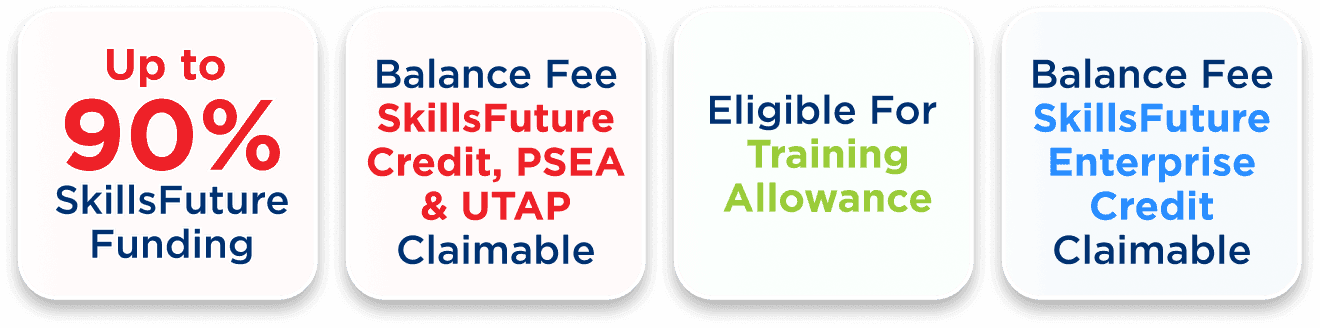
 From S$158.75 (inclusive of 9% GST) after 90% SWDA Subsidies
- SkillsFuture Credits, PSEA & UTAP Claimable
- SkillsFuture Enterprise Credits claimable
Continue Your AI Upskilling Journey

In this AI in Operations course, you'll learn to automate workflows, forecast demand, reduce waste, and build smarter, data-driven operations.
3 Days (9.00am - 6.00pm)
In this AI Business Intelligence course, you'll learn to automate reporting, build dashboards, analyse data, and make smarter decisions with AI.
3 Days (9.00am - 6.00pm)
In this AI-Powered Finance course, you'll learn to automate accounting workflows, manage financial risks, strengthen compliance, and drive smarter finance operations.
3 Days (9.00am - 6.00pm)