
You've used ChatGPT to draft an email. Maybe your team has too, for a proposal, a social caption, or a meeting summary. It felt like progress.
But months later, that's still all anyone's doing with it, and you have a nagging sense the business is missing something bigger.
You're not wrong, and you're not alone. Singapore's SME AI adoption tripled between 2023 and 2024, but look closer, and 84% of businesses using AI are only using basic, off-the-shelf tools- the same starting point everyone begins at, and where most also get stuck.
This is the gap this guide is built to close: what it actually takes to move from occasional AI use to AI that runs parts of the business, reliably, and without creating new risks.
Whether you're leading a team or running the whole show yourself, the questions are the same: What comes after "I've tried ChatGPT a few times"?
How do you turn AI into something that reliably saves you time every week? And how do you do that without creating new risks around data and compliance, such as Singapore's PDPA, or losing the human touch that got you here?
This guide walks through where most businesses get stuck, what moving forward actually looks like, and how to start, without needing a tech team or a big budget.
What Is the State of AI Adoption Among Singapore Businesses Today?
AI adoption among Singapore SMEs more than tripled in a single year: from 4.2% in 2023 to 14.5% in 2024, according to the Infocomm Media Development Authority's (IMDA) Singapore Digital Economy Report 2025. That's real momentum. Larger companies are further ahead, at 62.5% adoption.
But growth in adoption doesn't mean growth in depth.
The same report found that 84% of businesses using AI rely purely on basic tools like the free or standard versions of ChatGPT or Copilot, with very few using more advanced, tailored AI solutions built for their specific industry.
In other words, most businesses have opened the door to AI. Very few have walked through it.
The question, then, isn't whether your business has "tried AI"; it's whether that trial has actually turned into anything structured yet.
Why Do Most Businesses Get Stuck at AI Experimentation?
Most businesses' AI journey looks the same: someone tries ChatGPT for an email or a social caption, it works, and that becomes the extent of "our AI strategy."
There's no structured process to go further, no one mapping AI onto actual workflows, no plan for automation, no one thinking about governance until something goes wrong.
Staying stuck here has a real cost, even if you don't see it on the books right away:
- Wasted subscriptions. Paying for AI tools that a handful of staff use occasionally, with no measurable return.
- Falling behind, quietly. Competitors who move from experimentation to automation start pulling ahead on speed and cost — a gap that widens over time.
- Hidden risk. Using AI casually with no clear rules in place is often riskier than not using it at all, especially when it comes to handling data (under Singapore's PDPA).
The businesses that break out of this stage aren't necessarily the ones with the biggest budgets. They're the ones with a clear framework for what "further" actually looks like — which is exactly what the next section lays out.
What Are the Stages of AI Maturity for a Business?
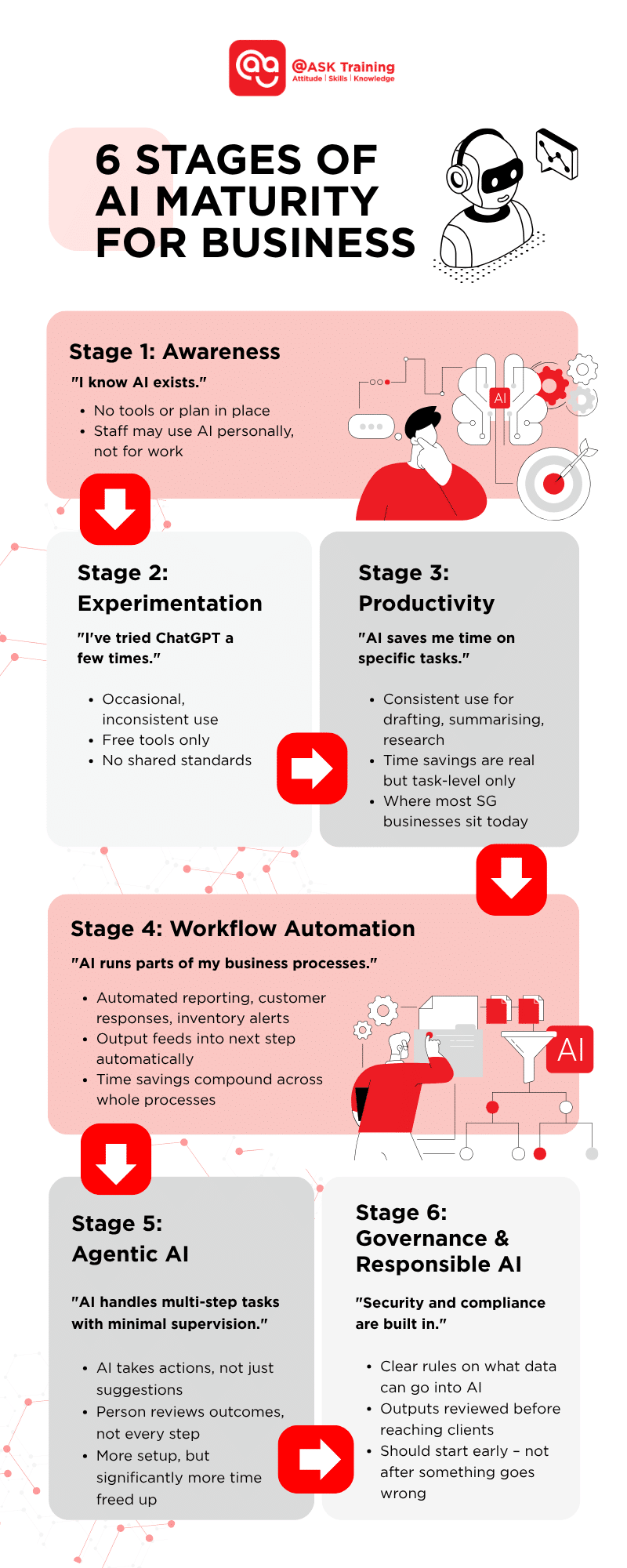
Progressing with AI tends to follow a predictable path. Most businesses move through these stages roughly in order:
1. Awareness
You know AI exists and roughly what it can do, but haven't used it in the business yet.
- Staff may have used AI personally, but not for work
- No tools, budget, or plan for AI has been discussed at the business level
2. Experimentation
Individual staff (or you) try out everyday AI tools now and then, without any real plan behind it.
- Use is occasional, personal, and inconsistent across the team
- Usually limited to free or basic tiers of tools like ChatGPT or Copilot
- No shared standards for what AI should or shouldn't be used for
3. Productivity
AI is used consistently for specific tasks; saving real, noticeable time.
- Common uses: drafting content, summarising documents, basic research
- Time savings are real but stay confined to individual tasks, not whole processes
- This is where most Singapore businesses currently sit
4. Workflow Automation
AI is built into actual business processes, not just individual tasks.
- Examples: automated reporting, customer response workflows, inventory alerts
- The output of one AI step feeds directly into the next step, without manual handoffs
- Time savings compound across a whole process, not just one task
5. Agentic AI
AI systems (agents) handle multi-step tasks with minimal supervision, working across tools on your behalf.
- The AI takes actions, not just suggestions: checking data, drafting responses, flagging exceptions
- A person reviews outcomes and makes final decisions, rather than directing every step
- Requires more setup, but frees up significantly more time than automation alone
6. Governance & Responsible AI
Data security, compliance, and risk management are built into how AI is used, not bolted on after a problem occurs.
- Clear rules exist for what data can and can't go into AI tools
- AI-generated outputs are reviewed before they reach a client or inform a decision
- This stage runs alongside the others, not after them; governance should start as early as stage 2
Most businesses in Singapore today sit somewhere between stage 2 and 3. The rest of this guide covers what it takes to move through stages 4 to 6, the stages where the real business value (and the real risk) lives.
We'll start with the skills stage 3 businesses need to build before they can move any further.
What AI Skills Does a Business Need Beyond Basic Prompting?
Knowing how to write a good ChatGPT prompt is a starting skill, not an endpoint. Beyond prompting, the skill that actually moves the needle is workflow redesign: looking at a real business process end-to-end and figuring out where AI can take over, assist, or accelerate a step.
The difference in practice:
- Prompting skill: "Use AI to write a better customer email."
- Workflow redesign: "Redesign the customer inquiry process so AI drafts the first response, flags urgent cases, and logs the interaction automatically."
The second one is where the actual time savings show up, because it changes a process, not just one task inside it.
This is also where role-specific training outperforms generic AI courses, since "practical AI skills" look different depending on the job:
- Finance teams: Applying AI to reporting, reconciliation, and risk flagging
- Marketing teams: Applying AI to campaign content, targeting, and performance tracking
- Operations teams: Applying AI to demand forecasting and process automation
- HR teams: Applying AI to screening, workforce planning, and policy drafting
Once workflow redesign is in place, the next stage takes it a step further: instead of a person directing AI through each step, the AI starts handling entire sequences on its own.
What is an AI Agent and How Can a Small Team Use One?
An AI agent is a system that can complete a multi-step task on its own, not just answering one question, but carrying out a sequence of actions toward a goal, often across multiple tools, with a person checking in rather than directing every step.
A simple example, an inventory reorder, handled by an agent instead of a person:
- Monitors stock levels across your systems
- Flags items running low
- Drafts the reorder request to your supplier
- Notifies you only when a decision is actually needed
You've gone from doing three tasks to reviewing one decision.
For a small team or solo operator, this is often where AI has the highest leverage, not because it replaces judgement, but because it removes the repetitive steps around judgement, freeing up time for the decisions that actually need a human.
But the more AI does on your behalf, the more it touches sensitive business and customer data, which is exactly where governance comes in.
How Do Businesses Manage AI Governance and Data Security Risks?
AI governance means having clear rules for what data can go into AI tools, who can use AI for what, and how outputs get checked before they're relied on, and it becomes more important, not less, as AI moves deeper into daily operations.
Here's a scenario that plays out more often than businesses realise:
An employee pastes a client's contract, financial details, or personal data into a free AI tool to get a quick summary, without realising that data may be stored, used for training, or otherwise outside the business's control. No malicious intent, just no governance in place.
As AI use grows from the occasional prompt to full workflows and AI agents, more business and customer data ends up passing through these tools.
Getting the basics right doesn't require a compliance department, just a few clear rules:
- Which tools staff are allowed to use for work
- What information should never be typed or pasted into an AI tool
- Who double-checks AI-generated work before it reaches a client or gets acted on
Sorting this out early is far easier than fixing it after something goes wrong.
Governance protects the business. But there's a second, quieter concern that often sits behind slow AI adoption: what all this automation means for the people doing the work.
Will AI Replace Jobs or Augment Them?
AI augments work; it takes over repetitive, structured tasks so people can spend more time on the things that actually require judgement, relationships, and expertise, which is exactly the work small businesses and solopreneurs built their business on in the first place.
This is worth saying plainly, because it's often the real hesitation behind "we're not ready for AI": a quiet worry about what it means for the team, or for the owner's own role.
But workflow automation and agentic AI aren't about removing the people who understand the customer, the craft, or the industry. In practice, the split usually looks like this:
- What AI takes over: chasing paperwork, retyping reports, drafting routine emails, monitoring for exceptions
- What stays human: client relationships, judgement calls, creative and strategic decisions, the craft or expertise the business was built on
The businesses that get the most out of AI treat it as something that extends what their people are good at, not something that replaces them.
Building this mindset, alongside the technical skills, is part of what makes AI adoption sustainable rather than something that stalls after the first attempt.
None of this progression is worth much if the cost of training feels out of reach, so it's worth knowing just how much of it is already subsidised in Singapore.
Is AI Training in Singapore Government-Funded?
Yes – most WSQ-accredited AI training in Singapore is eligible for SkillsFuture funding, and this applies to individuals as well as registered companies, which matters for solopreneurs who often assume funding support is only for businesses with employees.
A few funding avenues worth knowing:
1. SkillsFutureCredit:
- Usable by Singapore Citizens aged 25 and above, including sole proprietors and self-employed individuals, to offset course fees directly.
2. SkillsFutureEnterprise Credit (SFEC)
- Reimburses or offsets up to 90% of eligible out-of-pocket training costs for employers, up to a S$10,000 cap, on top of upfront course subsidies.
- The current SFEC expires 30 November 2026, after which a redesigned version launches on 1 December 2026 under the new Enterprise Workforce Transformation Package (EWTP), giving eligible companies a fresh credit usable upfront rather than by reimbursement.
- Worth checking current terms at the time of enrolment.
3. Enhanced Training Support for SMEs
- Provides subsidies of up to 90% on eligible course fees for SMEs sponsoring Singapore Citizen or PR staff.
4. UTAP and PSEA
- Additional claimable support depending on eligibility: UTAP for NTUC members (self‑sponsored courses), and PSEA for younger Singaporeans with an active Post‑Secondary Education Account.
Combined, these can bring a multi-day AI course down from four figures to a fraction of that cost, which changes the calculation for a business owner who's been treating AI training as a "someday" investment.
How Ready Is Your Business to Move to the Next Stage?
Before deciding where to start, it helps to know where you actually stand. Check off what's already true for your business:
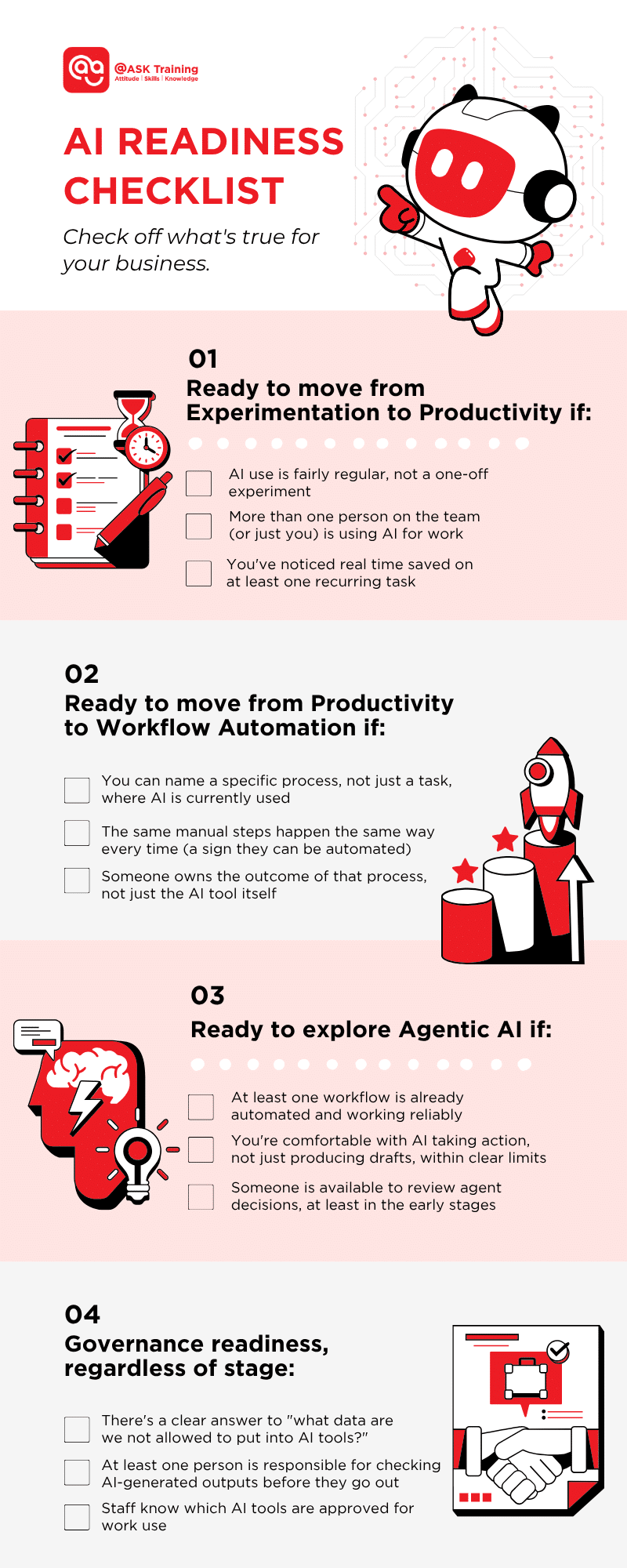
If most boxes in a section are unchecked, that's not a bad sign; it just tells you where to focus next, which is exactly what the rest of this guide is for.
With clarity and cost less of a barrier, the real question becomes where to actually begin.
How Should a Business Start Its AI Journey?
Start with one workflow, not a full transformation. Pick a single repetitive task or process and apply AI to just that, before expanding further.
A few common starting points:
- Customer inquiries: first-response drafting or triage
- Monthly reporting: pulling and summarising recurring data
- Inventory checks: stock monitoring and reorder alerts
This matters more for smaller operations, not less. A 200-person company can afford a stalled pilot project. A solopreneur or a five-person team can't. Every hour spent on the wrong thing is an hour not spent serving clients.
The businesses that succeed with AI usually aren't the ones that tried to do everything at once; they're the ones that picked one real problem, solved it with AI, and used that result to justify the next step.
The Bottom Line
That email you drafted with ChatGPT months ago wasn't wasted effort; it was step one.
The businesses pulling ahead in Singapore right now aren't the ones with the biggest AI budgets; they're the ones that treated that first step as the start of a progression, not the end of one.
Awareness to experimentation, experimentation to productivity, productivity to automation, automation to agents, and governance built in along the way – each stage compounds into the next, and none of it requires replacing the people who built the business in the first place.
The next step doesn't have to be a leap. It just has to be the next one.
How Can @ASK Training Help You Take the Next Step?
At @ASK Training, we no longer just teach people how to use AI tools; we help businesses build AI into how they actually operate.
Our Generative AI courses are structured around exactly this progression, from practical, role-specific AI skills to workflow automation, agentic AI, and governance, with most courses SkillsFuture-funded.
Where to start depends on where you are right now:
Leading a team?
Try out these two courses that you can apply directly to your function's workflow:
- (24hrs) AI in Operations: Enhancing Workflow Efficiency & Automation, or
- (32hrs) AI Driven Sales & Marketing: Boosting Engagement & Conversions
Ready to explore automation further?
- Our 1-day AI Agents Made Easy: Let AI Do the Work for You course is a direct, no-code introduction to building and managing AI agents.
The human side of this transition on your mind?
- Our 1-day AI-Ready Mindset course builds confidence and adaptability for yourself or your team in an AI-enabled workplace.
Working solo or leading a lean team, not sure where to start?
- Our 1-day Beyond ChatGPT: The Ultimate GenAI Toolkit for Workplace Productivity course is a practical, one-day entry point covering eight tools you can apply immediately.
Explore our Generative AI courses today, or if you're unsure, feel free to speak to our programme consultants, and we'll be happy to help!
Related Courses
- (1 Day) AI Agents Made Easy: Let AI Do the Work for You
- (24 hrs) AI in Operations: Enhancing Workflow Efficiency & Automation
- (32 hrs) AI Driven Sales & Marketing: Boosting Engagement & Conversions
- (1 Day) AI-Ready Mindset: Building Confidence, Adaptability & Human Skills in the AI Era
◆◆◆
Related Articles
Article Topics
- What Is the State of AI Adoption Among Singapore Businesses Today?
- Why Do Most Businesses Get Stuck at AI Experimentation?
- What Are the Stages of AI Maturity for a Business?
- What AI Skills Does a Business Need Beyond Basic Prompting?
- What is an AI Agent and How Can a Small Team Use One?
- How Do Businesses Manage AI Governance and Data Security Risks?
- Will AI Replace Jobs or Augment Them?
- Is AI Training in Singapore Government-Funded?
- How Ready Is Your Business to Move to the Next Stage?
- How Should a Business Start Its AI Journey?
- The Bottom Line