
As organisations continue moving applications, data, and infrastructure to the cloud, demand for security professionals continues to grow.
However, many aspiring professionals find themselves comparing cloud security vs cybersecurity and wondering which career path offers the better fit.
The challenge is that these terms are often used interchangeably, even though they refer to different areas of security.
Cybersecurity is the broader discipline focused on protecting systems, networks, devices, applications, and data from cyber threats.
Cloud security is a specialised area within cybersecurity that focuses on securing cloud environments, infrastructure, identities, and cloud-hosted applications.
Neither path is inherently better than the other. The right choice depends on your interests, existing technical background, and long-term career goals.
This guide breaks down the key differences, the required skills, and the available roles so you can make a more informed career decision.
What Is Cybersecurity?
Cybersecurity is the practice of protecting digital assets from unauthorised access, attacks, misuse, and disruption. These digital assets include networks, computers, servers, applications, databases, and the sensitive information that organisations rely on every day.
The goal of cybersecurity is not only to prevent cyber-attacks but also to detect threats quickly, respond effectively, and minimise the impact of security incidents when they occur.
As organisations become increasingly dependent on digital technologies, cybersecurity has evolved into a critical business function.
Whether it is a bank protecting customer data, a retailer securing online transactions, or a healthcare provider safeguarding patient records, organisations across every industry need cybersecurity professionals to help manage risk and maintain trust.
It covers a wide range of disciplines, including:
- Security operations
- Network security
- Application security
- Incident response
- Threat intelligence
- Governance, risk, and compliance (GRC)
- Penetration testing
- Security architecture
Professionals working in a cybersecurity career may spend their time monitoring threats, investigating incidents, managing vulnerabilities, developing security policies, or helping organisations meet compliance requirements.
For example, a cybersecurity analyst may investigate suspicious login activity, review alerts from a Security Information and Event Management (SIEM) platform, document findings, and escalate confirmed threats to the incident response team.
Many large organisations maintain dedicated Security Operations Centres (SOCs) that continuously monitor for threats. Companies such as IBM, Accenture, and Deloitte operate extensive cybersecurity teams supporting clients around the world.
Importantly, cybersecurity professionals may work with cloud systems, but their responsibilities are not necessarily cloud-focused.
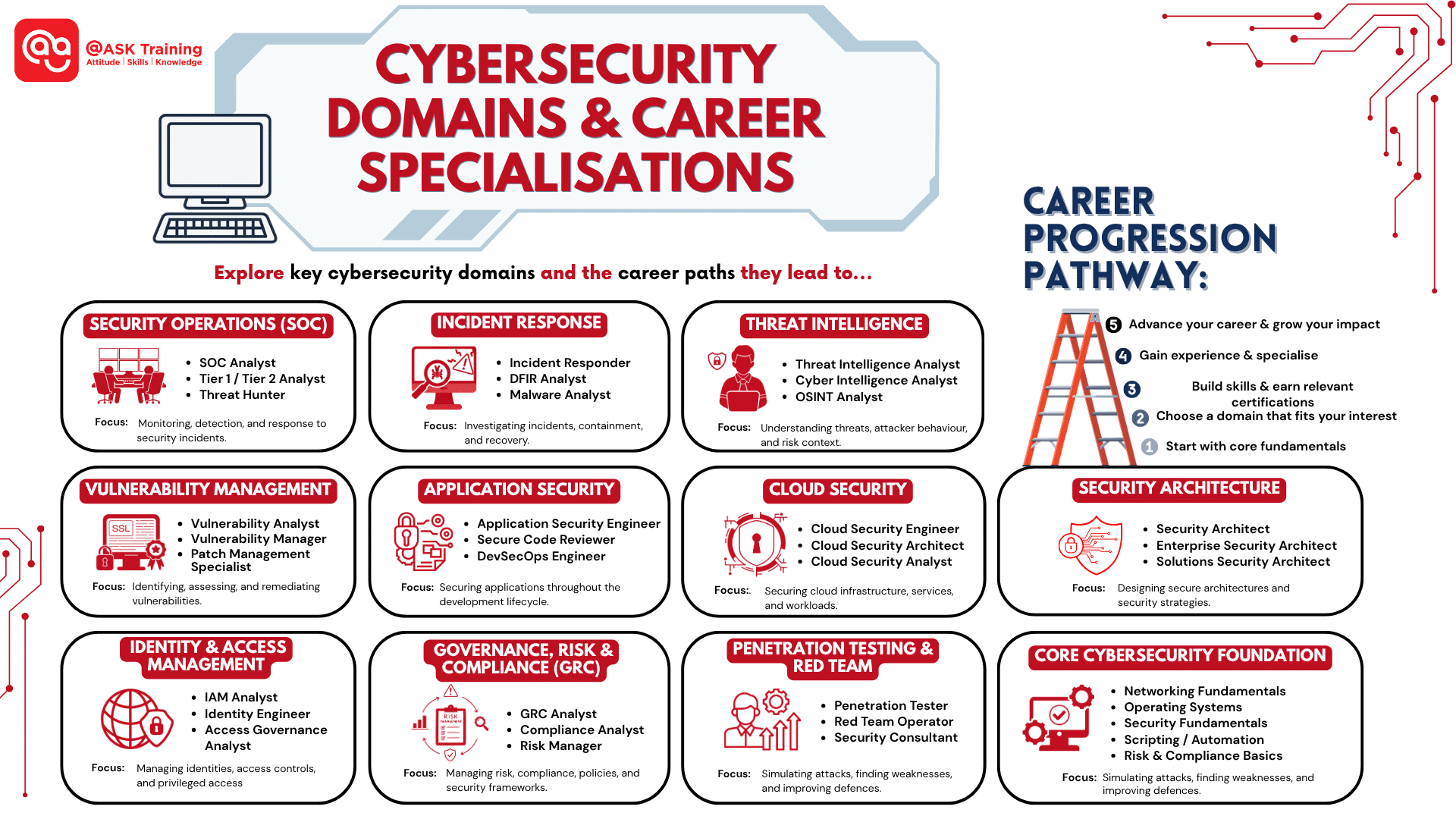
Here’s a simple guide on the key cybersecurity domains and career paths:
Now that we have established what cybersecurity encompasses, let us turn to its more specialised counterpart.
What Is Cloud Security?
Cloud security focuses specifically on protecting cloud-based infrastructure, applications, identities, and data.
As organisations increasingly move their systems, workloads, and sensitive information to the cloud, securing these environments has become a critical business priority.
Cloud security helps ensure that cloud resources are properly configured, access is tightly controlled, data is protected, and potential threats are detected before they can cause harm.
Unlike traditional cybersecurity roles that may cover an organisation's entire technology environment, cloud security professionals focus on the unique risks associated with cloud platforms and services.
This includes securing cloud accounts, managing identities and permissions, protecting cloud-hosted applications, monitoring activity across cloud environments, and helping organisations meet security and compliance requirements.
As organisations increasingly adopt platforms such as Amazon Web Services (AWS), Microsoft Azure, and Google Cloud, security professionals must understand how to secure these environments effectively.
A cloud security career typically involves areas such as:
- Identity and Access Management (IAM)
- Cloud networking
- Encryption
- Security monitoring
- Cloud governance
- Infrastructure as Code (IaC)
- Container security
- DevSecOps (integrating security into software development and deployment processes)
Cloud security builds upon traditional cybersecurity knowledge but adds cloud-platform expertise.
For example:
A cloud security engineer may review AWS IAM permissions, secure S3 storage, configure cloud logging, monitor security posture, and identify cloud resources that are unintentionally exposed to the internet.
Across Singapore, organisations in sectors such as banking, healthcare, government, and technology continue expanding their use of cloud services. As cloud adoption grows, professionals who understand both cybersecurity and cloud technologies are becoming increasingly valuable.
Here’s a simple guide on what a cloud architecture looks like by Google:
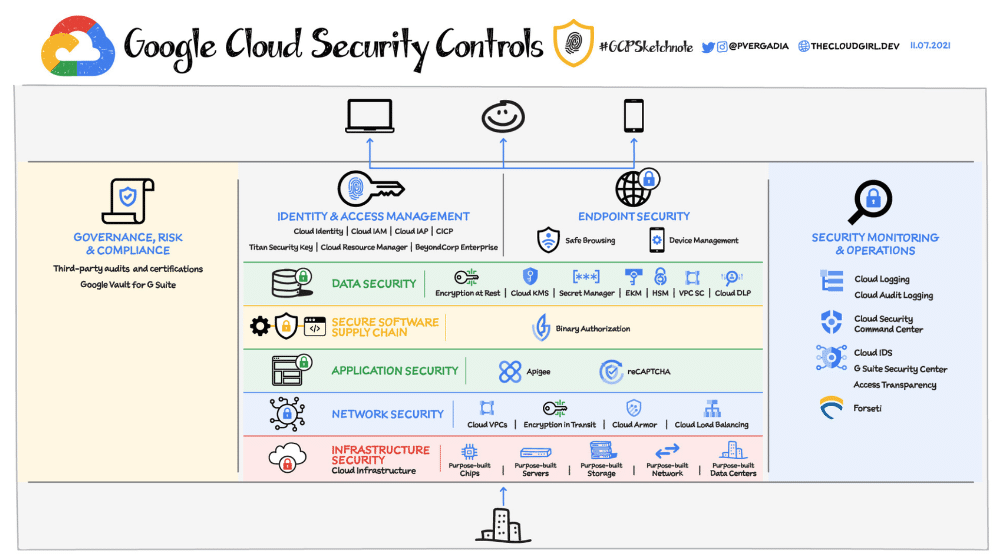
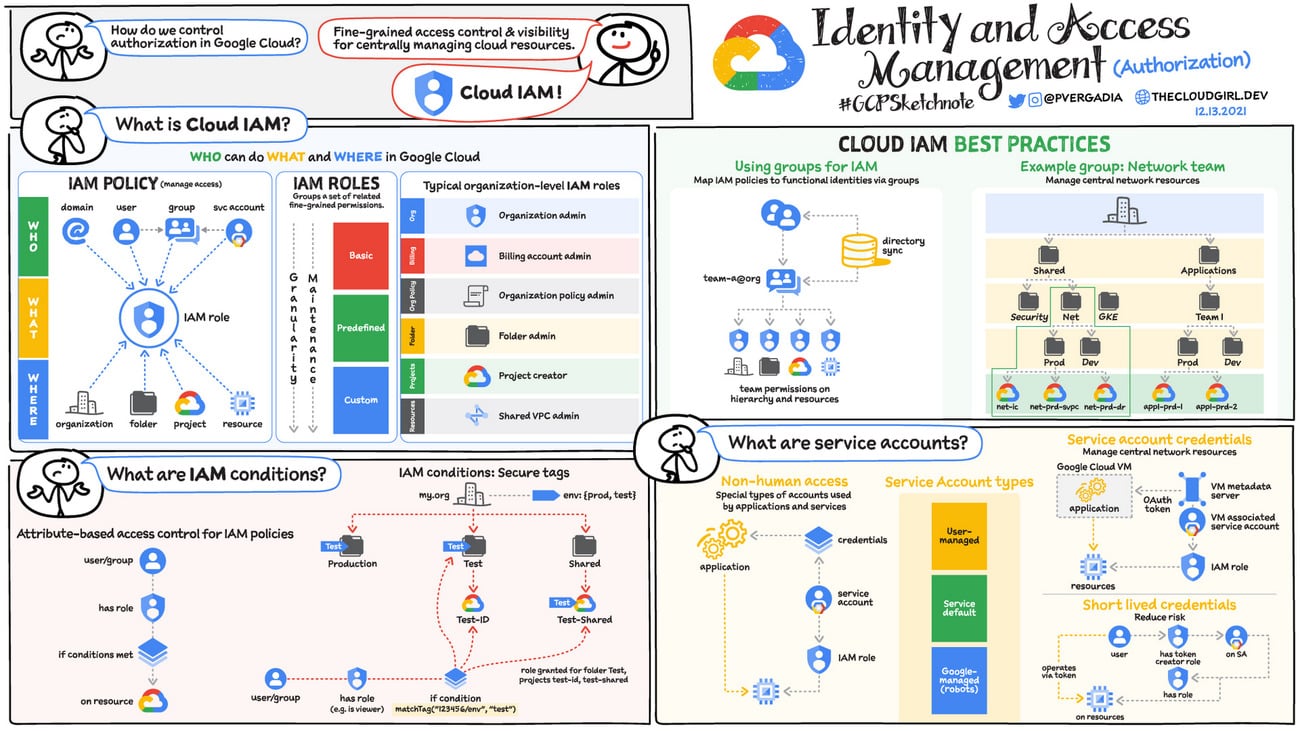
Google Cloud Security Overview (Source: Google Cloud)
With a clear understanding of what each field entails, the next logical question is: how do they actually differ in practice?
Cloud Security vs Cybersecurity: The Core Difference
At first glance, cloud security and cybersecurity can appear almost identical. Both focus on protecting systems, data, and users from cyber threats. Both require an understanding of security principles, risk management, identity controls, and incident response.
In fact, many of the concepts and best practices used in cloud security are built upon cybersecurity fundamentals, including frameworks such as the NIST Cybersecurity Framework.
For someone exploring a career in security, the distinction becomes clearer when looking at the type of work involved.
Cybersecurity roles often focus on protecting the organisation as a whole, including monitoring threats, investigating incidents, managing vulnerabilities, supporting compliance initiatives, and developing security controls across systems and technologies.
Cloud security roles take a more specialised approach. Rather than covering every aspect of organisational security, they focus on securing cloud environments and ensuring cloud services are configured, managed, and monitored securely.
This often requires a deeper understanding of cloud architecture, identity management, cloud networking, automation, and cloud-native security controls.
As more organisations migrate applications and data to cloud platforms, cloud security has become an increasingly important specialisation. However, it remains closely connected to cybersecurity because the same core security principles still apply.
The simplest way to understand the difference is through scope:
| Area | Cybersecurity | Cloud Security |
| Primary Focus | Organisation-wide security | Cloud environments and services |
| Common Work | Monitoring threats, incident response, vulnerability management | Cloud configuration, IAM, cloud infrastructure security |
| Typical Tools | SIEM, EDR, vulnerability scanners, firewalls | AWS Security Hub, Azure Defender, cloud-native security tools |
| Ideal Background | Networking, security operations, IT support | Cloud administration, infrastructure, DevOps |
Neither path is inherently better than the other. Cybersecurity offers exposure to a broader range of security disciplines, while cloud security provides an opportunity to develop deeper expertise in cloud technologies and infrastructure.
The right choice depends on your interests, existing experience, and long-term career goals. Understanding how these differences translate into day-to-day responsibilities can make it easier to determine which path aligns best with the type of work you enjoy.
Next, let’s see how it plays out in a typical workday that makes the comparison truly tangible.
How the Daily Work Differs
One of the best ways to understand the difference between cloud security and cybersecurity is to look at the work professionals perform daily.
Although both career paths focus on protecting organisations from cyber threats, their responsibilities, priorities, and areas of focus can vary significantly.
Cybersecurity roles often centre on:
- Identifying threats
- Investigating suspicious activity
- Managing security incidents
- Helping organisations reduce risk across their broader technology environment
Depending on the role, a typical day may involve analysing security alerts, investigating potential breaches, reviewing vulnerabilities, conducting security assessments, or supporting compliance initiatives.
Cloud security professionals also focus on reducing risk, but their work is typically centred on cloud platforms and infrastructure.
Their responsibilities often include:
- Reviewing cloud configurations
- Managing identities and permissions
- Securing cloud workloads
- Implementing security controls
- Working closely with infrastructure, platform, or devsecops teams to ensure cloud services remain secure
The difference is not simply about the technologies being used. It is also about where your attention is focused.
Cybersecurity professionals are often concerned with detecting and responding to threats across the organisation, while cloud security professionals spend more time designing, configuring, and maintaining secure cloud environments.
For example:
A SOC analyst might spend part of the day investigating a phishing alert, analysing suspicious network activity, and determining whether a user account has been compromised.
A cloud security engineer, on the other hand, may be reviewing AWS IAM permissions, fixing an overly permissive storage bucket, implementing multi-factor authentication policies, or securing a cloud deployment pipeline.
This distinction explains why some professionals are drawn more towards investigation and defence, while others prefer infrastructure, architecture, and automation.
Of course, the type of work you do each day is directly shaped by the skills you bring to the table. So, what exactly do you need to learn for each path?
Skills Needed for Each Career Path
When comparing cloud security and cybersecurity careers, it is easy to assume that they require completely different skill sets.
In reality, both paths are built on many of the same security fundamentals. Whether you are protecting an organisation's network, investigating security incidents, or securing cloud infrastructure, understanding core security principles is essential.
Both career paths require a solid foundation in areas such as:
- Networking fundamentals
- Identity and access management
- Risk management
- Security controls
- Threat awareness
- Incident response
Beyond these fundamentals, each path requires its own specialised knowledge and technical expertise.
Cybersecurity Skills
Important cybersecurity skills often include:
- Threat detection
- Vulnerability management
- SIEM platforms
- Endpoint security
- Network security
- Incident response
- Security frameworks such as NIST and ISO 27001
- Threat intelligence
Professionals who enjoy investigations, analysing attack patterns, and responding to security incidents often thrive in these areas.
Cloud Security Skills
Important cloud security skills often include:
- AWS, Azure, or Google Cloud
- IAM management
- Cloud networking
- Infrastructure as Code (IaC)
- Container security
- Encryption technologies
- Cloud logging and monitoring
- Secure cloud architecture
Professionals who enjoy automation, architecture, and infrastructure design often find cloud security especially rewarding.
For example:
Someone who enjoys investigating alerts and understanding attacker behaviour may prefer a SOC analyst role. Someone who enjoys building secure environments and optimising cloud infrastructure may prefer cloud security.
Once you have identified the skills you want to build, it h elps to know where they can take you. Let us explore the common roles available in each field.
Common Roles in Cloud Security and Cybersecurity
Both cybersecurity and cloud security offer a wide range of career opportunities, from entry-level analyst positions to specialised engineering and architecture roles.
Understanding the types of jobs available can help you visualise where each career path might lead and identify roles that align with your interests and strengths.
Common Cybersecurity Roles
Common cybersecurity roles include:
- Cybersecurity analyst
- SOC Analyst
- Security Engineer
- Incident Responder
- Penetration Tester
- GRC Analyst
These roles typically focus on areas such as threat detection, security operations, incident response, governance, compliance, and risk management.
Common Cloud Security Roles
Common cloud security roles include:
- Cloud Security Analyst
- Cloud Security Engineer
- Cloud Security Architect
- DevSecOps Engineer
- Cloud Compliance Analyst
These roles generally focus on securing cloud infrastructure, cloud identities, cloud-hosted applications, and cloud-native services.
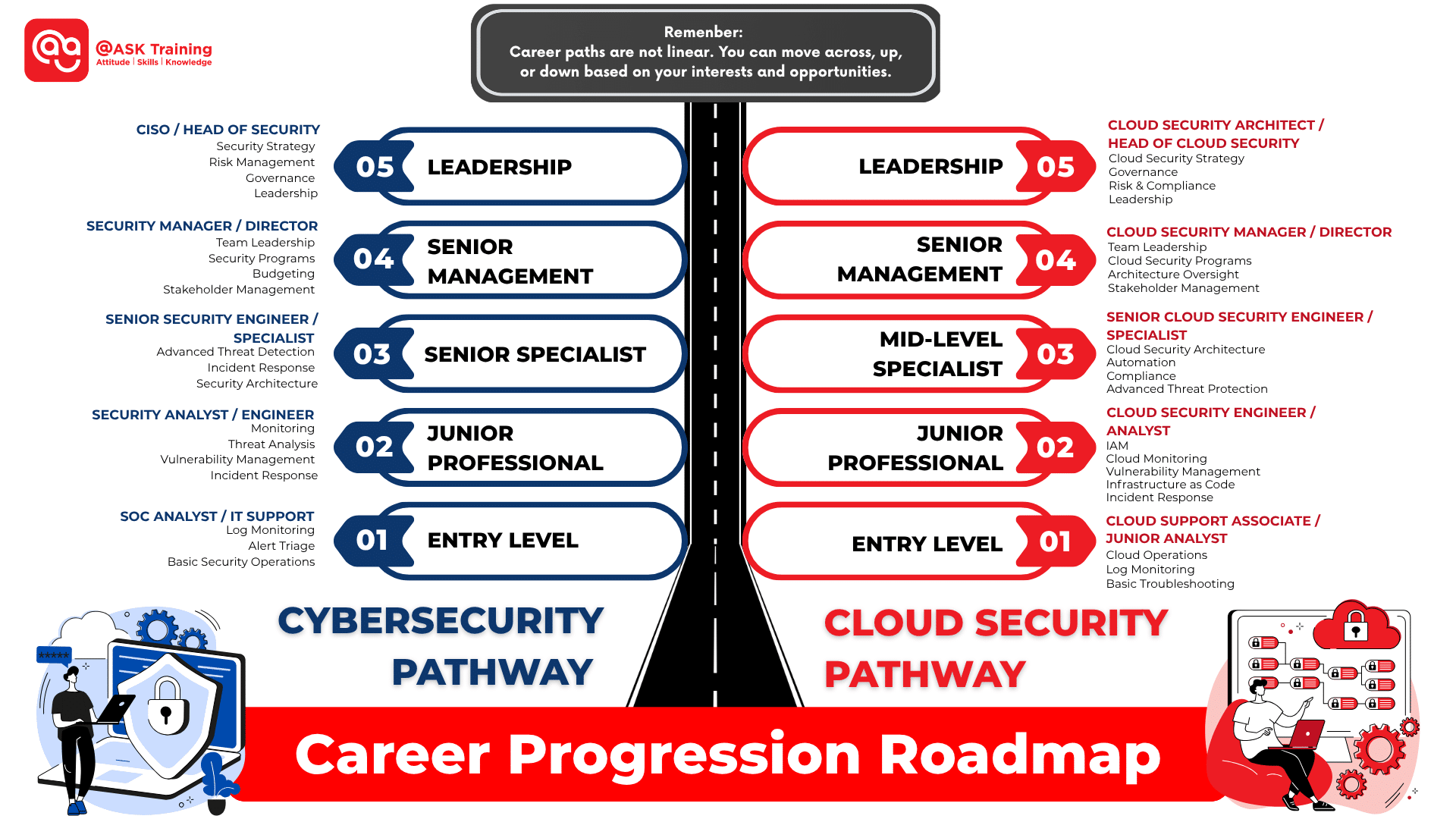
The cloud security career path often evolves from cloud administration, systems administration, infrastructure engineering, or DevOps roles.
The cybersecurity career path frequently starts in IT support, networking, security operations, or junior analyst positions before progressing into specialised security functions.
Because employers may use different job titles for similar responsibilities, it is important to review the job description carefully and focus on the actual skills and day-to-day work involved rather than relying solely on the title.
Here’s a clear example of career progression between cybersecurity and cloud security:
With so many options available, a common question arises: which path is actually easier to break into?
Which Career Path is Easier to Start With?
A common question for anyone exploring a cloud security vs cybersecurity decision is: which path is easier to enter?
The answer depends largely on your current background.
For many beginners, a general cybersecurity career is often easier to start with. Entry-level learning paths, foundational certifications (like CompTIA Security+), and junior analyst roles provide a structured way to learn core security principles. It is a broad field with many points of entry for IT support staff, help desk workers, and recent graduates.
However, if you already have experience in cloud administration, systems engineering, or DevOps, the cloud security career path may be more accessible. Your existing knowledge of cloud platforms and infrastructure gives you a significant head start.
Here is a simple way to think about it:
- Help Desk or IT Support Background: You will likely find it easier to transition into a general cybersecurity or SOC analyst role first, where you can learn the fundamentals of threat detection and response before specialising.
- Cloud Support or DevOps Background: Your direct experience with cloud platforms like AWS or Azure creates a more natural and direct entry point into a cloud security role, as you already understand the environment you need to secure.
The "easiest" path is not about one being simpler than the other, but about which one aligns best with the skills you already possess.
Understanding which path is easier to start is helpful, but the more important question is: which path is right for you in the long run?
Which Career Path Should You Choose?
There is no universal "best" choice between cloud security and cybersecurity. Both offer strong career prospects, opportunities for advancement, and the chance to work on meaningful security challenges.
A more useful question is: what type of work do you want to do every day? Do you enjoy investigating threats and responding to incidents, or are you more interested in cloud platforms, infrastructure, and secure system design?
Understanding which activities and technologies interest you most can help you identify the path that is the best fit.
Quick Quiz: Which Path Fits You Best?
Not sure whether cybersecurity or cloud security suits you? Read the statements below and simply note whether you lean more towards A (Cybersecurity) or B (Cloud Security).
1. You enjoy investigating puzzles and uncovering hidden patterns.
- Yes, I love analysing clues to figure out what happened.
- I prefer building and designing things from the ground up.
2. You are fascinated by how attackers operate and how to stop them.
- Absolutely. Understanding attacker behaviour and hunting threats excites me.
- I'm more interested in how systems work and how to make them secure by design.
3. You prefer working with automation, scripts, and infrastructure tools.
- Not really. I prefer hands-on investigation and analysis.
- Yes. Automating security and managing infrastructure is my strength.
4. You want a role that touches many parts of the business.
- Yes. I like variety and dealing with different teams and systems.
- I prefer going deep into cloud platforms and specialised technologies.
5. You enjoy designing secure architectures and optimising systems.
- I prefer responding to active threats and incidents.
- Yes. Building and securing cloud environments is what I enjoy most.
What Your Answers Suggest:
- Mostly A's (Cybersecurity): You are drawn to investigation, threat hunting, and defending organisations across diverse systems. Roles like SOC analyst, incident responder, or penetration tester could be an excellent fit.
- Mostly B's (Cloud Security): You are excited by cloud platforms, automation, and building secure architectures. Roles like cloud security engineer, DevSecOps specialist, or cloud architect may be your calling.
- A Mix of Both: This is completely normal! Many professionals start with cybersecurity fundamentals and later specialise in cloud security. Both paths are rewarding, and you can always pivot as your interests evolve.
Choose Cybersecurity If You Enjoy...
Cybersecurity may be the better choice if you enjoy:
- Threat detection
- Incident investigations
- Vulnerability management
- Penetration testing
- Security governance
- Broad organisational security
These roles often appeal to professionals who enjoy analysing threats, responding to incidents, and helping organisations manage security risks across a wide range of technologies and systems.
Choose Cloud Security If You Enjoy...
Cloud security may be the better choice if you enjoy:
- Cloud platforms
- Infrastructure security
- Automation
- Identity management
- Secure architecture
- DevSecOps practices
These roles are often well-suited to professionals who enjoy designing secure environments, working with cloud technologies, and integrating security into modern infrastructure and development workflows.
Not Sure? Start with the Fundamentals
If you are still uncertain, a practical approach is to build strong cybersecurity foundations first and then develop cloud expertise over time. This gives you a broad understanding of security principles while keeping future specialisation options open.
A strong long-term learning path could be:
- Learn cybersecurity fundamentals.
- Develop networking and security knowledge.
- Learn AWS or Azure fundamentals.
- Study cloud IAM and cloud networking.
- Explore cloud logging, monitoring, and secure architecture.
For example:
Someone starting in IT support or a junior security role may first learn threat detection, incident response, and security fundamentals before progressing into cloud platforms and cloud security specialisations.
This approach provides a solid foundation that remains valuable regardless of which path you ultimately choose.
So, as we have seen, the decision ultimately comes down to where you want to focus your efforts.
Wrapping Up
When comparing cloud security and cybersecurity, the most important distinction is scope.
Cybersecurity is the broader discipline responsible for protecting an organisation's systems, networks, applications, users, and data. Cloud security is a specialised branch that focuses on protecting cloud environments and cloud-native technologies.
The two career paths overlap significantly because cloud security still relies on cybersecurity fundamentals. The difference lies primarily in where you apply those skills.
- If you enjoy investigating threats, responding to incidents, and managing security risks across an organisation, cybersecurity may be the better fit.
- If you enjoy cloud platforms, infrastructure, automation, identity management, and architecture, cloud security may align more closely with your interests.
Whichever path you choose, security professionals remain in high demand, and building strong foundational skills today can create opportunities across both fields tomorrow.
Ready to Start Your IT Security Career?
The decision between a cybersecurity or cloud security career is an important one, and building the right skills is your first step.
@ASK Training offers industry-recognised IT courses designed to equip you with the practical, job-ready expertise employers are looking for.
Here are the most relevant courses to support your journey:
- (24hrs) Cybersecurity Essentials: Master core security principles and threat recognition to build your foundational defence skills.
- (40hrs) Cloud Computing: Gain essential cloud platform knowledge to secure modern, cloud-based infrastructures.
- (48hrs) Systems and Server Administration: Build critical server and system administration skills that underpin every security role.
Let us be your ally in this journey. Choose your path, build your skills, and step into a career that makes a difference!
Related Courses
◆◆◆