
AI tools have moved beyond answering questions. They can now update a database, send an email, or even trigger a payment on your behalf.
That shift from "chatting" to "doing" is powerful, but it also raises new questions for managers, operations leads, and anyone responsible for how work gets done in Singapore.
In January 2026, Singapore launched the world's first Model AI Governance Framework for Agentic AI. It's not a law, but it's the most practical guide available for organisations deploying AI agents.
This article breaks down what the framework says, the four dimensions of agentic AI governance, and a checklist you can use before switching on an agent at work.
Whether you're piloting your first agent or sitting on an approval committee, you'll walk away with a clearer picture of what responsible deployment looks like.
What Is Agentic AI?
Agentic AI refers to AI systems that reason and take actions to complete tasks on your behalf. Unlike a chatbot that suggests what you might say, an AI agent can log into a system, retrieve information, make changes, and see the task through.
That distinction matters for you because it changes what supervision actually looks like in your day-to-day.
Here's a simple contrast. A generative AI tool might draft a follow-up email for you to review. An AI agent checks the meeting notes, identifies who needs the follow-up, drafts the email, and sends it, all without you clicking through the steps.
One produces content. The other completes work. If you're figuring out how to move your team from basic AI use to more advanced deployment, our guide on stages of AI maturity walks you through that progression.
That difference in capability is exactly why you can't govern agents the same way you govern a chatbot, and why the risks deserve your attention before you deploy one.
Why Do AI Agents Need Their Own Governance?
AI agents introduce risks that traditional AI tools don't. Because they can access sensitive data and make changes to their environment, like updating a customer record or initiating a transaction, you face a real risk of unauthorised or erroneous actions.
As an operations lead, that means the blast radius of a mistake is much larger than a poorly worded email.
There's also the human factor you need to watch for. When an automated system performs reliably for a while, your team starts to over-trust it. This is called automation bias; the tendency to stop questioning a system that has "always worked".
Over time, your oversight becomes ceremonial rather than meaningful. Risk and compliance staff see this pattern often, but it can catch any team off guard.
IMDA's framework is clear on one point: you remain ultimately accountable. The goal isn't to remove yourself from the loop. It's to design the loop so that your judgment actually matters.
With that principle in mind, let's look at what Singapore's framework actually gives you.
What Is Singapore's Model AI Governance Framework for Agentic AI?
The framework was launched by Minister Josephine Teo at the World Economic Forum on 22 January 2026. It's the first dedicated guide for agentic AI, and it's written for anyone building agents in-house or adopting third-party agentic solutions.
That includes you if you're piloting tools, assessing them for approval, or reviewing them as a public-sector officer. It's voluntary and designed as a "living document."
On 20 May 2026, IMDA updated it with feedback from over 60 organisations, including AWS, DBS, Google, and Salesforce, and added more than ten real-world case studies.
This places it in a lineage that started with the 2020 Model AI Governance Framework and continued with the 2024 Generative AI framework, giving you a consistent approach to AI governance over time.
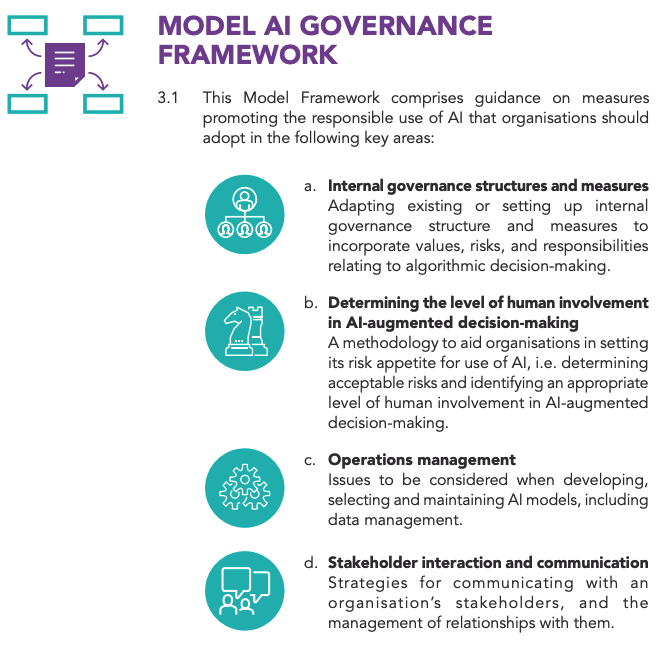
The framework is structured around four dimensions. Each one translates into something you can act on without a technical background, and each comes with a real example from IMDA's case studies.
The Four Dimensions of Agentic AI Governance
1. Assess and Bound the Risks Upfront
Before an agent touches a live system, you decide what it's allowed to do. That means choosing suitable use cases and placing hard limits on the agent's autonomy, tool access, and data access. As a team lead, this is where you define the boundaries your staff will actually enforce.
Real-World Example
Dayos, an IT ticketing agent, uses a three-tier system. Fully automated for password resets. Human-approved for fixes. No action at all for permission changes. The tiering matches the risk of the action to the level of oversight.
Bounding risk is your foundation, but it only works if someone is genuinely responsible for the decisions the agent makes.
2. Make Humans Meaningfully Accountable
Putting a human in the loop isn't enough if that human just clicks "approve" without reading.
The framework recommends you define specific checkpoints where human approval is required, especially for high-stakes or irreversible actions. Treat these checkpoints as real decision points, not formalities your team rushes through.
Real-World Example
Tencent's CodeBuddy explains complex commands in plain English before requesting approval. You get enough context to make a genuine decision, not just rubber-stamp one.
(Source: MGF for Agentic AI, pg. 30)
Accountability needs support. That's where technical controls and processes come in.
3. Implement Technical Controls and Processes
Governance isn't only about policy. It's about the systems that support it. The framework calls for baseline testing, whitelisted services, logging, and monitoring across the entire agent lifecycle.
If you're in IT or compliance, you'll recognise this as the operational backbone of any deployment you approve.
Real-World Example:
GovTech rolled out agentic coding assistants in phases. They started with low-risk internal systems and no external tools. Only after central logging and monitoring were in place did they scale up. Phased deployment isn't indecision, it's risk management.
(Source: MGF for Agentic AI, pg. 40)
Even the best technical controls won't help if the people using the agent don't understand their role in keeping it safe.
4. Enable End-User Responsibility
Your users need to know when they're interacting with an agent, and they need to be able to review its reasoning. Transparency and training are explicitly part of the governance model, which means you can't treat end-user education as optional.
Real-World Example:
Workday's HR agents disclose that users are interacting with AI and show the agent's reasoning. Users aren't left guessing what just happened.
(Source: MGF for Agentic AI, pg. 48)
Together, these four dimensions form a governance model you can actually apply. The next step is turning them into questions you can answer before deployment.
A Pre-Deployment Checklist for AI Agents
The four dimensions translate into practical questions. Before you switch on an agent, run through this checklist with your team. (Consider using the infographic below for your staff)
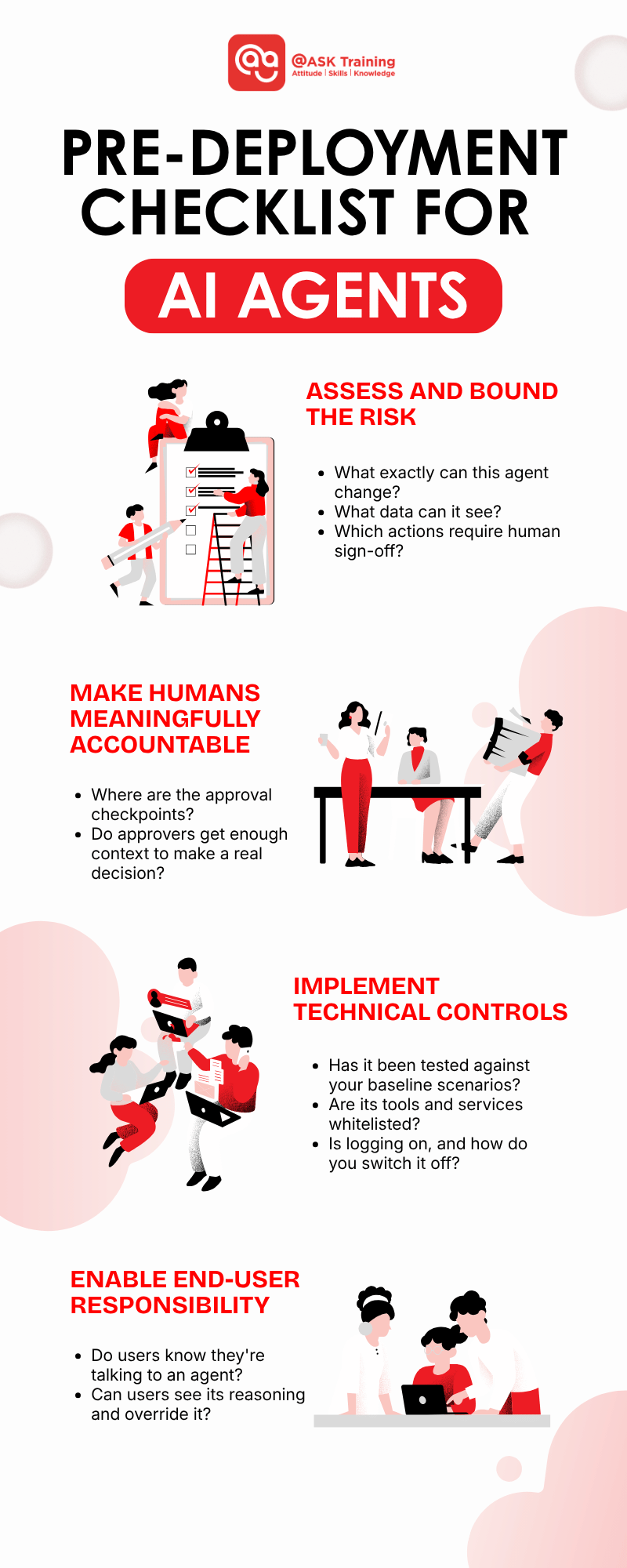
If you're also evaluating the broader technology stack, our checklist before approving new technology covers the wider IT governance angle.
A checklist reduces your risk, but it won't save you from the most common rollout mistakes.
Common Mistakes When Rolling Out AI Agents
Even well-intentioned deployments go wrong. Watch for these patterns:
- Giving agents broad permissions "to save time." Convenience today becomes a security incident tomorrow.
- Approval checkpoints so frequent that staff stop reading. If every action needs a click, your team clicks without thinking.
- Connecting third-party tools or other agents without review. Each connection expands the attack surface and the room for error.
- Skipping user training because the tool "just works." Dimension 4 exists because it doesn't always just work.
Avoiding these mistakes starts with recognising who actually needs to be trained.
Who Needs Agentic AI Skills?
Here's the part you might underestimate: it's not just IT. Your operations leads, HR staff, finance teams, and administrators will supervise agents day to day.
They're the ones who will notice when an agent drifts, and they're the ones who need to know when to step in.
If you're a career switcher or public-sector officer moving into an AI-adjacent role, you'll benefit from understanding agent governance before it lands on your desk.
Dimension 4 of the framework makes training an explicit governance requirement, not an optional extra. Understanding who needs training is one thing. Finding the right programme is the next step.
Build Agentic AI Skills with @ASK Training
Knowing the framework is one thing. Applying it at work is another. @ASK Training offers practical, no-code courses that turn governance principles into habits you can use on the job—designed for managers and operations staff, not just technical teams.
Here are three ways you can build your agentic AI skills, depending on where you are right now:
1. Just getting started? Go with AI Agents Made Easy
AI Agents Made Easy: Let AI Do the Work for You is a one-day course built for non-technical professionals like you.
- Set up a live agent from scratch, no coding required
- Learn how multi-agent hand-offs work in practice
- Leave with a pre-deployment checklist you can use immediately
2. Running operations? Go with AI in Operations
AI in Operations: Enhancing Workflow Efficiency & Automation is for operations teams automating workflows.
- Covers PDPA considerations you need to stay compliant
- Builds in ethical AI governance from the start
- Teaches Human-in-the-Loop oversight for day-to-day use
3. Want a deeper pathway? Go with the SCTP Diploma
The (SCTP) Diploma in Generative AI spans 168 hours across six business functions plus a capstone project.
- Builds responsible AI frameworks with Human-in-the-Loop oversight as a core element
- As an SCTP-pathway learner, you receive career advisory support, resume and interview help, and job matching through @ASK Training Career Services
Pick the course that matches where you are today, and start building the skills your workplace will need tomorrow.
With the right training in place, you're ready to put Singapore's framework into practice.
Wrapping Up: The Bottom Line for Your Workplace
Agentic AI governance isn't about slowing innovation down; it's about making sure your speed doesn't outrun your ability to stay in control.
Singapore's Agentic AI framework gives you a structure that's practical, voluntary, and already tested by organisations across sectors.
The four dimensions work best together:
- Bound the risk so the agent can't act beyond its remit.
- Keep humans meaningfully accountable so oversight isn't just a formality.
- Put technical controls in place so you can see what's happening and stop it if needed.
- And train the people who'll use the agent every day, because they're your last line of defence.
Start small. Choose a low-risk use case. Limit access. Set clear checkpoints. And treat training as part of your deployment, not an afterthought.
Get these basics right, and you'll be in a stronger position to scale agentic AI safely, and confidently!
Don’t forget to explore our range of Generative AI courses today!
Related Courses
- AI Agents Made Easy: Let AI Do the Work for You
- (24hrs) AI in Operations: Enhancing Workflow Efficiency & Automation
- (SCTP) Diploma in Generative AI
- (24hrs) AI in HR: Transforming Talent Acquisition & Workforce Management
◆◆◆
Related Articles
Article Topics
- What Is Agentic AI?
- Why Do AI Agents Need Their Own Governance?
- What Is Singapore's Model AI Governance Framework for Agentic AI?
- The Four Dimensions of Agentic AI Governance
- A Pre-Deployment Checklist for AI Agents
- Common Mistakes When Rolling Out AI Agents
- Who Needs Agentic AI Skills?
- Build Agentic AI Skills with @ASK Training
- Wrapping Up: The Bottom Line for Your Workplace