
Technology is no longer just a support function. It now sits at the centre of how modern businesses operate, serve customers, manage data, control risk, and grow. Almost every major business decision has a technology component, whether it involves cloud platforms, cybersecurity, data privacy, automation, customer experience, vendor management, or compliance.
This makes IT governance increasingly important. The challenge is not whether a business uses technology. Every modern business does. The real question is whether technology decisions are being made in a structured, accountable, and risk-aware way.
IT governance gives businesses a clear way to direct and control how technology is used. It defines who makes technology decisions, who owns systems, what risks must be reviewed, how investments are approved, and how performance is measured.
At its best, IT governance is the decision-making layer that connects business goals, technology execution, and risk oversight.
IT governance fails when it becomes a layer of approvals that nobody trusts. If every technology decision requires the same level of review, teams will eventually bypass the process, buy tools directly, or create workarounds.
Effective governance is more selective. It gives higher-risk decisions more scrutiny, while allowing lower-risk decisions to move quickly through clear rules and predefined approval paths.
This matters because weak governance can lead to:
- Duplicated tools and wasted spending
- Unclear ownership and fragmented data
- Poor vendor oversight and security gaps
- Failed projects and avoidable compliance risk
Strong governance helps prevent these issues by making technology decisions clearer, more accountable, and better aligned with business priorities.
This article explains what IT governance is, why it matters, how IT governance and risk management work together, which IT governance frameworks businesses commonly use, and how modern organisations can get started in a practical way.
Let’s dive in.
What Is IT Governance?
IT governance is the set of policies, roles, processes, decision rights, and oversight structures that guide how an organisation uses technology. It helps ensure that technology supports business goals, manages risk, and delivers measurable value.
In practical terms, IT governance helps a business answer five important questions:
- Who decides?
- Who owns?
- What risks must be reviewed?
- How is success measured?
- How is performance monitored and improved?
These questions matter because technology decisions are rarely just technical decisions. Choosing a new cloud platform, approving a customer database, implementing an AI tool, changing an access control process, or selecting a SaaS vendor can affect cost, security, compliance, operations, customer trust, and business continuity.
IT Governance vs IT Management
IT governance and IT management are different but complementary.
- It governance sets direction, accountability, rules, and oversight.
- IT management handles execution, delivery, support, and day-to-day operations.
Example: If a company wants to adopt a new cloud platform:
- IT management may handle the implementation, migration, configuration, and support.
- IT governance defines who approves the platform, what cybersecurity and data risks must be reviewed, who owns the platform after rollout, and how success will be measured.
Seen this way, IT governance is not just an IT department concern. It is a business operating model for making technology decisions responsibly.
Why IT Governance Matters for Modern Businesses
Modern businesses depend heavily on technology, which means technology decisions now directly affect business performance, risk exposure, regulatory compliance, and customer trust.
The Risks of Weak Governance
When IT governance is weak, problems often appear gradually:
- Different departments may buy their own tools
- Teams may store data in separate systems
- Vendors may be onboarded without proper review
- Access rights may not be removed when employees change roles
Over time, these issues become expensive and risky. A company may end up with duplicated software, fragmented data, rising subscription costs, weak security controls, unclear vendor accountability, and poor visibility over critical systems. When something breaks, no one is fully sure who owns the problem.
This is one of the biggest practical reasons IT governance matters: it creates accountability before problems occur, not after the business is already dealing with disruption.
The Business Value of Strong Governance
Strong IT governance helps businesses:
- Make better technology investment decisions
- Align IT initiatives with business goals
- Reduce duplicated tools and wasted spending
- Improve cybersecurity and risk oversight
- Clarify ownership of systems, data, vendors, and controls
- Support IT compliance and audit readiness
- Improve visibility for senior leadership
- Strengthen business resilience
The value of IT governance is not only control, but clarity: teams know who can approve decisions, who owns the outcome, and when risks need to be escalated.
A common misconception is that governance slows the business down. In reality, governance only slows the business down when it is badly designed. The test of good IT governance is not whether every decision is controlled. It is whether the right decisions receive the right level of control.
How IT Governance Supports Risk Management
IT governance and IT risk management are closely connected, but they are not identical.
- IT governance defines the structure, accountability, and oversight for managing technology risk.
- IT risk management identifies, assesses, controls, and monitors specific risks.
Governance, risk management, and compliance are also related, but they are not interchangeable:
- Governance defines how decisions are made and who is accountable.
- Risk management identifies and controls threats.
- Compliance ensures that regulatory, contractual, and internal requirements are met.
In practical terms, governance decides how risk should be managed. Risk management handles the actual work of identifying and controlling those risks.
IT governance should define:
- Who reviews cybersecurity risk
- Who approves exceptions
- Who owns vendor risk
- How risks are reported to leadership
- How often major risks are reviewed
- Which controls must be in place before a system goes live
Common IT Risk Areas
- Cybersecurity risk
- Data privacy risk
- Cloud and infrastructure risk
- Vendor and third-party risk
- System outage and business continuity risk
- Access control risk
- Compliance risk
- Project delivery risk
- Shadow IT risk
- AI and automation risk
A Practical Example:
A business team adopting a new SaaS tool for customer engagement. Without governance, the team may subscribe directly, upload customer data, invite users, and start using the tool without involving IT, security, legal, or compliance. That may seem efficient in the short term, but it creates several risks:
- What customer data is being uploaded?
- Where is the data stored?
- Who can access it?
- Does the vendor meet security requirements?
- What happens if the vendor has an outage?
- Who owns the tool after rollout?
- Who removes users when they leave the company?
- What happens if the vendor is discontinued or replaced?
IT governance helps answer these questions before the tool becomes embedded in business operations. A practical governance process would define who reviews vendor risk, who approves data access, who checks cybersecurity requirements, who owns the system, and how the tool will be monitored after implementation.
This is why many IT risks are not purely technical. They are often ownership, process, vendor, data, and accountability risks. Not every risk can be eliminated, but governance ensures that risks are visible, owned, reviewed, and accepted at the right level of the organisation.
Common IT Governance Frameworks
Businesses do not need to build IT governance from scratch. Several established IT governance frameworks can help organisations create structure, define responsibilities, and improve oversight.
However, the right framework depends on the problem the organisation is trying to solve. A framework is useful only when it helps the business make better decisions, manage risk, improve accountability, and deliver measurable value.
A note for leaders: If you are starting fresh, the choice of framework depends on your primary pain point:
- If accountability is lacking at the top → ISO/IEC 38500
- If IT projects are failing and controls are weak → COBIT
- If operations are chaotic and slow → ITIL
- If you are panicking about cyberattacks → NIST
You do not need all of them. You need the one that solves your biggest business problem first.
1. COBIT
Main purpose: Enterprise-wide IT governance and management.
Best used for:
- Aligning IT controls, risks, and performance with business goals
- Larger organisations, regulated businesses, and companies with complex IT environments
- Clarifying how IT decisions are made, how controls are designed, and how performance is measured
- Ensuring technology supports business goals effectively
2. ISO/IEC 38500
Main purpose: Board-level governance of IT
Best used for:
- Strengthening senior leadership oversight and accountability
- Providing principles for responsible and effective use of IT
- Helping leaders evaluate, direct, and monitor technology decisions
- Giving boards visibility over major systems, cybersecurity exposure, data protection, vendor dependency, and technology investment performance
3. ITIL
Main purpose: IT service management
Best used for:
- Improving IT operations, support, change, and service delivery
- Standardising operational processes such as incident management, change management, service requests, problem management, and service performance
- Businesses that struggle with inconsistent IT support, poor change control, recurring incidents, or unclear service levels
4. NIST Frameworks
Main purpose: Cybersecurity and information security risk management.
Best used for:
- Helping organisations identify, protect, detect, respond to, and recover from cybersecurity risks
- Businesses that handle sensitive data, customer information, critical systems, or regulated operations
- Strengthening cybersecurity governance as a major part of the wider IT governance strategy
| Framework | Main Purpose | Best Used For |
| COBIT | Enterprise IT governance and management | Aligning IT controls, risks, and performance with business goals |
| ISO/IEC 38500 | Board-level governance of IT | Senior leadership oversight and accountability |
| ITIL | IT service management | Improving IT operations, support, change, and service delivery |
| NIST | Cybersecurity and information-security risk | Managing cyber risk and improving security resilience |
Choosing The Right Framework
Most organisations do not need to implement every framework fully. A better approach is to choose the parts that fit the organisation’s size, industry, risk profile, regulatory environment, and technology maturity.
- A small company may only need a lightweight governance model.
- A multinational company operating across markets may need formal committees, defined controls, risk registers, board reporting, vendor review processes, and audit trails.
The goal is not to use a framework for the sake of using one. The goal is to create an IT governance strategy that works for the business.
Core Components of IT Governance
Effective IT governance defines how technology decisions are proposed, reviewed, approved, funded, implemented, monitored, and improved. The exact structure will vary by organisation, but most IT governance models include several core components.
1. Decision Rights
Decision rights define who has authority to make technology decisions. This includes decisions such as:
- Who can approve new systems
- Who can buy software
- Who can approve cloud platforms
- Who can grant access to sensitive data
- Who can approve cybersecurity exceptions
- Who can sign vendor contracts
- Who can approve major IT investments
Without clear decision rights, businesses either move too slowly or make decisions inconsistently. Some teams may wait unnecessarily for approvals, while others may bypass the process completely. Clear decision rights help the business move with control, and the same principle applies to ownership.
2. Clear Ownership
Every important system should have a clearly assigned owner. Ownership should not be vague, because unclear ownership is one of the most common causes of weak accountability in technology environments.
A system owner should understand:
- What the system does
- Who uses it
- What data it contains
- Which vendor supports it
- How much it costs
- What risks are involved
- What happens if it fails
- What changes or improvements are planned
In many organisations, technology problems become difficult because ownership is unclear. IT may support the system technically, but the business uses it daily. Finance may pay for it, but operations may depend on it. A vendor may manage part of it, but internal teams still own the risk.
Good IT governance clarifies this by defining business ownership, technical ownership, budget ownership, data ownership, and risk ownership where necessary.
3. Policies and Standards
Policies and standards define the rules that guide technology use, but they should not become documents that exist only for audit purposes. A useful policy makes decisions easier because it tells employees what is allowed, what requires approval, and what standards must be followed.
Common IT governance policies may include:
- Information security policy
- Data protection policy
- Acceptable use policy
- Vendor management policy
- Access control policy
- Cloud usage policy
- Software approval policy
- Incident response policy
- Change management policy
Policies should be practical, clear, accessible, enforceable, and aligned with how the business actually works. A long policy that nobody understands or follows is not governance. It is documentation without impact.
4. Risk Management
Risk management is a core part of IT governance because technology decisions always carry some level of risk. Governance should define how IT risks are identified, rated, prioritised, assigned, mitigated, reported, and reviewed.
For example, a company may maintain an IT risk register that tracks key risks such as outdated systems, vendor concentration, weak access controls, cybersecurity vulnerabilities, cloud misconfigurations, or compliance gaps.
Each risk should have an owner, a rating, a mitigation plan, and a review timeline. Without this structure, risks tend to remain informal. People may be aware of the risk, but no one is clearly accountable for reducing it.
5. Compliance Oversight
Many businesses must comply with data protection laws, industry regulations, contractual obligations, internal audit requirements, and cybersecurity standards. IT governance helps ensure that technology practices support these obligations.
This may include controls over data access, data retention, system logging, vendor due diligence, incident reporting, audit trails, and change approvals. Compliance should not be treated as a separate activity that happens only before an audit. It should be built into everyday technology decision-making.
6. Vendor Oversight
Vendor risk has become a major part of IT governance because modern businesses rely heavily on SaaS platforms, cloud providers, outsourced IT teams, software vendors, consultants, agencies, and managed service providers.
This creates dependency on external parties, many of which may handle sensitive data or support critical operations.
A business should know:
- Which vendors are critical
- What data vendors can access
- What security controls vendors have
- What service levels vendors provide
- How vendor performance is reviewed
- What the exit plan is if the vendor fails or the relationship ends
Vendor oversight should include due diligence before onboarding, contract review, security assessment, performance monitoring, and periodic review. This is especially important for vendors that handle customer data, employee data, financial information, operational systems, or critical infrastructure.
7. Performance Metrics
IT governance should not only control risk. It should also measure value. Useful metrics may include:
- System uptime
- Incident volume
- Resolution times
- Project delivery status
- Technology spend
- Cost savings
- User adoption
- Vendor performance
- Cybersecurity risk levels
- Compliance gaps
- Business outcomes
The purpose of metrics is not to create reports for their own sake. The purpose is to help leadership understand whether technology is supporting the business effectively.
8. Reporting and Review
Governance must be visible to leadership, but this does not mean leaders need to review every technical detail. They need the right level of information to make informed business decisions.
Senior leaders should have regular visibility over:
- Major IT risks
- Critical projects
- Cybersecurity posture
- Vendor exposure
- Technology spending
- Compliance issues
- System reliability
- Major technology dependencies
Governance without reporting becomes invisible. Reporting without ownership becomes theatre. The value comes from connecting information to decisions and accountability.
What IT Governance Looks Like in Practice
In practice, IT governance is not a single policy or committee. It is an operating model made up of recurring decision forums, approval processes, reporting structures, and accountability mechanisms.
Depending on the size and complexity of the organisation, this operating model may include:
- An IT steering committee to prioritise technology investments
- A risk committee to review major IT and cybersecurity risks
- An architecture review board to assess system design and integration
- A change advisory process to manage high-impact technology changes
- A data governance council to oversee data quality, privacy, and usage
- A vendor review process to assess third-party risk
- A regular executive reporting cadence for major risks, projects, and technology performance
The important point is not that every organisation must have all of these forums. The point is that governance must exist somewhere in the operating rhythm of the business. If technology decisions are made informally, inconsistently, or only after problems occur, the organisation does not have effective governance.
A mature IT governance model creates a clear path from decision to ownership to execution to monitoring. It should be clear how a technology request is raised, who reviews it, who approves it, who owns it after implementation, and how performance or risk will be reported over time.
IT Governance Best Practices
IT governance should be practical, proportionate, and aligned with business needs. The following IT governance best practices can help organisations build a governance model that works.
1. Start With Business Objectives
IT governance should not begin with tools, policies, or frameworks. It should begin with the business priorities the organisation is trying to support and the risks it needs to control.
Useful questions include:
- What is the organisation trying to achieve in the next 12 months?
- Which systems are critical to those goals?
- Which risks matter most to your long-term resilience?
- Where is the business most exposed if a technology fails?
- Which technology decisions currently cause confusion, delay, or risk?
- Which areas need stronger oversight?
Context matters. If the company is expanding into new markets, governance may need to focus on scalability, vendor consistency, data compliance, and cross-border risk.
If the company is digitising customer service, governance may need to focus on customer data, platform reliability, cybersecurity, and integration.
The governance model should follow the business strategy, not the other way around.
2. Make Ownership Explicit
One of the simplest and most powerful governance improvements is to make ownership clear.
Every critical system, data set, vendor relationship, cybersecurity risk, and major technology investment should have an accountable owner. This prevents the common problem of shared ownership becoming no ownership.
Example: A CRM platform may be used by sales, marketing, customer service, and management. IT may support the platform, but the business still needs to own:
- How it is used
- What data goes into it
- What outcomes it is expected to deliver
Clear ownership helps prevent confusion during incidents, audits, renewals, upgrades, and performance reviews.
3. Keep Governance Proportional
Good governance should match the size, complexity, and risk profile of the business.
A small company does not need the same governance structure as a regulated multinational enterprise. Too much governance can slow the business down and encourage teams to work around the process.
A smaller business may start with:
- A simple software approval checklist
- Named system owners
- Basic cybersecurity policies
- A monthly review of top IT risks
- Basic vendor review rules
- Clear access control requirements
A larger or regulated business may need:
- Formal steering committees
- Board-level reporting
- Audit trails
- Vendor due diligence
- Risk registers
- Control testing
- Documented approval processes
- Formal compliance reporting
The principle is simple: governance should be strong enough to manage risk, but not so heavy that it blocks useful work.
4. Address Shadow IT Constructively
Shadow IT happens when business teams adopt technology without formal IT approval or oversight. This often happens because teams need speed. They may feel that IT processes are too slow, too complicated, or disconnected from business needs.
The wrong response is to simply block everything, because that usually pushes technology use further underground.
A better approach is to create a simple and practical approval process:
- Define which tools require review
- Clarify what data risks need to be checked
- Create a list of pre-approved vendors or tools
- Allow low-risk tools to move through a faster process
- Educate teams on data, security, and vendor risks
- Make IT a business enabler, not only a gatekeeper
Good governance makes safe adoption easier. It gives business teams clear rules and faster pathways, while still protecting the organisation from unnecessary risk.
5. Include AI Governance in the Model
AI adoption has made IT governance more important, not less. Many business teams are experimenting with AI tools for writing, analysis, coding, customer support, marketing, reporting, and automation.
These tools can improve productivity, but they also introduce risks around data privacy, accuracy, intellectual property, security, vendor dependency, and accountability.
A practical IT governance strategy should define:
- Who can approve AI tools
- What types of data can be used in AI systems
- Which AI use cases require legal, compliance, or security review
- How AI-generated outputs should be reviewed
- Which vendors are approved for AI-related work
- What employees should not upload into public AI tools
- Who is accountable when AI is used in a business process
AI governance does not need to block experimentation. It should create safe boundaries so that teams can use AI productively without exposing the organisation to unnecessary risk.
6. Review Governance Regularly
IT governance is not a one-time project. Business priorities change, regulations change, cyber threats evolve, vendors change, cloud environments expand, and employees find new ways to collaborate, automate, and share data.
Governance must keep up. Organisations should review their governance model regularly to ensure:
- Policies remain relevant
- Approval processes are still effective
- Risk registers are up to date
- Vendor controls are adequate
- Reporting structures provide useful visibility
A governance process that worked three years ago may not be enough for today’s risk environment.
7. Use Frameworks Practically
Frameworks such as COBIT, ISO/IEC 38500, ITIL, and NIST can be useful, but they should not be implemented mechanically.
The purpose of a framework is to improve:
- Decision-making
- Accountability
- Risk control
- Performance
- Compliance readiness
- Leadership visibility
If a framework produces documentation but does not improve how the business manages technology, it has missed the point. Start with the business problem, then use the relevant parts of a framework to solve it.
8. Make Governance Visible to Leadership
Technology risk should be visible to senior leadership. Executives do not need to understand every technical detail, but they should understand:
- The organisation’s major technology dependencies
- Top IT risks, critical vendors
- Cybersecurity exposure
- Compliance gaps
- Major technology investments
- Performance of critical systems
If leadership only hears about IT when something breaks, governance is already weak. Good governance creates regular visibility before issues become crises.
A Practical Checklist Before Approving New Technology
One of the simplest ways to make IT governance more useful is to apply a consistent checklist before approving new technology. The checklist does not need to be complicated, but it should force the organisation to ask the right questions before money is spent and risk is created.
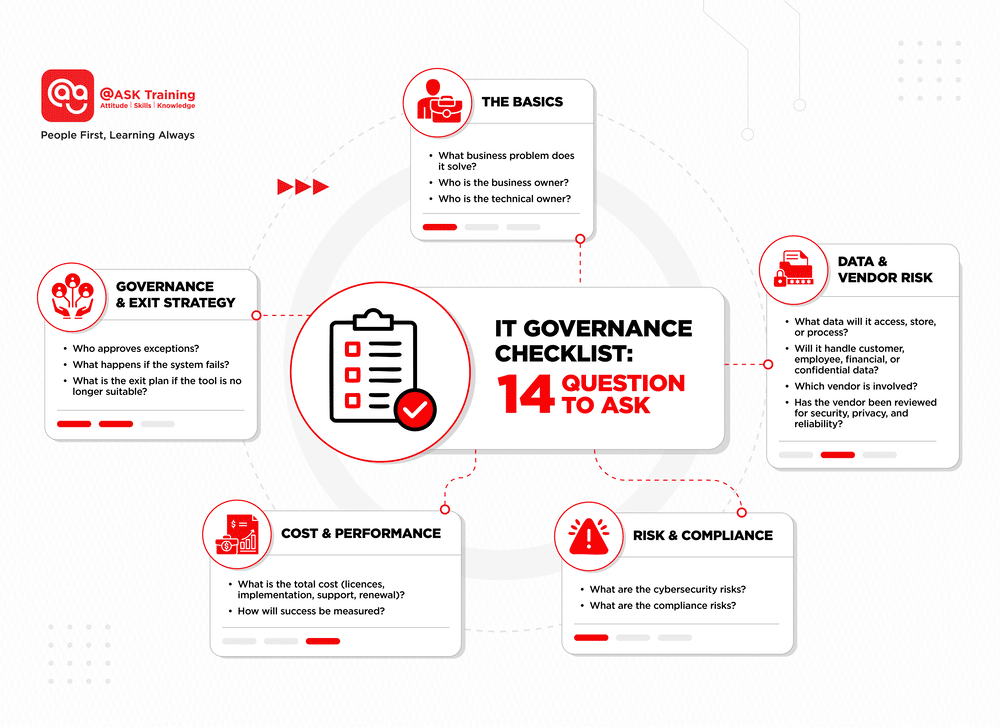
A practical governance checklist for any new system, SaaS platform, cloud tool, or major technology change should cover the following questions:
- What business problem does it solve?
- Who is the business owner?
- Who is the technical owner?
- What data will it access, store, or process?
- Will it handle customer, employee, financial, or confidential data?
- Which vendor is involved?
- Has the vendor been reviewed for security, privacy, and reliability?
- What are the cybersecurity risks?
- What are the compliance risks?
- What is the total cost, including licences, implementation, support, and renewal?
- How will success be measured?
- Who approves exceptions?
- What happens if the system fails?
- What is the exit plan if the tool is no longer suitable?
This kind of checklist turns governance from an abstract concept into a practical decision-making tool. It also helps business teams understand why certain approvals are required.
How to Get Started With IT Governance
Businesses do not need to implement a full enterprise governance framework on day one. A practical approach is to start with the basics and improve over time.
Step 1: Identify Critical Systems
Start by listing the systems the business depends on. These may include customer systems, finance systems, HR systems, sales and CRM platforms, data platforms, cloud infrastructure, cybersecurity tools, operational systems, and communication platforms.
The goal is to understand which technologies are truly important to business operations. Once the organisation knows which systems are critical, it becomes easier to decide where stronger governance is needed.
Step 2: Assign Owners
Once critical systems are identified, assign owners. Each major system should have a business owner and a technical owner. Where necessary, there should also be a budget owner, data owner, vendor owner, or risk owner.
This creates accountability and makes it easier to manage incidents, changes, renewals, and improvements.
Step 3: Define Approval Rules
Next, define simple approval rules for buying software, onboarding vendors, granting access to sensitive data, approving cloud tools, launching major IT projects, and making cybersecurity exceptions.
The rules do not need to be complicated. They need to be clear. For example, a low-risk productivity tool may only need department approval, while a tool that stores customer data may require IT, security, legal, and data protection review.
Step 4: Document Basic Policies
Document the policies that matter most. These may include access control, software approval, vendor management, information security, acceptable use, incident response, and data protection.
Avoid creating documents that exist only for audit purposes. Policies should guide behaviour and decision-making.
Step 5: Review Top IT Risks Regularly
Create a simple IT risk register. Identify the top risks, assign owners, define mitigation steps, and review progress regularly with leadership.
The risk register does not need to be perfect at the start. It needs to create visibility and accountability. Over time, the organisation can improve how risks are rated, tracked, reported, and controlled.
Step 6: Choose a Framework if Useful
After the basics are in place, consider whether a formal framework would help:
- COBIT may be useful for enterprise governance
- ISO/IEC 38500 may help with board-level oversight
- ITIL may improve IT service management
- NIST may strengthen cybersecurity and information security risk management
The framework should support the organisation’s needs. It should not become the starting point before the business understands its own priorities and risks.
Step 7: Improve Over Time
IT governance should mature with the business. A growing company may start with a software approval process, named owners for critical systems, monthly IT risk reviews, vendor review rules, and access control requirements.
As the organisation becomes larger or more regulated, it can add formal committees, metrics, reporting dashboards, audit trails, control testing, and more detailed risk management processes.
The best approach is to start lightweight, focus on the highest-value controls, and build maturity over time.
IT Governance by Business Size and Maturity
IT governance should be scaled to the organisation. A startup, SME, mid-sized company, regional enterprise, and multinational company do not need the same level of governance.
The right model depends on business size, complexity, regulatory exposure, technology dependency, and risk profile.
A small business may focus on:
- Basic software approval
- Named owners for important systems
- Password and multi-factor authentication rules
- Simple vendor checks
- Basic data protection practices
- A short list of top technology risks
A mid-sized company may need:
- A formal IT risk register
- Vendor review processes
- Change control for important systems
- Access reviews
- Monthly or quarterly leadership reporting
- Basic IT compliance documentation
- Defined cybersecurity policies
A large, regulated, or multinational business may require:
- Formal IT steering committees
- Board or executive reporting
- Architecture review
- Third-party risk management
- Audit trails
- Control testing
- Data governance
- Business continuity planning
- Cross-border compliance review
- More mature cybersecurity governance
This staged approach prevents over-engineering. The goal is not to create the most complex governance model possible. The goal is to create the right level of governance for the organisation’s current risk and maturity.
Common IT Governance Mistakes to Avoid
Many organisations understand the need for IT governance but implement it in ways that create frustration rather than value. The most common mistakes include:
- Copying a framework blindly without adapting it to the business
- Treating IT governance as a compliance exercise only
- Making every technology decision go through senior management
- Allowing business teams to buy tools without any risk review
- Assuming IT alone owns every business system
- Creating long policies that employees do not understand
- Reviewing vendors only during procurement, not after implementation
- Tracking risks without assigning owners
- Reporting metrics that do not support decisions
- Ignoring shadow IT until a problem occurs
Avoiding these mistakes is as important as choosing the right framework. Governance should help the business make better decisions, not create a parallel layer of paperwork that people learn to avoid.
Conclusion
IT governance helps businesses make better technology decisions. It aligns technology with business goals, improves accountability, strengthens risk management, supports compliance, reduces waste, and gives leadership better visibility over critical systems and risks.
Governance and risk management should work together. Governance defines oversight, accountability, decision rights, and reporting, while risk management identifies and controls specific threats. The most effective IT governance models are not built around paperwork. They are built around better decisions.
For modern businesses, this matters more than ever. Technology environments are becoming more complex, vendors are more deeply embedded in operations, cybersecurity risks are increasing, data is moving across more systems, and AI adoption is accelerating.
Business teams expect speed, flexibility, and innovation, but the organisation still needs control, resilience, compliance, and accountability.
Without governance, technology can quickly become fragmented, risky, expensive, and unaccountable. With the right governance model, businesses can move faster with more confidence.
The best place to start is simple: identify critical systems, assign clear owners, define practical approval rules, document basic policies, review top IT risks regularly, and build maturity over time.
The aim is not to govern technology for its own sake. The aim is to make sure every important technology decision has a business purpose, an accountable owner, a known risk profile, and a clear path for review.
Build Your IT Governance Expertise with @ASK Training
Mastering IT governance, risk management, and compliance requires a strong foundation in the very systems and processes this article discusses.
@ASK Training offers industry-relevant, hands-on IT courses in Singapore designed to equip you with the practical skills needed to implement and manage these critical functions.
Here are three highly relevant courses to deepen your expertise:
- (24hrs) IT Service Management and Help Desk Operations (ITIL 4 Foundation): Master the ITIL framework to standardise IT service management and incident response.
- (24hrs) Cybersecurity Essentials: Gain core cybersecurity skills to identify, prevent, and manage IT security risks.
- (24hrs) Network Fundamentals and Troubleshooting: Build a strong foundation in network management to ensure reliable and secure IT infrastructure.
These courses are designed for aspiring IT specialists, experienced practitioners, and mid-career professionals.
Many are eligible for SkillsFuture funding, making it an ideal time to invest in your professional development and strengthen your organisation’s IT governance framework!
Related Courses
- (24 hrs) IT Service Management and Help Desk Operations (ITIL 4 Foundation)
- (24 hrs) Cybersecurity Essentials
- (24 hrs) Network Fundamentals and Troubleshooting
- (40 hrs) Cloud Computing
◆◆◆
Related Articles
Article Topics
- What Is IT Governance?
- Why IT Governance Matters for Modern Businesses
- How IT Governance Supports Risk Management
- Common IT Governance Frameworks
- Core Components of IT Governance
- What IT Governance Looks Like in Practice
- IT Governance Best Practices
- A Practical Checklist Before Approving New Technology
- How to Get Started With IT Governance
- IT Governance by Business Size and Maturity
- Common IT Governance Mistakes to Avoid
- Conclusion