
 Artificial intelligence is changing the way Singapore businesses work, but you do not need to become a software engineer or data scientist to build a career around it.
If you are searching for the highest-paying AI jobs in Singapore (no coding), there are several AI-adjacent career paths worth considering. These non-technical AI careers where your existing professional expertise becomes your greatest advantage.
From marketing and finance to HR, operations and business analysis, companies increasingly need professionals who understand both their business function and how AI can be applied to improve it.
This is creating opportunities for experienced professionals looking for AI jobs without coding, allowing them to move into AI-related roles without starting their careers from scratch.
According to the Infocomm Media Development Authority (IMDA):
- 73.8% of workers surveyed in Singapore reported using AI tools at work.
- 85% of AI users said AI had improved productivity, saved time, or improved work quality.
- Among AI-adopting businesses, 63% expected to redesign jobs to better integrate AI.
For mid-career professionals, this points to an important opportunity: rather than competing directly with AI engineers, you can combine your existing professional expertise with practical AI skills.
This article covers the highest-paying AI-adjacent roles in Singapore, the transferable skills you already have, the specific AI skills employers screen for, and the funded training pathways that can help you upskill, without writing a single line of code.
What Counts as an "AI-Adjacent" Job?
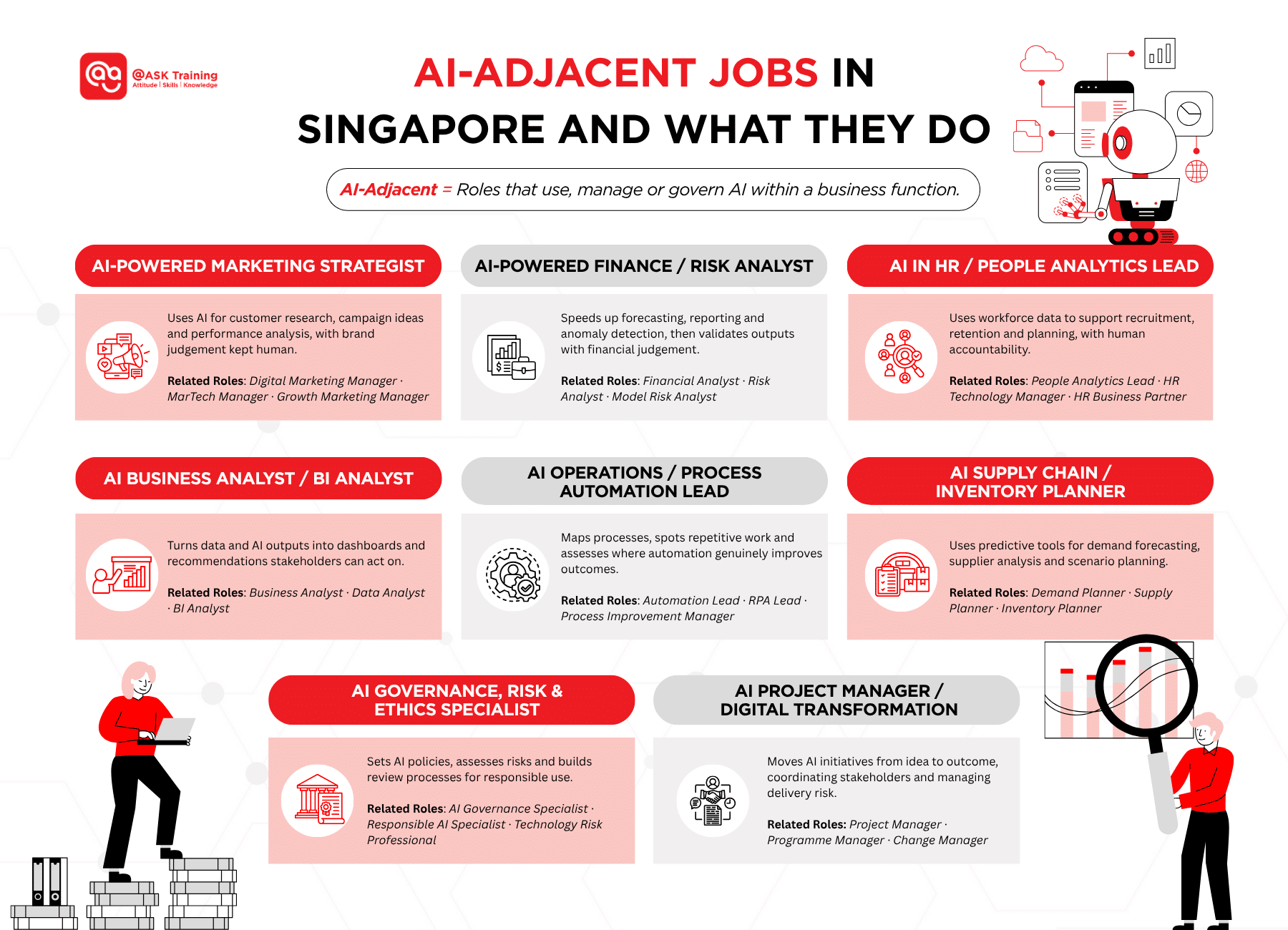
An AI-adjacent job sits between traditional business work and technical AI development.
A technical AI professional may build machine-learning models, develop AI applications, work with algorithms, or manage the data infrastructure behind AI systems.
An AI-adjacent professional, on the other hand, uses, manages, applies, or governs AI within an existing business function.
Singapore is actively encouraging this type of workforce development.
IMDA's National AI Impact Programme aims to help professionals develop more "AI-bilingual" capabilities by combining their existing domain expertise with practical AI skills that can be applied to specific workflows.
This is creating opportunities for non-technical AI careers, where professionals can use AI to improve processes, support decision-making, and create value without needing to become AI engineers or programmers.
For example:
- Marketing: Use generative AI to analyse customer feedback, develop campaign variations and summarise performance while retaining responsibility for strategy and brand decisions.
- Finance: Use AI tools to analyse financial information, identify unusual trends and prepare management summaries, while applying professional judgement to verify the results.
- HR: Use AI to structure interview questions, analyse employee feedback or draft job descriptions, while maintaining human oversight over recruitment and employee decisions.
- Operations: Identify repetitive processes, improve workflows, develop SOPs and explore opportunities for automation.
- Governance and risk: Use AI to monitor compliance, flag potential bias, and support responsible AI practices, while ensuring outputs meet regulatory and ethical standards
In every case, you are applying AI rather than building it. The specific software varies between employers. Common tools may include ChatGPT, Microsoft Copilot, Google Gemini, DeepSeek, AI-enabled Excel and Power BI, as well as AI features built into CRM, HR, finance, and workflow platforms.
You do not need to master every AI tool. Employers increasingly need professionals who can identify useful AI applications, work effectively with AI, evaluate its outputs, and translate those outputs into business decisions.
Your advantage comes from combining existing domain expertise and business experience with practical AI skills. For many mid-career professionals, this makes upskilling in AI less about starting over and more about adding a new capability to the career you already have.
The Highest-Paying AI-Adjacent Roles in Singapore
AI is changing work across marketing, finance, HR, operations, supply chain and governance. However, employers often hire for established roles, not entirely new titles such as "AI-Powered Marketing Strategist".
If you already have domain expertise, AI skills can help you take on higher-value work, improve decision-making and contribute to AI adoption.
The salary figures below are comparable base-salary benchmarks, not a guaranteed AI-related premium; actual pay varies by seniority, employer, sector and scope of responsibility
1. AI-Powered Marketing Strategist
Marketing teams use AI to understand audiences, improve campaign performance and produce relevant content more efficiently. Professionals in this area combine marketing judgement with AI-supported research, analytics and workflow tools.
What the role does
- Uses AI to support customer research, audience segmentation and competitor analysis.
- Develops campaigns, content ideas and personalised communications.
- Reviews campaign data to identify what is working and where to improve.
- Balances AI-generated insights with brand guidelines, customer understanding and commercial goals.
Typical salary range
Comparable Digital Marketing Manager benchmarks:
- 5–10 years' experience: about S$120,000 a year or S$10,000 a month.
- 10–15 years: about S$150,000 a year or S$12,500 a month.
- 15+ years: about S$180,000 a year or S$15,000 a month.
(Source: Morgan McKinley, JobStreet SG)
Industries hiring
Consumer brands and retail, technology and SaaS, financial services, healthcare and hospitality, professional services.
Related job titles to search for:
Digital Marketing Manager, Marketing Manager, MarTech Manager, Growth Marketing Manager, Content Strategist.
2. AI-Powered Finance Analyst / Risk Analyst
Finance and risk teams increasingly use AI to analyse large volumes of information, identify unusual patterns and support faster reporting.
The strongest professionals pair AI fluency with sound financial judgement, control awareness and the ability to explain their conclusions clearly.
What the role does
- Supports financial forecasting, management reporting and reconciliation.
- Uses AI-assisted tools to detect anomalies and research market developments.
- Analyses risk exposures, scenarios and financial trends.
- Validates outputs and ensures recommendations meet financial, regulatory and governance requirements.
Typical salary range
Comparable Singapore benchmarks vary significantly by specialisation:
- Financial / Business Analyst: about S$80,000 a year or S$6,700 a month.
- Market Risk professional: about S$200,000 a year or S$16,700 a month.
- Portfolio Risk and Analytics professional: about S$220,000 a year or S$18,300 a month.
These figures represent different role families and seniority levels, rather than a single standard salary range.
(Source: Morgan McKinley, Indeed SG)
Industries hiring
Banks and insurers, investment firms and asset managers, fintech companies, accounting and advisory firms, multinational corporations
Related job titles to search for
Financial Analyst, Business Analyst, Risk Analyst, Market Risk Analyst, Portfolio Risk and Analytics Analyst, Model Risk Analyst.
3. AI in HR / People Analytics Lead
HR teams use AI and analytics to understand workforce needs, improve employee experiences and plan talent more effectively.
This work requires a careful balance: AI can support insight and administration, but people decisions still need fairness, context and human accountability.
What the role does
- Analyses workforce data to support recruitment and talent planning.
- Identifies patterns in employee feedback, retention and engagement.
- Supports learning and development planning with skills and workforce data.
- Improves HR reporting and routine workflows through automation.
- Helps ensure AI-supported HR practices remain fair, transparent and appropriate.
Typical salary range
People analytics salaries vary depending on whether the role is positioned within HR, HR technology, data analytics or business partnering.
Use the closest comparable HR benchmark rather than presenting one universal People Analytics Lead figure; Morgan McKinley's 2026 guide covers HR business partnering, HR analytics and HR technology job families.
Industries hiring
Multinational corporations, technology companies, banks and financial institutions, healthcare organisations, professional-services firms, large employers with dedicated HR teams.
Related job titles to search for
People Analytics Lead, HR Data and Analytics Lead, Workforce Intelligence Lead, HR Technology Manager, HR Business Partner.
4. AI Business Analyst / BI Analyst
Businesses need professionals who can turn data and AI outputs into useful decisions. This role suits people who understand business processes, ask the right questions and communicate technical insights to non-technical stakeholders.
What the role does
- Gathers business requirements and defines problems worth solving.
- Analyses data from multiple sources to identify trends and opportunities.
- Builds reports, dashboards and decision-support materials.
- Uses AI to accelerate research, information synthesis and reporting.
- Helps stakeholders turn data-driven insight into practical action.
Typical salary range
- Data Analyst: S$90,000–S$170,000 a year, or about S$7,500–S$14,200 a month.
- Financial / Business Analyst: about S$80,000 a year, or S$6,700 a month.
Industries hiring
Technology and software, banking and financial services, consulting, healthcare, logistics and telecommunications, retail and large enterprises.
Related job titles to search for
Business Analyst, Data Analyst, Business Intelligence Analyst, Analytics Consultant, Digital Transformation Analyst.
5. AI Operations / Process Automation Lead
Operations professionals play a practical role in AI adoption: they identify repetitive work, improve workflows and ensure that automation delivers measurable results.
Success depends on understanding the existing process before deciding whether AI is the right solution.
What the role does
- Maps business processes and identifies bottlenecks.
- Evaluates opportunities for automation, workflow redesign and AI support.
- Coordinates implementation with operations, technology and business teams.
- Tracks results such as time saved, errors reduced, cost improvement and service quality.
- Supports employees as processes and tools change.
Typical salary range
- Business Process Improvement Manager: about S$190,000 a year or S$15,800 a month.
- Digital Project Management professional: about S$180,000 a year or S$15,000 a month.
Industries hiring
Financial services, manufacturing, logistics, healthcare, retail, government-linked companies, regional headquarters and large enterprises.
Related job titles to search for
Intelligent Automation Lead, RPA Lead, Automation Lead, Operational Excellence Lead, Business Process Improvement Manager, Business Transformation Manager.
6. AI Supply Chain / Inventory Planner
Supply chain teams use AI and predictive analytics to make better decisions about demand, stock, suppliers and logistics.
Professionals who understand both operational realities and data-driven planning can help organisations reduce costs while protecting product availability and customer service.
What the role does
- Supports demand forecasting and inventory optimisation.
- Analyses supplier performance, supply risks and purchasing patterns.
- Uses scenario planning to prepare for disruptions or changing demand.
- Monitors stock exceptions and recommends action.
- Balances inventory costs, customer service levels and operational constraints.
Typical salary range
- Supply Chain Manager: about S$160,000 a year or S$13,300 a month.
- Buyer / Planner: about S$75,000 a year or S$6,250 a month.
Pay can increase with regional responsibility, people management, sector experience and responsibility for high-value or complex supply networks.
(Source: Morgan McKinley, JobStreet SG)
Industries hiring
Manufacturing, FMCG, pharmaceutical, retail and e-commerce, logistics and aviation, semiconductor companies.
Related job titles to search for
Supply Chain Manager, Demand Planner, Supply Planner, Buyer / Planner, Inventory Planner, Supply Chain Analytics Manager.
7. AI Governance, Risk & Ethics Specialist
As more organisations deploy AI in customer, employee and business processes, they need professionals who can help manage the associated risks.
This is one of the most clearly emerging AI-focused job families in Singapore, particularly for people with experience in governance, compliance, audit, cybersecurity, legal or risk.
What the role does
- Develops policies and procedures for responsible AI use.
- Assesses data, model, bias, privacy and compliance risks.
- Establishes review, approval, testing and monitoring processes.
- Works with legal, compliance, risk, technology and data teams.
- Trains staff on responsible AI practices and governance expectations.
- Supports alignment with Singapore's AI governance guidance on risk assessment, human accountability, technical controls and responsible use.
Typical salary range
Comparable governance and risk benchmarks include:
- Technology Risk and Governance: S$180,000–S$230,000 a year, or about S$15,000–S$19,200 a month.
- Regulatory Compliance: about S$250,000 a year, or S$20,800 a month.
These are comparable senior governance benchmarks, not direct salary figures for every AI Governance Specialist role.
Industries hiring
Banks and insurers, technology firms, consulting companies, healthcare organisations, government-linked companies, large enterprises implementing AI at scale
Related job titles to search for
AI Governance Specialist, AI Ethics and Governance Specialist, Responsible AI Specialist, AI Governance and Risk Specialist, Technology Risk and Governance Professional
8. AI Project Manager / Digital Transformation Manager
AI projects need professionals who can move an idea from experimentation to a workable business outcome. This involves coordinating stakeholders, managing delivery risks and helping employees adopt new ways of working.
What the role does
- Defines project objectives and practical AI use cases.
- Coordinates business, data, technology, legal and risk stakeholders.
- Manages project scope, timelines, budgets and implementation risks.
- Supports testing, rollout, training and change management.
- Measures whether the initiative improves productivity, service, revenue or risk management.
Typical salary range
- Project Manager: about S$180,000 a year or S$15,000 a month.
- Digital Project Management: about S$180,000 a year or S$15,000 a month.
- Senior Business Transformation roles: up to about S$300,000 a year or S$25,000 a month.
Industries hiring
Banks and financial institutions, technology companies, consulting firms, multinational corporations, organisations undergoing enterprise-wide digital transformation.
Related job titles to search for
Project Manager, Digital Project Manager, Programme Manager, Change Manager, Business Transformation Manager
A note on these figures: Salary benchmarks are guides, not guarantees. Your actual offer will depend on your experience, industry, employer size, and the specific responsibilities of the role. Use these ranges to set realistic expectations and to negotiate from an informed position.
If one of these roles sounds like a natural extension of what you already do, that's not a coincidence. The strongest candidates for AI-adjacent work are not AI experts — they are professionals who already have the domain knowledge employers need.
The Transferable Skills You Already Have
One of the biggest advantages of upskilling in AI is that you may already have many of the skills employers need.
The strongest candidates are not necessarily those who know the most AI terminology; they are professionals who can connect AI capabilities with real business problems.
Here are the transferable skills that map directly to what employers list in AI-adjacent job postings:
1. Communication and Stakeholder Translation
AI projects involve explaining opportunities, limitations, and recommendations to people who may not have technical backgrounds.
Organisations need people who can translate technical possibilities into practical business actions.
What employers look for:
- Ability to communicate complex concepts to non-technical stakeholders
- Experience facilitating cross-functional discussions
- Strong presentation and reporting skills
Domain Expertise
A finance professional understands financial controls. An HR professional understands employee considerations. A marketer understands customers and brands. That knowledge remains valuable when AI is introduced.
What employers look for:
- Deep understanding of your function's processes
- Industry experience
- Ability to identify AI use cases within your domain
Project Management and Change Coordination
AI adoption often involves multiple stakeholders, deadlines, budgets, and changes to existing processes. Professionals who can coordinate teams and manage change are increasingly important as organisations integrate AI.
What employers look for:
- Experience managing cross-functional projects
- Change management skills
- Ability to coordinate between business and technical teams
Process Design and Improvement
Many AI-adjacent roles involve identifying where AI can improve an existing workflow. This requires understanding how processes work today and where they break down.
What this looks like in practice:
- Mapping a current workflow to identify repetitive or manual steps
- Documenting a process so it can be improved or partially automated
- Evaluating whether AI is the right solution, or whether a simpler fix works better
What employers look for:
- Process mapping and improvement experience
- Ability to identify automation opportunities
- Experience developing SOPs
Data Literacy and Reporting
You do not need advanced programming skills, but you should be comfortable reading spreadsheets, dashboards, charts, and basic performance indicators.
What this looks like in practice:
- Reading a dashboard and identifying which numbers matter most
- Spotting an unusual trend and knowing what questions to ask
- Preparing a management summary that highlights key findings
What employers look for:
- Comfortable working with data and dashboards
- Experience preparing management reports
- Ability to derive insights from business data
Critical Thinking and AI Output Validation
AI can produce inaccurate, incomplete, or misleading information. Professionals need to question outputs rather than accept them automatically.
What employers look for:
- Strong analytical and critical thinking skills
- Ability to validate AI-generated outputs
- Sound judgement in decision-making
Your domain knowledge is the foundation. AI fluency is the multiplier. Together, they make you more valuable than someone with AI knowledge alone because you can apply it to real business problems.
Knowing which skills matter is one thing. Showing employers you have them is another, and that's where positioning becomes important.
The AI Skills Employers Actually Screen For
Employers are looking for non-technical professionals who can use AI tools effectively, improve everyday workflows, work with AI-supported data, and apply AI responsibly within their area of expertise.
Developing the right AI skills for non-tech professionals can help you move beyond simply using AI tools and demonstrate how AI can create practical value within your role.
Here are the four skill areas employers screen for:
1. Practical Prompting and AI-Assisted Workflows
Knowing how to get useful results from AI tools is becoming an increasingly practical workplace skill. This goes beyond simply asking ChatGPT a question.
What this involves:
- Providing context and clear instructions
- Refining prompts when the first output isn't useful
- Reviewing AI output before using it
- Building AI into an existing workflow — not just using it ad hoc
Common workplace tools: ChatGPT, Microsoft Copilot, Google Gemini, and DeepSeek (depending on your organisation's technology environment).
What this looks like by function:
- Marketing: Use AI to analyse customer feedback, generate campaign variations, and summarise campaign results.
- HR: Use AI to organise employee survey responses or draft an initial job description.
- Operations: Use AI to document processes, identify repetitive tasks, and develop workflow improvement ideas.
- Finance: Use AI to summarise financial reports or draft initial variance explanations.
The objective is to identify where AI can reduce repetitive work, improve efficiency, or help produce better outputs.
2. AI for Reporting, Dashboards and Decision Support
AI is changing how professionals work with business information. Non-technical roles increasingly involve using no-code or low-code tools to analyse data, generate reports, and support decision-making.
You do not need to become a data scientist. You do need to understand the business question you are trying to answer and know how to use available data and AI-enabled tools to find useful insights.
What this involves:
- Reading and interpreting dashboards and reports
- Using AI-enabled tools to analyse data
- Turning data into clear, actionable summaries
- Supporting decisions with AI-assisted insights
What this looks like by function:
- Finance: Use AI-assisted analysis to identify unusual trends in financial information.
- HR: Examine workforce data to identify patterns in employee turnover.
- Operations: Analyse productivity or inventory data to identify areas requiring attention.
- Marketing: Use AI to consolidate campaign performance data into management summaries.
Tools: AI-enabled Excel, Power BI, and other business intelligence platforms can help you move from data → insight → decision without advanced programming skills.
3. Responsible and Ethical AI Use
Being AI-literate also means understanding when AI should not be used without human oversight.
AI-generated information can be inaccurate or misleading. AI-generated images, videos, and audio can make misinformation and deepfakes harder to identify.
Professionals need to question outputs, verify important information, and recognise when something may be unreliable.
What this involves:
- Validating AI-generated content before acting on it
- Recognising potential bias in AI outputs
- Understanding privacy and confidentiality considerations
- Knowing when sensitive data should not be entered into an AI tool
- Applying human judgement to AI-assisted decisions
Why it matters by function:
- HR: AI outputs can influence hiring, performance, or employee relations decisions.
- Finance: AI outputs can affect financial reporting, controls, or compliance.
- Operations: AI outputs can shape processes that affect service quality and safety.
These considerations are especially important in functions where AI outputs influence people, financial decisions, or business processes.
4. Applying AI Within Your Business Function
Perhaps the most important skill is knowing how AI applies to your specific area of expertise. Employers need professionals who understand their business function and can identify meaningful opportunities to apply AI.
This is where your existing professional experience becomes an advantage. You already understand the problems, processes, and decisions within your function. Developing practical AI skills allows you to look at those areas differently.
What this involves:
- Identifying where AI can add value in your function
- Translating business problems into AI use cases
- Working with technical teams to implement solutions
- Measuring whether AI actually improves the outcome
Ultimately, employers are looking for professionals who can use AI tools, improve workflows, interpret AI-assisted information, recognise risks, and apply AI to real business problems.
Your domain expertise plus practical AI capability is what makes you a stronger candidate than someone with AI knowledge alone.
Knowing which skills matter is one thing. Showing employers you have them is another — and that's where positioning becomes important.
How to Position Yourself for These Roles
Once you have identified an AI-adjacent role that fits your experience, the next step is to show employers that you can apply AI in a practical business setting.
For professionals planning a generative AI career switch in Singapore, this means demonstrating what you have achieved with AI, rather than simply listing the tools or courses you have completed.
Here are three practical steps:
1. Update Your Resume and LinkedIn
Do not simply add "ChatGPT", "Copilot" or "Generative AI" to your skills list. Show employers how you have used AI to improve your work.
For example, instead of writing:
"Proficient in ChatGPT and Microsoft Copilot."
You could highlight an outcome such as:
"Used AI-assisted analysis to consolidate customer feedback and reduce the time required to prepare monthly insight reports."
On LinkedIn, update these sections:
- Headline: Include your function + AI capability (e.g., "Marketing Manager | AI-Assisted Campaign Analytics")
- About section: Mention one or two AI-assisted outcomes you have delivered
- Experience: Add AI-related achievements to your current role — not as a separate skill set
- Skills: List specific AI capabilities (e.g., "AI-assisted reporting," "Prompt design") rather than generic tool names
Your existing experience still matters. The objective is to show how AI has made you more effective in your current function, and how those capabilities transfer into your target AI-adjacent role.
2. Build a Small Portfolio of AI-Assisted Work
You do not need a large portfolio or a collection of complicated technical projects. A few practical examples can provide stronger evidence of your capabilities.
Examples you could demonstrate:
- A workflow you improved or partially automated using AI
- A report or dashboard developed with AI-assisted analysis
- A marketing campaign optimised using AI-generated insights
- A process where AI reduced repetitive administrative work
- A business problem where you tested an AI solution and measured the outcome
For each example, show three things:
- The problem: What needed solving?
- The AI-assisted approach: What did you do, and which tools did you use?
- The result: What changed? (Time saved, errors reduced, output improved, decisions faster.)
Even if the project was completed as part of your current job, you can describe the process and outcome without revealing confidential company information. This gives prospective employers something more tangible to assess.
3. Choose a Recognised, Function-Specific Certification
A relevant certification can strengthen your profile, particularly when you are moving into an AI-adjacent role. However, not all AI courses demonstrate the same level of relevance.
Avoid: Generic "AI 101" badges that don't connect to your function.
Look for: Training that connects AI to the function you want to work in.
Examples:
- Marketing professional → AI-driven sales and marketing
- Finance professional → AI-powered financial analysis and risk management
- HR professional → AI in talent acquisition and people analytics
- Operations professional → AI for workflow efficiency and automation
This approach builds on the experience you already have — and gives you a clearer story to tell employers:
Existing professional expertise + function-specific AI skills + practical evidence of applying them.
If you are also considering a more technical IT career path, our guide to Highest Paying IT Certifications in Singapore in 2026 compares other high-value certification options in Singapore.
Even with the right skills and positioning, some career switchers unintentionally slow their own progress. Knowing the common missteps can help you avoid them.
Common Mistakes Career Switchers Make
Moving into an AI-adjacent role is achievable, but some missteps can slow your progress or weaken your candidacy. Being aware of them helps you avoid wasted effort.
Here are five common mistakes and how to avoid them.
1. Leading with Tools Instead of Outcomes
Listing "ChatGPT" or "Copilot" on your resume without showing what you achieved with them carries little weight. Employers want evidence of improved workflows, faster reporting, or better decisions — not a tool inventory.
Instead: Describe the problem, your AI-assisted approach, and the result.
2. Pursuing Generic AI Certifications
A broad "AI 101" course does not differentiate you. Employers are looking for function-specific capability — not general awareness.
Instead: Choose training that connects AI to your function (HR, finance, marketing, operations, supply chain).
3. Waiting Until You Feel "Ready"
AI-adjacent roles value applied experience. You do not need to master every tool before applying or before using AI in your current role.
Instead: Start small. Use AI for one task this week. Document the outcome. Build from there.
4. Ignoring Governance and Ethics
Employers increasingly screen for responsible AI use. Being able to identify bias, protect data privacy, and validate AI outputs is not optional — it is a core competency.
Instead: Learn the basics of responsible AI. Understand what data should not be entered into AI tools. Know how to validate outputs.
5. Treating AI as a Separate Career
The strongest candidates position AI as an enhancement to their existing expertise — not a replacement for it. Your domain knowledge is the foundation. AI fluency is the multiplier.
Instead: Frame your story as "existing expertise + AI capability," not "I left my old career to do AI."
Avoiding these mistakes is easier when you have a structured path forward. In Singapore, funded training pathways can shorten the distance between where you are now and the AI-adjacent role you want.
Funded Pathways to Build These Skills in Singapore
For professionals considering upskilling in AI, the cost of training does not have to be a major barrier. Singapore's SkillsFuture ecosystem provides several ways for eligible individuals and employers to offset training costs.
Here are the main funding options, and how they apply to SCTP courses.
SkillsFuture Funding Options at a Glance
1. SkillsFuture Career Transition Programme (SCTP)
- Designed for mid-career individuals seeking to reskill or pivot into new roles
- Eligible trainees receive baseline funding of up to 70% of course fees
- Singapore Citizens aged 40+ receive enhanced funding of up to 90% under the SkillsFuture Mid-Career Enhanced Subsidy
- Eligible jobseekers with greater needs (long-term unemployed, ComCare/WIS recipients, Persons with Disabilities) may receive up to 95% course fee funding
2. SkillsFuture Credit
- All Singapore Citizens aged 25+ receive $500 Opening Credit (no expiry)
- Singapore Citizens aged 40+ receive an additional $4,000 Mid-Career Credit (no expiry)
- Can be used on top of existing course fee subsidies to offset out-of-pocket fees
3. Union Training Assistance Programme (UTAP)
- For NTUC members
- Provides 50% support for unfunded course fees (the balance after government subsidy)
- Capped at $250/year for members below 40; $500/year for members aged 40+
- Claims must be submitted within 6 months of course completion
4. SkillsFuture Enterprise Credit (SFEC)
- For eligible employers to offset workforce transformation costs
- $10,000 credit per eligible employer
- Offsets up to 90% of out-of-pocket costs for supported programmes
Note: The current SFEC expires 30 November 2026. A redesigned SFEC will launch from 1 December 2026 with a fresh $10,000 credit
Match Your Target Role to the Right AI Course
The most useful approach is to choose training that builds AI capability within the professional function you already understand. @ASK Training offers function-specific courses designed for non-technical professionals.
| Target Role | @ASK Training Course | Duration |
| AI-Powered Marketing Strategist | AI Driven Sales & Marketing: Boosting Engagement & Conversions | 32 hrs |
| AI-Powered Finance Analyst / Risk Analyst | AI-Powered Finance: Automating Insights & Risk Management | 24 hrs |
| AI in HR / People Analytics Lead | AI in HR: Transforming Talent Acquisition & Workforce Management | 24 hrs |
| AI Operations / Process Automation Lead | AI in Operations: Enhancing Workflow Efficiency & Automation | 24 hrs |
| AI Business Analyst / BI Analyst | AI-Driven Business Intelligence: Smarter Reporting & Analytics | 24 hrs |
| AI Supply Chain / Inventory Planner | AI Smart Inventory: Predictive Analytics & Optimisation | 24 hrs |
Want to Understand UTAP Support in More Detail?
If you are an NTUC member considering UTAP funding, read our guide to the UTAP AI Tools Subsidy: A Guide to 21 Approved Tools and How to Qualify before choosing your training and AI tools.
If you are comparing training providers, our guide to Leading Gen AI Training Providers in Singapore for 2026 can help you understand the different options available.
With the right course and the right funding support, the path into AI-adjacent work becomes far more achievable than it might first appear.
Conclusion
AI is creating higher-value opportunities for professionals who can apply it effectively, across marketing, finance, HR, operations, business intelligence, and governance. You do not need to be a coder to build a career around AI.
For mid-career professionals, the most practical path into AI-adjacent jobs in Singapore is to build on the expertise you already have. Pair your domain knowledge with recognised, function-specific AI skills — and apply them immediately in your current role.
Here's a quick recap:
That combination is what employers are hiring for. And with funded training pathways available, the cost of getting there is more manageable than many professionals expect.
You have spent years building expertise that AI cannot replace. Now is the time to add the capability that makes it more valuable.
Explore our Generative AI courses to find the SCTP-funded course that matches your target role, or speak to a programme consultant for guidance on which pathway fits your experience!
Related Courses
- (24 hrs) AI-Driven Business Intelligence: Smarter Reporting & Analytics
- (24 hrs) AI in Operations: Enhancing Workflow Efficiency & Automation
- (24 hrs) AI-Powered Finance: Automating Insights & Risk Management
- (24 hrs) AI in HR: Transforming Talent Acquisition & Workforce Management
◆◆◆
Related Articles
Article Topics
- What Counts as an "AI-Adjacent" Job?
- The Highest-Paying AI-Adjacent Roles in Singapore
- The Transferable Skills You Already Have
- The AI Skills Employers Actually Screen For
- How to Position Yourself for These Roles
- Common Mistakes Career Switchers Make
- Funded Pathways to Build These Skills in Singapore
- Conclusion