

As organisations in Singapore continue to adopt digital technologies, the ability to interpret data and translate insights into action has become increasingly valuable.
Companies across finance, technology, healthcare, logistics, and consulting rely on analytical professionals to improve decision-making, optimise performance, and identify growth opportunities.
You have likely come across two common career paths: data analyst and business analyst. While the titles may sound similar, the day-to-day work, required skills, and career trajectories differ in meaningful ways.
Understanding how these roles compare helps individuals choose a path aligned with their strengths, interests, and long-term earning potential.
Before diving into salary and job demand, let us first clarify what each role actually does day to day.
What is the Difference Between A Data Analyst and A Business Analyst?
Both roles contribute to organisational decision-making, but they approach problems from different perspectives.
A data analyst primarily focuses on analysing datasets to identify patterns and insights, while a business analyst focuses on improving business processes and ensuring solutions align with organisational objectives.
Let us break down the key differences for you:
1. Core Focus
A data analyst focuses on analysing structured data, while a business analyst focuses on improving business processes.
2. Primary Objective
A data analyst identifies insights from datasets. A business analyst recommends solutions to business problems.
3. Orientation
Data analysts take a technical and quantitative approach. Business analysts take an operational and strategic approach.
4. Typical Outputs
Data analysts produce dashboards, reports, and models. Business analysts produce requirements documents and process improvements.
5. Stakeholder Interaction
Data analysts have moderate stakeholder interaction. Business analysts have high stakeholder interaction and work closely with multiple teams.
6. Tools Commonly Used
Data analysts use SQL, Excel, Python, and Tableau. Business analysts use Excel, PowerPoint, Jira, and process mapping tools.
Although both roles rely on structured thinking, the nature of the work differs. Data analysts often spend more time working directly with data, while business analysts spend more time working with stakeholders to understand organisational needs.
Now that you understand the high-level differences, let us explore each role in more detail.
What Does A Data Analyst Do?
A data analyst transforms raw information into insights that organisations can use to make informed decisions.
In this role, you will be collecting data from multiple sources, preparing datasets for analysis, and identifying patterns that reveal meaningful trends.
Consider a real-world example. If you work as a data analyst in an e-commerce company, you might evaluate customer purchasing behaviour to understand which marketing channels drive conversions.
In banking, you could analyse transaction patterns to identify emerging risk indicators. Across industries, your goal remains the same: use data to improve clarity and support decision-making.
Typical work may involve:
- Querying databases using SQL
- Cleaning and structuring datasets
- Analysing patterns and correlations
- Building dashboards to visualise trends
- Presenting insights in a clear format
You will commonly use tools such as Excel, SQL, Python, Tableau, and Power BI. Strong logical thinking and attention to detail are essential because analytical findings often influence strategic decisions.
While data analysts focus on the data itself, business analysts take a broader view of organisational operations. Let us look at their role next.
What Does A Business Analyst Do?
A business analyst focuses on improving organisational performance by identifying problems and recommending practical solutions.
In this role, you will understand business needs, analyse workflows, and ensure that systems or processes align with organisational goals.
You will often support transformation initiatives such as implementing new software platforms or improving operational processes.
For example, you might evaluate customer onboarding workflows to identify inefficiencies or work with technical teams to define requirements for new systems.
Typical responsibilities include:
- Gathering requirements from stakeholders
- Analysing operational workflows
- Identifying inefficiencies
- Documenting functional requirements
- Recommending improvements supported by data insights
- Facilitating communication between technical and business teams
Because you will work closely with stakeholders across departments, strong communication skills play an important role in your success as a business analyst.
With both roles now clearly defined, let us help you figure out which one fits you better.
Which Role Suits You Better?
Now that you understand what each role does, let us make this personal. Ask yourself the following questions to see which path aligns with your natural strengths and working style.
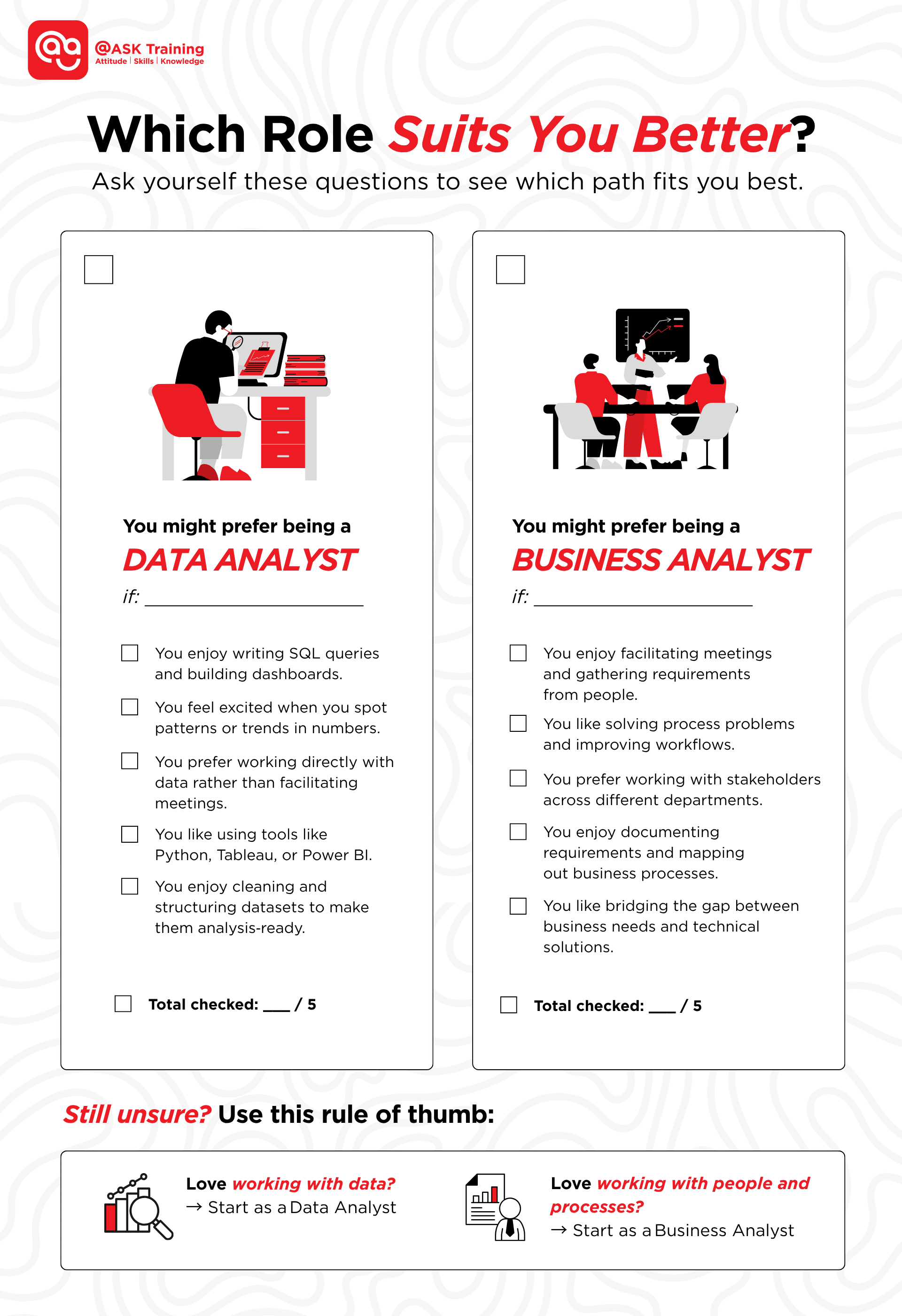
Both paths lead to rewarding careers. The right choice depends on what energises you most each day.
Now that you have a clearer sense of which role suits you, let us talk about something that matters to everyone: salary.
Data Analyst vs Business Analyst Salary In Singapore
Your salary expectations will vary depending on your experience, industry, and level of expertise.
Based on aggregated salary data from major employment platforms, both roles offer competitive earning potential within Singapore.
Data Analyst Monthly Salaries in Singapore (SGD)
- Entry level: 3,000 – 5,200
- Mid-level: 4,500 – 6,500
- Senior level: 6,500 – 8,500
Business Analyst Monthly Salaries in Singapore (SGD)
- Entry level: 4,000 – 5,500
- Mid-level: 5,500 – 7,500
- Senior level: 7,000 – 10,000+
Why do business analysts often earn slightly more?
Business analysts frequently work on strategic initiatives and cross-functional projects, which typically command higher compensation at mid to senior levels.
However, do not count out the data analyst path. Highly skilled data analysts with expertise in predictive modelling or machine learning can earn comparable or higher salaries, particularly in technology-driven industries.
Salary alone does not tell the full story. You also need to know whether companies are actively hiring for these roles in Singapore.
Job Demand For Analysts in Singapore
Demand for analytical professionals continues to grow as organisations increase investment in digital capabilities.
According to the Singapore Economic Development Board, the digital economy now contributes significantly to GDP growth. This drives strong demand for business analyst jobs in Singapore and data roles across the island.
Companies rely on data insights to improve efficiency, enhance customer experiences, and support strategic planning. LinkedIn's Jobs on the Rise reports consistently list analytics roles among the fastest-growing positions.
Which industries should you target? We see active hiring across:
- Financial services
- E-commerce
- Healthcare
- Consulting
- Telecommunications
- Logistics
- Government technology agencies
- Software companies
As organisations continue to generate increasing volumes of information, the ability to interpret and apply data insights remains valuable across sectors.
With demand strong across industries, you may wonder which skills you actually need to build for each role. Let us break them down.
Skills Needed For A Data Analyst Career
Let us focus on the specific technical and analytical skills you will need to succeed as a data analyst. These are your core tools, not your daily tasks.
Technical Skills You Must Build
- SQL: You will use this to query databases and extract data efficiently.
- Excel: You need this for data organisation, pivot tables, and basic analysis.
- Python or R: These help you perform statistical analysis and automate repetitive workflows.
- Tableau or Power BI: You use these to create dashboards that visualise trends clearly.
- Data cleaning techniques: Raw data is rarely clean. You must know how to prepare it for analysis.
- Statistical interpretation: You need to understand what numbers actually mean, not just calculate them.
Soft Skills That Set You Apart
- Attention to detail: Small errors can lead to wrong conclusions.
- Logical thinking: You must structure your analysis step by step.
- Curiosity: The best data analysts ask "why" and dig deeper.
If you are building data analyst skills in Singapore, focus on mastering SQL and a visualisation tool like Tableau or Power BI first. These two skills alone will make you employable.
Now, let us look at the very different skill set you will need as a business analyst.
Skills Needed For A Business Analyst Career
As a business analyst, your skills centre on communication, problem-solving, and process thinking. You work with people, not just data.
Core Competencies You Must Develop
- Stakeholder communication: You will interview, listen to, and manage expectations from multiple teams.
- Requirements gathering: You must translate vague business needs into clear, actionable requirements.
- Workflow analysis: You map out current processes and identify bottlenecks or inefficiencies.
- Problem structuring: You break down complex business problems into manageable parts.
- Documentation skills: You write clear requirements documents, user stories, and process maps.
- Presentation skills: You present recommendations to leadership and explain "why" behind your proposals.
Tools You Will Commonly Use
- Excel and PowerPoint for analysis and presentation
- Jira or Trello for tracking requirements
- Process mapping tools like Lucidchart or Visio
Soft Skills That Drive Your Success
- Empathy: You need to understand what stakeholders actually need, not just what they ask for.
- Facilitation: You lead workshops and meetings to gather input from different groups.
- Negotiation: You balance competing priorities across departments.
Unlike data analysts who dive deep into numbers, you bridge the gap between business strategy and technical implementation. Your value lies in clarity, not complexity.
Skills open the door, but long-term growth matters just as much. Let us explore career progression for both roles.
Career Progression Opportunities
Both roles offer structured career progression depending on your experience and specialisation.
Let us show you what your career path could look like.
Typical Data Analyst Progression
- Junior Data Analyst
- Data Analyst
- Senior Data Analyst
- Analytics Manager
- Data Scientist
Typical Business Analyst Progression
- Junior Business Analyst
- Business Analyst
- Senior Business Analyst
- Product Manager
- Strategy Manager
Your career growth depends on your ability to solve complex problems and contribute to organisational decision-making.
- A data analyst career in Singapore can lead you into data science or analytics management.
- A business analyst career in Singapore often transitions into product or strategy leadership.
Given all this information, you are probably ready for a direct answer to the salary question.
Which Career Pays More in Singapore?
Let us give you a straight answer. Business analysts often earn slightly higher salaries on average.
Why? Their responsibilities frequently include influencing strategic decisions and managing cross-functional initiatives.
However, specialised data analysts with advanced technical expertise can earn comparable or higher salaries in certain industries. It really depends on where you focus your skills.
Your earning potential ultimately depends on your experience, technical capability, industry demand, and leadership responsibilities. Both career paths offer strong salary growth potential within Singapore's digital economy.
Here is our advice: do not focus only on starting salary. Choose the role that best matches your interests and strengths. Your long-term progression depends on sustained engagement with your work.
If you have decided which path interests you, the next question is: how do you actually start?
How To Start A Career in Data or Business Analytics?
You typically begin by developing foundational knowledge in statistics, data interpretation, and business concepts.
Practical experience plays an important role. Employers value your ability to apply analytical thinking to real-world scenarios.
Here are a few useful starting steps you can take today:
- Learning Excel And SQL Fundamentals
- Understanding Basic Statistics Concepts
- Practising Data Visualisation Techniques
- Analysing Sample Datasets
- Building Small Portfolio Projects
Training and certification pathways can accelerate your journey. Structured training programmes and guided learning pathways help you build confidence and demonstrate what you can actually do.
You now have a clear comparison. Let us bring everything together in a final summary
Wrapping Up
Both data analysts and business analysts contribute to better organisational decision-making. Here is the bottom line:
- As a data analyst, you focus on interpreting structured datasets to identify meaningful insights.
- As a business analyst, you focus on improving processes and aligning solutions with strategic objectives.
Salary levels in Singapore vary depending on your experience, industry, and specialisation. Both roles offer strong career opportunities in a data-driven economy.
Your choice depends largely on whether you prefer technical analytical work or broader organisational problem-solving.
As demand for analytical skills continues to grow, you can build a sustainable career in either field if you develop structured thinking and practical capabilities!
Ready to Start Your Journey?
Now that you understand the differences between a data analyst and a business analyst, the next step is building the right skills for the path you have chosen.
Whether you lean toward the technical depth of data analytics or the strategic focus of business analysis, @ASK Training offers hands-on, WSQ-accredited courses to help you get there.
Start with our most popular and relevant programmes:
- Professional Certificate in Business Analytics & Statistics with Excel
- Data Analysis with Microsoft Excel DASHBOARD Reporting for Management
- Advanced PivotTable Techniques in Microsoft Excel
- Excel Dynamic Power Query and Power Pivot Time Intelligence DAX
2. (24hrs) AI-Driven Business Intelligence: Smarter Reporting & Analytics
This course combines artificial intelligence with business intelligence tools to help you uncover deeper insights, automate reporting, and stay ahead in Singapore's data-driven economy.
Not sure which course fits your career goals?
Contact our course consultants today! We will help you choose the right learning path based on whether you are aiming for a data analyst or business analyst role!
Related Courses
- (24hrs) AI-Driven Business Intelligence: Smarter Reporting & Analytics
- Data Analysis with Microsoft Excel DASHBOARD Reporting for Management
- WSQ Data Visualisation and Storytelling with Power BI
◆◆◆
Related Articles
Article Topics
- What is the Difference Between A Data Analyst and A Business Analyst?
- What Does A Data Analyst Do?
- What Does A Business Analyst Do?
- Which Role Suits You Better?
- Data Analyst vs Business Analyst Salary In Singapore
- Job Demand For Analysts in Singapore
- Skills Needed For A Data Analyst Career
- Skills Needed For A Business Analyst Career
- Career Progression Opportunities
- Which Career Pays More in Singapore?
- Wrapping Up