
Search is changing faster than ever. Not long ago, finding information online meant typing a query into Google, scrolling through pages of links. Today, that behaviour is shifting dramatically.
AI-powered tools like ChatGPT, Perplexity, Bing Copilot, and Google’s AI Overviews are giving users direct answers instantly — often without requiring a single click.
This shift is reshaping how people discover information, make decisions, and interact with brands. Whether researching a product or solving a problem, users increasingly rely on AI-generated summaries instead of visiting individual websites, often without seeing the original sources.
This is where Answer Engine Optimisation (AEO) comes in. While traditional SEO focuses on helping your website rank on search engines, AEO helps your content get recognised, reused, and quoted by AI systems.
In a world where zero-click search is becoming normal, AEO is quickly becoming just as important as traditional SEO, and in some contexts, even more so.
This guide is for digital marketers, content creators, and business owners ready to adapt. You’ll learn what it is, why it matters, and how to make your content AI-friendly – no technical expertise needed.
Now, let’s explore what’s driving this fundamental shift, and why you can’t afford to ignore it.
What’s Driving the Shift to Answer Engines
The way people search is no longer just changing, it’s becoming conversational, instant, and AI-driven. Users now expect direct, accurate answers the moment they ask a question, not a list of links.
Tools like ChatGPT, Perplexity, Bing Copilot, and Google’s AI Overviews are built around conversational search, where the user interacts with an AI assistant.
These systems synthesise information from across the web to deliver coherent, single-source responses.
This fuels the growth of zero-click search, where users get what they need without ever leaving the platform. For them, it’s convenient. For creators, it’s a fundamental shift in visibility.
Why does it matter for content creators?
Marketers and creators are no longer just competing for rankings; they’re competing for inclusion in the AI’s generated answer. Even a #1 ranking may not guarantee clicks if AI already provides a complete answer.
What this means for your content strategy:
For digital marketers and content creators, this shift demands a dual strategy: optimise for both human readers and AI systems. Success now depends on creating content that is:
- Structured for clarity and extractability
- Clear and direct in its messaging
- Ready to be understood and reused by intelligent algorithms
Understanding this shift makes it clear why AEO is now an essential skill.
Now that we understand why this shift is happening, let’s define exactly what AEO is, and how it differs from the SEO you already know.
What AEO Actually Means (Simply Put)
Answer Engine Optimisation (AEO) shapes your content so AI tools can easily understand, extract, and reuse it within their generated answers.
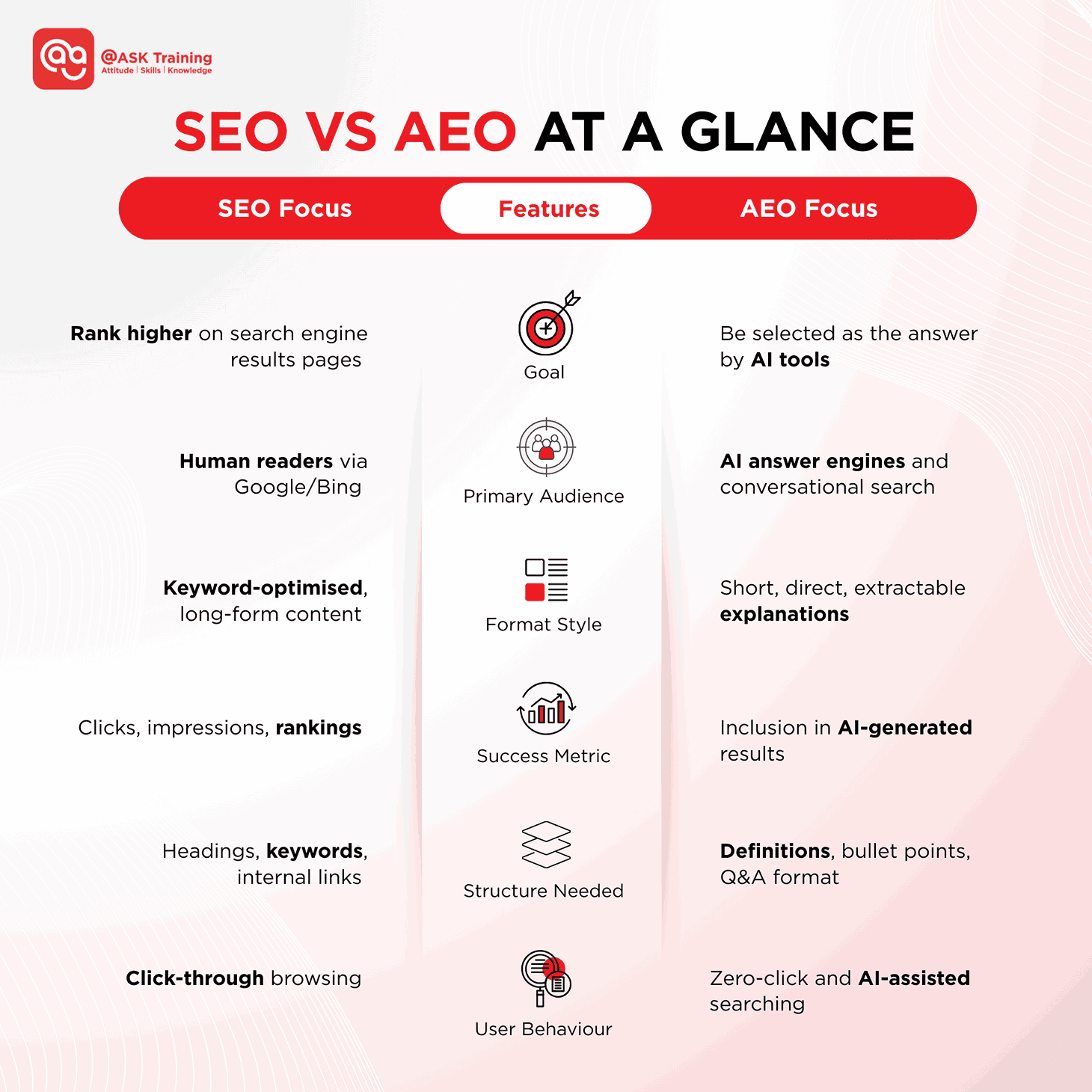
While traditional SEO helps your website rank higher, AEO focuses on being selected as the answer by AI systems.
Think of it this way:
SEO helps users find your page. AEO helps AI find your answer.
AEO vs SEO: Understanding the Shift
AEO vs SEO key difference lies in their role in modern search:
- SEO still matters because people continue to use Google and traditional search engines to browse, compare, and discover information.
- AEO is becoming essential as AI tools become part of everyday search behaviour.
As AI reshapes how answers are delivered, your content must be formatted in ways these systems can quickly recognise, understand, and reuse.
What Does AEO-Friendly Content Look Like?
AEO-friendly content is structured for clarity and extractability. It usually includes:
- A direct answer at the top of a section
- Short, clear definitions that express one idea at a time
- Question-based headings or prompts (e.g., “What is AEO?”)
- Clear structure using bullet points and short paragraphs
These elements make it easier for AI models to interpret what your content is about and pull the most important information into their responses.
A Simple Example of AEO in Action
Here’s how an AEO-friendly explanation might appear in practise:
Question: What does AEO help AI systems do?
Answer: AEO helps AI tools recognise your content as a clear answer by placing a short, direct explanation before the detailed breakdown.
This structure works because AI systems prefer content that:
- answers one idea clearly
- uses predictable formatting
- separates the direct answer from supporting details
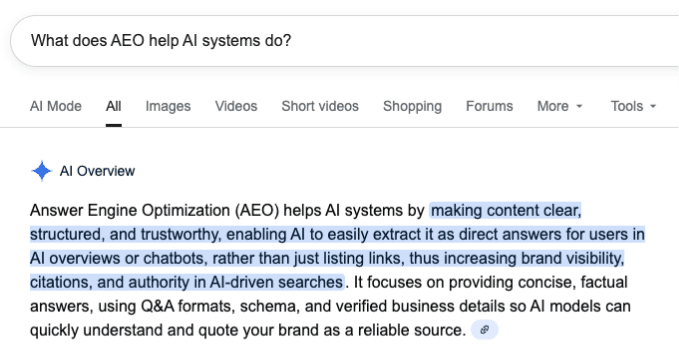
Example of Google’s AI Overview Answer
Now that you know what AEO is, let’s explore how AI answer engines actually find and interpret content, and what they look for first.
How Answer Engines Find and Use Content
AI answer engines scan, interpret, and synthesise content from across the web to generate a single answer, prioritising clarity, structure, and directness.
What AI Answer Engines Look For
To be selected and quoted by AI, your content should include:
- Short, focused statements that express one idea at a time
- Question-based headings that clearly signal user intent
- Clean, skimmable structure using bullet points and short paragraphs
- Direct answer content at the beginning of each section
- Simple, quotable explanations that are easy to extract and reuse
Real-World Example of AI-Friendly Writing
Here’s a simple illustration of the kind of phrasing answer engines prefer:
In short: AEO makes your content easier for AI to interpret, understand, and quote within AI-generated results.
This kind of sentence works well because it is:
- Short and to the point
- Direct in its messaging
- Focused on one idea without fluff
- Easy for AI to lift as a featured answer
Why This Matters for Your Visibility
Creating clear, well-structured content directly increases your chances of appearing in conversational search results and featured answers. It’s not about ranking; it’s about being understood and selected by AI.
Now that you know how AI interprets content, let’s examine what this shift means for traditional SEO, and how the two can work together.
What This Shift Means for Traditional SEO
AI answer engines enhance and reshape how SEO works. SEO remains essential, but fewer users click through when AI already provides answers.
Two Layers of Modern Visibility
In the past, high rankings guaranteed visibility. Today, visibility depends on two complementary layers:
- Search engine rankings (traditional SEO)
- Answer engine visibility (AEO)
Even if your page ranks well, users may never click through if an AI summary already gives them a complete answer instantly.
Where SEO and AEO Overlap
The good news? The core principles of strong content still apply to both. Search engines and AI systems both prioritise content that demonstrates:
- Clarity in messaging
- Authority on the topic
- Accuracy of information
- Helpfulness to the user
Where they differ is in how they evaluate content:
- SEO looks at backlinks, site speed, keyword usage, and on-page optimisation.
- AEO focuses on meaning, structure, and how clearly your content answers a specific question.
SEO and AEO: Better Together
Rather than viewing AEO vs SEO as a choice, successful creators treat them as complementary tools:
- SEO helps search engines find and rank your content.
- AEO helps AI systems understand and reuse your content.
Together, they maximise your visibility—whether through traditional blue links or AI-powered conversational answers.
SEO vs AEO at a Glance
Ready to put this into practice? Let’s explore simple, actionable ways to make your content AEO-friendly that you can try today.
Simple Ways to Make Your Content AEO-Friendly
Making your content AEO-friendly doesn’t require technical skills. Small changes in how you structure and present information can significantly improve how AI answer engines interpret and reuse your content.
Your goal? To create direct answer content that AI tools can quickly identify and quote within their responses.
1. Start with the Answer, Then Explain
One of the simplest ways to do this is to lead every section with a brief, direct answer, followed by supporting details. This helps both readers and AI systems understand the core message immediately.
Example:
Question: What is zero-click search?
Answer: Zero-click search happens when a user gets the information they need directly on a results page or AI answer, without clicking through to any website.
This one-sentence definition gives a clear, extractable answer. After that, you can add more context or detail so readers get a fuller understanding, and AI still captures the key point.
2. Refresh and Repurpose Older Content
Don’t retire older articles; refresh them. Many well-researched pieces lack the clarity, structure, or modern formatting needed for AI-generated results.
AEO-friendly updates include:
- Adding direct introductory answers to key sections
- Tightening long paragraphs into short, focused explanations
- Improving skimmability with subheadings, bullet points, and clear transitions
This extends the lifespan of your content and increases its chances of being selected by answer engines.
3. Avoid AI-Unfriendly Pitfalls
Content that is cluttered, overly dense, or tries to convey multiple ideas in one paragraph is harder for AI systems to use. Keep it clean, focused, and structured.
4. AEO Content Checklist: A Simple Guide for Writers
Use this actionable checklist to ensure your content is structured for both readers and AI:
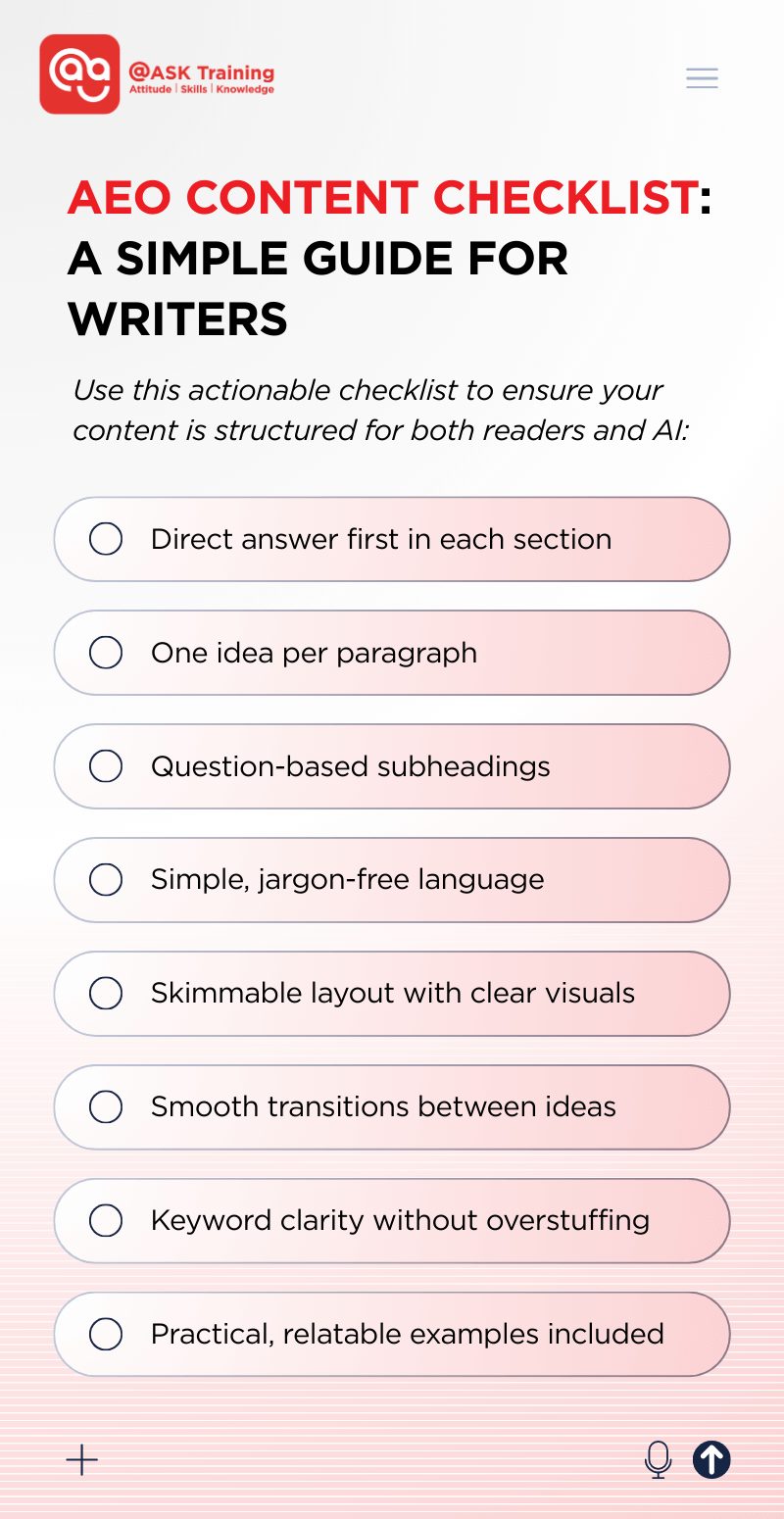
This checklist provides a clear, practical framework for applying AEO principles. This isn’t about starting over; it’s about adapting your style to be clearer, more structured, and intentional.
Even with the best AEO practices, there are challenges to anticipate. Let’s explore the limitations—and how to navigate them wisely.
Challenges and Limitations to Keep in Mind
While Answer Engine Optimisation (AEO) offers new opportunities for visibility, it also presents challenges that every content creator should anticipate.
Unlike traditional SEO, where rankings and traffic can be tracked with clear metrics, AEO performance is harder to track and predict.
1. Measurement Difficulties Across Platforms
AEO visibility varies widely depending on the AI tool. ChatGPT, Perplexity, Bing Copilot, and Google AI Overviews each use different models and ranking logic, meaning your content may be featured in one tool but overlooked in another.
However, some visibility can be tracked through mentions and citations. Tools like SEMrush now provide metrics showing when your content is cited or mentioned in AI-generated summaries.
This gives you tangible insight into how often your content is being sourced by AI systems.
Key Takeaway: What works on one platform may not translate to another, making consistent measurement a challenge.
2. The Clarity-Over-Complexity Bias
AI systems strongly favour clarity and simplicity. If your content crams multiple ideas into one paragraph, uses vague language, or lacks clear definitions, AI models are likely to skip it entirely, even if the information is valuable and accurate.
Weak Example:
“AEO builds authority, improves visibility, and shifts content formats to match AI tools…”
This tries to cover too much at once, giving AI no clear answer to extract.
Strong Example:
“AEO improves visibility by helping AI systems identify and reuse direct answers from your content.”
This focuses on one idea, answers a specific question, and is easy for AI to lift and reuse.
3. The Ever-Evolving AI Landscape
AEO is not a “set and forget” strategy. As AI models advance, what works today—such as short, direct-answer formatting—may shift tomorrow.
This doesn’t invalidate your efforts, but it does mean AEO requires ongoing refinement, updates, and adaptation.
4. Balancing AEO with Traditional SEO
Your best defence against AI uncertainty is a strong SEO foundation. Even if answer engines change how they process information, well-optimised content will continue to rank in traditional search.
By combining clear, structured AEO-friendly writing with core SEO principles, you build content that performs across both human and AI-driven platforms.
Looking beyond these challenges, the future of AEO is closely tied to how AI itself evolves. Let’s look ahead at the trends shaping the future of content visibility.
What’s Next for AEO and AI Search
The future of Answer Engine Optimisation (AEO) is evolving alongside the AI tools it’s designed to support. As answer engines grow more sophisticated, they will deliver even more personalised, context-aware responses tailored to individual users.
1. The Rise of Personalised AI Answers
Instead of showing the same result to everyone, AI systems will increasingly tailor answers based on individual preferences, search history, location, and behaviour.
This shift toward personalised AI answers means content creators need to focus on clarity, accuracy, and structure so their information remains useful in a wide range of contexts.
2. Voice Search and Conversational AI
Voice search and conversational search are becoming mainstream. As more people use voice assistants and chat-based AI, they’ll expect natural, direct replies—not lengthy articles.
This makes AEO essential, as AI systems depend on short, structured content to generate spoken answers that sound human and helpful.
3. The Growth of Niche Vertical Answer Engines
We’re entering the era of niche vertical answer engines, AI tools built to specialise in fields like finance, healthcare, education, or tech. Unlike general-purpose AI, these engines deliver exact answers within a specific domain.
They favour content that:
- Demonstrates deep expertise
- Remains clear and extractable
- Balances depth with simplicity
Writers who can merge specialisation with readability will lead in these focused arenas.
4. Consistency Amid Change
Despite rapid advances, one principle remains constant: AI prioritises content that is clear, accurate, and easy to interpret.
Even as algorithms evolve, they’ll continue to rely on the structural cues and direct answers that AEO promotes. Improving readability today prepares your content for tomorrow’s platforms.
5. Start Small, Think Long-Term
You don’t need perfection to benefit from AEO. Small, consistent improvements, like clearer definitions, tighter structure, and focused explanations, can significantly boost visibility across both conversational and AI-powered search.
Adapting now ensures your content stays relevant as the search landscape continues to evolve.
As AI continues to redefine how we find information, mastering AEO isn’t just an advantage; it’s becoming essential for anyone who creates content. Let’s bring everything together.
Wrapping Up
Search has shifted from ranking pages to delivering answers. As AI reshapes discovery, Answer Engine Optimisation (AEO) is now essential for staying visible.
Users increasingly turn to AI-generated summaries, conversational responses, and zero-click results, often without ever visiting a website. To stay seen, your content must be AI-ready.
Here’s what embracing AEO means for you:
- Visibility in the AI era depends on being selected by answer engines, not just ranking on Google.
- Clear, structured content gets quoted, featured, and reused by AI tools like ChatGPT and Google AI Overviews.
- Small changes deliver big impact – updating old posts, adding direct answers, and simplifying structure boost AI readability and user experience.
- AEO complements SEO – together, they ensure your content performs everywhere, from search engines to AI chats.
- Start now, adapt consistently. You don’t need perfection, just progress.
By adopting AEO today, you’re not just optimising for current algorithms—you’re preparing your content for the future of search.
Build Your Foundation in AI-Driven Marketing
Ready to put these insights into action? Whether you’re new to AI in marketing or looking to strengthen your digital skill set, ASK Training provides the foundational training you need to stay competitive.
Start with these essential Digital Marketing courses:
- Search Engine Optimisation (SEO)
- Mastering ChatGPT for Strategic Communication
- WSQ Generative AI for Digital Marketing
Whether you’re an individual looking to upskill or a corporation training your team, our courses are designed to give you the practical, relevant knowledge to thrive in an AI-powered marketplace.
Speak to our learning consultant and take the first step toward mastering the future of digital marketing today!
Related Courses
- Search Engine Optimisation (SEO)
- Mastering ChatGPT for Strategic Communication
- WSQ Generative AI for Digital Marketing
◆◆◆