
The demand for video editor jobs in Singapore has seen steady growth over the past few years, driven by the explosion of digital marketing, social media, and video-first platforms.
From brand campaigns to short-form social content, video is now a core communication tool across industries. As businesses compete for attention online, skilled video editors are valued not just for technical execution but for their ability to tell compelling stories that drive engagement.
This article maps the current and future landscape for video editing professionals in Singapore. For aspiring and current editors looking to navigate this dynamic field, we’ll cover essential insights on job types, salary expectations, in-demand skills, career progression, and market demand projected through 2026.
Let’s get started.
Overview of Video Editor Jobs in Singapore
The term “video editor jobs in Singapore” encompasses a wide spectrum of creative and technical roles. You’ll find openings under various titles, from Video Editor and Videographer-Editor to Content Creator, Multimedia Specialist, and Social Media Video Editor, each reflecting a different blend of responsibilities and scope.
Professionals in this field work in diverse settings, providing services to a range of industries:
- Media and advertising agencies
- Production houses and studios
- Start-ups and SMEs
- E-commerce brands
- In-house marketing or communications teams
A video editor’s core daily tasks involve transforming raw footage into polished final products. This includes editing clips, colour correction, sound syncing, adding motion graphics or effects, and managing project timelines.
Crucially, editors rarely work in isolation. They collaborate closely with marketing managers, designers, and creative leads to ensure every piece of content aligns with strategic campaign goals and brand voice.
The role is rapidly evolving. Video editing jobs in Singapore increasingly demand a hybrid skill set.
Beyond post-production, many positions now require basic videography, active content ideation, and a savvy understanding of platform-specific formats, especially for the fast-paced world of social media and short-form video.
With this understanding of the role’s general scope, the next logical consideration is compensation. Let’s explore that next.
Video Editor Salaries in Singapore
Understanding the video editor salary Singapore landscape is crucial for career planning.
Based on aggregated data from major job portals and recruitment benchmarks, full-time salary ranges for 2026 typically fall within the following bands:
1. Entry-level / Junior Video Editors
- S$2,000 – S$3,000 per month
- Common for fresh graduates or those with under two years of experience, often in social media or in-house marketing roles.
- Salaries on the lower end of this band are typical for purely social media editing.
(Source: Indeed SG)
2. Mid-level Video Editors (2–4 years’ experience)
- S$2,700 – S$3,800 per month
- Typical for editors who can independently manage projects, collaborate with marketing teams, and deliver on tight deadlines.
(Source: Payscale)
3. Senior Video Editors / Specialised Roles
- S$3,500 – S$5,800+ per month
- Seen in agencies, advertising, or roles demanding expertise in motion graphics, colour grading, or creative leadership.
- Senior editors in agency or high-end production environments can command salaries at the upper end of this scale.
(Source: Indeed SG)
Important Note: These figures represent base monthly salary for full-time positions and do not include bonuses, freelance income, or project-based incentives.
Compensation also varies significantly depending on job scope:
- Social media video editors tend to sit at the lower end of the range due to faster turnaround and template-based workflows.
- Corporate, branded, or advertising editors typically earn more due to higher production standards and client-facing responsibilities.
- Freelance video editors in Singapore may exceed these monthly equivalents during busy periods, but income is less predictable and depends heavily on client volume.
Several key factors influence pay beyond title:
- Years of experience and portfolio quality
- Project complexity and turnaround speed
- Proficiency in advanced software or workflows (e.g., DaVinci Resolve for colour grading, After Effects for custom motion graphics)
- Industry focus (e.g. advertising, broadcast, social media)
For Example: A junior editor focusing on social clips may earn noticeably less than a peer editing branded campaigns or high-end corporate videos.
Ultimately, your earning potential is closely tied to the specific skills you bring to the table.
Let’s examine the core and emerging capabilities that will define value and command higher salaries through 2026.
In-Demand Skills for Video Editor Jobs in 2026
Video editing has evolved far beyond simple cuts. Thriving in this field now demands a powerful combination of technical proficiency, creative vision, and a sharp awareness of digital trends.
By 2026, employers in Singapore will prize editors who master both timeless foundations and forward-thinking capabilities.
1. Core Technical Skills
Core technical skills remain the foundation for any video editor role. Employers expect proficiency in industry-standard editing software, including:
- Adobe Premiere Pro: The cornerstone for timeline editing, assembly, and final output.
- Adobe After Effects: Critical for creating motion graphics, animated text, and visual effects.
- DaVinci Resolve: The industry choice for professional colour grading and advanced post-production.
- Post-Production Workflow Management: The crucial skill of organising assets, managing project files, and collaborating efficiently across teams.
Why These Skills Matter:
These tools are the instruments of your craft. Proficiency ensures you can deliver polished, professional work efficiently and collaborate seamlessly with directors, marketers, and designers.
For hiring managers, this mastery signals reliability and the ability to own complex projects.
Market Advantage:
Versatility across these platforms makes you highly adaptable, a trait especially valued in agencies and startups.
Editors who combine core editing with motion graphics and colour grading become indispensable multi-skilled creatives, paving the way for higher pay and faster career progression.
2. Emerging Skills
The landscape is shifting rapidly. To stay competitive, editors must cultivate skills that meet the demands of modern content:
- AI-Assisted Editing Tools: Automate routine tasks such as basic cuts, subtitle generation, or scene detection, freeing editors to focus on storytelling.
- Motion Graphics and Animation: Integrating dynamic visual elements is becoming standard in marketing, social media, and branded content.
- Vertical and Mobile-First Video Formats: Essential for platforms like TikTok, Instagram Reels, and YouTube Shorts.
- Marketing-Aware Editing: Understanding engagement metrics, audience retention, and platform algorithms to optimise content performance.
Why These Skills Matter:
These capabilities allow you to meet modern content demands head-on. An editor skilled in vertical formats and motion graphics can independently helm a full social campaign.
AI proficiency boosts productivity, giving you a significant competitive edge.
Market Advantage:
Editors with these emerging skills command premium salaries and greater opportunities. Brands increasingly seek these hybrid creatives who blend technical execution with strategic insight, making them vital to campaign success.
Future-Proof Your Expertise:
Emerging skills often build on core competencies. Targeted training, such as courses in motion graphics or digital content strategy, can help you bridge the gap and stay ahead of industry curves.
Mastering this blend of foundational and future-focused skills directly shapes your professional trajectory.
Next, we’ll map out the potential career paths and progression opportunities these skills can unlock in Singapore’s dynamic market.
Career Paths and Progression for Video Editors
A career in video editing in Singapore is not a single track but a dynamic landscape with multiple routes for growth.
Your video editor career path can unfold vertically into leadership, branch out into specialisations, or pivot into a successful freelance practice; all shaped by your unique strengths and interests.
Understanding this progression is key to strategically planning your development and aligning your skills with market opportunities.
1. Entry-Level Roles and Early Career Development
Most video editors begin their careers through internships, traineeships, or assistant editor roles.
This crucial phase focuses on absorbing professional workflows and honing core video editing skills, rather than leading projects.
Common responsibilities at this stage include:
- Logging and organising footage and project files.
- Performing basic cuts, syncing audio, and preparing rough assemblies.
- Assisting senior editors with revisions, exports, and technical tasks.
- Learning to manage deadlines within a production pipeline.
Maximising exposure to various content types, from social clips to corporate videos, at this stage builds a versatile foundation essential for advancement.
2. Progression to Video Editor and Senior Editor Roles
With experience, editors progress into full video editor roles where they take ownership of projects from start to finish. At this stage, responsibilities typically expand to:
- Interpreting creative briefs and campaign goals.
- Making key editorial decisions on pacing, tone, and narrative.
- Collaborating directly with clients or internal stakeholders
As editors gain confidence and a stronger portfolio, they may advance to senior video editor positions.
Senior editors often mentor juniors, handle more complex projects, and contribute to creative direction. These roles are common in agencies, production houses, and larger in-house teams.
Progression at this level is driven less by tenure and more by the ability to consistently deliver high-quality output under tight timelines.
3. Leadership and Creative Advancement
For editors interested in leadership, career progression can extend into roles such as:
- Content Producer: Oversees end-to-end production, coordinating teams and budgets.
- Creative Lead: Guides the visual and narrative style across multiple campaigns.
- Creative Director: Sets the overarching creative strategy and manages creative departments.
These positions demand more than technical skill; they require excellent communication, project management, and strategic thinking.
Editors who deeply understand brand objectives and marketing impact are best positioned for this transition.
4. Specialisation and Lateral Career Paths
Not all editors pursue management or leadership. Many choose to specialise or pivot laterally into adjacent creative roles, including:
- Videography and cinematography
- Motion graphics and animation
- Colour grading and post-production finishing
- Creative strategy or content planning
Specialisation can lead to higher earning potential and niche expertise, particularly in advertising, branded content, or high-end production environments.
5. Freelance and Independent Career Paths
Freelancing is a vibrant and viable path for video editors in Singapore, often pursued after building a network and a strong portfolio.
Progression as a freelancer typically involves:
- Evolving from one-off projects to retained, long-term client relationships.
- Taking on projects with increasing scope and creative responsibility.
- Shifting from pure execution to a trusted advisor or creative lead role.
Experienced freelance video editors who combine editing expertise with strategy and reliability can command higher rates and enjoy greater flexibility, though income stability depends on client pipeline and market conditions.
What Drives Long-Term Career Growth
Regardless of the path chosen, long-term advancement is fueled by:
- A Dynamic Portfolio: Continuously updated with diverse, results-oriented work.
- Relentless Skill Development: Proactively learning emerging tools, software, and formats.
- Professional Integrity: A reputation for reliability, collaboration, and meeting deadlines.
While formal qualifications can open doors, the industry increasingly values demonstrated experience, a strong creative portfolio, and sound professional judgment.
This clear understanding of career trajectories highlights the robust opportunities within Singapore’s market.
Now, let’s examine the current job demand and hiring trends that make these paths possible.
Job Demand and Market Trends for Video Editors
The demand for video editor jobs in Singapore remains strong, with active listings for roles at every career stage—from junior to senior and freelance positions.
This steady hiring activity, visible on platforms like JobStreet, JobsDB, Indeed, and LinkedIn, spans the full spectrum from fast-paced social media output to high-end post-production work.
Employers across all sectors now treat video as a non-negotiable component of their content strategy, sustaining strong recruitment momentum.
Key Industries Driving Hiring
Video editors are finding significant opportunities within these expanding sectors:
- Social Media & Digital Marketing Agencies
- E-commerce & Direct-to-Consumer (DTC) Brands
- Education & Training Providers (e-learning, corporate training)
- Media, Entertainment, & Streaming Platforms
Dominant Trends Shaping the Role
The nature of the work is being transformed by two powerful, evidence-backed forces:
1. The Rise of Short-Form Content
- The dominance of platforms like TikTok, Instagram Reels, and YouTube Shorts has fundamentally reshaped job descriptions.
- Editors are now expected to be experts in producing high-impact, platform-optimised videos with rapid turnaround times.
- Agility and format-specific knowledge are core requirements.
2. The Strategic Integration of AI Tools
- Market analysis confirms that AI is augmenting, not replacing, editors.
- Industry reports indicate that tools like Adobe Firefly can automate up to 50% of routine tasks, such as syncing, basic cuts, and subtitle generation.
- This efficiency gain strategically elevates the editor’s role, freeing them to dedicate significantly more time to high-value creative decision-making, nuanced storytelling, and strategic input—areas where human creativity remains indispensable.
The Outlook for 2026 and Beyond
Looking ahead, the evolution of the industry is guided by clear national and global priorities. By 2026, video editors in Singapore will need to adapt to two major shifts.
1. The Format Shift: Interactive & Immersive Content
Industry forecasts and frameworks like SkillsFuture Singapore’s SKills Framework for Media highlight the growing demand for:
- Interactive video (shoppable content, branching narratives).
- Immersive experiences (360° video, augmented reality integrations).
2. The Role Shift: The Rise of the Hybrid Creative
Analysis from Davos 2026 sessions at the World Economic Forum—like “When Code and Creativity Collide”—underscores the need for professionals who blend technical and strategic skills where AI meets creativity.
The most sought-after editors will be hybrid creatives who combine:
- Core editing expertise with AI-augmented workflows.
- Content strategy & planning for platform-specific resonance.
- Basic design principles (e.g., motion graphics).
- Marketing & performance analytics for measurable impact.
This powerful combination transforms editors from post-production technicians into strategic partners, ensuring both campaign success and long-term career resilience amid AI-driven changes.
With strong demand and clear trends defining the market, the final step is understanding how to successfully enter and advance within it.
How to Get Video Editor Jobs in Singapore
Securing video editor jobs in Singapore is a highly active pursuit, with platforms like Indeed.sg and LinkedIn consistently listing 75–100+ open roles.
To stand out in this competitive market, you need a strategy combining a razor-sharp portfolio, smart networking, and proof of your skills.
Follow these actionable steps, rooted in Singapore’s current digital landscape, to land your next role.
1. Build a Strong, Results-Driven Portfolio
Your portfolio is your most critical asset. Prioritise quality over quantity by focusing on 3–5 polished clips that demonstrate:
- Technical & Narrative Skill: Clean editing, strong pacing, and clear storytelling.
- Creative Flair: Effective use of motion graphics, dynamic transitions, or colour grading.
- Platform Expertise: Examples in high-demand formats like vertical video for TikTok/Reels.
- Measurable Impact: Where possible, note outcomes (e.g., “Boosted campaign engagement by 35%”).
Pro Tip: Upload your portfolio to Behance or a personal website. MyCareersFuture.sg postings show employers increasingly prioritise outcome-focused reels over lengthy showreels.
2. Engage in Local Creative Communities
Connecting with other creatives and industry professionals can lead to job opportunities, collaborations, and referrals.
Examples of communities and platforms that are useful for video editors include:
- Local Meetups and Workshops: Social media groups or event listings like Meetups for filmmakers and creatives often host networking events and skillshare sessions.
- Digital Communities: Singapore-focused groups for videographers and content creators help you stay informed about gigs and trends.
- Creative Hubs and Events: Network at marketing meetups or find weekly events on Eventbrite.
Being active in these communities can help you build relationships that lead to referrals or freelance opportunities.
3. Gain Real-World Experience on Freelance Platforms
Freelancing builds your resume, portfolio, and professional confidence. Start with these platforms popular in Singapore:
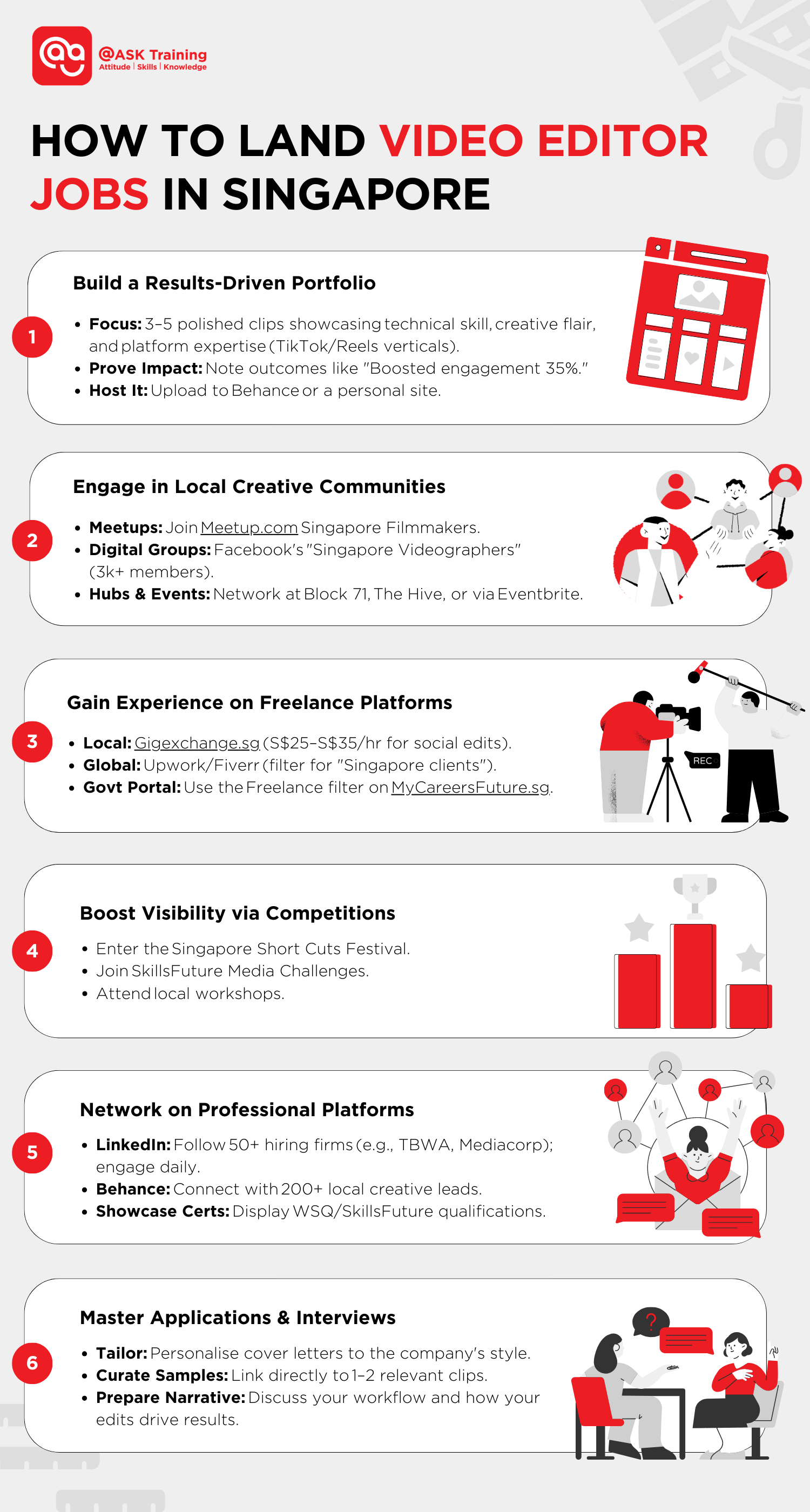
- Local Platforms: Check Gigexchange.sg for local hourly gigs (e.g., social media edits at S$25–S$35/hr).
- Global Marketplaces: Use Upwork or Fiverr, filtering for Singapore-relevant projects.
- Government-Portal Gigs: Explore freelance listings on MyCareersFuture.sg.
Building strong reviews here is a proven stepping stone to full-time roles via client referrals.
4. Participate in Local Campaigns and Competitions
Participating in local creative initiatives provides exceptional portfolio pieces and visibility.
Look for:
- Local film festivals and video competitions.
- Online challenges (e.g., brand hackathons, storytelling contests).
- Initiatives run by university film clubs or community media workshops.
Such projects can serve as powerful conversation starters with potential employers.
5. Network Strategically on Professional Platforms
Use LinkedIn and Behance as your digital professional front door. Actively:
- Showcase your best work in a dedicated portfolio section.
- Connect with recruiters, creative leads, and marketing managers.
- Follow and engage with companies that hire editors.
- Display certifications (like WSQ qualifications) and gather endorsements.
Regularly sharing insights or commenting on industry content can significantly raise your profile with hiring teams.
6. Tailor Applications and Prepare for Interviews
When applying for video editor jobs, go beyond the generic:
- Tailor Your Application: Personalise cover letters to reflect the company’s brand and content style.
- Curate Your Samples: Provide direct links to 1–2 portfolio pieces that align with the role.
- Prepare Your Narrative: Clearly explain your editing decisions and how your work drives results.
By following these steps—from crafting a targeted portfolio to acing interviews—you transform from a candidate into a compelling hire.
For those ready to formalise their training and accelerate this journey, structured education offers a direct path to credibility and skill.
Wrapping Up: Pathway Forward
Singapore’s growing content and digital media industries continue to drive strong demand for video editors across sectors. Success is defined by three pillars:
- High Market Demand: Sustained growth across industries fuels steady hiring.
- Future-Proof Skills: Mastery of AI tools, vertical content, and hybrid creative roles is key.
- Proactive Career Strategy: Continuous learning and a strong portfolio drive long-term success.
Invest in Structured Upskilling
To accelerate your progress and transform market knowledge into a competitive advantage, targeted education is essential.
Let @ASK Training be your strategic partner. As a SkillsFuture Singapore-appointed CET Centre, we offer practical, industry-aligned courses designed to fast-track your readiness.
Here’s how we can build your capabilities:
1. Master the Core Craft:
- WSQ Video Editing: Learn to transform raw footage into engaging stories through core editing techniques and narrative pacing.
- Video Editing & Videography Course: Master end-to-end video creation from storyboarding to final production.
2. Expand Your Strategic Value:
- WSQ Digital Content Creation Course: Learn to plan, create, and optimise multi-format digital content using modern tools and strategies.
Explore our courses today and join the new generation of editors!
Related Courses
◆◆◆