
Your AI assistant can draft an email. It can summarise a report. It can even generate a presentation.
But can it read the room? Can it calm an upset client? Can it mediate a disagreement between teammates?
Probably not.
And that’s exactly why your Critical Core Skills just became your most valuable career asset.
In Singapore, more than 57,000 jobs were added in 2025 alone, and organisations are increasingly selective about the skills they hire for – especially as AI automates more technical tasks.
As AI continues to automate technical tasks across Singapore’s workplaces, one thing is becoming clear: machines calculate, but humans connect.
The ability to think critically, interact with others, and stay relevant is no longer “soft.” It’s strategic.
Whether you’re a professional eyeing your next promotion, a corporate team leader struggling with cross-department friction, or a business owner worried about talent retention and agility, this article is for you.
The question isn’t whether AI will change work. The more important question is whether you’ve built the human skills to work alongside it.
Let’s explore what those skills are, and why they matter more than ever.
What Are Critical Core Skills?
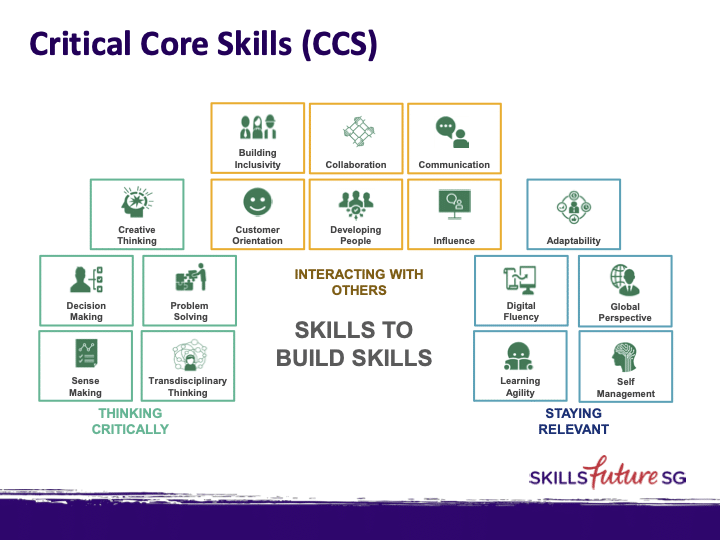
Let’s start with the basics. Under SkillsFuture Singapore’s framework, Critical Core Skills (CSS) are 16 competencies grouped into these three essential areas:
Thinking Critically
Decision Making, Problem Solving, Creative Thinking, Sense Making, Transdisciplinary Thinking, Digital Fluency, and Global Perspective.
Interacting with Others
Building Inclusivity, Collaboration, Communication, Customer Orientation, Developing People, Influence, and Adaptability.
Staying Relevant
Learning Agility and Self-Management.
Here’s the corrected version:
These competencies appear alongside technical KPIs in performance reviews across many Singapore organisations.
Here’s what leading companies have realised. Technical skills help you hire people. But human skills determine how long they stay, how well they lead, and how fast the business grows.
That brings us to an important question: If AI is becoming so capable, why do these human skills matter even more now?
A 2025–2026 hiring-manager survey in Singapore found that while automation has reduced some manual tasks, it has actually raised expectations for human skills such as judgment, leadership, and adaptability.
Let’s look at what AI still cannot do.
The AI Blind Spot: What Machines Still Can’t Do
Let’s be honest about what AI can do. AI excels at pattern recognition. It handles data synthesis with ease. It automates repetitive tasks efficiently. No question about that.
However, AI has clear and lasting limitations and matters enormously for Singapore’s workforce. No amount of training data can overcome these gaps.
- AI lacks genuine empathy.
- AI has no ethical discernment.
- AI cannot resolve genuine human conflict.
- AI struggles with creative reframing.
- AI misses cultural and emotional nuance entirely.
Consider this real-world Singapore scenario:
AI can flag a disengaged employee through attendance or output data. That’s straightforward for a machine.
But a human with Influence and Developing People skills must have that difficult, caring conversation. That single conversation might turn an employee’s entire trajectory around.
Similarly, AI can analyse customer feedback at scale. It can spot trends and sentiment patterns.
But Customer Orientation and Communication turn cold data into genuine client loyalty. This requires judgment, tone, and emotional intelligence.
These differences have real consequences.
- For business owners: These gaps directly affect retention rates and client satisfaction.
- For corporate teams: They impact your ability to execute complex projects without falling apart under pressure.
- For professionals: They determine whether you’re seen as replaceable or indispensable.
This explains why soft skills training has become a business priority. It helps you become genuinely irreplaceable in an AI-augmented workplace.
So which specific skills should you focus on first?
6 Critical Core Skills That AI Can’t Fake
All 16 CCS are valuable. But some resist automation more than others.
Here are six of the most AI-resistant key competencies from the SSG CCS framework. Each one matters right now in Singapore’s fast-paced business environment.
Let’s break them down.
1. Collaboration
Cluster: Interacting with Others
Why AI can’t replace it:
AI facilitates tasks, but it cannot build trust. Trust requires reliability, vulnerability, and shared experience, all human qualities.
Workplace example:
A cross-functional project with competing priorities across departments. Multiple stakeholders bring different agendas.
No one has direct authority over others. Collaboration makes this work. AI cannot mediate these dynamics.
2. Communication
Cluster: Interacting with Others
Why AI can’t replace it:
AI lacks tone, intent, and emotional intelligence. It can generate words, but it cannot sense when someone feels unheard or holds back concerns.
Workplace example:
Delivering difficult feedback to a team member or managing upwards with a stressed leader. The message matters, but delivery matters more.
3. Influence
Cluster: Interacting with Others
Why AI can’t replace it:
AI informs, but it cannot persuade. Persuasion requires reading the room, adapting arguments in real time, and building emotional connection.
Workplace example:
Getting team or leadership buy-in for a new process or digital tool. Data makes the case. Influence closes the deal.
4. Adaptability
Cluster: Interacting with Others
Why AI can’t replace it:
AI follows rules. Humans rewrite them. When circumstances change unexpectedly, adaptability keeps teams moving forward instead of freezing.
Workplace example:
Pivoting during last-minute client or market changes. Singapore’s economy moves fast. Adaptability becomes a survival skill.
5. Digital Fluency
Cluster: Thinking Critically
Why AI can’t replace it:
Digital fluency goes beyond using AI. It means questioning AI outputs, spotting bias, and knowing when to distrust the machine.
Workplace example:
Catching an error or bias in an AI-generated report before it reaches a client. The machine produced it. The human validated it.
6. Learning Agility
Cluster: Staying Relevant
Why AI can’t replace it:
AI does not seek feedback. It does not reflect on mistakes. It does not unlearn old habits that no longer serve the team or business.
Workplace example:
Moving from legacy systems to new workflows without productivity loss. Learning agility separates thriving teams from resisting teams
If you’re a professional, these six skills drive promotions and provide career security.
If you’re a team lead, they help you retain talent and build culture.
If you’re a business owner, they become your competitive advantage and leadership pipeline.
Knowing which skills matter gets you halfway there. The next question is why soft skills training has become urgent now, especially for Singapore organisations.
Let’s answer that.
Why Soft Skills Training is No Longer Optional
Singapore’s workplace moves fast. It’s multi-cultural. It’s increasingly hybrid. In this environment, soft skills training directly impacts the bottom line.
This isn’t exaggeration. You can observe it across industries.
Let’s look at what happens when CCS are neglected.
- Low Collaboration creates silos, duplicated work, and delayed projects.
- Poor Communication leads to client friction, internal tension, and costly misunderstandings.
- Weak Adaptability slows digital transformation and frustrates employees eager to move forward.
- Underdeveloped Influence allows good ideas to die without traction. Innovation stalls.
- Lack of Learning Agility keeps teams stuck in outdated workflows while competitors race ahead.
Now consider the opposite.
Teams with strong SSG Critical Core Skills alignment make faster decisions. They retain talent longer. They innovate more effectively.
Here’s a real example from Singapore
One local team reduced project delays by nearly a third. How did they do it? Focused training on Problem Solving and Collaboration. That’s measurable ROI, not theory.
- For business owners: This means spending less on recruiting and more on growth.
- For corporate teams: This means smoother change management and higher psychological safety.
- For professionals: This means becoming the person leadership trusts with challenging assignments.
IMF-led research on Singapore estimates that a significant share of the workforce, especially managers, professionals, and technical experts, could experience productivity gains from AI, but only if they are supported with skills training in judgment, ethics, and collaboration.
So, where can Singapore professionals and teams build these skills effectively?
Where to Start: Practical First Steps
You don’t need to overhaul everything at once. The CCS framework covers many skills, but the most effective approach stays targeted and gradual.
Here’s how different roles can begin:
For Professionals
- Start with Self-Management. Focus on your energy, boundaries, and emotional regulation.
- This foundation supports every other Critical Core Skill. Without it, communication and influence collapse under pressure.
For Corporate Teams
- Identify one recurring friction point. Slow meetings? Handover confusion? Client complaints that keep coming back?
- Map that friction to a CCS gap. Train specifically for that skill. Small wins build momentum.
For Business Owners
- Ask yourself honestly, what does low CCS cost your organisation right now? Is it turnover? Rework? Missed opportunities? Lost clients?
- Once you quantify the cost, investing in soft skills training becomes an obvious business decision.
No matter where you start, begin before AI reshapes your industry further.
Final Thought: Machines Calculate. Humans Connect.
AI will continue to evolve. It will write better drafts. It will analyse faster. It will automate more tasks each year.
- But AI will never truly understand a colleague’s frustration after a difficult week.
- It will never earn trust through consistent, reliable behaviour over time.
- It will never inspire a team to push through a hard deadline together.
- It will never build inclusivity or develop people the way a thoughtful human leader can.
Those are Critical Core Skills.
These skills remain yours to keep, but only if you choose to develop them actively.
So no, AI cannot replace your people skills. However, without intentional soft skills training, you or your team might become less relevant in a world that still desperately needs human connection.
Machines calculate. Humans connect.
Adapt, influence, and lead. No algorithm can fake that.
Ready to Build Skills That AI Cannot Replace?
At @ASK Training, our soft skills courses map directly to the SSG Critical Core Skills framework.
We help Singapore professionals, corporate teams, and business owners build the human skills that AI cannot replace.
Here are some courses that are worth exploring that span across the three essential areas (Thinking Critically, Interacting with Others, Staying Relevant) for today’s workplace:
- Enhancing Your Emotional Intelligence: Develop the four domains of EQ to lead with empathy and self-awareness. (Interacting with Others)
- Persuasive Communication for Leaders: Learn visual, vocal, and verbal techniques to influence and motivate others. (Interacting with Others)
- The Five Behaviours of a Cohesive Team: Identify and fix team dysfunctions using DISC profiling. (Interacting with Others)
- Critical Thinking for Effective Problem Solving: Apply whole-brain thinking to analyse and solve workplace challenges. (Thinking Critically)
- Building Personal Resilience and Wellbeing: Strengthen your ability to adapt and recover from workplace stress. (Staying Relevant)
- Resilience at Work: Turning Stressful Situations into Your Advantage: Develop a resilience blueprint for lasting career agility. (Staying Relevant)
Not sure which skills your team needs most?
Contact us for a complimentary Training Needs Analysis. We’ll help you pinpoint exactly which gaps to prioritise!
Related Courses
- Persuasive Communication for Leaders
- The Five Behaviours of a Cohesive Team
- Critical Thinking Training
◆◆◆