
In the modern workplace, a job title grants you authority, but it doesn’t guarantee a loyal following.
Real leadership is an “earned” status, built through the small, everyday interactions that either strengthen or erode the trust of your team.
Whether you are a new manager or a seasoned lead, the challenge remains the same: how do you balance high standards with a human-centred approach?
This guide breaks down the practical behaviours that define “follow-worthy” leadership in Singapore today, offering actionable strategies to help you lead with clarity, resilience, and impact.
What “Follow-Worthy Leadership” Looks Like Today
In Singapore, people rarely leave their jobs because of the technical nature of the work or the pressure of responsibility. More often, they leave because of poor working relationships with a particular manager.
Day-to-day experiences such as unclear expectations, inconsistent standards, public criticism, and lack of support gradually shape whether employees feel engaged or begin to disengage.
This is reflected in local data: PwC Singapore reports that only about 49% of employees trust their direct managers. Furthermore, 64% of employees believe their managers are intolerant of small-scale failures.
When your team feel unsafe making small mistakes, they tend to hide problems rather than surface them early.
To bridge this gap, we must redefine what it means to lead. Follow-worthy leadership isn’t about charisma, personal magnetism, or always having the right answer.
Instead, it is a formula of trust + clarity + consistency + care.
Shifting from “Command-and-Control” to People-Centred Leadership
Effective leadership training in Singapore now emphasises moving away from rigid hierarchy toward a people-centred leadership approach.
Consider the difference in impact:
- Command-and-Control: “Do this because I said so.”
- People-Centred: “Here’s the outcome we’re aiming for, here’s what ‘good’ looks like, and here’s the support available to you.”
Quick Checklist: What Your Team Actually Wants
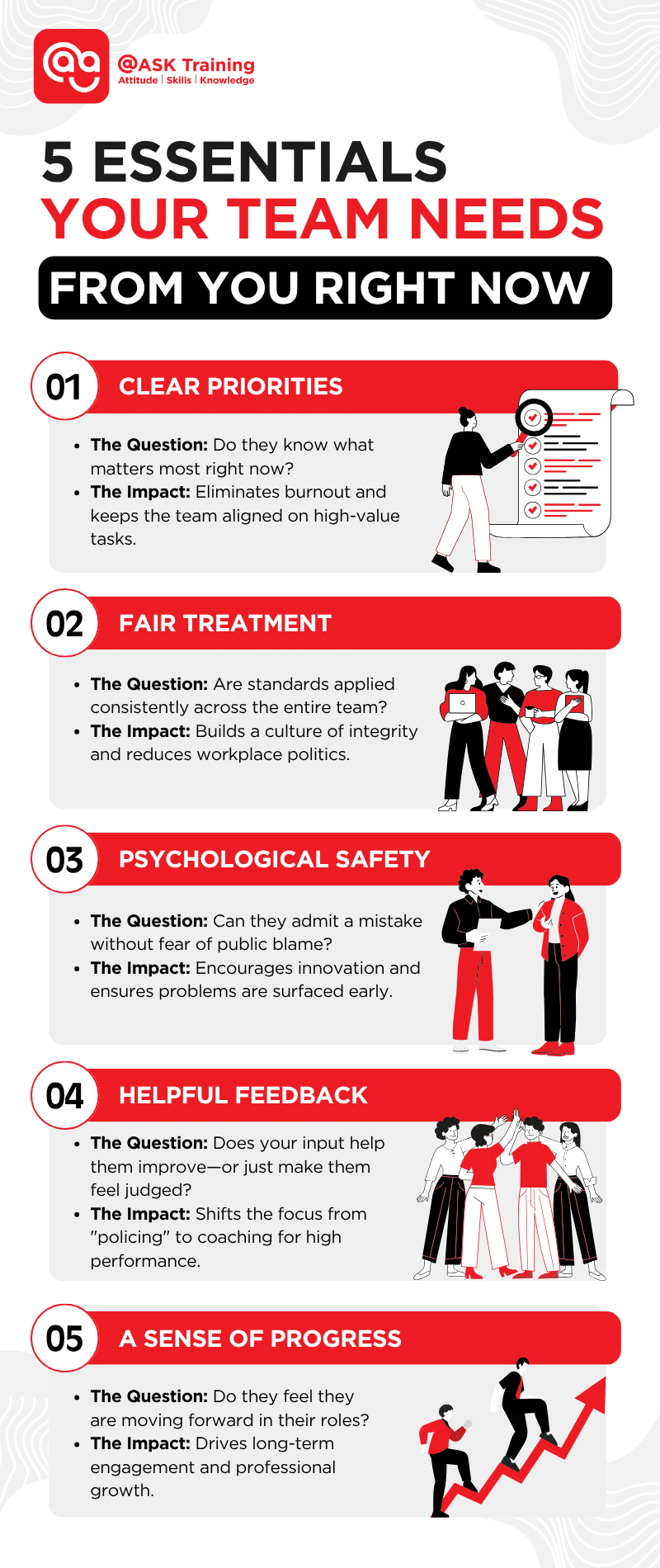
Leadership is experienced through consistent, observable behaviours that make work feel manageable. Ask yourself if you are providing these five essentials:
- Clear Priorities: Do they know what matters most right now?
- Fair Treatment: Are standards applied consistently across the team?
- Psychological Safety: Can they admit a mistake without fear of public blame?
- Helpful Feedback: Does your input help them improve or just make them feel judged?
- A Sense of Progress: Do they feel they are moving forward in their roles?
By mastering these fundamentals, you transform from a manager with formal authority into a leader with genuine followership.
While understanding what followership looks like is the first step, sustaining it requires a high level of self-awareness and leadership resilience, especially when things go wrong.
Leader Yourself First: Emotional Intelligence Under Pressure
True leadership begins with self-regulation. Emotional intelligence shows up most clearly in how you regulate yourself under pressure.
When leaders lack emotional self-awareness, they often fall into reactive leadership, characterised by sharp tones, defensiveness, or snap decisions, which directly affects whether people dare to speak up.
To build leadership resilience, you must shift from reacting to responding. A simple but effective method is the “Pause and Choose” technique:
- When to use it: Before replying to an upsetting message or reacting to bad news.
- How it works: Pause for 10 seconds, internally name the emotion you are feeling (e.g., “I am frustrated”), and then consciously choose the outcome you want to achieve (e.g., “I want to resolve the issue without blame”).
Putting it into Practice
Consider a common workplace scenario: a teammate misses a critical deadline. Instead of a reactive, personal judgment, choose a neutral, outcome-focused response.
- The Reactive Response: “Why are you always late?”
- The Lead-Yourself Response: “The report wasn’t ready at 3pm; what blocked you, and what’s the plan to deliver it by 5pm?”
By choosing neutral language and staying focused on results rather than personal reactions, you stabilise the conversation and encourage accountability rather than defensiveness.
Once you have mastered your internal responses, you can focus on the external actions that build a foundation of trust within your team.
Build Trust with Everyday Behaviours, Not Big Speeches
Trust is not built during town halls or big speeches; it is earned through small, repeated actions.
In practical terms, a good leader is someone who is predictable, fair, and capable of making sensible decisions.
While a job title gives you formal authority, only consistent reliability and fairness create true followership.
Weekly “Trust Deposits”
Think of trust as a bank account where you must make regular deposits to keep the relationship healthy. Try these weekly habits:
- Keep Your Promises: Follow through on even the smallest commitment made in a meeting.
- Give Credit Publicly: Acknowledge contributions openly so the team feels seen.
- Share Context: Explain the “why” behind decisions before making changes.
- Protect the Team: Shield your members from unnecessary last-minute requests or friction.
Beware of “Trust Breakers”
Just as small actions build trust, specific behaviours can quickly erode it. Avoid these common pitfalls:
- Changing priorities without explaining the shift in strategy.
- Taking credit for others’ work.
- “Ghosting” the team, only appearing when something has gone wrong.
- Publicly calling out errors via email or group chat, which often causes embarrassment rather than growth.
By focusing on these observable behaviours, you ensure that after every conversation, your team knows exactly “what good looks like” next.
Beyond building trust, your effectiveness as a leader depends on your ability to communicate expectations so clearly that confusion has no room to grow.
Communicate So People Feel Seen and Clear at the Same Time
Effective leadership communication is the bridge between a manager’s intent and an employee’s impact.
Poorly delivered feedback or vague instructions erode trust, while clear communication makes work feel manageable. To reduce confusion, use this simple four-step structure:
Context → Expectation → Why it Matters → Next Step.
By using firm but respectful language, you keep the focus on observable behaviour rather than personal judgment. Try these professional phrases:
- “Here’s what I’m seeing…”
- “The impact is…”
- “What I need going forward is…”
- “What support would help you deliver that?”
Clarity vs. Vagueness:
- Vague: “Be more proactive.”
- Clear: “Post a daily 5pm update in the channel: what’s done, what’s blocked, and what you need.”
Example from a Singapore-Based Platform Company
Grab has implemented structured feedback mechanisms such as performance report cards for driver-partners, providing frequent, data-based feedback rather than relying only on infrequent reviews.
For office teams, the equivalent is regular performance snapshots, clear metrics, and frequent feedback. The outcome is fewer surprises and clearer expectations.
When communication is clear, you can stop managing tasks and start leading people by moving from control to empowerment.
Motivate Without Micromanaging
Motivation in a people-centred leadership model is driven by autonomy, mastery, recognition, and meaning, not fear.
Competent leaders set priorities and remove obstacles rather than hovering over every detail.
To delegate effectively without losing control, try this approach: “You own the solution. Success looks like X by Friday. Check in with me Wednesday for 10 minutes if blockers show up.”
Empowerment in Action
- Micromanagement: “Send me every draft before you message the client.”
- Empowerment: “Use this template to keep the tone consistent, and loop me in only if the client pushes back on the timeline or price.”
As you empower your team, your role shifts from being the “answer-provider” to being a coach who unlocks their potential.
Coach for High Performance Instead of “Telling More”
A coaching leadership style focuses on development rather than just compliance.
You don’t need an hour-long session; most coaching moments happen in 10-minute everyday conversations using a simplified framework:
Goal → Reality → Options → Next Step.
5 Questions for Any Situation:
- “What outcome are you aiming for?”
- “What’s getting in the way?”
- “What have you tried so far?”
- “What are 2–3 options?”
- “What will you do by when?”
Example for a struggling performer: “Your client updates are inconsistent. What system could make updates reliable? Would a Friday template and a calendar reminder solve it?”
Effective coaching sets the stage for accountability, ensuring that agreed-upon actions lead to real-world results.
Create Accountability and Ownership Without Fear
Accountability is not about punishment; it is the combination of clear expectations, agreed commitments, and consistent follow-up.
To ensure ownership, always end a discussion with a “commitment close”:
- The Commitment Close: “To confirm: you’ll send the revised proposal by 2pm Thursday, and if legal delays happen, you’ll alert me by 10am.”
To maintain high standards while allowing for psychological safety, distinguish between what is non-negotiable and what is flexible.
- Non-negotiable: Client deadline and data accuracy.
- Flexible: The specific tool used or the format of the slide deck.
Even with accountability, misalignments will happen; how you handle those moments of conflict determines the health of your team.
Turn Conflict into Better Decisions
Respected leaders reframe constructive conflict management as a tool for better decision-making. Conflict is usually just a signal of misalignment, not a personal attack.
When emotions rise, use a de-escalation script to find common ground:
“Let’s align on the goal first. What are we both trying to achieve? Now let’s list the trade-offs of option A vs. B.”
Scenario: Speed vs Quality.
If two teammates disagree, one wanting speed and the other wanting perfection, resolve it by defining a “minimum quality bar” and a “hard deadline,” then selecting the approach that meets both.
By resolving conflict healthily, you reinforce the behaviours that create a cohesive team culture where people actually want to belong.
Build A Team People Want to Belong To
A cohesive team is built on trust, healthy debate, commitment, and accountability.
You can reduce workplace politics by establishing practical team norms:
- “Disagree in the meeting, commit after the meeting.”
- “No surprises: raise risks early.”
- “Assume positive intent, ask before judging.”
Creating Psychological Safety: In project retrospectives, always ask “What did we learn?” before asking “Who caused this?” This shifts the culture from blame to growth.
Example from Singapore’s Public Sector
GovTech has publicly shared its emphasis on building psychological safety and encouraging staff to speak up to support innovation.
In practical terms, their managers explicitly ask for input and treat honest mistakes as learning signals. The result? Issues surface earlier when they are smaller and easier to address.
While these internal behaviours are vital, a truly great leader also knows how to navigate the external complexities of strategy and power.
Learn Strategy from the Three Kingdoms: Leading Through Chaos, Politics, and Pressure
At @ASK Training, we believe modern leaders can find deep wisdom in the strategic lessons of the Three Kingdoms Leadership.
These programmes offer a unique lens for navigating high-pressure environments through timeless strategic moves:
- Deploy Talent Intentionally: Like a master strategist, put your strongest operator on the most time-sensitive, highest-impact work.
- Manage Timing: Sequence changes when capacity exists; avoid launching major shifts mid-crisis unless absolutely necessary.
- Build Alliances: Win cross-team support by clarifying shared outcomes and “what’s in it” for each stakeholder.
- Read People Accurately: Notice individual motivation drivers, such as status, security, or growth, and adapt your influence style accordingly.
The Strategy in Action:
Imagine two departments competing for limited resources. Instead of a “blame spiral,” create a coalition plan:
Align on a shared outcome, set objective decision criteria (impact, urgency, and risk), and trade support across projects to ensure both teams succeed.
Mastering these strategic and behavioural habits is the final step in becoming a leader that people don’t just work for, but truly want to follow.
Conclusion: Leadership Is Experienced, Not Announced
People decide whether you are a leader worth following through everyday interactions, not job titles.
They notice how you respond when things go wrong, whether your expectations are clear, and if you truly listen.
Follow-worthy leaders aren’t perfect; they are predictable, fair, and focused on helping their people succeed.
If your team leaves every interaction feeling clearer about their goals and respected as professionals, they will follow you even when the work becomes difficult.
Your 2-Week Personal Development Plan
Becoming a better leader doesn’t happen overnight; it happens through intentional practice.
Choose one behaviour to focus on
(e.g., Clarifying expectations, giving clearer feedback, or the “Pause and Choose” technique).
Practice it intentionally
for two weeks in every meeting and email.
Ask for upward feedback
At the end of two weeks, ask a trusted teammate: “What is one thing I should stop, start, or continue doing to better support your work?”
Take the Next Step in Your Leadership Journey
Mastering these behaviours requires more than just reading; it requires a safe space to practice.
@ASK Training provides high-impact leadership training in Singapore designed to help you navigate modern workplace complexities with confidence and strategy.
If you’re ready to shift from “managing” to true “follow-worthy” leadership, explore our signature courses:
People-Centred Leadership – Motivating, Inspiring, and Engaging Others
Learn the foundational behaviours that build trust and drive high performance in a modern Singaporean context.
Three Kingdoms Leadership in Today’s Context
Master the art of influence and decision-making by applying timeless strategic wisdom to contemporary leadership challenges.
Applying Three Kingdom Strategies in Your Organisation
A deep dive into high-level organisational strategy, alliance building, and navigating corporate politics effectively.
Ready to lead with impact? Browse all Leadership & Management Courses here!
Related Courses
- People Centered Leadership- Motivating, Inspiring and Engaging Others
- Three Kingdoms Leadership Courses
◆◆◆
Related Articles
Article Topics
- What Follow-Worthy Leadership Looks Like
- Emotional Intelligence Under Pressure
- Build Trust with Everyday Behaviours
- Communicate with Clarity and Care
- Motivate Without Micromanaging
- Coach for High Performance
- Create Accountability Without Fear
- Turn Conflict into Better Decisions
- Build a Team People Want to Belong To
- Learn Strategy from the Three Kingdoms
- Conclusion: Leadership Is Experienced