
Many professionals in Singapore avoid giving feedback because they do not care. They avoid it because they are unsure how the feedback will be received.
Even when your intentions are good, there is a lingering worry that giving feedback at work might sound harsh, trigger defensiveness, or create unnecessary conflict.
These concerns are supported by local data.
A survey by Randstad Singapore found that:
- 72% of employees say they feel uncomfortable giving and receiving feedback with their managers.
- 15% report that they are never asked for feedback during performance appraisals.
At the same time, PwC Singapore reports that:
- Only around 40% of employees proactively seek feedback to improve performance.
Together, these figures suggest that although feedback is widely recognised as important, many do not feel psychologically safe enough to engage openly.
In our fast-moving, high-pressure workplaces, silence doesn’t mean everything is fine; it often means problems are accumulating quietly.
Giving effective feedback is not about having a specific personality or being naturally good with people. It is a learnable skill built on structure, emotional control, and clarity.
This article provides a practical approach to delivering constructive feedback. You will learn what to say, how to say it, and how to navigate strong emotions so that your conversations improve performance, build trust and strengthen your team culture.
To master this skill, let’s first understand what constructive feedback is.
What Constructive Feedback Really Means (And What It Is Not)
Constructive feedback is information that helps someone improve future behaviour or results.
It is specific, based on observable behaviour, and oriented toward improvement.
It is not venting frustration, labelling personality traits, making assumptions about intent, or relying on vague statements.
A useful principle is to focus on describing behaviour and impact rather than character.
Next, let’s understand why even our best intentions can sometimes come across as harsh.
Why Feedback Comes Out Harsh (Even with Good Intentions)
In many Singapore workplaces, feedback often sounds harsher than intended because of the high-pressure environment we operate in.
Understanding these drivers is the first step towards delivering constructive feedback that actually works.
The Common Drivers of Harshness
Feedback typically loses its impact when it is influenced by:
- Rushed Delivery: Working professionals in Singapore are interrupted on average every two minutes by emails or meetings, leading to tone and wording that suffer during quick interactions.
- Delayed Frustration: When issues are left unresolved, frustration builds and eventually “leaks” into the conversation when something finally breaks.
- Unclear Objectives: If you don’t know exactly what change you want to see, the conversation becomes unfocused and confusing.
- Assuming Intent: It is easy to replace facts with assumptions, turning a “late submission” into a label like “lazy”.
Judgment vs. Observable Behaviour
The secret to keeping a conversation professional is to contrast “judgment” with “observable behaviour”.
Focusing on describing what happened rather than labelling the person:
Judgment: “You’re careless with deadlines.”
Observable Behaviour: “The report was submitted two days late last week, which delayed the client proposal.”
Judgment: “You have an attitude problem.”
Observable Behaviour: “I noticed a very short reply to the client’s inquiry earlier today.”
Judgment: “You’re being unprofessional.”
Observable Behaviour: “The meeting notes haven’t been sent within the agreed 24-hour window.”
Clarity While Keeping Dignity Intact
The core goal of constructive feedback training is to help you make the message crystal clear while keeping the other person’s dignity intact.
By focusing on facts rather than criticising someone’s character, you reduce the perceived threat and make it easier for them to hear you.
Rather than blaming yourself for sounding harsh, recognise that a high-speed environment makes harshness more likely; the best move is to slow the process down.
To do this effectively, you need more than just a script; you need the internal awareness to manage the moment.
Emotional Intelligence Is the Foundation of Good Feedback
While the frameworks provide the “what” of a conversation, emotional intelligence (EI) determines the “how”. PwC Singapore found that 64% of employees believe their managers are intolerant of small-scale failures.
When people sense low tolerance, they are more likely to hide mistakes than discuss them.
To change this dynamic, you can lean on four core EI capabilities that transform feedback from a source of stress into a tool for growth:
Self-Awareness
Notice your own emotional state before you speak. If you are feeling irritated, tired, or rushed, it is often better to delay the conversation to avoid letting your triggers dictate your tone.
Self-Management
This is your ability to regulate your tone and pace. By staying outcome-focused even under stress, you can choose neutral language that keeps the conversation productive rather than emotional.
Empathy and Perspective-Taking
Consider how the message may sound from the other person’s perspective. Predicting how your feedback might “land” allows you to adjust your language to ensure the message is heard as intended.
Relationship Management
The goal is to address performance gaps while keeping trust intact. This ensures that the professional bond remains strong, even after a difficult conversation.
Effective feedback does not require “softness”; it requires emotional steadiness. By managing your internal state, you create the psychological safety necessary for others to accept and act on your input.
Once you have the right emotional mindset, the next step is to ensure your message is backed by clear, objective preparation.
Prepare Before the Conversation
Most awkward feedback moments happen because the conversation is improvised. Taking a few minutes to follow a short preparation process significantly reduces tension and ensures you remain behaviour-focused.
To get the best results, use these four preparation steps:
Define the Desired Outcome
In one sentence, clarify what “better” looks like. Ask yourself, “After this conversation, what do I want to be different?”.
Capture Observable Facts
List specific examples of what happened and when it happened. Avoid assumptions and stick to what was actually said or done.
Explain the Practical Impact
Identify how the behaviour affects team workflow, customer outcomes, deadlines, or trust.
Choose a Single Focus
To avoid “feedback dumping”—the mistake of piling on multiple issues at once—select the one most important area to address.
Example: The Preparation Checklist
If you were addressing a missed deadline, your preparation might look like this:
- Outcome: Reports are submitted by the agreed deadline every Friday.
- Fact: The last two weekly reports were submitted on Monday instead of Friday.
- Impact: The client review was delayed, and the team had to work through the weekend to catch up.
If you cannot state the outcome, fact, and impact clearly, you are not ready to have the conversation yet.
By doing this groundwork, you ensure your delivery is professional and grounded in reality.
With your preparation complete, the next step is to choose the right environment to ensure your message is received well.
Timing and Setting Matter More Than Wording
Even with the best preparation, giving feedback at work can fail if the environment isn’t right. In many Singaporean workplaces, two common mistakes are giving corrective feedback in group chats and giving feedback publicly to “send a message.”
Both approaches tend to backfire by triggering defensiveness rather than improvement.
To ensure your message is heard, follow these guidelines for timing and setting:
- Public vs. Private: Always keep corrective feedback private to protect the individual’s dignity, while reserving public settings for recognition and praise.
- The “Goldilocks” Timing: Deliver feedback close enough to the event so it remains relevant, but avoid doing so mid-emotion or during an argument.
- Respect the Schedule: Choose a dedicated time that supports a real, two-way conversation; avoid squeezing it into a hallway chat or the three minutes between meetings.
- The Professional Opening: Start with a respectful line that signals development rather than punishment.
Using opening phrases like, “I want to share something that can help us work better together,” or “This is about improving the outcome, not blaming.”
When you set the right stage, you move from a “critique” to a collaborative discussion. Once the setting is secure, you can use a structured framework to keep the conversation flowing smoothly.
A Simple Feedback Structure That Keeps Things Professional
To ensure your message remains professional and objective, it helps to use a repeatable feedback conversation framework.
This structure allows you to deliver high-impact information without lecturing or guessing at someone’s intent.
A practical five-step sequence for any feedback session is:
Behaviour → Impact → Expectation → Perspective → Agreement
Lead with the Specific Behaviour
- Use neutral, factual language to describe what happened.
- For example, “In yesterday’s meeting, you interrupted the client several times“.
Explain the Impact
- Describe how the behaviour affected the work, the team, or the goal.
- In this case, “The impact was that we missed some of their concerns and the discussion felt rushed”.
State the Expectation
- Clearly define what the person needs to start, stop, or continue doing.
- “Going forward, I need you to let them finish before responding”.
Ask for Perspective
- Invite the other person to share their context.
- This invites dialogue without losing accountability. “How do you see it?”
Agree on Next Steps
- Collaborate on what will happen differently and how progress will be tracked.
- “What would help you do that?”
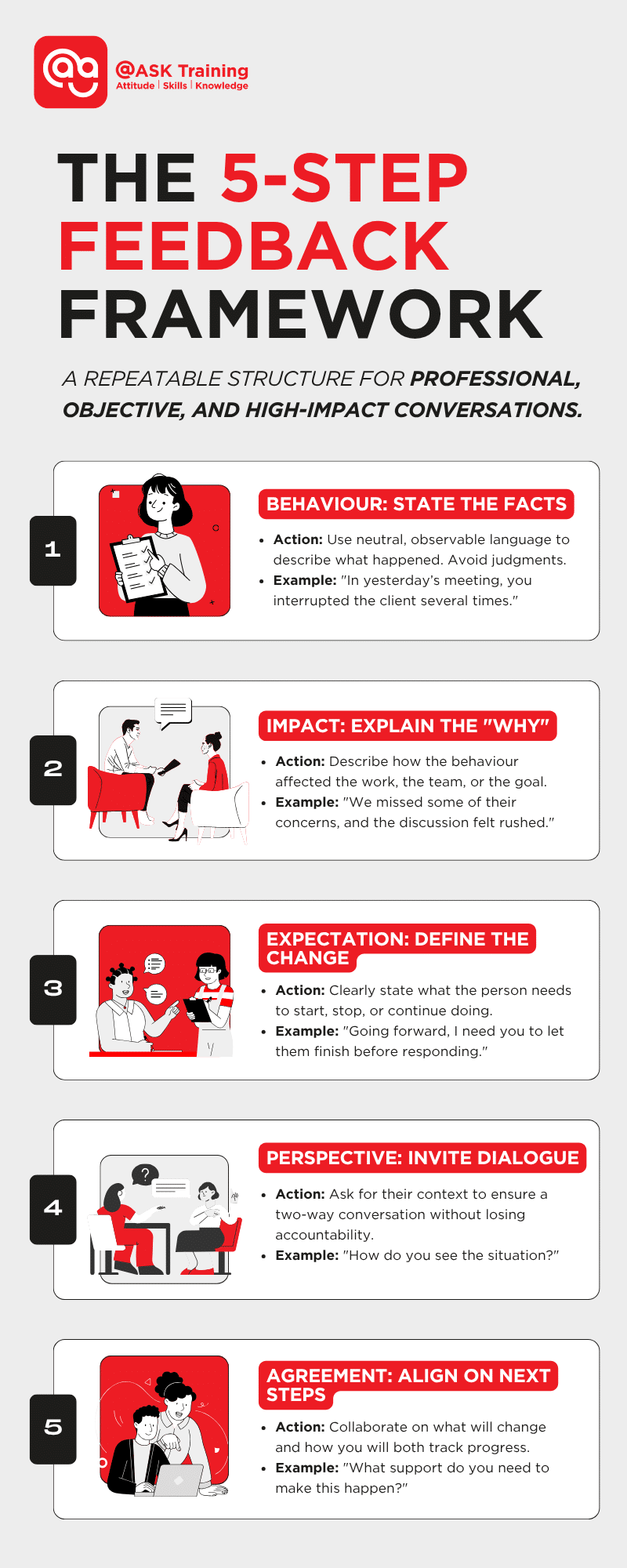
By following this sequence, you ensure the conversation starts with facts, explains consequences, and ends with clear alignment.
This structured approach is a cornerstone of constructive feedback training, helping you maintain a professional tone even in difficult moments.
While the framework provides the map, the specific words you choose will determine how smoothly the journey goes.
Language That Reduces Defensiveness
Small wording shifts make a significant difference in how your message is received. When giving feedback at work, your goal is to minimise defensiveness so the other person can focus on the solution rather than feeling attacked.
To achieve this, replace personality judgments with specific, observable actions:
- Use “I” Statements: Phrases like “I noticed…” or “The impact I saw was…” feel neutral and factual. Avoid “You” traps like “You always…” or “You never…”, which often feel like an attack on someone’s character.
- Focus on Behaviour Over Labels: Instead of labelling someone as “unprofessional” or “careless,” describe the exact behaviour you want to see changed.
- Eliminate Vagueness: If an instruction can be misunderstood, it isn’t specific enough. Replace “improve communication” with a clear, measurable expectation.
Common Feedback Scenarios: Before & After
Here are some feedback examples for work that transform vague criticism into actionable requests:
Missed Deadline:
- Instead of: “You’re always late with your work.”
- Try: “I noticed the last two reports were submitted after the deadline. The impact was a delay in our client presentation; going forward, I need these by 3pm every Friday.”
Meeting Behaviour:
- Instead of: “You’re being disruptive in meetings.”
- Try: “I noticed you were speaking over colleagues in today’s sync. It made it difficult for the team to share their full ideas. Let’s ensure everyone finishes their point before we respond.”
Quality Errors:
- Instead of: “Your work is getting sloppy.”
- Try: “I noticed three formatting errors in the latest draft. This affects our brand consistency. Please use the updated checklist for all future submissions.”
Communication Gaps:
- Instead of: “You need to be more responsive.”
- Try: “I noticed some client emails went unanswered for 24 hours. Moving forward, please acknowledge all external messages within four working hours.”
By choosing words that describe the “what” rather than the “who,” you keep the focus on professional growth.
However, delivering the right words is only half the battle; you must also be prepared to listen to the response.
Use Active Listening to Prevent Escalation
Giving feedback at work is not a monologue; it is a two-way street. Applying active listening skills at work allows you to navigate the other person’s reaction without losing the objective of the conversation.
When people feel heard, their biological “threat response” diminishes, making them more likely to process your suggestions.
To keep the conversation productive, use these active listening techniques:
- Reflect Back Key Points: Summarise what you’ve heard to show understanding. For example, “So what I’m hearing is that the project timeline felt unclear from the start.” This demonstrates respect without necessarily agreeing with an excuse.
- Ask Clarifying Questions: Instead of making assumptions, uncover actual constraints by asking, “What got in the way?” or “What support is missing that would have helped?”
- Check Alignment on the Goal: Pivot back to the future by asking, “What would success look like to you next time?”
- Use Strategic Silence: If tension rises, a brief three-second pause and a calm summary of the points discussed can effectively slow the emotional tempo of the room.
Listening does not mean you are lowering your standards or agreeing with poor performance. It means you are gathering the information necessary to solve the problem permanently.
Even with great listening, emotions can sometimes boil over. Knowing how to de-escalate these moments is vital for maintaining a professional environment.
Handling Resistance and Strong Emotions
When handling defensive team members during feedback, it is important to remember that some level of resistance is a natural human response.
Your goal as a leader is to manage the energy of the room so the conversation stays focused on the solution.
Follow these steps to manage high-emotion moments:
- Name the Emotion Neutrally: If you see a colleague getting upset, acknowledge it without judgment. Say, “I can see this is frustrating,” or “I recognise this is a lot of information to take in at once.”
- The “Pause and Reset” Rule: If anger rises or the conversation becomes circular, it is perfectly professional to say, “Let’s pause here and come back to this tomorrow morning when we’ve both had time to reflect.”
- Avoid the Escalation Traps: Do not match the other person’s intensity, debate their feelings, or start “piling on” more examples of mistakes to prove your point. This only increases the sense of being attacked.
- Return to the Shared Objective: Always ground the conversation back in the common goal. “Ultimately, we both want this project to succeed and for you to feel confident in your role.”
By remaining emotionally steady, you model the professional behaviour you expect from your team.
This creates a culture where even difficult conversations at work are seen as a pathway to improvement rather than a source of dread.
Once the emotions have settled, the final and most important step is to turn the discussion into a concrete plan for the future.
Turn Feedback into Action with SMART Follow-Up
Without a clear plan for the future, feedback can feel like a one-time complaint rather than a professional development tool.
To ensure your conversation leads to lasting change, convert your expectations into SMART goals feedback follow-up (Specific, Measurable, Achievable, Relevant, and Time-bound).
To turn a conversation into a result, follow these steps:
- Create a SMART Goal: Instead of saying “be faster,” try: “For the next four weeks, please submit your project drafts 24 hours before the deadline, so I have time for a final review.”
- Agree on Evidence and Timing: Define exactly what success looks like and when you will check in. Decide if progress will be tracked via email updates, a shared tracker, or a quick weekly 1-on-1.
- Reinforce Improvement Early: When you see the behaviour change, acknowledge it immediately. A simple, “I noticed the last two reports were in early; great work on that,” reinforces the positive shift and increases the likelihood of repeat behaviour.
- Evaluate and Adjust: If progress stalls despite the agreement, don’t wait for the annual review. Re-open the conversation early to identify if there are new constraints or if a different approach is needed.
By moving from vague critiques to structured goals, you provide your team with a clear finish line to aim for.
This clarity is what transforms a “difficult conversation” into a successful coaching moment.
While individual follow-up is vital, the ultimate goal is to create an environment where these exchanges happen naturally every day.
Build a Feedback Culture (So It’s Not Scary Every Time)
If feedback only happens during formal appraisal seasons, it will always feel like a high-stakes, high-stress event.
To reduce the “fear factor,” organisations should strive to build a feedback culture in teams where growth-oriented conversations are part of the daily rhythm.
You can start building this culture by focusing on these four areas:
Normalise Low-Stakes Feedback
- Give small pieces of feedback frequently.
- When you address minor items as they happen, they don’t accumulate into “big failures” that require a heavy, formal meeting.
Encourage Peer-to-Peer Feedback
- Feedback shouldn’t just flow downward.
- Encourage team members to share respectful, specific, and timely observations with one another to build collective accountability.
Focus on Coaching Over Compliance
- Use feedback as a tool for mentorship and growth.
- When employees feel you are invested in their success, rather than just checking a box, they are much more likely to seek out your input.
Celebrate Learning Moments
- PwC Singapore data shows that only about 40% of employees feel they can truly be “themselves” at work.
- By celebrating improvements and treating mistakes as learning opportunities, you build the psychological safety needed for people to surface problems early when they are still easy to fix.
When feedback is treated as a helpful resource rather than a hidden threat, your team becomes more resilient, agile, and open to continuous improvement.
Final Thoughts
Giving feedback without sounding harsh isn’t about simply being “nicer”; it is about being clearer and more deliberate in how you structure your conversations.
When your team understands exactly what the issue is, why it matters, what is expected next, and how progress will be tracked, feedback begins to feel like a valuable resource rather than a personal critique.
To recap, mastering this skill requires a blend of several essential elements:
- Emotional Regulation: Managing your own triggers and maintaining a steady, professional tone.
- Preparation: Gathering facts and defining the desired outcome before you speak.
- A Simple Framework: Using the Behaviour → Impact → Expectation sequence to stay objective.
- Active Listening: Ensuring the other person feels heard to reduce natural defensiveness.
- SMART Follow-Up: Turning discussions into actionable, measurable goals.
The key takeaway is that combining clarity with care is a skill that can be practised and improved over time.
By moving away from vague judgments and toward specific, behaviour-focused dialogue, you allow feedback to strengthen working relationships instead of weakening them.
Take the Next Step in Your Leadership Journey
Ready to move from theory to practice? At @ASK Training, we provide hands-on, contextualised training to help you lead with confidence and impact.
Explore our popular Leadership and Management course to master these essential skills:
- Build Your Foundation: Strengthen your self-management and social awareness with Enhancing Your Emotional Intelligence: The Key to Effective Leadership.
- Lead with Connection: Discover how to build deeper trust and psychological safety through Empathy: Harnessing the Power of Connection at the Workplace.
Equip yourself with the tools to transform your team culture today!
Related Courses
- People Centered Leadership- Motivating, Inspiring and Engaging Others
- Three Kingdoms Leadership Courses
◆◆◆
Related Articles
Article Topics
- What Constructive Feedback Means
- Why Feedback Sounds Harsh
- Emotional Intelligence in Feedback
- Prepare Before the Conversation
- Timing and Setting Matter
- A Simple Feedback Structure
- Language That Reduces Defensiveness
- Use Active Listening
- Handling Resistance and Emotions
- SMART Follow-Up
- Build a Feedback Culture
- Final Thoughts