
In 2026, AI in marketing is no longer experimental. It is operational necessity; embedded in daily workflows across Singapore SMEs, mid-market brands, and agencies.
Before we begin: Two Types of AI in marketing:
Predictive AI analyses historical data to score leads, forecast outcomes, or optimise bids—answering “what will likely happen.”
Generative AI creates new content: text, images, ideas, and campaign variations—answering “what could we say or show.”
This article focuses on generative AI: how Singapore marketers use it to produce more, test faster, and maintain quality.
Why this matters for Singapore teams:
- Digitally fluent audiences
- Short decision cycles
- Intense competition for attention
- Same resources, more output required
Here’s what you’ll learn: where generative AI marketing delivers the most value and how to build repeatable systems that safeguard brand quality, accuracy, and trust.
Throughout the sections ahead, you’ll see these capabilities translated into daily workflows.
Why 2026 Is A Turning Point For Singapore Marketing
Singapore’s market conditions highlight both the opportunities and risks of generative AI adoption. The country’s digital maturity means audiences are quick to spot low-effort or misleading content.
The opportunity: Speed, variation, and scalability.
The risk: Audiences with high digital literacy spot low-effort or misleading content instantly, and they don’t forgive twice.
What Makes Singapore Different?
- Campaigns move faster than regional averages
- Attention is expensive and fiercely contested
- Audience expectations are calibrated against global best practices
This pressure has accelerated AI marketing adoption in Singapore—not as a shortcut, but as a way to generate more variations, test ideas rapidly, and maintain brand quality without expanding headcount.
Here’s the division of labour that works:
- Generative AI enables teams to quickly produce more headlines, hooks, and content variations.
- Human judgement ensures quality, protects brand voice, and guides decision-making, maintaining accountability and trust.
At-a-Glance: Singapore Digital Marketing Adoption (2026)
Digital Marketing Usage:
- 84% of Singapore companies use digital marketing channels (MILI HubSpot Research)
Top Channels:
- Social Media: 62%
- Content Marketing: 50%
- Search Engine Marketing: 49% (Adgully Study)
Why this matters for your team:
- Small marketing teams (1–5 people) are expected to generate more content and run more campaigns than ever before.
- Generative AI can multiply content output while preserving human oversight for quality and brand voice.
- While 84% of Singapore companies use digital marketing, only 14.5% of SMEs have successfully integrated AI into their workflows (HubSpot, 2024)
- In a market where attention is expensive and fiercely contested, the teams that close this gap first will own the advantage.
But understanding the market context is only half the picture. The other half is understanding how Singapore consumers themselves now use GenAI, and what that means for your content strategy.
How Singapore Consumers Use GenAI — And What Brands Should Do
Singapore consumers increasingly use AI-powered tools to evaluate options before committing.
These tools summarise, compare, shortlist, and surface key differences in seconds, meaning your brand content must be clear, concise, and easy to assess at a glance.
High-performing pages in Singapore prioritise:
- Visible SGD pricing ranges (not “contact us for pricing”).
- Clear descriptions of what is included and what is excluded.
- Statements of suitability—who this is for and who it isn’t.
Reducing friction upfront also helps prevent mismatched leads and post-purchase dissatisfaction. This means surfacing:
- Setup times
- Delivery timelines
- Eligibility requirements
Trust cues reinforce confident decision-making. Include:
- Policies and guarantees
- Customer reviews and ratings
- Measurable outcomes or case snippets
One page element every Singapore brand should add:
A simple “Who this is for / Who it’s not for” box helps users self-qualify before they contact you. This reduces mismatched leads and post-purchase dissatisfaction.
Example — AI Marketing Tools Page:
Who this is for:
- Marketing teams with 1–5 members who need to produce more content with existing headcount.
- Brands running 3+ campaigns monthly across social, email, and paid channels.
- Companies targeting Singapore consumers with locally relevant pricing and offers.
Who this is not for:
- Enterprise teams requiring custom API integration and dedicated instance.
- Organisations without a designated person to review AI outputs before publishing.
- Teams expecting fully automated, human-free campaign management.
Real-Life Singapore Examples of GenAI in Action
1. SME E-commerce Store
- Use case: GenAI drafts 5 product descriptions per day; human editor reviews tone and local cultural references.
- Impact: Cuts copywriting time by ~50% while keeping content aligned with Singaporean shopper expectations.
2. Local Food & Beverage Brand
- Use case: AI generates 3 social media campaign variations; the marketing team tests which hook performs best on Instagram and Facebook.
- Impact: Enables rapid iteration without adding headcount.
3. Digital Agency Client Campaign
- Use case: AI generates 10 ad variations for Google Search campaigns; the team selects the top-performing hooks and CTAs.
- Impact: Faster testing, higher click-through rates, and more confidence in creative decisions.
What these examples have in common:
- GenAI handles the volume; humans handle the judgement.
- Testing is built into the workflow, not added on after.
- Local relevance (tone, cultural references, SGD pricing) is reviewed before publishing.
- No team expanded headcount to increase output.
Who Should Use GenAI and Who Shouldn’t
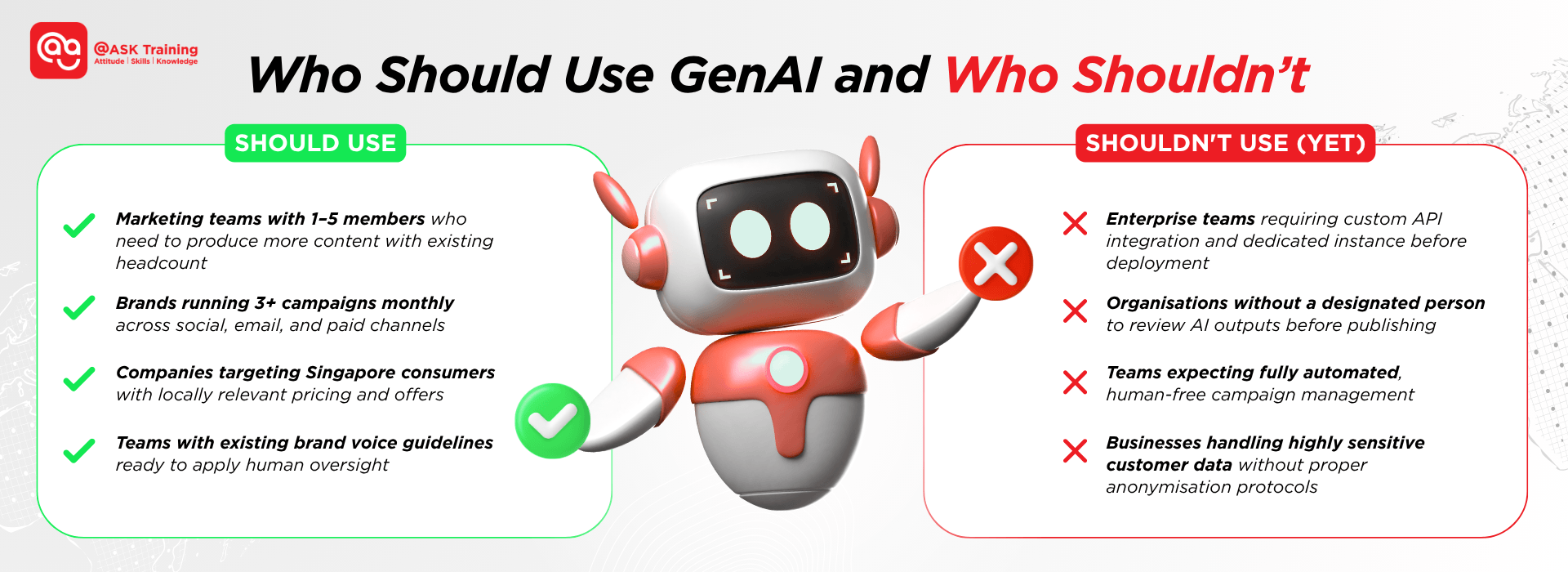
When you align content to how consumers actually evaluate options, GenAI becomes a tool for clarity, not just speed.
Next, we’ll examine the specific use cases where Singapore teams are seeing the strongest returns.
The GenAI Use Cases That Matter Most For Singapore Teams
Start here, not everywhere.
The most valuable GenAI in digital marketing applications don’t attempt to automate entire campaigns end-to-end. Instead, they target three outcomes: speed, variation, and content reuse.
Your role is simple: use AI to generate multiple options—headlines, hooks, draft copy—then apply your judgement to select, refine, and localise.
Singapore teams succeed with GenAI precisely because they treat it as an idea expander, not a human replacement.
AI Marketing Use Cases for Singapore Teams
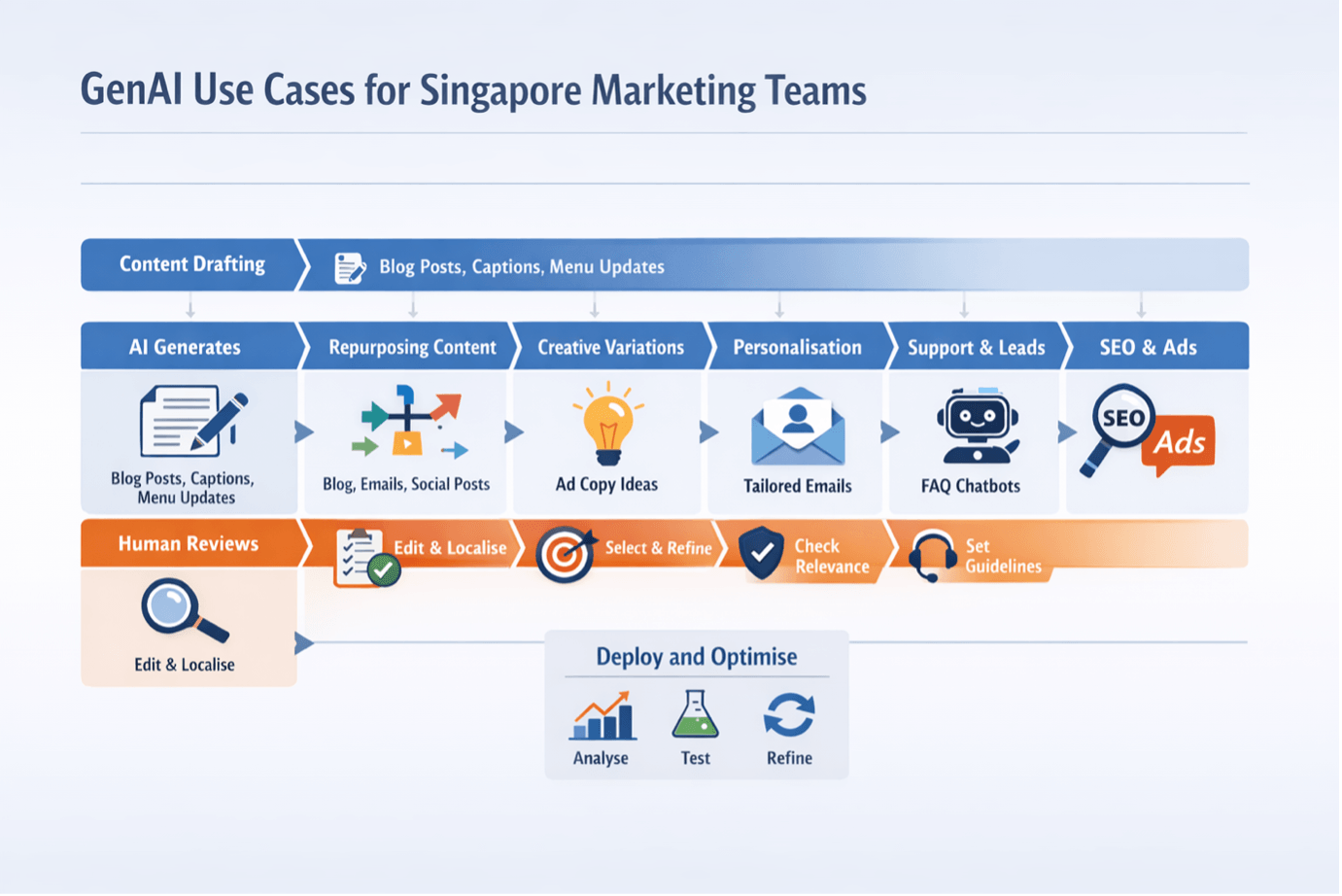
From drafting to SEO and ads, this workflow illustrates how AI-generated content and human review work together to accelerate outputs while maintaining brand quality, accuracy, and local relevance.
1. Content Drafting: Draft smarter, edit smarter
Example: A local F&B chain uses GenAI to draft first versions of blog posts, weekly menu highlights, and promotional social captions. The marketing team then reviews for brand tone, accuracy, and Singapore-specific context, such as pricing in SGD or local taste preferences.
Benefit: Accelerates content creation while ensuring messaging remains relevant and aligned with brand voice.
2. Repurposing Content: Turn one asset into many
Example: A Singapore-based tech startup runs webinars. GenAI transforms one session into a blog summary, an email newsletter, five LinkedIn posts, and ten ad hooks.
Benefit: Enables teams to deploy multi-channel content quickly while maintaining consistent messaging across platforms.
3. Creative Variations: Match tone to channel
Example: A lifestyle brand generates 10 campaign hooks in three different tones: direct, playful, and premium.
Benefit: Supports testing across multiple audiences and channels (e.g., Instagram vs LinkedIn) without adding extra workload.
4. Personalisation Support: Speak to segments, not everyone
Example: An online education platform drafts three versions of the same email for new, returning, and price-sensitive users based on non-sensitive context like behaviour, lifecycle stage, and intent.
Benefit: Increases engagement and relevance without exposing personal data, ensuring compliance with privacy regulations.
Support & Lead Capture: Answer questions before they’re asked
Example: A fintech company uses AI to create a chatbot FAQ script that answers questions about pricing, account setup, and delivery timelines, ending with a clear escalation path for personalised support.
Benefit: Reduces manual inquiry handling while maintaining brand voice and response consistency.
Kickstart Two High-Impact Pilots
SEO Example:
A travel services team uses GenAI to draft six FAQ questions for a service page, which are then reviewed and localised for Singaporean travellers.
Ads Example:
An agency generates 10 new ad hooks for an ongoing campaign, then tests the top three to optimise performance.
Benefit: Provides structured starting points for faster iteration while leaving strategy, targeting, and final creative decisions to humans.
What you should take away from this section:
- GenAI handles the volume and variation. You still own the strategy, the judgement, and the localisation.
- Start with one use case. Pick content drafting, repurposing, or FAQ generation—not all six at once.
- The goal is not automation. It is acceleration with human oversight.
This balance – AI for speed, humans for quality – is exactly what we teach at @ASK. Not just how to use tools, but how to apply human judgment to safeguard brand quality, accuracy, and trust in Singapore’s digitally mature market.
Now let’s apply this pattern to specific channels—starting with SEO and search visibility.
GenAI for SEO and Search Visibility
Search visibility in 2026 depends on clarity, structure, and usefulness rather than keyword density.
GenAI can support marketers by acting as a planning and drafting assistant, helping teams organise content logically, generate outlines, and surface FAQs that match user intent.
When used thoughtfully, it helps teams produce search-friendly content that answers real questions and aligns with how Singapore audiences search online.
This is where AI for SEO and ads provides value. Singapore marketing teams use GenAI to:
- Map topic clusters: Identify related topics and subtopics to create comprehensive, structured content hubs.
- Understand search intent: Draft content tailored for informational, comparison, or transactional queries relevant to local users.
- Generate structured outlines: Produce blog, landing page, and FAQ frameworks that ensure clarity, scannability, and consistency.
- Draft FAQ blocks: Create concise answers under 60 words that address common questions while including local context, e.g., pricing in SGD or Singapore-specific examples.
- Refresh older content: Improve structure, add local statistics or examples, and make content relevant for 2026 without padding or fluff.
A practical SEO workflow for Singapore teams:
- Choose the target keyword – Focus on what Singapore users are searching for.
- Identify user intent – Determine whether the query is informational, comparison-based, pricing-related, or seeking the best options.
- Create a structured outline – Organise headings, subheadings, and FAQ blocks for clarity.
- Draft the content – Use GenAI to generate initial drafts aligned with the outline.
- Edit for accuracy and clarity – Ensure all data, pricing, and references are correct and locally relevant.
- Add concise FAQ blocks – Provide short, actionable answers to common questions (include SGD pricing or Singapore-specific context).
- Publish and monitor – Track performance metrics such as clicks, impressions, and engagement.
- Refresh with new examples – Regularly update content to maintain relevance and incorporate the latest trends or data.
Concrete SEO Example for AI in Marketing (Singapore)
This example is designed for marketing teams and content creators to illustrate how to structure clear, concise, and locally-relevant FAQs for a service page on AI in marketing.
Each answer is kept under 60 words to optimise scannability for readers, search visibility, and mobile readability.
1. What does it cost in Singapore?
Small businesses typically invest between SGD 1,500–3,000 per month for AI content workflows. This includes drafting, testing, and automation tools, depending on team size and campaign complexity.
2. What are the best use cases?
AI is commonly applied to social media caption generation, email personalisation, ad creative variations, and FAQ content updates. Singapore teams often use it to accelerate content for fast-moving campaigns.
3. What risks should teams watch for?
Risks include publishing inaccurate local pricing, using culturally insensitive language, or relying solely on AI without human review. Regular oversight ensures accuracy, brand voice, and trust.
4. Which tools are commonly used?
Popular platforms among Singapore marketers include Jasper.ai, ChatGPT, Canva AI, and Copy.ai, supporting content creation, workflow optimisation, and creative testing.
5. How is success measured?
Key metrics include click-through rates, email open rates, social engagement, and efficiency gains in content production. Singapore teams often compare AI-assisted content against human-only outputs to optimise ROI.
6. How is data kept privacy-safe?
Teams should anonymise client or internal data before using AI tools and store sensitive information in Singapore-compliant secure systems, ensuring regulatory compliance.
Tip for marketers:
Keep answers under 60 words. This ensures the content is easy to scan, search-friendly, and mobile-optimised, while maintaining clarity and relevance for Singapore audiences.
Your turn this week:
- Take one existing service page. Identify three questions customers ask repeatedly that aren’t answered on the page.
- Draft 60-word answers using GenAI, verify the details, and publish the updated FAQ block.
- Measure impressions after 14 days.
The same principle—using GenAI to create structured, intent-aligned content—applies directly to paid advertising. But the testing rhythm is different.
Next, we’ll look at how Singapore teams structure ad creative tests with GenAI.
GenAI for Paid Ads and Creative Testing
In 2026, Singapore’s digital marketing is highly competitive, with attention spans limited and campaigns moving at high speed.
GenAI helps teams generate multiple ad concepts, hooks, and messaging angles quickly, enabling more test rounds.
Human review ensures that only the most relevant, accurate, and on-brand ideas are executed, balancing efficiency with quality.
See Google Search Central – Helpful Content Guidelines for user-first content best practices.
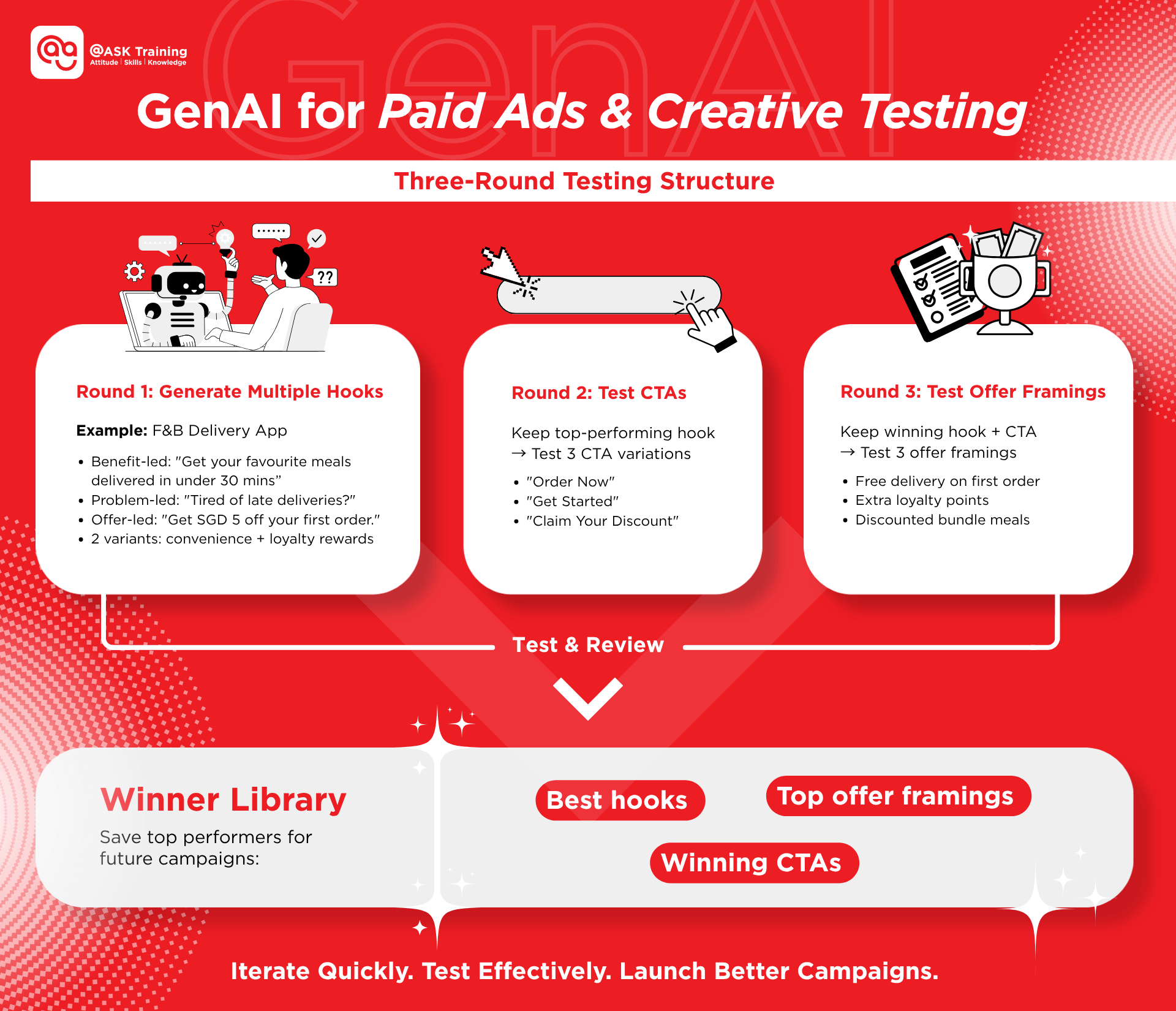
Figure 1: GenAI workflow for paid ads and creative testing in Singapore — iterate quickly, test effectively, and store top performers.
Here’s a three-round testing structure you can run with any active campaign.
Step 1: Generate multiple hooks
Example: A Singapore F&B delivery app launches a campaign to promote faster meal delivery. GenAI creates 5 hooks for Round 1 testing:
- Benefit-led: “Get your favourite meals delivered in under 30 minutes—powered by AI efficiency.”
- Problem-led: “Tired of late deliveries? Our AI optimises routes for on-time service.”
- Offer-led: “Sign up this week and get SGD 5 off your first order.”
- Two additional variants focus on convenience and loyalty rewards.
Step 2: Test CTAs
Keep the top-performing hook (e.g., benefit-led) and test 3 CTA variations:
- “Order Now”
- “Get Started”
- “Claim Your Discount”
Step 3: Test offer framings
With the winning hook and CTA, try 3 offer framings:
- Free delivery on first order
- Extra loyalty points
- Discounted bundle meals
Step 4: Maintain a “winner library”
- Store the top-performing hooks, CTAs, and offer framings from each campaign.
- Benefit: reduces repetitive testing and accelerates future campaign launches.
Why this works:
Most teams stop after one round of creative testing. By running three rounds sequentially, you isolate which variable actually moved performance—hook, CTA, or offer.
You also build institutional knowledge you can reuse. The next campaign starts with a library of proven assets, not a blank page.
Your turn this week:
- Pick one active campaign.
- Run Round 1 only: generate 5 new hooks and test them with the same budget.
- Identify the winner.
- Save it to your library—even if you don’t proceed to Rounds 2 and 3 yet.
Paid ads benefit from rapid hook and CTA testing, but email and social demand a different approach: consistency across high-volume, repetitive outputs.
Next, we’ll look at how GenAI systematises those channels.
GenAI for Email, Social, and Content Operations
In Singapore’s fast-moving digital landscape, marketing teams must produce high volumes of personalised and engaging content across multiple channels.
GenAI content marketing 2026 supports these efforts by accelerating drafting, repurposing, and quality assurance.
At the same time, it allows human teams to maintain brand consistency, accuracy, and local relevance.
Here are three workflows that require minimal setup and pay back within week:
1. Email
With AI for email marketing, teams can draft multiple subject lines in different tones, personalise content for lifecycle segments, and optimise performance efficiently.
Draft multiple subject lines: Generate 10 options in three styles (curiosity, benefit, urgency), then select and refine the top 3 in brand voice.
Singapore Examples:
- Curiosity: “3 marketing shifts every Singapore brand should watch in 2026”
- Benefit: “Save 5 hours a week with this AI-powered content workflow.”
- Urgency: “Ends Friday: Claim your SGD 50 consultation credit.”
Personalisation: Create 3 versions of the same message for different segments—new users, returning users, and price-sensitive customers—using only non-sensitive context (behaviour, lifecycle stage, intent).
Measure & optimise: Track open rates, CTRs, and engagement to refine AI-generated drafts.
Benefit: Increases engagement and relevance without exposing personal data, ensuring compliance with privacy regulations.
2. Social Media Content
Repurpose once, publish everywhere.
Turn one campaign message into platform-native outputs:
- LinkedIn post (professional, insight-led)
- Short video script (30 seconds, visual storytelling)
- Instagram carousel copy (step-by-step, swipeable)
- 10 comment reply templates (FAQs, pricing, delivery, promotions)
Example — F&B delivery campaign:
- LinkedIn post: Highlighting AI-powered delivery efficiency
- Short video script: “30-second delivery journey from kitchen to doorstep”
- Carousel copy: Step-by-step showcase of AI-assisted ordering
- Comment reply templates: FAQs about pricing in SGD, delivery times, promotions, and order updates
Convert one blog section into five angles:
- Myth-busting: “AI won’t replace human marketers in Singapore—here’s why”
- Checklist: “5 ways café owners can save time on social content with AI”
- Story: Case study of a local café using AI for social posts
- Stat-led: “30% of Singapore SMEs using AI report faster content production”
- How-to: Step-by-step repurposing of blog content into social-ready formats
Purpose: Ensures content is channel-optimised, engaging, and ready for audience interaction, while maintaining brand voice and local relevance.
3. Content Operations
Build once, use repeatedly.
Create structured AI instructions for your highest-volume content types:
- Blog drafts and SEO articles
- Email subject lines and campaign sequences
- Social posts, carousel copy, and video scripts
- Ad hooks, headlines, and CTAs
- FAQs and landing page drafts
Start with one. Don’t build for every channel at once. Pick your highest-volume content type and create one reusable prompt template this week. Test it on three assets, refine, then expand.
Brand voice sheet:
Document your brand’s tone traits, do’s and don’ts, and Singapore-specific cultural or regulatory notes. Include this in every prompt pack.
QA Checklist for every AI-assisted asset
Before publishing, verify:
- Pricing in SGD — not USD, not “contact us”
- Compliance with local regulations and terms
- Clarity, accuracy, and on-brand messaging
- No AI filler or generic buzzwords (“game-changing,” “revolutionary,” “best-in-class” without proof)
- Local promotions, delivery times, and Singapore-relevant references are accurate
Individually, these workflows save hours per week. Together, they form the building blocks of something larger: a repeatable GenAI system that delivers consistent quality regardless of who runs the prompt.
Next, we’ll show you how to build that system in four steps.
Turning GenAI into a Repeatable Marketing System
GenAI delivers the most value when it’s embedded into a clear, consistent AI marketing workflow, rather than used ad hoc.
A repeatable system ensures outputs stay reliable, on-brand, and useful across channels, while letting teams learn from past results and improve over time.
At its core, a repeatable GenAI system includes:
- A defined workflow
- Reusable prompt packs
- Input standards
- Quality checks
- A repository of successful outputs
With these components, marketing teams can scale their use of AI without compromising accuracy, relevance, or brand voice.
A Standardised Workflow
An effective GenAI workflow often follows these stages:
- Brief – Define the objective, audience, positioning, and constraints.
- Generate – Use GenAI to create initial drafts, multiple variations, or ideas.
- Edit – Refine for accuracy, tone, and factual correctness.
- Brand alignment – Adjust voice and style to fit your brand guidelines.
- Publish – Deploy the asset across channels.
- Measure – Track performance using relevant metrics (engagement, conversions, CTRs).
- Update prompts – Improve your prompts based on performance insights.
This workflow helps teams avoid inconsistent or generic outputs and ensures each asset contributes to strategic goals rather than just existing as another content piece.
How to Prepare and Reuse Prompt Packs
Prompt packs are collections of structured AI instructions designed to be reusable across campaigns, content types, and channels.
In fast-moving markets like Singapore, they help teams save time, maintain brand consistency, and produce outputs that are locally relevant and on-brand.
By combining creation and reuse, teams can establish a repeatable GenAI system that scales efficiently without sacrificing quality or accuracy.
Step 1: Define Common Content Tasks
Identify recurring content needs across your channels:
- Blog drafts and SEO articles
- Email subject lines and campaign sequences
- Social posts, carousel copy, short video scripts, and 10 comment reply templates
- Ad hooks, headlines, CTAs, and offer framings
- FAQs or landing page drafts
This ensures prompt packs are aligned with actual workflows and campaign needs.
Step 2: Create Structured Templates Per Media Type
One prompt pack per media type is recommended:
Blog Prompt Pack
Example prompt:
“Generate a 500-word blog on AI in marketing in Singapore. Include 3 FAQs, SGD pricing references, and a local case study.”
Purpose: Draft, rewrite, repurpose long-form SEO content.
Email Prompt Pack
Example prompt:
“Write 5 email subject lines in curiosity, benefit, and urgency styles for a lunch promotion in Singapore. Include SGD pricing and local references.”
Purpose: Subject lines, body copy, CTAs, follow-up sequences.
Social Prompt Pack
Example prompt:
“Generate 3 carousel copy variants highlighting AI-powered delivery for an F&B brand in Singapore. Include local pricing and emojis where appropriate.”
Purpose: Platform-native outputs and comment reply templates.
Ad Prompt Pack
Example prompt:
“Generate 5 ad hook variations for a new Singapore fintech product. Include benefit-led, problem-led, and offer-led styles with SGD pricing.”
Purpose: Hooks, headlines, CTAs, and offer framings for paid campaigns.
Benefit: Keeps outputs optimised per channel while maintaining brand voice and local relevance.
Step 3: Identify Variables to Update
Separate structure from content. Your prompt pack stays usable even as offers change rapidly.
Update these variables each time:
- Product/service name
- Promotion or offer
- Pricing and currency (SGD)
- Date, delivery time, eligibility, or channel constraints
By separating structure from content, the prompt pack remains usable even as content changes rapidly.
Step 4: Test and Refine Prompts
- Generate sample outputs and refine instructions for clarity, accuracy, and alignment with brand voice.
- Ensure outputs meet channel-specific formatting rules (character limits, disclaimers, tone).
Standardised Inputs So Outputs Improve
- Provide GenAI with clear inputs to ensure high-quality outputs:
- Product truths: what it is, who it’s for, key differentiators, pricing constraints
- Brand voice rules: tone traits, do/don’t phrases, prohibited words
- Channel constraints: character limits, formatting, required disclaimers
- This guarantees outputs are accurate, on-brand, and locally relevant while aligning with strategy and regulatory requirements.
Store Successful Outputs as Templates
- Centralise strong outputs in a winner library:
- Top-performing headlines
- High-engagement email subject lines
- Best ad hooks and CTAs
- FAQs that improved SEO
- Repurposed blog and social angles
- Benefits:
- Reduces repetitive testing
- Speeds up future campaigns
- Serves as a team knowledge base for consistency and efficiency
- Singapore examples:
- A fintech team standardises prompts for weekly newsletters, ensuring brand-aligned, SGD-priced, and compliant emails.
- An e-commerce brand repurposes top-performing product page headlines into social captions for Instagram and LinkedIn.
- An F&B chain uses carousel prompts for Instagram campaigns with 10 pre-set comment replies, maintaining brand tone and reducing response time.
Continuous Improvement
- Refine prompts based on performance insights from campaigns.
- Update or expand packs as new channels, formats, or content types emerge.
Moving on, a system accelerates good work, but it also amplifies mistakes. That is why every GenAI workflow needs guardrails.
The Rules That Keep GenAI Safe and Brand-Ready
GenAI scales speed and variation, but trust, accuracy, and originality remain human responsibilities.
In Singapore’s digitally mature market, low-effort or misleading AI outputs are quickly noticed — and quickly lose credibility.
The following rules help teams protect brand reputation while scaling GenAI use responsibly.
Protect Accuracy
- Always verify numbers, pricing, policies, and sensitive claims before publishing.
- Treat GenAI outputs as drafts, not facts.
Example: If an AI-generated landing page mentions “from $199”, confirm the price reflects current SGD rates and inclusions before launch.
Protect Brand Voice
- Rewrite generic phrasing into your brand’s tone and vocabulary.
- Remove filler, repetition, and overused AI buzzwords.
- Replace vague claims (“best”, “guaranteed”, “industry-leading”) with proof or remove them.
Example: A Singapore B2B brand replaces “game-changing solution” with a concrete benefit and use case relevant to local SMEs.
Protect Originality and IP
- Avoid prompts that ask to “rewrite competitor content” or mirror existing campaigns.
- Generate original angles, unique examples, and locally relevant scenarios.
Example: Instead of copying competitor FAQs, generate new answers based on your own service scope, pricing model, and customer objections.
Protect Data and Privacy
- Never paste personal data, customer records, or confidential internal information into general GenAI tools.
- Use anonymised placeholders and hypothetical scenarios when prompting.
Example: Replace real customer names or emails with “Customer A” or “SME retail client” during prompt generation.
Apply a Final Pre-Publish Check
Before any AI-assisted asset goes live, ask:
- Is it true?
- Is it clear?
- Is it on-brand?
- Is it safe to publish?
- Is the CTA specific and appropriate for Singapore audiences?
If any answer is uncertain, revise before publishing.
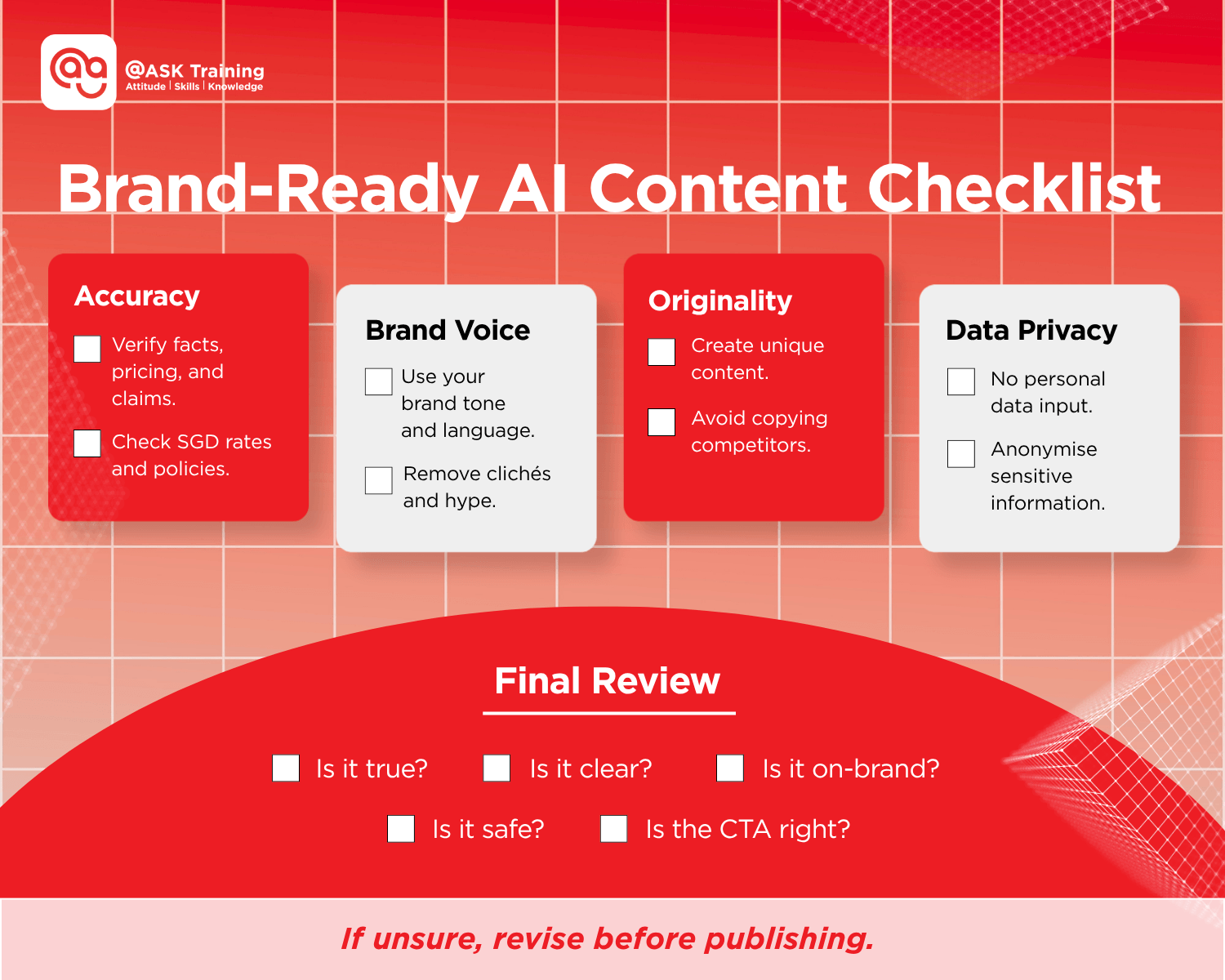
Brand-Ready AI Content Checklist
Wrapping Up
Generative AI is now a practical reality for Singapore marketing teams. Those seeing real results combine AI-driven variation with human review, structured workflows, and clear brand guardrails.
When GenAI is embedded into a repeatable system — supported by reusable prompts, standardised inputs, quality checks, and performance feedback — teams can scale output while maintaining trust, relevance, and accuracy.
Your clear action step:
This week, add 6 FAQs to one service page. Next week, run one ad test round using 5 new hooks.
Start with one page. One campaign. One prompt. Then build the system that works for your team!
Related Courses
- (16 hrs) Generative AI for Digital Marketing
- Beyond ChatGPT: The Ultimate GenAI Toolkit for Workplace Productivity
- (16 hrs) Social Media Marketing
◆◆◆