
 Your organisation rolled out a generative AI tool six months ago. Your team uses it daily. But has anyone actually defined which data can go into it, who reviews the output before it reaches a client, or what happens when the AI gets something wrong?
You are not alone. AI adoption in Singapore has surged in recent years:
- SME AI adoption rose from 4.2% to 14.5% (2023 to 2024)
- Non-SME AI adoption rose from 44% to 62.5% (2023 to 2024)
- 84% of AI-using firms rely on off-the-shelf generative AI tools
- 73.8% of workers reported using AI tools at work
(Source: IMDA, 2025)
Singapore has responded not with a single AI law, but with a layered system of voluntary frameworks, testing tools, and data protection guidance. Understanding this landscape is no longer optional for professionals who use AI at work. It is becoming part of the job.
This article gives you a plain-language map of AI governance in Singapore: the frameworks, the data rules, how schools are applying them, and how you can build the skills employers now expect.
What Is AI Governance?
AI governance is the set of rules, roles, and checks that determine which AI systems your organisation uses, what data those systems can access, who is accountable for their output, and how risks are managed.
It differs from IT governance in a critical way: Traditional IT governance focuses on infrastructure, security, and service delivery.
AI governance adds a new layer of risks: hallucinated outputs, biased decisions, copyright exposure, and, with newer agentic systems, autonomous actions taken without human review.
Where IT governance asks "Is the system running?", AI governance asks "Should this decision be made by this system, with this data, and who signs off on the result?"
This distinction matters because AI has spread beyond IT teams. Marketing uses it to draft copy. HR uses it to screen resumes. Finance uses it to summarise reports. When every function touches AI, every function needs to understand the guardrails.
For a deeper dive on the traditional side, see our article on IT governance frameworks.
How Does Singapore Approach AI Governance?
Singapore's approach is best described in IMDA's own words: "practical and balanced… where guardrails are put in place, while providing space for innovation."
In practice, this means the frameworks are voluntary guidance, not law. They signal where regulation is likely heading and give organisations a structured way to manage AI risks without waiting for legislation.
The National AI Council, announced in February 2026 and chaired by the Prime Minister, provides high-level direction for the national AI agenda, including unlocking regulations and resources for AI deployment.
For professionals, the takeaway is straightforward: Singapore expects you to use the guidance. Voluntary does not mean optional if you want to manage risk credibly.
The Model AI Governance Framework: Three Generations
Singapore's Model AI Governance Framework has evolved through three distinct editions, each addressing a different class of AI risk.
Traditional AI (First Edition 2019, Second Edition 2020)
The original framework, updated in January 2020, targets traditional AI and decision systems. It rests on two guiding ideas: AI decisions should be explainable, transparent, and fair, and AI systems should be human-centric.
The framework organises governance around four areas:
- Internal governance structures and measures — clear roles, responsibilities, and a coordinating body
- Human involvement in AI-augmented decision-making — from human-in-the-loop to fully automated, based on risk
- Operations management — data quality, bias prevention, explainability, and traceability
- Stakeholder interaction and communication — transparency about AI use and feedback channels
This edition remains the foundation for how Singapore thinks about responsible AI: not just principles, but concrete, implementable measures.
Generative AI (2024)
Launched on 30 May 2024 by IMDA and the AI Verify Foundation, the Model AI Governance Framework for Generative AI addresses risks specific to generative tools: hallucinations, copyright exposure, and data leakage.
It introduces nine dimensions: accountability, data, trusted development and deployment, incident reporting, testing and assurance, security, content provenance, safety and alignment R&D, and AI for public good.
The framework is designed to be read in totality—you do not pick one dimension and ignore the rest.
For organisations deploying tools like ChatGPT or Copilot, this framework provides the checklist for what "responsible use" actually looks like.
Agentic AI (2026)
In January 2026, Singapore launched the world's first Model AI Governance Framework for Agentic AI, with an updated version published in May 2026. Agentic AI systems can take actions—booking, purchasing, executing workflows—without direct human instruction at each step.
The framework retains four pillars: assess and bound risks upfront, make humans meaningfully accountable, implement technical controls, and enable end-user responsibility.
The May update added real-world case studies and expanded guidance on multi-agent risks, automation bias, and human review checkpoints.
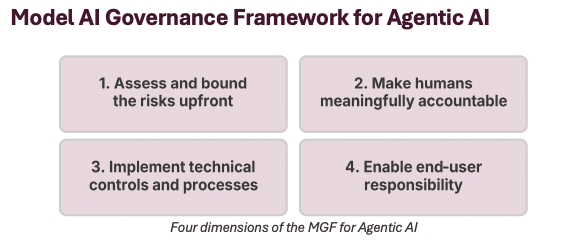 (Source: IMDA)
This is a rapidly evolving area. We will cover it in depth in a dedicated article; for now, know that Singapore is setting the global pace on agentic governance.
What is AI Verify?
AI Verify is Singapore's AI governance testing framework and toolkit. It allows organisations to validate their AI systems against 11 governance principles through standardised tests.
The 11 principles are:
- Transparency
- Explainability
- Repeatability/Reproducibility
- Safety
- Security
- Robustness
- Fairness
- Data Governance
- Accountability
- Human Agency and Oversight
- Inclusive Growth, Social and Environmental Well-Being
AI Verify conducts technical tests on three principles—fairness, explainability, and robustness—and applies process checks to all 11.
The limits matter: AI Verify does not set ethical standards or guarantee a system is risk-free. It is a testing tool, not a certification of safety. Think of it as a diagnostic, not a seal of approval.
How Does the PDPA Apply to Generative AI?
If you use generative AI tools at work, the Personal Data Protection Act (PDPA) applies to what you put into them.
The PDPC opened consultation on its Advisory Guidelines on Use of Personal Data in Generative AI on 2 June 2026 and launched the final version on 20 July 2026. The guidelines take a lifecycle view: development, deployment, and post-deployment.
Three stakeholder roles carry distinct responsibilities:
- Model Providers — those who develop and make available GenAI models for distribution
- System Providers — those who build and make available GenAI systems
- System Deployers — organisations that use or enable use of GenAI systems under their authority
The key practical point for most professionals: System Deployers bear primary responsibility for PDPA compliance when using AI tools. That means your organisation, not the tool vendor, owns the data protection obligations for what flows through your systems.
For day-to-day work, this translates into a simple rule: do not paste personal data into public AI tools. Customer names, NRIC numbers, employee records, client contact details—these should never go into a system you have not vetted for data protection compliance.
If your organisation has a breach notification obligation under the PDPA, unauthorised disclosure through an AI tool could trigger it.
Read more about PDPA breach notification requirements in our cybersecurity article.
AI Governance Beyond the Workplace: How Singapore's Schools Apply It
The MOE AI-in-Education (AIEd) Framework builds directly on IMDA's Model AI Governance Framework. It rests on four principles: Agency, Inclusivity, Fairness, and Safety.
Students are learning to cite AI use and question AI outputs before accepting them. Teachers are being guided on where AI supports learning and where it does not.
The habits being formed in classrooms—disclosure, critical evaluation, human oversight—are the same habits employers now expect from their staff. We will cover this in full in a separate article on AI in Singapore education.
What Does AI Governance Mean for Your Day-to-Day Work?
You do not need to memorise frameworks to practice good AI governance. You need a checklist you can apply to your actual work.
The practical checklist:
- Use approved tools only. If your organisation has not vetted a tool, do not use it for work data. Personal experimentation is fine; work data is not.
- Know the data do's and don'ts. No personal data, no confidential business information, no client details in public AI tools. When in doubt, leave it out.
- Review before the output reaches a client. AI-generated content should pass through human judgment before it leaves your organisation.
- Disclose AI use where it matters. If a client or colleague would reasonably want to know, tell them.
- Keep records. For higher-stakes uses, note what you asked, what the AI produced, and what you changed. This is your traceability.
A workplace scenario:
An HR officer uses AI to summarise a batch of resumes. Ungoverned version: pastes full resumes, including names and NRIC numbers, into a public chatbot, then forwards the summary to hiring managers without review.
Governed version: uses an approved tool, removes identifying details before processing, reviews the summary for accuracy and bias, and documents the prompts used. Same task. Very different risk profile.
Is AI Governance a Career Skill?
Yes—and employers are increasingly hiring for it.
The demand is not just for people who can use AI, but for people who can manage its risks. AI governance is appearing alongside other in-demand skills in Singapore as a differentiator for mid-career professionals.
Roles where governance knowledge adds immediate value:
- Operations leads — defining where AI fits in workflows and where humans stay in the loop
- HR business partners — managing AI in recruitment, performance, and employee data
- Finance controllers — ensuring AI-assisted reporting meets audit and compliance standards
- Compliance officers — translating PDPA guidance into internal AI policies
- AI transformation associates — bridging business needs and technical implementation with governance built in
You do not need to become a lawyer or a data scientist. You need enough fluency to ask the right questions, spot the risks, and build the checks into your team's workflow.
How to Build Responsible AI Skills with @ASK Training
Knowing the frameworks is one thing. Embedding them into how your teams actually work is another. @ASK Training offers two structured pathways for organisations that want to build responsible AI capability at scale.
Pathway 1: The Full Qualification — (SCTP) Diploma in Generative AI
The comprehensive route for professionals who will lead or oversee AI adoption within your organisation.
- 7 modules, 168 hours: Structured, career-focused training
- Governance built in: Learn to navigate PDPA, MAS guidelines, and the Workplace Fairness Act, and build Human-in-the-Loop oversight into real AI workflows
- SkillsFuture Mid-Career Training Allowance (Part-Time): Accessible for working professionals
- Career support included: Resume building, interview preparation, and job matching through @ASK Training Career Services for SCTP-pathway learners
Explore the (SCTP) Diploma in Generative AI
Pathway 2: The Shorter, Role-Focused Start — Generative AI Courses
Targeted training for teams that need specific competencies without a full qualification commitment.
- (24hrs) AI in Operations: Enhancing Workflow Efficiency & Automation: Includes a dedicated learning unit on PDPA and ethical AI governance. Best for operations leads and managers.
- Generative AI Threats and Deepfake Detection Essentials (1 day): Covers legal and ethical boundaries around AI-generated content in Singapore. Best for compliance, HR, and risk professionals.
Browse all Generative AI courses
Which Path Fits You?
- If you want a full qualification and career transition support, start with the Diploma.
- If you want a quick, role-specific win, start with a short course.
Whichever you choose, the point is the same: governance is not something you read about once and file away. It is a skill you build, practise, and carry with you.
And that skill is exactly what Singapore's layered approach to AI governance demands.
Conclusion
Singapore's approach to AI governance is layered: voluntary Model Frameworks for traditional, generative, and agentic AI; a testing toolkit in AI Verify; PDPA advisory guidelines for data protection; and sector-specific frameworks like MOE's AIEd.
No single law governs AI here, but the guidance is clear enough to act on.
What matters most for you is this: governance is a skill, not just a policy document. The professionals who thrive in the next phase of AI adoption will be those who can use these tools effectively and manage their risks credibly.
Reading about frameworks is a start. Applying them with confidence is a career advantage.
Related Courses
- (SCTP) Diploma in Generative AI
- (24hrs) AI in Operations: Enhancing Workflow Efficiency & Automation
- (24hrs) AI in HR: Transforming Talent Acquisition & Workforce Management
- Generative AI Threats and Deepfake Detection Essentials
◆◆◆
Related Articles
Article Topics
- What Is AI Governance?
- How Does Singapore Approach AI Governance?
- The Model AI Governance Framework: Three Generations
- How Does the PDPA Apply to Generative AI?
- AI Governance Beyond the Workplace: How Singapore's Schools Apply It
- What Does AI Governance Mean for Your Day-to-Day Work?
- Is AI Governance a Career Skill?
- How to Build Responsible AI Skills with @ASK Training
- Conclusion