
What if the secret to a more engaged, loyal, and high-performing team wasn’t another strategy off-site, but a concept from relationship psychology?
Understanding the types of love languages is not just for personal connections; it’s a powerful, often overlooked leadership tool.
When you learn how each of your team members truly feels valued, you unlock the ability to:
- Boost engagement and morale with personalised recognition
- Build deeper trust through meaningful communication
- Reduce miscommunication and unmet expectations
This guide breaks down the 5 love languages and gives you actionable strategies to apply them professionally, transforming how you lead, connect, and inspire.
Let’s explore how you can lead with more empathy and impact.
Why Understanding the Types of Love Languages Matters for Leaders
Think about your team. You give everyone the same sincere, verbal praise for a job well done because that’s what would motivate you.
Yet, some team members still seem disconnected or undervalued. The issue isn’t your intent. It’s your method.
That’s why understanding the types of love languages is a leadership essential, not just a personal concept.
Here’s why this matters for every leader:
Personalised Communication Boosts Engagement, Trust & Morale
When you tailor recognition to match an employee’s primary love language, you move from generic acknowledgement to meaningful connection. This leads to:
- Higher Engagement: Employees who feel personally seen are more invested.
- Deeper Trust: Consistent, authentic appreciation shows you value who they are, not just what they produce.
- Stronger Morale: A culture of personalised recognition creates a more positive and energised team environment.
Employees Respond Differently to Recognition
A one-size-fits-all approach to feedback falls flat. Consider two team members:
- Alex thrives on public praise (Words of Affirmation).
- Sam values dedicated, one-on-one strategy time (Quality Time).
Using the same approach for both means one will consistently feel overlooked. Understanding the different love languages removes this guesswork.
The Risk of Leadership Blind Spots
Many leaders unconsciously default to their own preferred love language. This creates a critical blind spot:
- If your language is Acts of Service, you might help with tasks to show care.
- An employee who needs Words of Affirmation may interpret your silent support as indifference.
Without awareness, your efforts to connect can miss the mark entirely.
Reduce Miscommunication & Unmet Expectations
The 5 love languages provide a shared vocabulary to clarify how people give and receive appreciation. This framework:
- Turns vague feelings of being undervalued into clear, actionable insights.
- Ensures your message of support isn’t just sent—it’s received and understood.
- Aligns expectations and strengthens communication channels across your team.
By mastering the types of love languages, you shift from managing tasks to leading people, building a culture where every team member feels recognised, respected, and motivated to contribute their best.
What Are the Types of Love Languages? Leadership Friendly Overview
So, the 5 love languages—what are they? Originally developed by Dr. Gary Chapman for romantic partnerships, this concept identifies the primary ways people give and receive love and appreciation.
In a professional context, think of them as preferences for how people feel valued and respected. The five classic types of love languages are:
- Words of Affirmation
- Quality Time
- Acts of Service
- Physical Touch
- Receiving Gifts
Modern workplaces have also seen new, modern types of love languages emerge, such as connection through technology or shared experiences.
This framework provides an actionable lens through which to view all your professional interactions, setting the stage for more meaningful connections.
Now, let’s take a closer look at each of these different love languages and how they manifest at work.
Words of Affirmation: The Language of Verbal Recognition
For individuals with this as their primary type of love language, spoken or written praise isn’t just nice, it’s essential.
Love language words of affirmation are all about using language to build people up and affirm their worth.
How Leaders Can Apply It:
- Offer specific, timely praise in front of peers (e.g., “Sam, your detailed analysis in that report directly influenced our strategy.”).
- Send a handwritten note or personalised email acknowledging a specific contribution.
- Provide constructive feedback that starts with recognition of what’s working well.
Common Pitfalls to Avoid: Generic statements like “great job,” infrequent feedback, or criticism without affirmation.
Mastering verbal recognition builds confidence, but for many team members, actions speak louder than words—or in this case, time speaks loudest.
Quality Time: The Language of Undivided Attention
The quality time love language is about giving someone your complete focus and presence. In our distracted world, this is a rare and valuable gift. For employees who value this, a leader’s time is the ultimate sign of respect.
How Leaders Can Apply It:
- Conduct regular, unhurried 1:1 meetings with cameras on and devices away.
- Practice active listening—paraphrase their points and ask follow-up questions.
- Create “collaboration hours” for focused problem-solving without interruptions.
Common Pitfalls to Avoid: Multitasking during conversations, constantly rescheduling check-ins, or making interactions feel transactional.
While focused time builds deep trust, other team members feel most supported when you actively help clear their path.
Acts of Service: The Language of Supportive Action
The acts of service love language is demonstrated through helpful deeds that ease a burden. Leaders who embody this don’t just delegate; they actively enable.
This is one of the most powerful types of love languages for driving a supportive, high-performance culture.
Acts of service examples for leaders include:
- Removing bureaucratic roadblocks that slow your team down
- Rolling up your sleeves to help during a critical deadline
- Proactively offering resources or training to help someone succeed
Common Pitfalls to Avoid: Micromanaging under the guise of “helping” or creating dependency by not empowering team ownership.
This tangible form of support is deeply valued, yet for some, a thoughtful symbol of appreciation carries equal weight.
Physical Touch: The Language of Appropriate Professional Connection
In the workplace, the physical touch love language requires careful and respectful reinterpretation. It’s about appropriate, consensual gestures that convey professionalism and camaraderie within clear boundaries.
Appropriate professional expressions include:
- A firm handshake to greet or congratulate
- A celebratory fist bump or high-five (with clear cultural and personal fit)
- For remote teams, prioritising occasional in-person gatherings for those who value physical co-presence
Critical Consideration: Always prioritise consent and cultural norms. This is the most sensitive of the 5 love languages to navigate professionally.
While physical presence matters to some, others place a higher value on receiving tangible tokens that symbolise thoughtfulness.
Receiving Gifts: The Language of Meaningful Tokens
The receiving gifts love language is often misunderstood. At work, it’s not about materialism but the symbolic thought behind a gesture. It’s a tangible reminder that someone is seen and remembered.
Meaningful workplace gift ideas:
- A personalised item tied to a personal interest (e.g., a book by their favourite author)
- A team celebration with their favourite food to mark a project milestone
- A small desk plant or quality pen with a note explaining why they’re appreciated
Common Pitfalls to Avoid: Generic, impersonal gifts (like standard company swag), or gifts that feel obligatory rather than sincere.
These five classic languages provide a strong foundation, but the modern workplace is evolving new dialects of appreciation.
Modern Types of Love Languages Emerging in Today’s Workplace
Today’s teams, especially with hybrid work and younger generations, express and value connection in new ways. Recognising these modern types of love languages is crucial for staying relevant.
- Technology as Connection: Valuing prompt replies, encouraging Slack/Teams messages, celebratory GIFs, or a quick voice note check-in
- Shared Experiences: Bonding through well-planned off-sites, virtual team-building games, or shared learning opportunities like a workshop
- Acts of Kindness: Appreciating micro-gestures of empathy, like offering to cover a task when someone is overwhelmed or simply asking, “How are you, really?”
Understanding these evolving preferences is essential, but to apply them effectively, you must first become a detective of your team’s unique preferences.
How to Discover Your Team’s Love Languages
Identifying the different love languages on your team is a mix of observation and direct inquiry. Here is your actionable guide:
Step 1: Observe Expression
Notice how your team members show appreciation to others. People often express love in the way they wish to receive it. Someone who often offers to help likely values acts of service as a love language.
Step 2: Listen to Complaints
Frustrations are clues. “I feel invisible” may point to words of affirmation, while “I’m always stuck doing this alone” suggests quality time or acts of service.
Step 3: Ask Directly
Use onboarding, performance reviews, or a dedicated team retro to ask: “How do you prefer to receive recognition or feedback?” You can share a list of the 5 love languages as a discussion starter.
Step 4: Experiment and Observe
Try different approaches and note what gets the most positive, energised response from each person.
With this knowledge in hand, you can move from theory to integrated practice.
Integrating Love Languages into Your Leadership Framework
Applying the types of love languages strategically moves you from occasional gestures to a consistent leadership philosophy.
Your Action Plan:
- Create a “Recognition Profile” for each team member, noting their suspected primary and secondary languages.
- Tailor Your Communications: Adjust your feedback, praise, and mentoring style to match their profile. For a words of affirmation person, prioritise verbal praise; for an acts of service person, offer concrete help.
- Systemise Fairly: Use a tracker to ensure you’re recognising everyone consistently, just in different ways that matter to them.
- Review and Adapt: Preferences can change. Revisit this understanding periodically.
This intentional integration yields a significant return on investment for your team’s culture and performance.
The Tangible Benefits: Why This Matters for Performance
Investing in the 5 types of love languages framework is not just “soft skills”—it drives hard results. Teams with leaders who personalise appreciation see:
- Higher Engagement & Morale: People feel individually valued.
- Increased Psychological Safety: Trust deepens when people feel understood.
- Stronger Collaboration: Reduced friction from mismatched expectations.
- Lower Turnover: Employees are less likely to leave where they feel seen.
Ultimately, this approach moves you from managing roles to leading individuals, which is the cornerstone of modern, effective leadership.
Wrapping Up: Leading the Whole Person
The journey through the different love languages reveals a simple truth: the most effective leaders recognise people as individuals.
Here’s a quick recap of the 5 types of love languages:
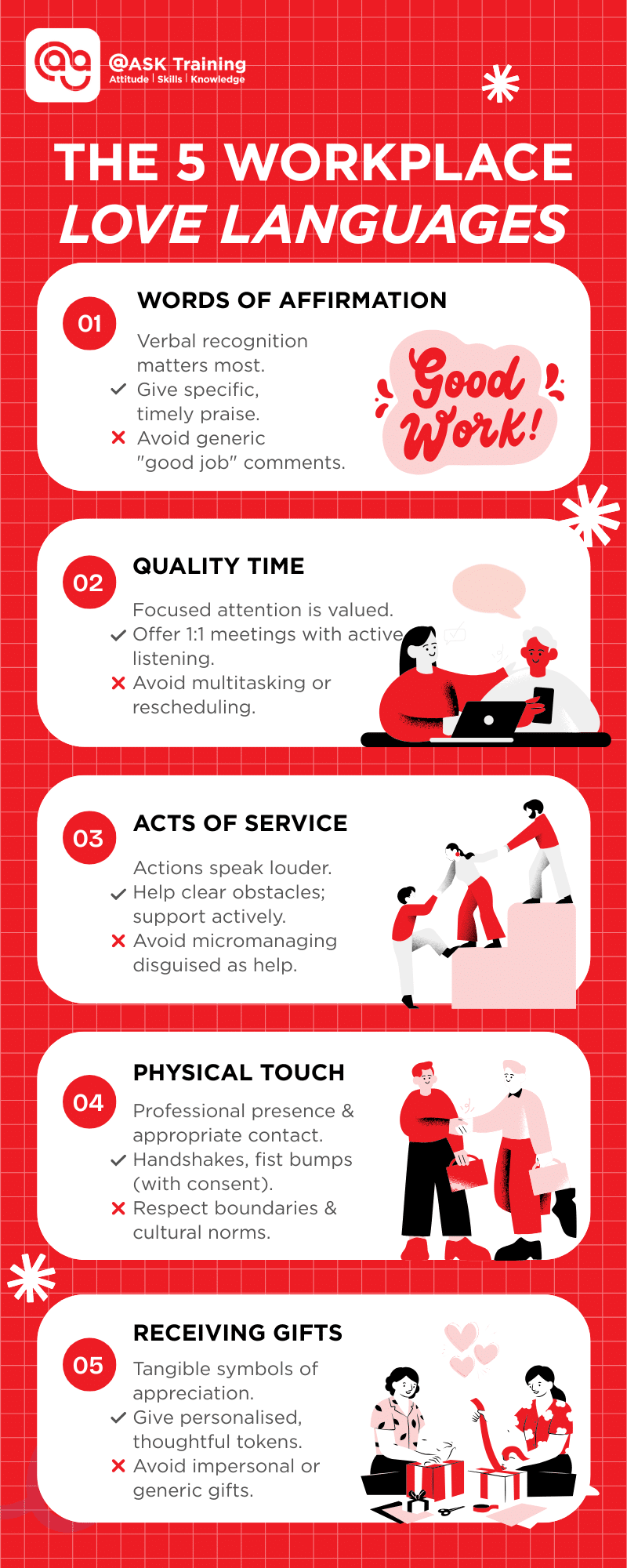
- Words of Affirmation
- Quality Time
- Acts of Service
- Physical Touch
- Receiving Gifts
By understanding whether your team member thrives on quality time, acts of service, or words of affirmation as their love language, you unlock deeper connections and drive collective success. This framework empowers you to show up not just as a boss, but as a leader who truly sees their team.
Ready to Build a Team Where Everyone Feels Truly Valued?
Explore @ASK Training’s practical Leadership & Management courses and Personal Development courses designed to help you connect, communicate, and lead with empathy:
- Winning Relationships with the 5 Love Languages @Workplace: Learn to apply this framework professionally
- Keys to Instant Rapport – Effective Communication for Better Working Relationships: Master the art of connection
- Empathy: Harnessing The Power of Connection at Workplace: Build deeper understanding with your team
Explore our courses and transform your leadership approach today!
Related Courses
◆◆◆