
 For many SMEs in Singapore, digital marketing can feel like an uncharted territory and overwhelming. Where do you even begin?
How much should you spend? Which channels deserve attention? And how do you avoid wasting precious resources?
This guide provides a practical, easy-to-follow plan to help you set a clear digital marketing budget, allocate it wisely, test efficiently, track ROI, and leverage local grants, so you can invest with confidence and drive measurable growth.
It all starts with a fundamental question: How much should your business actually spend?
How to Decide Your Digital Marketing Budget
So, how much should your business actually spend? A good starting point for Singapore SMEs is to allocate around 7–8% of annual revenue to digital marketing.
Here’s what that looks like in practice:
- S$1 million annual revenue → S$70–80k per year (~S$5.8–6.7k/month)
- S$2 million annual revenue → S$140–160k per year (~S$11.7–13.3k/month)
A Critical Financial Check: Be Margin-Aware
Before you proceed, it’s essential to view this through the lens of profitability. A more precise and sustainable approach is to base your budget on your gross margin, the revenue left after accounting for the cost of goods sold (COGS).
- Why it matters: If your product costs are high (e.g., you sell physical goods), a budget based on revenue alone could eat into your profits. Your marketing spend should come from your gross margin, not your total revenue.
- Simple check: Ensure your planned marketing spend does not exceed a healthy percentage of your gross margin. This guarantees your customer acquisition is financially viable.
This baseline is a guide, not a rigid rule. You can adjust this based on your goals using three clear spending tiers:
Tier 1: Maintaining
- Reduce the anchor by 20–30% to keep current campaigns running without expansion.
- Example: If your anchor is S$6,000/month, maintaining means spending ~S$4,500–4,800 to continue your current Google Ads and social campaigns without launching anything new.
Tier 2: Growing
- Use the anchor level to expand into new audiences or channels.
- Example: S$6,000/month to add new ad creatives or try a small TikTok campaign while keeping your search campaigns running.
Tier 3: Accelerating
- Increase by 20–30% to push aggressive growth, but only if the extra spend will generate revenue or leads fast enough to justify the cost.
- Example: S$7,200–7,800/month to scale up high-performing campaigns or test multiple new channels where expected returns cover the additional investment quickly.
Before locking in your budget, it’s crucial to run a quick sanity check. Ask yourself:
- Are your ideal customer profiles (ICPs) clearly defined?
- How long is your typical sales cycle (e.g., 7 days vs 60 days)?
- Can your team follow up leads promptly, ideally within 24 hours?
- Most importantly: Does this budget align with our gross margin to ensure profitable growth?
Answering these questions ensures your budget is not only ambitious but also practical, matching your business goals with your team’s capacity to deliver.
Turning Your Goals into a Budget
Once you have a budgetary starting point, the next step is to anchor it firmly in your business objectives. Instead of guessing a marketing budget, start with your business goals.
Define how many leads you want or the revenue you aim to generate each month, then work backwards to figure out the marketing spend needed to reach those targets. This approach keeps your budget realistic and tied directly to results.
Let’s break it down into a clear, four-step process:
Step 1: Set your monthly goal
Start by defining your primary target. This could be:
- A qualified leads target (e.g., 40 leads)
- A revenue target (e.g., S$60k in e-commerce sales)
Step 2: Work backwards using key inputs
Now, gather your key performance metrics:
- Your landing page conversion rate (CVR) — e.g., 8%
- Your target cost per lead (CPL) or acquisition (CPA) — e.g., S$120 per qualified lead
- Your expected CPC (if using paid search/social) — e.g., S$2.00
Step 3: Calculate your media spend
Plug your numbers into the formula to see exactly what’s needed.
- Example: 40 qualified leads × S$120 CPL = S$4,800 in media spend
- Then, add 10-20% for in-house creative, tools, and overhead, giving you a total monthly budget of ~S$5,280-5,760 for the in-house model.
Step 4: Add a buffer (sensitivity cushion)
The digital landscape can shift, so it’s wise to build in flexibility.
- Recalculate your budget assuming your CPL and CVR are ±10–20% off to create a safe operating range.
- Example: With a ±15% buffer, total budget range becomes S$4,500–6,600
- This cushion prepares you for real-world fluctuations in campaign performance without causing panic or overspending
By starting with clear goals and including a buffer, your budget is directly tied to expected outcomes, making it easier to manage spending and measure ROI.
Splitting Your Budget Wisely
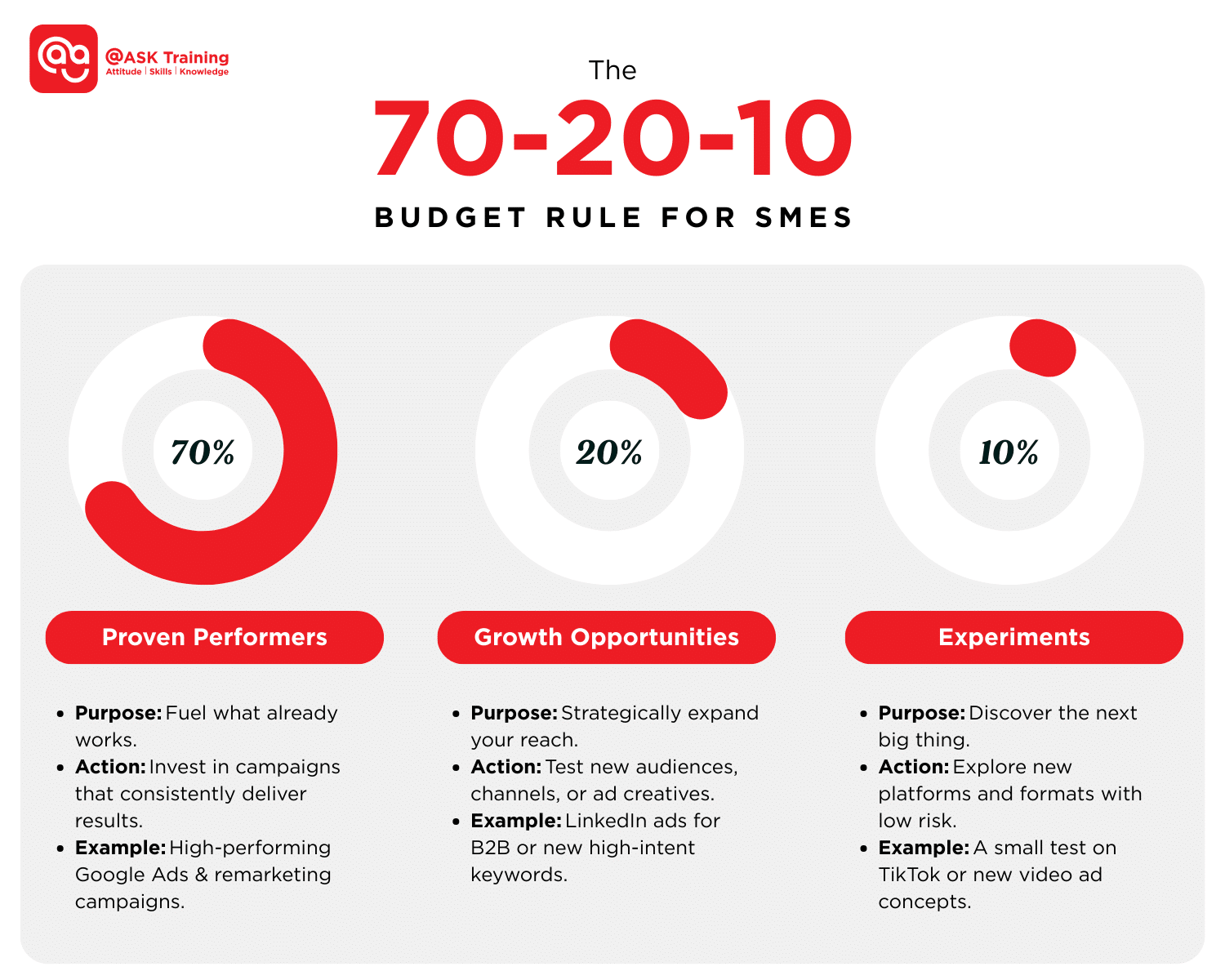
Once you know your total monthly budget, the next step is to allocate it effectively. A practical and effective default is the 70–20–10 rule, which balances stability, growth, and innovation.
70% to Proven Performers
- The core of your budget should go to campaigns and channels that already consistently deliver results.
- Example: Your current high-performing Google Ads search campaigns and remarketing ads.
20% to Growth Opportunities
- Allocate this portion to exploring new audiences, channels, or creatives with strong potential.
- Example: Trying LinkedIn ads for B2B leads or exploring new, high-intent keywords in your existing search campaigns.
10% to Experiments
- Dedicate a small, manageable portion to pure experimentation with new formats, platforms, or ad types.
- Example: Running a small test with TikTok ads or developing new video creatives for your social campaigns.
Budget Line Items
For clarity and control, structure your total budget into these key categories:
- Media – paid ads, PPC campaigns
- SEO / Content – articles, blog posts, topic clusters (This could be an in-house salary, a retainer for a freelance writer, or an agency fee).
- Creative / Production – design, video, photography (This could be an in-house designer’s time, a project fee to a production studio, or a subscription to a design tool).
- Tools & Analytics – tracking, reporting, automation software
- Training – staff skill upgrades (partially offset by SkillsFuture credits)
- Manpower / Professional Fees – A critical category that varies significantly:
- In-House Team: This is the salary and overhead for your marketing staff.
- External Agency: This is the monthly retainer or management fee.
- Freelancers: These are project-based or hourly costs.
As a guide, consider these suggested budget bands for specific line items:
- Tools & Analytics: 5–10% of your total budget
- Training: 2–5% of your total budget
Promotion Rule
Your budget allocation isn’t set in stone. To ensure continuous improvement, follow this simple promotion rule:
- Scale what works: Increase spend on channels or tactics that beat your current CPL or ROAS (Return on Ad Spend) for two consecutive review periods.
- Pause what doesn’t: Stop or adjust funding for elements that underperform consistently.
By splitting your budget using this structured approach, you balance steady performance, growth initiatives, and learning opportunities — all while keeping your spending predictable and directly tied to results.
Choosing the Right Channels
With your budget allocated, the next critical decision is selecting the right channels for your goals. Not all channels work the same way. To get the most from your budget, map each channel to the business goal it serves.
Align Channels with Your Primary Goals
Each channel excels at a different part of the customer journey. Here’s how to leverage their strengths:
1. Search / PMax (Google’s Performance Max)
Capture high-intent prospects ready to take action now, such as filling a lead form or calling your business.
- Example: Google Ads campaigns targeting “plumber Singapore”
- Tip: Use keyword match types to control who sees your ads
- Exact match (e.g., [plumber Singapore]): Your ad shows only for that exact search query
- Phrase match (e.g., “plumber Singapore”): Your ad shows for searches that include that phrase, like “best plumber Singapore for leak”.
2. SEO / Content
Build long-term visibility and compounding demand through service pages, blog posts, and local SEO.
- Example: Optimising your website and publishing blog posts to rank organically for “digital marketing services Singapore”.
3. Social Media (Meta/Facebook, TikTok, YouTube)
Perfect for reaching new audiences, testing creative concepts, and retargeting warm leads.
- Example: Running engaging video ads on TikTok for top-of-funnel awareness, then retargeting users who watched the video with a direct-response lead ad on Facebook.
Execution Tips for Immediate Impact
To ensure your channel strategy delivers, focus on these foundation actions:
- Prioritise high-intent keywords first; use exact match and phrase match sets for search campaigns
- Ensure clear CTAs on service pages, fast mobile load, and trust signals like testimonials or certifications
- For Local SEO: maintain consistent NAP (Name, Address, Phone), verify Google Business Profile, and list your business on Singapore directories
A Sample Budget Split for B2B Services
- Search / PMax: 35%
- SEO / Content: 25%
- Paid Social: 20%
- Video: 10%
- Tools / Training: 10%
By matching channels to specific goals and using a structured allocation, SMEs can maximise ROI while staying within budget.
Testing and Learning Fast
To make the most of your budget, always test one variable at a time. This keeps results clear and prevents wasting money on changes that aren’t actually effective.
Step 1: Choose a variable to test
Pick one element to experiment with while keeping everything else constant:
- Audience – target a new segment or interest group
- Creative – change images, videos, or ad copy
- Landing page – tweak headlines, CTAs, or layout
- Bid strategy – test different CPC or CPA targets
Step 2: Set a time and volume limit
- Run each test for 14 days or 1,000 clicks, whichever comes first
- Stop the test early if results clearly underperform or exceed your expectations
Step 3: Define success criteria
- Promote winners that:
- Achieve ≥15% cheaper CPL (Cost per Lead) or
- Generate ≥20% higher CVR (Conversion Rate)
- Only scale campaigns after seeing the improvement persist over two consecutive checks to make sure it’s consistent and not a one-time spike
Step 4: Apply learnings quickly
- Scale campaigns that pass your success criteria
- Pause or adjust campaigns that underperform
- Document results and insights for future tests
By testing carefully and scaling winners, SMEs can improve campaign performance without overspending, and continuously refine marketing strategies for better ROI (Return on Investment).
Tracking ROAS Correctly
To know if your marketing budget is paying off, you need reliable tracking. Without it, you’re essentially guessing which campaigns work.
Step 1: Set up proper analytics
- Install GA4 (Google Analytics 4) on all key pages and events
- Use UTM parameters in your campaign links to track where traffic, leads, or sales come from
- Example: https://example.com?utm_source=facebook&utm_medium=cpc&utm_campaign=spring_sale
- This tells you that the visit came from a Facebook paid ad for the Spring Sale campaign
Step 2: Track conversions correctly
- Make sure your key actions (leads, sales, calls) are tracked properly, not double-counted, and credited to the correct ads
- Understand attribution windows: the period during which a conversion is credited to an ad
- Example: 7-day click / 1-day view → if someone clicks your ad and converts within 7 days, or views it and converts within 1 day, it counts
Step 3: Focus on the right metrics
Measure performance by funnel stage and business goal:
- Leads / Services: CPL (Cost per Lead), CVR (Conversion Rate), qualified lead rate, time-to-first-contact
- E-commerce / Sales: ROAS (Return on Ad Spend), CPA (Cost per Acquisition), and LTV (Lifetime Value) / CAC (Customer Acquisition Cost) – compare how much you spend to acquire a customer versus how much revenue they bring over time.
- For phone leads, use dynamic call tracking to attribute calls to campaigns
Step 4: Keep reporting simple
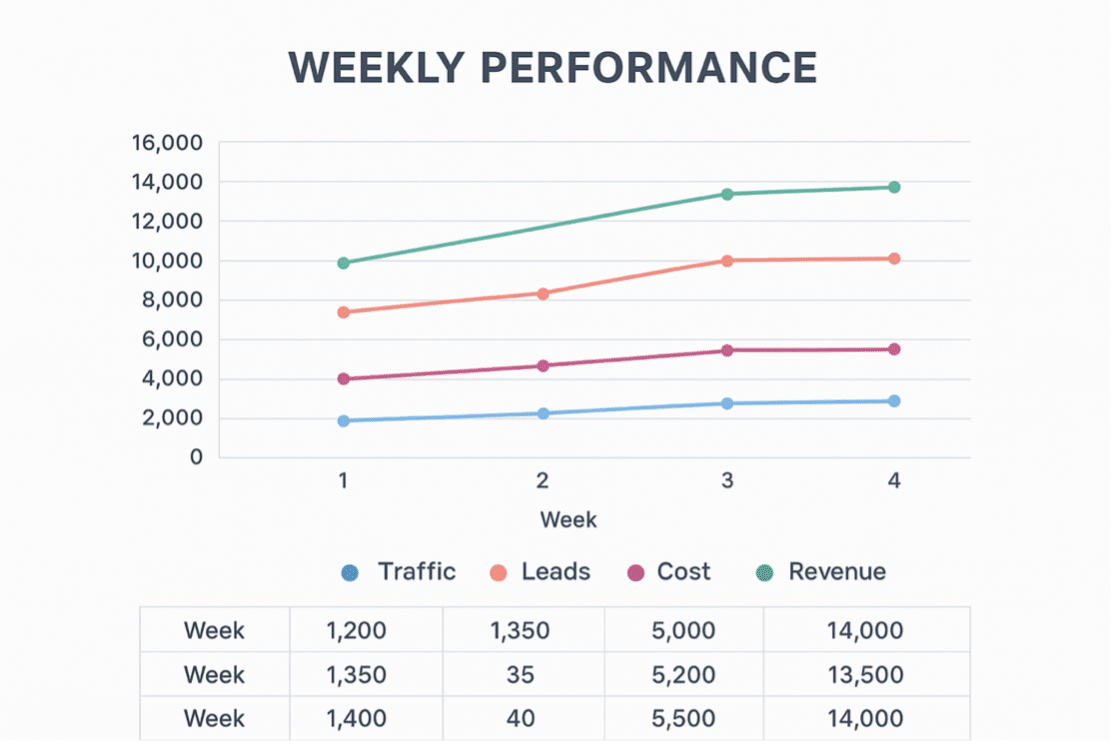
- Build a one-screen dashboard showing: Traffic → Leads → Cost → Revenue
- Track week-over-week trends and compare against the last 28-day baseline
By enforcing proper tracking and monitoring the right KPIs, SMEs can see which campaigns are working, scale winners, and stop wasteful spending.
Reading Your Numbers Weekly
Keeping a close eye on your campaigns each week helps you make fast decisions and avoid wasted spend. A simple weekly routine ensures you stay on top of performance.
Step 1: Build a one-screen dashboard
Your focus should be on clarity. Build a single dashboard that tracks the most critical metrics in one view:
- Traffic → number of visitors to your site or landing pages
- Leads → form submissions, calls, or sign-ups
- Cost → total spend per campaign
- Revenue → sales generated or value of qualified leads
To make this data actionable, incorporate week-over-week comparisons and a last 28-day snapshot to spot trends quickly.
| Week | Traffic | Leads | Cost (S$) | Revenue (S$) |
|---|---|---|---|---|
| 1 | 1,200 | 30 | 5,000 | 12,000 |
| 2 | 1,350 | 35 | 5,200 | 13,500 |
| 3 | 1,400 | 40 | 5,500 | 14,200 |
| 4 | 1,380 | 38 | 5,400 | 14,000 |
Example of Weekly Performance One-Screen Dashboard
Step 2: Set a simple weekly routine
Consistency is key. Adopt a straightforward weekly schedule to maintain momentum:
- Monday: Review performance across all channels
- Tuesday: Decide to keep, pause, or scale campaigns based on results
- Friday: Log learnings and plan next tests
Step 3: Benchmark wisely
Context is everything when interpreting your numbers.
- For the most accurate picture, compare performance against your last 30–90-day baseline to identify genuine trends
- Use external industry benchmarks only as context, not strict targets, as your business’s unique journey is the most important metric.
Following this routine helps SMEs spot trends, scale winners, and adjust underperforming campaigns quickly, ensuring every dollar in your budget is working as hard as you are.
Making it Work in Singapore
To win in Singapore’s small but highly competitive market, a locally-optimised strategy is non-negotiable. Careful budgeting must be paired with specific adaptations to resonate here.
This practical guide will help you tailor your campaigns for maximum local impact.
1. Two Copy-Ready Budget Options
Start with a budget framework designed for the Singapore context. Below are two ready-to-use options.
The Lean Budget (S$3–5k/month)
Ideal for establishing a foundation or testing the waters.
| Channel | % of Budget | Example Allocation (S$4k) |
|---|---|---|
| Search / PMax | 35% | S$1,400 |
| SEO / Content | 25% | S$1,000 |
| Social Media | 20% | S$800 |
| Video | 10% | S$400 |
| Tools / Training | 10% | S$400 |
The Growth Budget (S$8–12k/month)
Designed for aggressive scaling and capturing more market share.
| Channel | % of Budget | Example Allocation (S$10k) |
|---|---|---|
| Search / PMax | 40% | S$4,000 |
| SEO / Content | 25% | S$2,500 |
| Social Media | 25% | S$2,500 |
| Video | 5% | S$500 |
| Tools / Attribution | 5% | S$500 |
2. Set Conservative Output Expectations
Use your CPL and CVR assumptions to set realistic expectations. Based on the budgets above, you can anticipate:
- Lean Budget: 4,000–5,000 clicks per month → ~30–40 qualified leads
- Growth Budget: 10,000–12,000 clicks per month → ~80–120 qualified leads
Remember, these are indicative ranges. Your actual results will depend on your industry, offer, and ad quality.
3. Stretch with Local Support
A key advantage for Singapore SMEs is the powerful government support available. Leverage these grants to extend your marketing reach:
- PSG (Productivity Solutions Grant): Offset costs with pre-approved digital marketing solutions
- EDG (Enterprise Development Grant): Fund larger capability-building or strategy projects.
- SkillsFuture: Utilise credits to upskill your team in ads, analytics, and SEO.
4. Localisation Must-Dos
To maximise performance, your campaigns must feel local. Ensure you:
- Localise everything: From keywords and ad copy to your business address, opening hours, and call extensions.
- Prioritise Local SEO: This is critical for organic visibility. Claim and optimise your Google Business Profile and ensure consistent NAP (Name, Address, Phone) across local directories.
- Use call-enabled ads: For service-based businesses, this is a direct line to convert local leads instantly.
Wrapping Up
Successful digital marketing in Singapore isn’t just about spending money—it’s about spending smart. By combining goal-driven budgeting, careful channel allocation, local adaptation, and ongoing testing, SMEs can make every dollar count and achieve measurable results.
Here’s the path to digital marketing success in Singapore:
- Decide how much to spend (Lean or Growth)
- Turn goals into numbers using CPL/CVR formulas
- Split budget using 70–20–10 (proven performers, growth, experiments)
- Test small and scale winners
- Track ROAS and key metrics consistently
- Leverage Singapore grants (PSG, EDG, SkillsFuture) to stretch your budget
Your immediate next step is simple: Pick either Lean or Growth, plug in your numbers, and commit to a 90-day rollout starting this quarter.
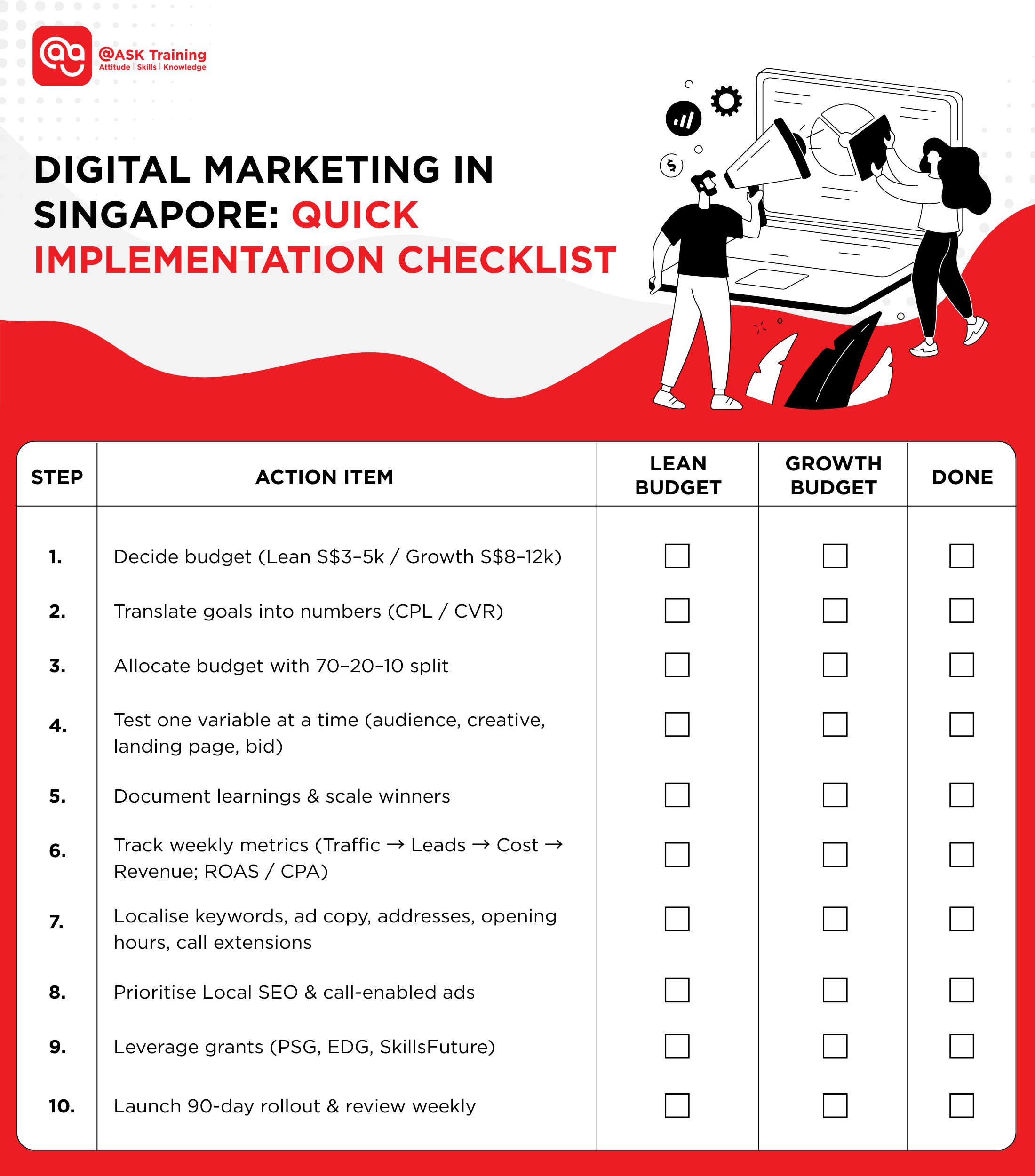
To make implementation easier, use the checklist below as a quick reference and tick off each step as you go.
Digital Marketing in Singapore: Quick Implementation Checklist
Ready to Execute Your Strategy with Confidence?
This guide gave you the blueprint. Our courses give you the tools. Stop planning and start doing with our industry-certified digital marketing courses, designed specifically for Singaporean SMEs.
Master the channels that drive growth:
- Google Ads & Online Advertising courses:
Capture high-intent customers actively searching for your business. - SEO, Website Analytics & Optimisation courses:
Build lasting organic visibility and make data-driven decisions. - Social Media Marketing courses:
Engage new audiences and turn followers into customers.
Looking to train your entire team? We offer customised Corporate Training solutions to uplift your organisation’s digital marketing capabilities at scale.
Get in touch with us today and invest in your skills!
Related Courses
- WSQ Diploma in Digital Marketing
- WSQ Specialist Diploma in Digital Marketing
- WSQ Advanced Digital Marketing Strategy
◆◆◆