
In today’s globalised and interconnected world, most professionals operate in workplaces that blend multiple cultures.
You might collaborate with colleagues from different countries, present to stakeholders in another region, or support clients whose communication styles are shaped by norms different from your own.
In hybrid and remote environments, these cross-cultural interactions happen even more frequently, making cultural intelligence (CQ) an essential skill rather than an optional one.
Cultural intelligence goes far beyond etiquette or general awareness. It is the capability to adapt your communication, behaviour, and thinking to work effectively with people from diverse cultural backgrounds.
As organisations expand globally and teams become more multicultural, CQ has emerged as a critical skill that affects collaboration, performance, and leadership impact.
This article will explore:
- What cultural intelligence really means
- How the four components of CQ skills work together
- Why CQ matters in today’s global and hybrid workplaces
- How cultural differences show up in daily work interactions
- Practical ways to build your cultural intelligence
- Common mistakes to avoid when interpreting cultural behaviours
- The long-term personal and organisational benefits of strong CQ
You’ll also find actionable tips to help you thrive in multicultural settings and strengthen your intercultural communication abilities.
“Cultural intelligence is the capability to function effectively in culturally diverse settings.” — Dr David Livermore, researcher and author known for pioneering the study of cultural intelligence (CQ).
But what exactly is cultural intelligence, and how does it differ from just being culturally aware? Let’s start with a clear definition.
What Is Cultural Intelligence?
Cultural intelligence (CQ), also referred to as cultural quotient, is the practical ability to work, communicate, and collaborate effectively across cultures.
Unlike a fixed trait, it’s a measurable, learnable skill that equips you to navigate cultural differences in professional and social environments.
Think of it like emotional intelligence, but for culture. People with high CQ can “read the room,” recognise how cultural norms are shaping behaviour, and adapt their approach in real time, whether they’re giving feedback, leading a meeting, or building trust with international clients.
CQ vs. Cultural Awareness
Many professionals confuse cultural awareness with cultural intelligence. Being aware of differences is a good start, but it doesn’t guarantee effective interaction.
- Cultural Awareness means knowing that some cultures value indirect communication to preserve harmony.
- Cultural Intelligence means recognising that norm and actively adjusting your feedback style to be more tactful, less confrontational, and more relationship-focused when appropriate.
The key difference lies in behavioural adaptability. CQ moves beyond knowledge into action, influencing your choices, language, tone, and decisions as you engage across cultures.
Simply put, awareness tells you what is different. CQ enables you to adapt effectively.
Now that we understand what cultural intelligence is, let’s break down the four components that make it work.
The Four Components of Cultural Intelligence (CQ)
Cultural intelligence consists of four interdependent capabilities: Drive, Knowledge, Strategy, and Action.
Together, they form a powerful framework for developing your CQ skills and improving your intercultural communication and multicultural teamwork.
Let’s break down each component:
1. CQ Drive — Motivation to Engage with Cultural Diversity
CQ Drive is your interest, curiosity, and confidence in working with people from different cultures. Without the desire to engage, knowledge and skills remain unused.
CQ Drive involves:
- Wanting to learn about other cultures
- Seeing the value of cultural skills in your work
- Feeling confident interacting with people who think differently
Example: Choosing to join a global project team rather than sticking with a familiar local group.
2. CQ Knowledge – Understanding Key Cultural Differences
CQ Knowledge involves understanding how cultures differ in their values, behaviours, and communication styles.
It’s about recognising the broad patterns that shape how people work, interact, and make decisions in the workplace.
Key areas of CQ Knowledge include:
- Communication Style: Direct vs. indirect expression.
- Role of Hierarchy: How authority and decision-making are viewed.
- Attitudes Toward Timeline: Monochronic (linear time) vs. polychronic (flexible time) perspectives.
- Approaches to Decision-Making: Individual vs. group-oriented processes.
Example: In high power-distance cultures, senior leaders may limit direct interaction with junior staff, as strict hierarchical boundaries govern workplace communication.
Building this knowledge helps you anticipate differences rather than being surprised by them.
3. CQ Strategy — Planning and Reflecting on Cross-Cultural Interactions
CQ Strategy is the ability to pause, think, and plan before and after cross-cultural interactions. It involves being aware of your own assumptions and intentionally considering how cultural differences might influence communication, expectations, or behaviour.
This strategic awareness helps prevent misunderstandings and reduces the likelihood of reacting too quickly based on your own cultural lens.
Example: Before a meeting with an international team, you might consider whether direct questioning will be seen as constructive or confrontational, and plan your approach accordingly.
4. CQ Action — Adapting Your Behaviour in Cross-Cultural Situations
CQ Action is the practical expression of cultural intelligence. It reflects your ability to adjust your behaviour, communication style, and approach when working with people from different cultural backgrounds.
Rather than relying on a single style in every situation, people with high CQ Action can shift how they speak, listen, and respond so that their message is received respectfully and clearly.
Example: Slowing down your speech, avoiding idioms, or providing written summaries to support colleagues who process information differently.
Here’s a quick view on the 4 components of CQ:
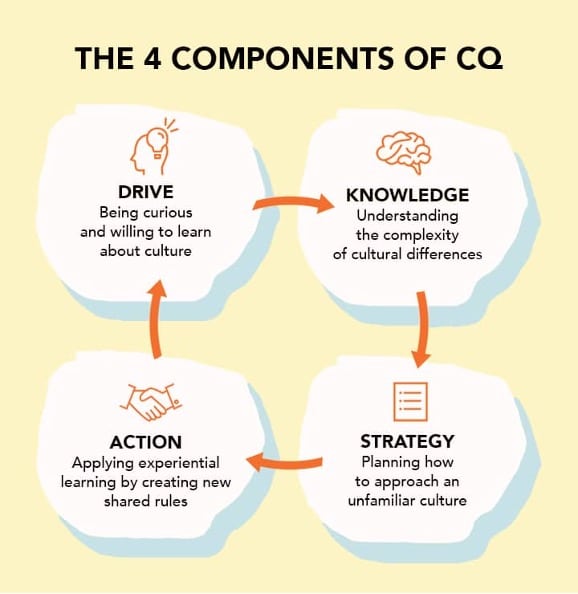
Together, these four components create a complete cycle of learning, planning, acting, and reflecting, essential for thriving in a global workplace.
But why does CQ matter so much in today’s professional environments? Let’s explore its real-world impact.
Why Cultural Intelligence Matters in Today’s Workplace
Singapore’s workforce is inherently multicultural and globally connected. Whether collaborating with local colleagues from diverse backgrounds, engaging with regional teams, or serving international clients, professionals here navigate a blend of cultural norms daily.
In hybrid and remote settings, these differences become even more pronounced. Digital communication can obscure tone and nuance, making cultural intelligence (CQ) not just beneficial, but essential for success in today’s global workplace.
Cultural intelligence enables professionals in Singapore to communicate effectively, build trust, and foster collaboration across cultures. It turns diversity into a strategic advantage, helping teams work more smoothly and organisations thrive in a competitive landscape.
Here are five key ways CQ creates impact in our local professional environment:
1. It Improves Cross-Cultural Communication
In a multicultural hub like Singapore, communication styles can vary widely. CQ helps you interpret tone, navigate formality, and adapt your messaging so it’s clearly understood, whether you’re in a meeting, writing an email, or presenting to stakeholders.
2. It Strengthens Team Collaboration
Singapore’s workplaces bring together diverse perspectives. CQ helps bridge differences in working styles, decision-making, and conflict resolution, ensuring every team member feels valued and heard, which boosts morale and innovation.
3. It Supports Better Problem Solving and Decision-Making
Diverse teams lead to richer discussions and better outcomes. With cultural intelligence, teams can leverage varied viewpoints without friction, resulting in more thoughtful solutions and stronger business decisions.
4. It Enhances Leadership Effectiveness
Leaders in Singapore often manage teams with mixed cultural backgrounds. High CQ allows them to adapt their approach, communicate with empathy, and create an inclusive environment where everyone can contribute and grow.
5. It Benefits Customer and Client Relationships
Whether dealing with local or international partners, CQ helps professionals read cues, adjust their approach, and build lasting rapport. This skill is especially valuable in client-facing roles and business development across sectors.
Clearly, CQ is a vital skill for navigating Singapore’s diverse professional landscape. But how do cultural differences actually show up in everyday work situations here?
Let’s explore some common scenarios.
How Cultural Differences Show Up in Daily Work Interactions
“The single biggest problem in communication is the illusion that it has taken place.” — George Bernard Shaw, playwright and Nobel Prize winner, known for his insights on communication and human behaviour.
Cultural differences influence how people behave and communicate at work, often in ways that are subtle but significant. In a diverse workplace like Singapore’s, these nuances shape everything from meetings to messaging.
Rather than focusing on abstract concepts, it’s helpful to look at everyday scenarios where cultural differences commonly surface. Understanding these patterns allows you to respond with greater clarity, empathy, and accuracy — key aspects of strong cultural intelligence.
Below are five common situations where cultural differences appear in day-to-day work.
1. How People Participate in Meetings
In some cultures, speaking up frequently shows engagement and confidence. In others, people may participate only after being invited or after senior members have spoken.
As a result:
- A quiet participant may be showing respect, not disengagement.
- Someone who jumps in quickly may be seen as confident in one culture but overly assertive in another.
Example: A team member who waits until the end of the meeting to share input might simply be following cultural norms around hierarchy or thoughtfulness.
2. How Feedback Is Shared and Received
Feedback varies widely across cultures:
- Some prefer direct, immediate feedback.
- Others expect feedback to be diplomatic, indirect, or framed positively.
What feels honest to one person may feel harsh to someone else—and what feels polite to one person may feel unclear to another.
Example: A comment like “You may want to consider another approach” might be interpreted as a polite suggestion by some and as a firm warning by others.
3. How Silence Is Interpreted
Silence carries different meanings across cultures:
- In some contexts, silence means disagreement or uncertainty.
- In others, it signals respect, reflection, or thoughtful listening.
Example: A pause before answering may simply mean someone is choosing their words carefully, not that they lack ideas.
4. How Decisions Are Made
Daily decision-making can vary even in small interactions:
- Some expect quick decisions and fast responses.
- Others expect time to consult with colleagues or gather input.
This can influence everything from email replies to project updates.
Example: A colleague’s “I’ll get back to you” may reflect a norm of internal consultation, not hesitation or lack of confidence.
5. How People Communicate in Digital Channels
Hybrid and remote work can magnify cultural differences because tone and nuance are harder to see. Differences may show up in:
- Response times
- How detailed or brief the messages are
- Use of emojis or exclamation points
- Levels of formality in writing
- Expectations around video vs. audio in meetings
Example: A short, direct message, “Please revise this”, may seem blunt to some but normal to others.
“Culture shapes meaning; CQ helps you decode it.”
6. The Value of Not Jumping to Conclusions
Most cross-cultural misunderstandings happen not because people intend to cause friction, but because behaviours are interpreted through one’s own cultural lens. By recognising these differences in everyday interactions, you can:
- Pause before reacting
- Ask clarifying questions
- Adjust their interpretation
- Respond with greater empathy and accuracy
This is the practical heart of cultural intelligence. Recognising these differences helps prevent misinterpretation and fosters more effective cross-cultural communication. But awareness alone isn’t enough; you need to actively build your cultural intelligence.
Let’s take a look at practical ways to develop your CQ.
How to Build Cultural Intelligence
Cultural intelligence grows with intentional practice. Strengthening each component of CQ—Drive, Knowledge, Strategy, and Action—helps professionals communicate more effectively across cultures and navigate diverse environments with greater confidence.
“Curiosity is the most powerful tool for bridging cultural gaps.” — Erin Meyer, business professor and author of The Culture Map, an influential book on cross-cultural communication.
Below are practical, actionable ways to build cultural intelligence in everyday work.
1. Strengthen CQ Drive
CQ Drive reflects the motivation and confidence needed to engage with cultural differences. It begins with simple curiosity and a willingness to move beyond familiar norms.
How to strengthen CQ Drive:
- Engage with diverse colleagues. Ask about their experiences, working preferences, or viewpoints.
- Seek multicultural exposure. Explore films, books, cuisines, and media from different cultures.
- Join global or cross-functional projects. Exposure reduces hesitation and increases comfort.
- Reflect on your purpose. Consider how cultural intelligence supports your career goals and relationships.
Example: Volunteering for a project that spans multiple regions helps increase your comfort and confidence in cross-cultural collaboration.
2. Build CQ Knowledge
CQ Knowledge grows through learning how cultural values shape behaviour, communication, and expectations at work.
How to build CQ Knowledge:
- Observe before assuming. Pay attention to how colleagues communicate, make decisions, or express disagreement.
- Learn about cultural patterns. Read books and articles, watch diverse media, or explore cross-cultural communication frameworks to recognise common differences.
- Ask respectful questions. When appropriate, ask colleagues how they prefer to communicate or work.
- Attend training sessions. Workshops or courses on global communication can provide helpful tools and insights.
Example: Noticing that a colleague consistently avoids direct disagreement may help you understand their cultural preference for maintaining harmony rather than assuming hesitation.
3. Improve CQ Strategy
CQ Strategy is about planning and reflecting. It helps you slow down, think ahead, and approach interactions with greater intention.
“Pause before you interpret.”
How to improve CQ Strategy:
- Prepare for cross-cultural meetings. Think about how participants might interpret your communication style.
- Reflect after interactions. Ask yourself what went well and what could be improved.
- Challenge your assumptions. Consider how your cultural lens might influence your interpretation of others’ behaviour.
- Pause before reacting. Give yourself a moment to consider alternate explanations.
Example: Before responding to silence in a meeting, pause to consider its possible meaning. Silence may signal reflection, respect, hesitation, or simply a preference for thinking before speaking—not necessarily disagreement.
4. Enhance CQ Action
CQ Action develops through practising small behavioural adjustments. These changes help your communication resonate across cultures and make interactions more inclusive.
“Small adjustments create meaningful connections.”
How to enhance CQ Action:
- Adapt your communication method. Simplify phrasing, avoid idioms or humour, or slow your pace when needed.
- Be mindful of nonverbal cues. Gestures, eye contact, tone, and pauses may have different meanings across cultures.
- Provide clarity and structure. Written summaries or agendas support colleagues who prefer more context.
- Invite varied participation styles. Offer opportunities for quieter colleagues to share input in ways comfortable for them.
- Adjust formality. Some cultures expect formal titles or structured language; others prefer informality.
Example: Sending a clear meeting recap ensures everyone—regardless of language or cultural background—has the same understanding of decisions and next steps.
Here’s a quick summary:
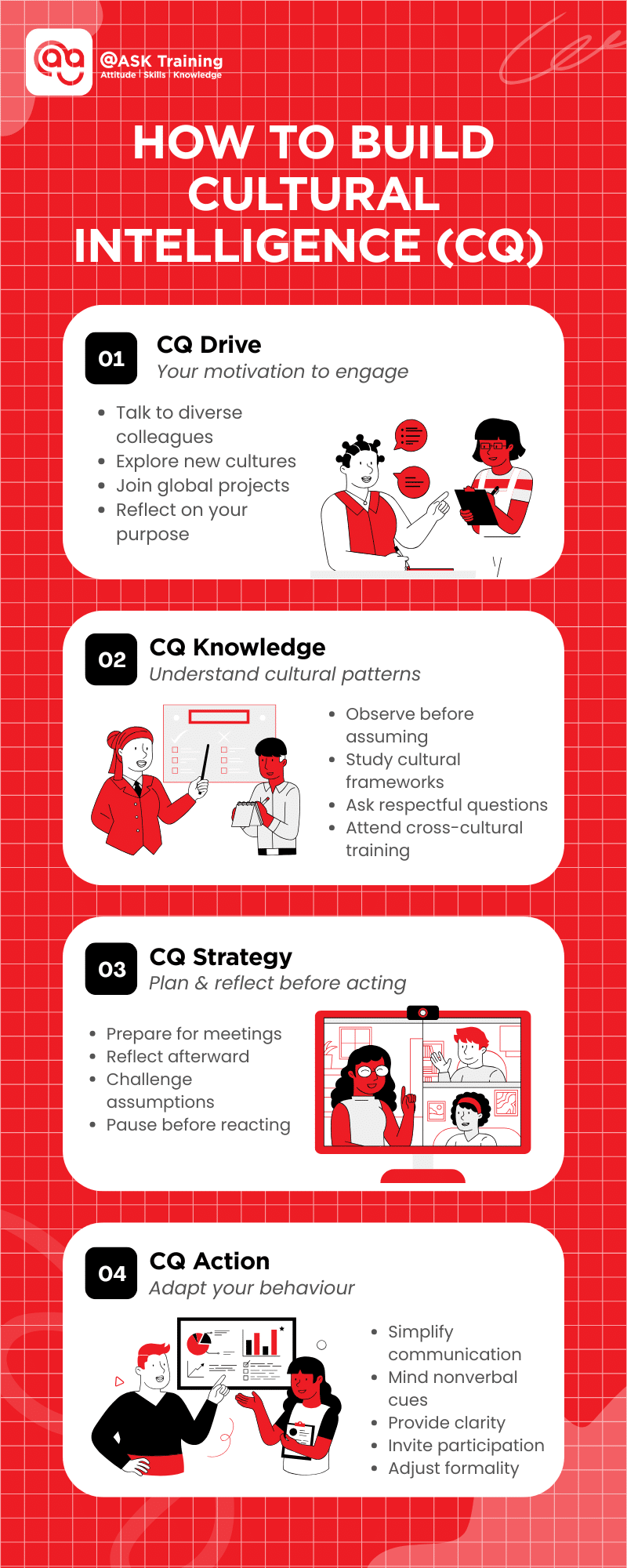
Building CQ is an ongoing process. It develops gradually through exposure, reflection, and practice. Remember: progress comes from consistency, not perfection.
Common Mistakes When Navigating Cultural Differences
Even well-intentioned professionals can misinterpret cultural cues or respond in ways that unintentionally create confusion.
These mistakes are a natural part of working in diverse environments, especially when people rely on their own cultural norms to make sense of others’ behaviour. Recognising these common pitfalls is an important step toward developing stronger cultural intelligence.
Below are some of the most frequent mistakes people make when navigating cultural differences, and how CQ helps prevent them.
1. Assuming Your Own Style Is the Norm
One of the most common errors is assuming that your way of communicating, giving feedback, or making decisions is the universal standard. In reality, behaviours that feel normal in one culture may feel abrupt, unclear, or overly formal in another.
Example: A manager who prefers direct communication may think they are being transparent, while a colleague from a more indirect culture may experience the same message as overly blunt.
2. Misinterpreting Behaviour Through Your Own Cultural Lens
People often interpret others’ actions based on their own norms, which can lead to inaccurate conclusions.
- Silence may be thoughtfulness, not disengagement.
- Indirect language may be politeness, not avoidance.
- Limited eye contact may be respect, not a lack of confidence.
CQ helps you pause before assigning meaning to behaviour that might have a different cultural intention.
3. Overgeneralising or Relying on Stereotypes
While cultural patterns are useful, they don’t apply equally to every individual. Overgeneralising can lead to incorrect assumptions and limit meaningful engagement.
Example: Assuming all members of a certain culture dislike direct feedback ignores individual personality, professional experience, and personal preference.
CQ encourages curiosity and open conversation rather than relying solely on generalisations.
4. Avoiding Cross-Cultural Interactions Out of Discomfort
Some professionals withdraw from multicultural situations because they fear making mistakes. Unfortunately, avoidance prevents growth and can create unintentional distance in teams.
Developing CQ means being willing to try, reflect, and adjust—mistakes included.
5. Overlooking the Role of Hierarchy
A frequent source of misunderstanding comes from different expectations around hierarchy.
- In egalitarian cultures, speaking up is expected.
- In hierarchical cultures, employees wait to be invited.
Misreading these cues can lead to false assumptions about confidence, competence, or engagement.
6. Not Asking for Clarification
Many misunderstandings continue simply because people hesitate to ask questions.
Questions like:
- “How do you prefer to receive feedback?”
- “Would you like more context or fewer details?”
- “Is this timeline acceptable for your team?”
Clarifying expectations—around communication, timelines, or decision-making—helps align everyone, remove ambiguity, and build trust.
7. Assuming Good Intent Is Obvious
Messages meant to be helpful may be interpreted differently across cultures. Without explicit clarity, your intention may not match the message others receive.
Example: A casual, friendly tone may be appreciated in some cultures but perceived as unprofessional in others.
CQ Action helps you adjust how your intent is communicated so that it is received as intended.
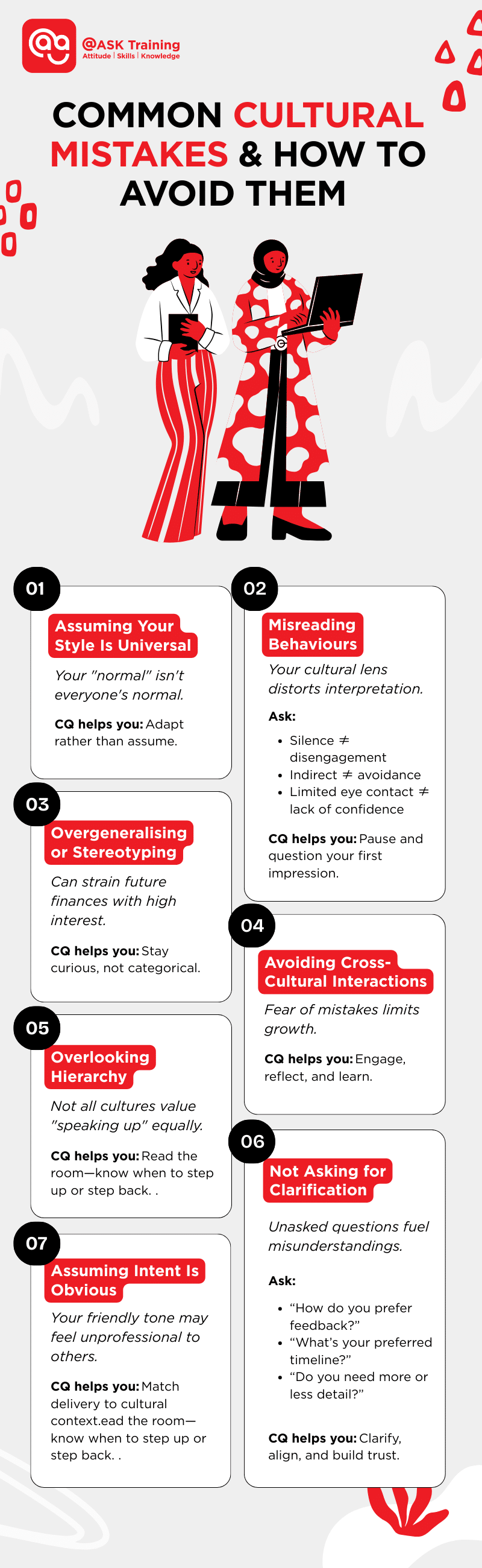
Mistakes Are Part of the Learning Process
Cultural intelligence grows through trial, reflection, and adjustment. Instead of viewing mistakes as failures, they can be seen as opportunities to understand yourself and others better. The goal is not perfection; it’s awareness, openness, and a willingness to adapt.
The Long-Term Benefits of Cultural Intelligence
Developing cultural intelligence is not just a short-term skill for solving immediate communication challenges—it is a long-term asset that shapes career growth, leadership effectiveness, and organisational success.
As workplaces continue to globalise and teams become increasingly diverse, the ability to navigate cultural differences with confidence and empathy becomes an enduring advantage.
Below are the key long-term benefits of building strong CQ.
1. Stronger Professional Relationships
Cultural intelligence helps individuals build deeper, more trusting relationships with colleagues, clients, and stakeholders from different backgrounds.
When people feel understood and respected, they are more likely to collaborate openly, share ideas, and engage fully in their work.
Over time, these relationships create stronger networks, smoother teamwork, and a more positive work environment.
2. Improved Adaptability and Resilience
Professionals with high CQ adapt more easily to new environments, shifting expectations, and unfamiliar cultural norms. This adaptability becomes incredibly valuable in global roles, cross-functional projects, or hybrid work settings where norms may shift frequently.
CQ also helps individuals remain calm and resourceful when misunderstandings occur, reducing frustration and increasing resilience.
3. Enhanced Leadership Capability
Leaders with strong cultural intelligence can motivate diverse teams, communicate clearly across cultures, and create environments where all team members feel valued.
They are skilled at:
- Adjusting their leadership style
- Delivering feedback effectively
- Managing conflict with sensitivity
- Ensuring everyone’s voice is heard
These abilities contribute to stronger team performance and higher engagement, qualities that define effective modern leadership.
4. Greater Innovation and Better Decision-Making
Diverse teams have the potential to generate more innovative ideas, but only when cultural differences are understood and respected.
CQ helps unlock that potential by enabling team members to:
- Contribute different viewpoints confidently
- Challenge assumptions thoughtfully
- Integrate diverse ideas into stronger solutions
As a result, teams with high CQ tend to make better decisions and solve problems more creatively.
5. Increased Career Mobility and Global Opportunities
Professionals who demonstrate strong cultural intelligence often stand out in multinational organisations. CQ signals that someone can work effectively across boundaries, manage multicultural clients, and represent the organisation globally.
This opens doors to:
- International assignments
- Regional leadership roles
- Cross-border project opportunities
- Career advancement in global markets
CQ has become a valuable differentiator in competitive industries.
6. More Inclusive and Collaborative Workplaces
Organisations benefit greatly when employees practice cultural intelligence. CQ contributes to a workplace culture where differences are viewed as strengths rather than obstacles.
This leads to:
- Fewer misunderstandings and conflicts
- Higher levels of trust and psychological safety
- More effective cross-cultural collaboration
- Stronger employee engagement and retention
Over time, teams become not only more harmonious but also more productive and innovative.
7. Long-Term Personal Growth
Beyond professional benefits, cultural intelligence enriches personal life. It broadens perspective, deepens empathy, and helps individuals appreciate cultural diversity in daily interactions.
People with high CQ tend to have more meaningful connections, greater curiosity about the world, and a stronger ability to navigate unfamiliar social contexts.
A Skill That Pays Off for Life
Cultural intelligence is more than a workplace skill; it’s a lifelong advantage.
As global connectivity grows, professionals who develop their CQ now position themselves for success in diverse, dynamic, and fast-evolving environments.
The benefits of CQ extend far beyond better communication. It fundamentally shapes how you lead, learn, collaborate, and engage with the world, enriching both your career and your personal interactions for years to come.
Wrapping Up
Cultural intelligence has become an essential skill in today’s global and diverse workplaces. More than a theoretical concept, CQ is a practical, everyday capability that helps you communicate clearly, interpret behaviours accurately, and build stronger relationships across cultures.
By understanding the four components of CQ: Drive, Knowledge, Strategy, and Action, you can approach cross-cultural interactions with greater confidence, empathy, and adaptability.
As workplaces continue to evolve through globalisation, hybrid collaboration, and increasingly diverse teams, cultural intelligence has become crucial. It:
- Enhances teamwork and collaboration
- Strengthens leadership and influence
- Reduces misunderstandings and friction
- Creates more inclusive environments where everyone feels heard
Beyond the workplace, CQ also enriches personal growth, broadening your perspective and deepening your connection with others.
Start Building Your CQ Today
- Reflect on a recent cross-cultural interaction.
- Ask a colleague about their preferred communication style.
- Adjust one small behaviour in your next meeting.
CQ isn’t about perfection; it’s about progress. Every small step builds your ability to connect, collaborate, and thrive in a multicultural world.
Ready to Put Your Cultural Intelligence to Action?
Building CQ is a journey, and sometimes, learning from the past can illuminate the path forward. @ASK Training offers practical, interactive workshops designed to help you thrive in diverse workplaces.
Whether you’re looking to improve communication, lead multicultural teams, or foster a more inclusive environment, we have a course that fits your needs.
For Teams & Leaders:
Working Relationships with Multi-Generational People
– Learn to bridge generational gaps and turn diversity into your team’s superpower.
For Strategic & Historical Insight:
Three Kingdoms’ Leadership in Today’s Context
– Discover how ancient strategies of alliance, negotiation, and adaptive leadership apply to modern multicultural challenges.
For Communication & Connection:
Empathy: Harnessing The Power of Connection at Workplace
– Develop the emotional and cultural empathy needed to build trust and collaboration.
For Personal Influence:
Connect, Engage and Influence with NLP Interpersonal Communication Techniques
– Master the subtle art of communicating across different styles and backgrounds.
Contact us to find the right programme for you or your team! Invest in your CQ. Lead with confidence. Succeed across cultures and across time.
Related Courses
- Working Relationships with Multi-Generational People
- People Centered Leadership- Motivating, Inspiring and Engaging Others
- Empathy: Harnessing The Power of Connection at Workplace
◆◆◆
Related Articles
Article Topics
- What Is Cultural Intelligence?
- The Four Components of Cultural Intelligence (CQ)
- Why Cultural Intelligence Matters in Today’s Workplace
- How Cultural Differences Show Up in Daily Work Interactions
- How to Build Cultural Intelligence
- Common Mistakes When Navigating Cultural Differences
- Mistakes Are Part of the Learning Process
- The Long-Term Benefits of Cultural Intelligence
- A Skill That Pays Off for Life
- Wrapping Up