
Business writing is no longer a specialist skill; it’s an essential professional competency. In today’s modern hybrid and digital workplaces, nearly every professional is expected to write clearly.
Whether you’re drafting project updates, documenting decisions, or explaining technical outcomes for leadership, your writing directly shapes how others perceive and engage with your work.
Clear writing keeps projects moving forward smoothly, while unclear communication creates misunderstandings, causes delays, and leads to time-consuming follow-ups that slow your entire team down.
As organisations rely more on digital communication and cross-functional collaboration, strong business writing has become a visible marker of professionalism and operational effectiveness.
This guide will walk you through what effective business writing looks like, how it adapts to different situations, and most importantly, how to communicate your ideas so they are understood and acted upon.
Let’s get started.
What Is Business Writing and Why It Matters
Business writing refers to written communication used in professional settings to inform, instruct, persuade, or document decisions. Its defining characteristic is clarity. The goal is to be understood, not to impress.
Effective business writing:
- Reduces ambiguity and rework
- Supports faster, more confident decision-making
- Improves collaboration across teams
- Reflects credibility and competence
Example: Vague vs Clear Reporting
A report that says a project is “mostly successful with some issues” raises more questions than it answers.
In contrast, a report that specifies what worked, what failed, why it matters, and what should happen next allows leaders to respond immediately.
The difference lies not in effort, but in clarity and structure. Good business writing removes friction from work, turning communication from a potential obstacle into a reliable tool for progress.
Now that we’ve established the why, let’s explore the how by breaking down the core types of business writing you’ll use every day.
The Core Types of Business Writing
Most workplace writing fits into a small number of categories. Identifying the purpose of your writing helps you choose the right tone and level of detail.
1. Informational Writing
Informational writing communicates facts or outcomes without persuasion. Reports, summaries, and meeting minutes fall into this category. Accuracy and structure matter most.
Example:
A vague project update leaves teams guessing, while a structured summary provides clear progress markers and next steps.
2. Instructional Writing
Instructional writing explains processes or procedures. Examples include SOPs and technical guides. Logical sequencing and precision are critical, as errors can lead to operational problems.
Example:
Unclear: “Upload the file into the system so it can be processed.”
Clear step-by-step guidance prevents costly mistakes and ensures consistent execution across teams.
3. Persuasive Writing
Persuasive writing supports decision-making. Proposals and business cases belong here. Effective persuasion relies on clear reasoning and evidence, not strong language.
Example:
Vague: “We should consider using a new project management tool because it could help the team.”
A compelling business case presents data-driven recommendations with clear benefits and realistic implementation plans.
4. Transactional Writing
Transactional writing supports daily operations. Emails and short updates are common examples. Although brief, poor transactional writing often causes the most inefficiency because of its frequency.
Example:
Ineffective:
Subject: Meeting
“Hi Team, just touching base about the thing we discussed. Let me know your thoughts when you can. Thanks.”
A well-structured email with a clear subject line and call-to-action saves time and prevents miscommunication.
Strong business writers adjust their approach based on purpose, mastering each type to communicate with precision and impact rather than writing everything the same way.
Let’s now apply this foundational understanding to structuring one of the most common informational documents: the professional business report.
How to Structure a Professional Business Report
Effective reports are planned before they are written. The first question to ask is who the report is for and what the reader needs to decide or understand.
Most professional business reports follow a familiar structure:
- Executive summary outlining key findings and recommendations
- Purpose and scope explaining why the report exists
- Findings presenting facts or observations
- Analysis interpreting what those findings mean
- Recommendations proposing clear actions
The executive summary deserves particular attention. A senior reader should be able to understand the situation and next steps without reading further.
Clarity improves significantly when findings and analysis are separated. Findings describe what happened. Analysis explains why it matters. Mixing the two often leads to vague conclusions.
For example, instead of stating that “system performance declined,” a strong, clear report explains:
- When the issue occurred: Tuesday, 10–11 AM, during peak user load.
- Who was affected: All users of the client portal in the APAC region.
- Why it happened: A database query timeout triggered by an unindexed table.
- What should be done next: The dev team will implement an index by EOD Friday and monitor performance through next week.
Layout also matters. Headings, short paragraphs, tables, and visuals help readers process information quickly. Dense text discourages careful reading.
Dense blocks of text, on the other hand, discourage careful reading and slow down comprehension.
Now that we’ve outlined a strong report structure, let’s explore how to adapt your writing for different audiences, especially when communicating technical details to non-technical readers.
Writing for Technical and Non-Technical Audiences
Many professionals struggle to explain technical work to non-technical stakeholders. The issue is rarely knowledge. It is framing.
Effective technical business writing:
- Leads with outcomes or impact
- Uses plain language before technical detail
- Explains terminology only when needed
- Separates summaries from deep technical sections
For example, rather than opening with system architecture details, a report might begin by explaining how a failure affected users, timelines, or costs. Technical explanations then follow for readers who need them.
A useful habit is to write a short, plain-language summary of any complex section. This allows decision-makers to understand implications without losing technical accuracy.
How it’ll look:
For Leadership:
The customer portal experienced a one-hour slowdown last Tuesday, affecting approximately 500 users during peak hours. This resulted in 12 missed support SLAs and increased call volume by 30%. We recommend a database optimisation to prevent recurrence.
For Technical Teams:
Root cause analysis traced the slowdown to an unindexed query in the user_sessions table under high concurrent load. Recommended action: Apply a non-clustered index on session_start and monitor through next week’s deployment.
Good business writing acts as a bridge between expertise and decision-making, ensuring that valuable insights lead to informed action.
With these principles in mind, let’s apply the same clarity and purpose to the everyday writing that drives daily productivity: professional emails and meeting summaries.
Professional Emails and Meeting Summaries
Everyday writing has an outsized impact on productivity. Clear, action-oriented communication keeps projects moving and teams aligned.
A professional email should answer three questions quickly:
- Why am I receiving this?
- What do I need to do, if anything?
- By when?
Clear subject lines, logical structure, and explicit calls to action reduce unnecessary follow-ups. Conversely, vague closings such as “Let me know your thoughts” often lead to delays or confusion.
Email Example
Subject: Action Required: Final Approval for Q3 Campaign Budget by 30 May
Hi Sofia,
Attached is the final Q3 marketing budget for your approval. The total is 5% under the allocated spend.
Key updates from our last review:
- Moved S$2K from print to digital to align with channel performance data.
- Included the influencer collaboration line item we discussed.
Next Step:
Please reply with “Approved” or your feedback by Thursday, 30 May, 6 PM.
Thanks,
Marcus
Meeting summaries serve a similar purpose. Effective summaries focus on:
- Key discussion points
- Decisions made
- Action items with owners and deadlines
They are not transcripts. Their value lies in creating shared understanding and accountability, especially in remote or cross-functional teams.
Meeting Summary Example
Project Sync – 28 May 2025
Decisions Made:
- The launch date is confirmed for 15 June.
- We will use Platform A for the beta test.
Action Items:
- Draft beta test announcement email – Priya | Due: 31 May
- Finalise user onboarding guide – David | Due: 3 June
- Schedule platform training for support team – Leo | Due: 5 June
By mastering these daily communication formats, you prevent confusion and create momentum.
Next, let’s identify and correct the common business writing mistakes that can undermine even the best intentions.
Common Business Writing Mistakes and How to Avoid Them
Most writing issues come from habit, not ability. Recognising these common patterns is the first step toward clearer, more effective communication.
Common problems include:
- Overly complex language that obscures meaning
- Weak structure that hides key points
- Skipping proofreading, which reduces credibility
Improvement usually comes from simplifying, reorganising, and rewriting with the reader in mind. Clear writing often feels shorter, even when it contains the same information.
Mistake 1: Overly Complex Language
Example:
“We endeavour to leverage synergistic paradigms to optimise operational throughput.”
Improved:
“We’re improving teamwork to get better results.”
Why it works:
Plain language removes the guesswork. Your reader shouldn’t need a dictionary to understand your message.
Mistake 2: Weak Structure
Example:
Burying the main request in the middle of a long email.
Improved:
Starting with the purpose:
Subject: Action Required: Please Review Q3 Proposal by Friday
Why it works:
A clear subject line and upfront purpose tell the reader exactly what to expect and what you need.
Mistake 3: Skipping Proofreading
Example:
“Their our several updates to the report which effects the timeline.”
Improved:
“There are several updates to the report which affect the timeline.”
Why it works:
Correct spelling and grammar protect your credibility and prevent misunderstandings.
By actively avoiding these common pitfalls, you can significantly enhance the clarity and impact of your writing.
Now that we’ve addressed what to avoid, let’s focus on how to proactively and consistently build your business writing skills over the long term.
Building Long-Term Business Writing Skills
Business writing improves with deliberate practice. Reading well-written reports, analysing how they are structured, and revising your own work all help build instinctive clarity.
Feedback accelerates improvement. Reviewing how others interpret your writing often reveals gaps you did not notice.
Whether through peer review, manager input, or guided training, an external perspective sharpens your ability to communicate effectively.
Side note: For those who prefer structured development with guided practice and feedback, formal training can help consolidate these skills more quickly.
WSQ-accredited courses, such as those offered by ASK Training, are designed specifically to build workplace-ready mastery through practical application and tailored instruction.
Back to the topic in hand, let’s bring these principles together and reflect on how clear business writing fundamentally supports your professional growth and organisational impact.
Wrapping Up
Clear, professional business writing supports better decisions, smoother collaboration, and stronger workplace credibility. Whether you are writing reports, technical explanations, emails, or meeting summaries, clarity and structure matter more than complex language.
Here’s a recap of the four core types of business writing:
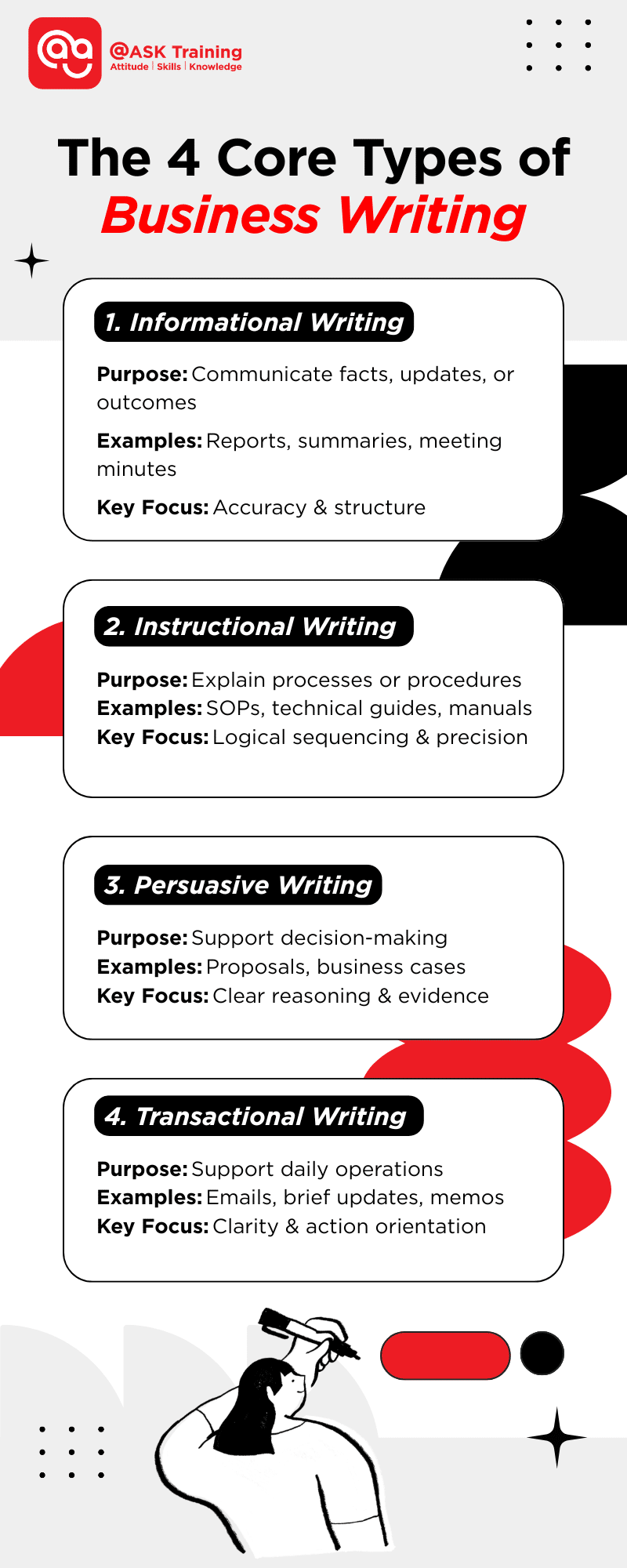
- Informational writing – reporting facts and outcomes clearly
- Instructional writing – guiding processes step by step
- Persuasive writing – supporting decisions with evidence
- Transactional writing – enabling efficient daily communication
Business writing is a learnable skill. With practice and the right guidance, anyone can communicate more effectively at work.
Ready to Formalise and Deepen Your Business Writing Skills?
Explore the WSQ-accredited business writing programmes offered by ASK Training, designed to build confidence and competence in workplace communication, report writing, and technical clarity.
Our WSQ Business Writing courses include:
- WSQ Business Report & Technical Writing Skills
Master the art of structuring professional reports, presenting data, and communicating technical information with clarity — ideal for roles requiring structured documentation. - WSQ Business Writing Essentials: From Emails to Meeting Summaries Build confidence in everyday workplace communication, from writing clear emails to documenting meetings effectively — perfect for enhancing daily productivity and team alignment.
Enrol with us today and write with purpose!
Related Courses
- WSQ Business Writing Essentials: From Emails to Meeting Summaries
- WSQ Business Report & Technical Writing Skills
- WSQ Copywriting & Content Writing
◆◆◆