
Singapore’s workplaces are evolving faster than ever. As digitalisation, hybrid teams, and innovation pressures rise, managers and business owners are asking: how do we inspire people—not just manage them? That’s where transformational leadership comes in.
In simple terms, transformational leadership is about leading with a clear vision, actively developing your people, and encouraging new ideas so your team can perform beyond expectations.
For Singapore teams balancing efficiency, multicultural dynamics, and rapid change, this leadership style offers a way to motivate and retain top talent while maintaining a sharp competitive edge.
In this article, you’ll get a practical guide to transformational leadership tailored for the Singapore context. You’ll learn:
- What it is and how it complements the common Singapore leadership style.
- How it differs from transactional leadership and when to use each.
- How to apply the four key components with clear examples.
- How to lead effectively in multicultural teams.
- How to start practising it this week and measure your impact.
Let’s move beyond theory. Discover how to translate these principles into everyday actions that boost engagement, spark innovation, and make you a more effective leader.
What is Transformational Leadership?
At its core, transformational leadership is the practice of inspiring and empowering people to achieve a shared, ambitious vision. It moves beyond task management and compliance to focus on collective growth, creativity, and a sense of purpose.
A simple definition:
In practice, transformational leadership is about painting a clear picture of where you’re headed, actively coaching your people to get better every day, and encouraging them to try new things. It’s how you get your team to deliver results that surprise even themselves.
This practical definition draws on the foundational work of leadership scholars James MacGregor Burns and Bernard Bass, whose transformational leadership theory remains a cornerstone of modern leadership development.
Adapted for Singapore, it bridges structure and empowerment—a key to thriving in today’s competitive, innovation-driven environment.
Instead of managing by checklists or reacting to issues, transformational leaders define a compelling future and motivate their teams to own it.
Example:
A customer service team lead in a local SME is tired of high stress and slow response times. Instead of handing down a new strict procedure, he tells his team:
“Our goal this year is to become the department other companies are jealous of, where we fix things so fast that customers are genuinely impressed. Let’s figure out how to cut our response time by 30% together.”
He then coaches them to find the bottlenecks and try new solutions. The team feels trusted, owns the problem, and is motivated by the shared mission, not just a KPI.
Now that we know what it is, let’s see how this approach fits with the leadership styles already common in Singapore.
What Leadership Style is Common in Singapore Today?
So, how does this transformational approach fit into the Singapore workplace? To understand that, we need to look at the current leadership landscape.
Traditionally, leadership in Singapore has been shaped by a drive for efficiency and excellence. You’ll still see this foundation in many workplaces, with norms like:
- A focus on clarity and structure: Well-defined roles, clear KPIs, and established procedures.
- Respect for hierarchy: Decisions are often made at the top, reflecting both cultural and organisational values.
- A strong results-orientation: Where performance, precision, and reliability are highly prized.
These traits have helped Singapore thrive in finance, logistics, and technology—but they can sometimes limit innovation and collaboration if not balanced with empowerment.
The Shift Towards Modern, Adaptive Leadership
Today, the leadership landscape is evolving. Research and practical observation show that the most effective leaders in Singapore are now those who can adapt.
While traditional structure remains valued, there is a strong preference for flexible approaches like Situational Leadership (tailoring your style to the individual and task) and Democratic Leadership (soliciting team input to build consensus). Studies have also found people-centric styles like Servant Leadership to be highly effective.
(Source: HR Online)
Modern Singaporean leaders are increasingly described as adaptable, empathetic, and empowering
Why This Shift is Critical: The Skills Gap & New Workforce
This evolution isn’t optional; it’s a response to critical needs. As far back as the mid-2000s, Singapore’s Workforce Development Agency (WDA) identified key skills gaps among local managers: Engagement, Motivation, and Inspiration. These remain the very skills required to navigate today’s economy of constant change and unpredictable markets.
Furthermore, managers now face the challenge of leading Generation Z, a discerning new workforce that expects consultation, empowerment, and meaningful work. A purely top-down, directive approach often fails to engage them.
Transformational leadership directly addresses these gaps and challenges. It provides the framework to develop those critical engagement skills and meet the expectations of a modern, purpose-driven workforce.
Where Transformational Leadership Fits In
The beauty of transformational leadership is that it doesn’t ask you to throw out these effective styles. Instead, it acts as an umbrella that brings them all together.
For instance:
- In compliance-heavy environments (e.g., healthcare, manufacturing, aviation), a transactional approach ensures safety and standards.
- In innovation or change-driven roles (e.g., digital marketing, tech, customer experience), transformational behaviours—like vision-setting and coaching—unlock potential.
The key is balance: Effective Singapore management style blends operational clarity with an inspiring vision, often achieving both stability and adaptability.
The Four Parts of Transformational Leadership
The transformational leadership model—pioneered by James MacGregor Burns and refined by Bernard M. Bass—is built around four core dimensions known as the Four I’s.
These are not abstract concepts but practical levers you can pull to inspire, develop, and elevate your teams. Let’s break down each “I” with a clear definition and a real-world example you can apply:
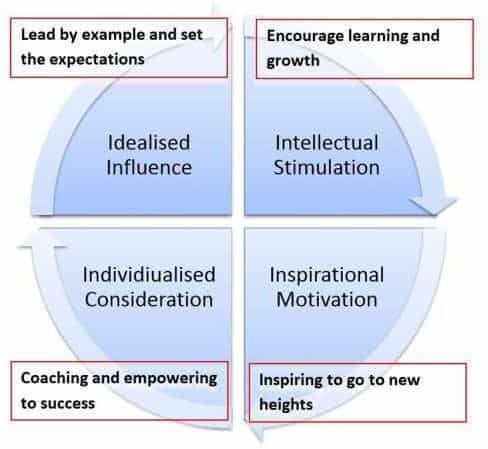
(Source: Research Gate)
1. Idealised Influence – Lead by Example
This is about earning trust and respect through your actions, not just your words. You model the integrity, accountability, and work ethic you expect from everyone else.
What it looks like: Instead of just telling the team that “customer focus” is important, you demonstrate it.
Quick Example: A department head personally joins a critical post-mortem meeting after a service failure. They don’t point fingers, but ask, “What can we learn from this?” This shows the team that accountability starts at the top and that learning is a shared value.
Key Behaviour: Live your values visibly every day.
2. Inspirational Motivation – Connect Daily Work to a Bigger Purpose
People need to know why their work matters. Your job is to paint a vivid, compelling picture of the future that turns routine tasks into meaningful steps toward a shared goal.
What it looks like: You articulate a clear, time-bound vision that creates energy and alignment.
Quick Example: The leader of a Singaporean logistics firm sets an 18-month vision: “To become known for reliability with heart—zero missed shipments and genuinely delighted customers.” They then connect every team meeting and project goal back to this theme, making the vision a daily touchstone.
Key Behaviour: Define a vivid, time-bound vision and repeat it until it shapes everyday decisions.
3. Intellectual Stimulation – Encourage Smart Experiments
Great leaders don’t have all the answers; they unlock the collective intelligence of their team. They challenge old assumptions and create a safe space for smart experimentation.
What it looks like: You actively invite challenges to the status quo and protect the learning that comes from trying new things.
Quick Example: A tech team manager runs a monthly “One Small Bet” challenge. Each team member is encouraged to test one small improvement—like automating a tedious report or tweaking a user interface. The only rule: every bet, win or lose, is reviewed for its learning value.
Key Behaviour: Make curiosity and intelligent risk-taking a celebrated part of performance.
4. Individualised Consideration – Grow Each Person
Recognise that your team members are motivated by different things. Invest time in understanding their unique strengths and aspirations, and tailor your coaching to help them grow.
What it looks like: You move from one-size-fits-all management to personalised development.
Quick Example: A retail operations leader meets with each team member to design a 90-day “stretch project.” For one employee aiming to be a manager, it’s mentoring a new hire. For another with a creative streak, it’s leading a store layout redesign. Regular check-ins then focus on support and progress.
Key Behaviour: Coach for growth—help individuals excel at what they do best and connect it to the team’s success.
Now that you have the toolkit, the key is knowing when to use these transformational techniques versus a more direct, transactional approach.
Transformational vs. Transactional: Which Works Better in Singapore and When?
Understanding the “Four I’s” gives you the tools for transformational leadership. But in the real world, the most effective leaders are pragmatic, not dogmatic. They master both transformational and transactional styles, knowing precisely when to use each for maximum impact.
At its core, the difference is fundamental, as this comparison shows:
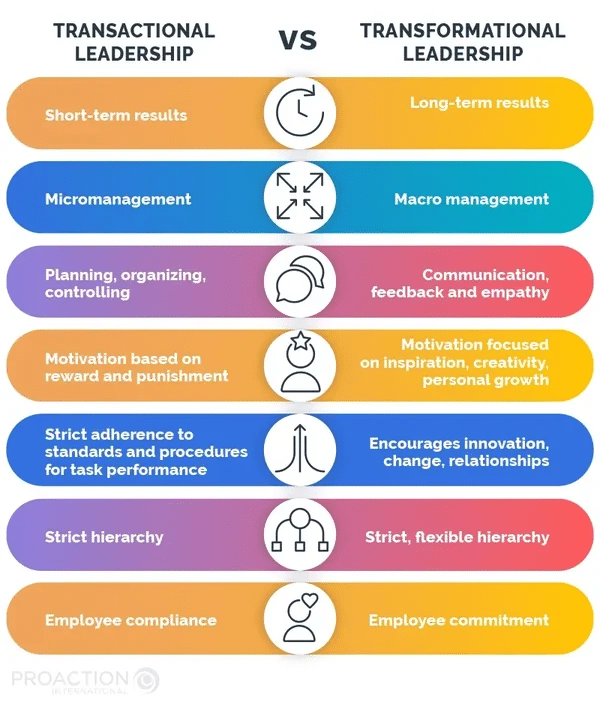
(Source: ProAction International)
As you can see, one style isn’t inherently “better” than the other—they serve different purposes. Transactional leadership is your go-to for stability, precision, and immediate results. Transformational leadership is your engine for long-term growth, adaptation, and building a passionate team.
In the Singapore workplace, where KPIs and collaboration are equally vital, this balance is your key to performance. Think of these styles not as opposites, but as complementary tools.
Use transactional leadership to ensure reliability and precision, while applying transformational leadership to energise your team and unlock innovation.
Example:
In a regulated operations centre, a leader uses strict daily checklists and performance targets (transactional) to guarantee safety and compliance. Simultaneously, they run a monthly “innovation sprint” where the team brainstorms ways to enhance customer satisfaction (transformational). One style maintains standards; the other elevates them.
Here’s a simple guide for when to emphasise each approach:
| Context | Transactional Leadership Works Best When… | Transformational Leadership Works Best When… |
| Operations & compliance | Procedures, safety, and accuracy matter most. | Team engagement or process innovation is needed. |
| Stable environments | Predictability and standardisation drive results. | Change or digital transformation is underway. |
| Early-career teams | Employees need clear direction and structure. | Teams are capable and seek purpose and growth. |
Takeaway:
For most Singaporean teams, the sweet spot isn’t choosing one over the other—it’s combining structure with inspiration. Maintain tight accountability on fundamentals while creating the space for your people to think, grow, and innovate.
The Mindset Shift: From Theory X to Theory Y
To truly blend these styles, leaders must first hold a mirror to their own beliefs. Many managers operate with a Theory X mindset, assuming people are inherently unmotivated and need to be controlled.
Transformational leadership requires a shift to a Theory Y mindset: believing that people are self-motivated and will excel when empowered, trusted, and aligned with a collaborative purpose.
This fundamental belief change is the first step toward effective practice.
What Can We Learn from Famous Transformational Leaders?
Blending leadership styles is the strategy, but seeing how others have applied these principles makes them tangible. While global and local icons operate on a different scale, their core approaches offer powerful, adaptable lessons for any Singaporean leader.
1. Lee Kuan Yew: Vision and Standards in Harmony
Lee Kuan Yew’s leadership blended big-picture vision with disciplined execution—hallmarks of transformational leadership Singapore-style. He articulated a clear national goal of building a developed, corruption-free Singapore, set non-negotiable standards, and empowered capable leaders to deliver results.
Your Modern Takeaway:
Don’t just set a target. Define a 12–24 month outcome, name 2–3 non-negotiable values or standards, and appoint a cross-functional “tiger team” empowered to remove obstacles. This structure keeps the focus high-level while enabling ownership at every level.
2. Satya Nadella: Reigniting a Culture through Curiosity
When Satya Nadella took over Microsoft, he performed a powerful act of intellectual stimulation. He shifted the culture from a “know-it-all” mindset to a “learn-it-all” one, replacing internal competition with empathy and collaboration.
Your Modern Takeaway:
Actively reward curiosity and learning, not just flawless execution. Create forums for knowledge sharing across departments and celebrate “smart failures”—experiments that provided valuable insights, even if they didn’t succeed.
Other Relatable Local Examples
- Anthony Tan (Grab): A regional example of Inspirational Motivation, building a company driven by a vision that combines business performance with tangible social impact.
- Philip Yeo (Former Chairman of EDB): A maverick leader known for challenging top-down bureaucracy to drive Singapore’s industrialisation. His experiences, detailed in his book ‘Neither Civil Nor Servant’, highlight the need for transformational principles like Intellectual Stimulation and empowerment to overcome rigid structures and spark innovation.
Crucial Note:
The goal is not to imitate these leaders blindly. A tactic that works in a flat tech start-up may fail in a structured manufacturing plant. The real skill lies in adapting these transformational principles—vision, empowerment, and people-development—to fit your unique team, industry, and context.
These examples show what’s possible, but to make it real, you need a starting point. The following steps are designed for you to begin implementing this today.
How to Start Practising Transformational Leadership in Singapore
Can you articulate your organisation’s mission in one compelling sentence that would make top talent choose purpose over a paycheck?
Seeing examples from famous leaders is inspiring, but the real magic happens when you translate these ideas into action. Transformational leadership isn’t about a grand title; it’s about a series of small, consistent habits.
You don’t need a big budget or a corporate mandate to start. You can begin this week with these six practical steps. We’ve even included simple templates to make it effortless.
Step 1: Define and Share a Simple Vision
If your team doesn’t know where you’re headed, they can’t help you get there. Start by crystallising your goal.
- Your Action: Draft a clear, 2-3 sentence vision for the next 12 months. Make it specific, time-bound, and focused on the value it creates.
- Example: Instead of “improve client onboarding,” say: “By next June, we will reduce new client onboarding time by 25% while maintaining a 95% customer satisfaction score.”
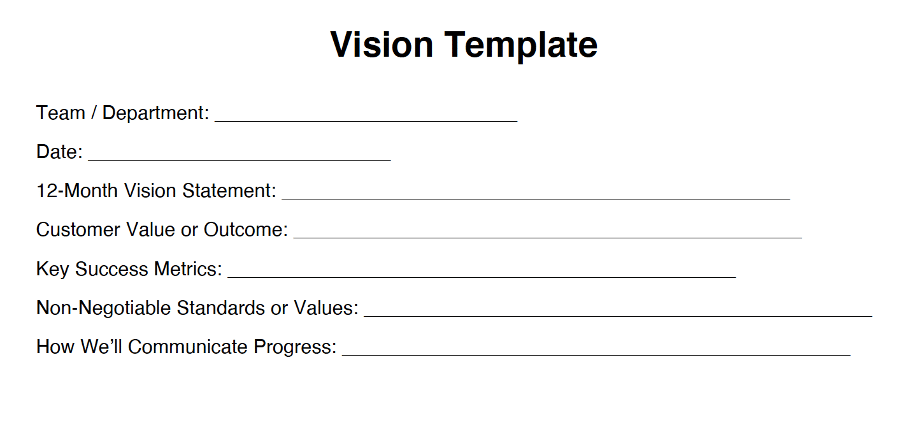
Template in Action: Use the Vision Template to structure your thoughts and ensure it’s comprehensive.
Next Step: Share this vision in your next team meeting. Discuss what success looks like and, crucially, ask them what support or resources they need to achieve it.
Identify Your “A-Player”:
- Beyond their resume, what specific problem is this candidate uniquely passionate about solving?
- How does this connect to your most critical business need?
Step 2: Introduce Two Lightweight Rituals
Culture is built through consistent routines. Introduce these two simple rituals to embed transformation into your team’s rhythm.
Ritual 1: The Weekly ‘Wins & Learnings’ Round
- How: At the start or end of each week, have everyone share one win and one learning.
- Why: It builds reflection and normalises discussing both successes and lessons, not just failures.
Ritual 2: The Monthly ‘One Small Bet’ Challenge
- How: Each month, challenge your team to run one small, low-risk experiment to improve a process or customer outcome.
Example: A retail team tests a new product display for one week to see if it boosts upsells.
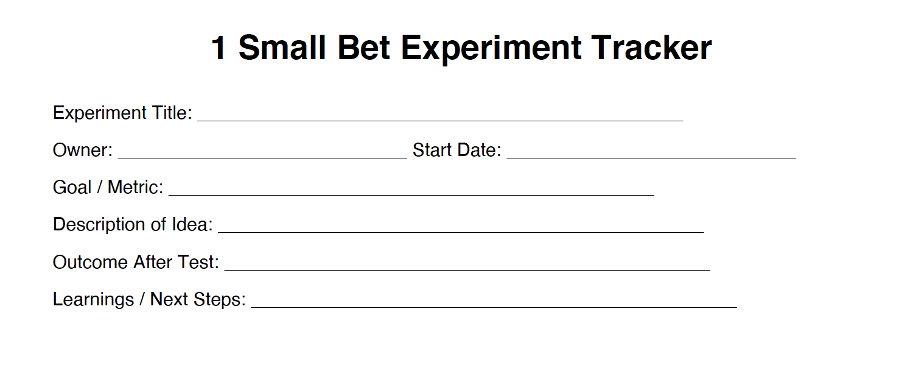
Template in Action: Use the 1 Small Bet Experiment Tracker to give structure to these experiments, document learnings, and decide on next steps.
Step 3: Schedule “Growth Chats”
Move beyond annual reviews. Transformational leaders invest in personalised, forward-looking conversations.
- Your Action: Every quarter, hold a 20-minute one-on-one “Growth Chat” with each team member.
- The Agenda: Focus on three things: one key strength you’ve observed, one stretch goal for the next 90 days, and one specific support you will provide.
- Example: “I’ve noticed your strength in data analysis. Your stretch goal is to lead the next monthly analytics report. I’ll support you by mentoring your presentation skills.“
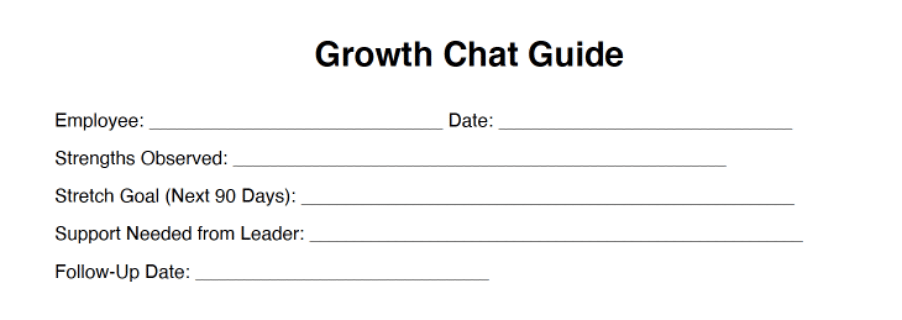
Template in Action: The Growth Chat Guide provides a perfect framework to ensure these conversations are focused and productive.
Step 4: Protect Time for Team Reflection
A learning team is a growing team. Regularly create a dedicated space to look back and improve as a unit.
- Your Action: Hold a 30-minute team retrospective every two weeks.
- The Goal: Identify what’s working and what isn’t, then commit to one concrete improvement.
- Example: A logistics team reviews a delayed shipment, identifies a communication gap, and agrees to implement a new pre-dispatch checklist.
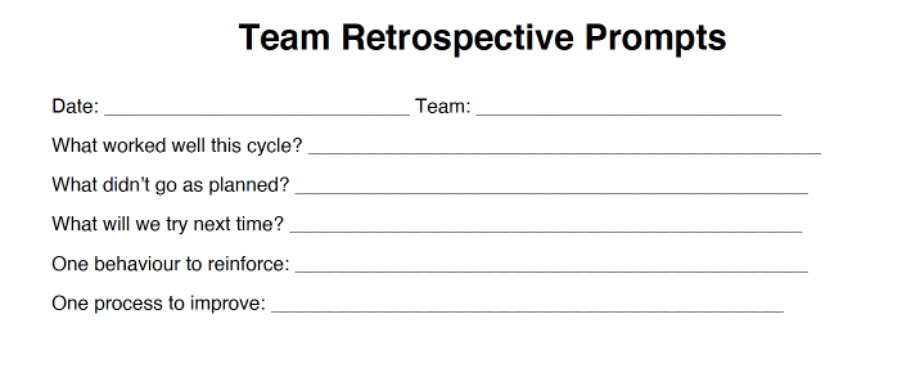
Template in Action: Use the Team Retrospective Prompts sheet to guide the discussion and capture actionable outcomes.
Step 5: Model Curiosity and Accountability
Your team will mirror your behaviour. Show them what a growth mindset looks like in a leader.
- Your Action: Regularly share your own lessons learned, especially when things don’t go to plan.
- Example: Open a team meeting by saying, “Here’s what I would do differently in last week’s client presentation. My key learning was…”
Step 6: Celebrate the Attempt, Not Just the Success
Publicly recognise initiative and intellectual courage. This tells your team that thinking creatively and taking ownership are valued, even if the outcome isn’t perfect.
The Critical Success Factor: Making Time
These steps require more than intent; they require time. Practices like ‘grow each person’, mentoring, and coaching cannot be squeezed into a packed schedule. The transformational leader must actively audit their calendar and organisational practices.
Your Action:
- Review your weekly activities.
- Identify and reduce time spent on low-value routines—excessive report-writing, unproductive meetings, or redundant updates.
- Free up this bandwidth to invest in the high-impact activities that define transformational leadership: engaging with your team, coaching, brainstorming, and fostering knowledge sharing.
- Your most limited resource is time; allocate it like a strategic asset.
These steps require no extra budget or training—just consistency and genuine intent. Over time, you will create a culture where people feel trusted, motivated, and aligned around shared goals.
Here’s a quick recap:
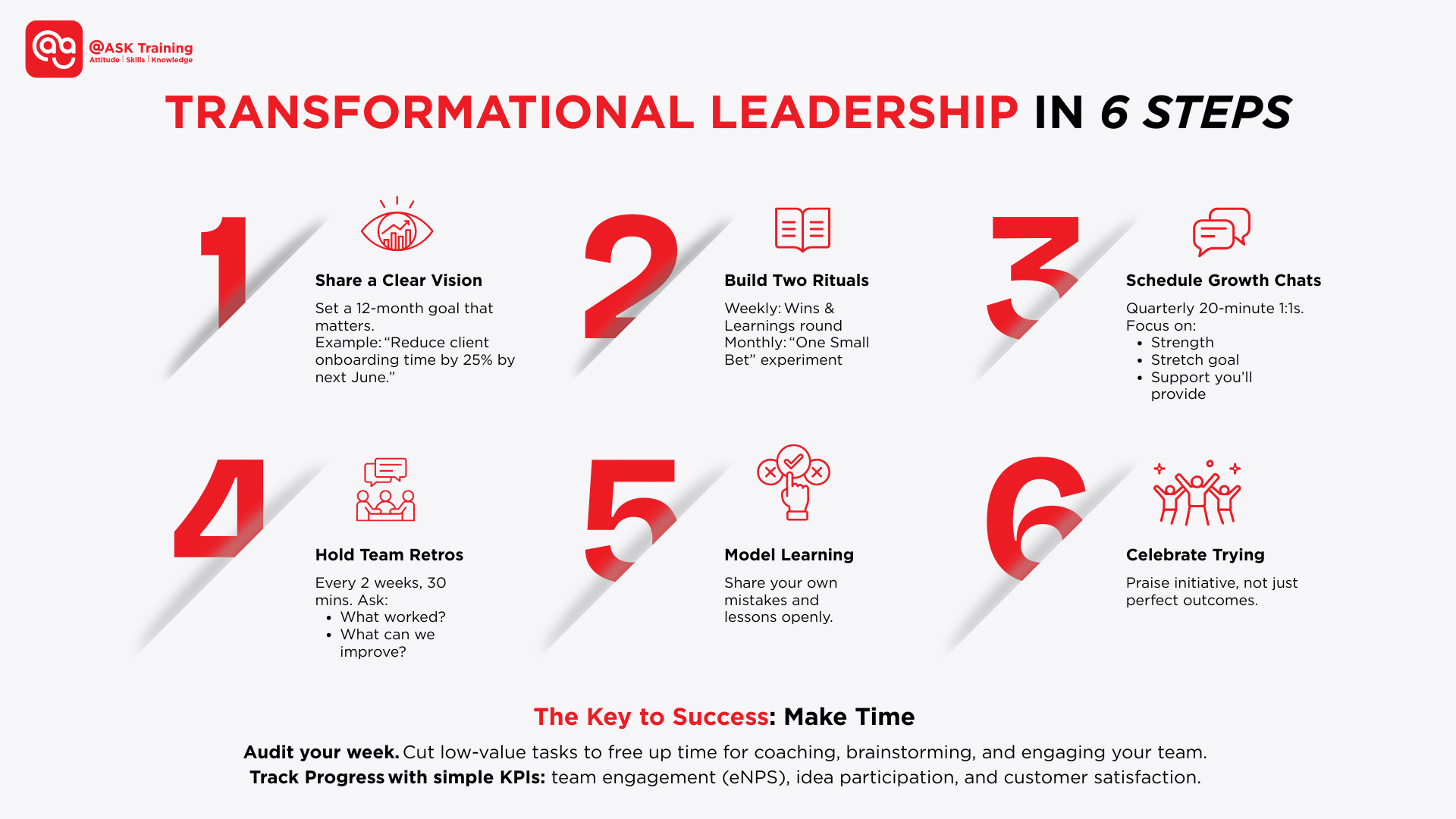
Of course, any new leadership approach needs to show results. So, how do you know if it’s actually working?
How to Tell If It’s Working: Simple KPIs for Teams and SMEs
Implementing new leadership habits is one thing; knowing they’re making a difference is another. The success of transformational leadership often shows up in your team’s energy and behaviour before it hits the bottom line.
The key is to track a mix of human and performance metrics. Here are practical, simple indicators any Singaporean team or SME can use to measure impact.
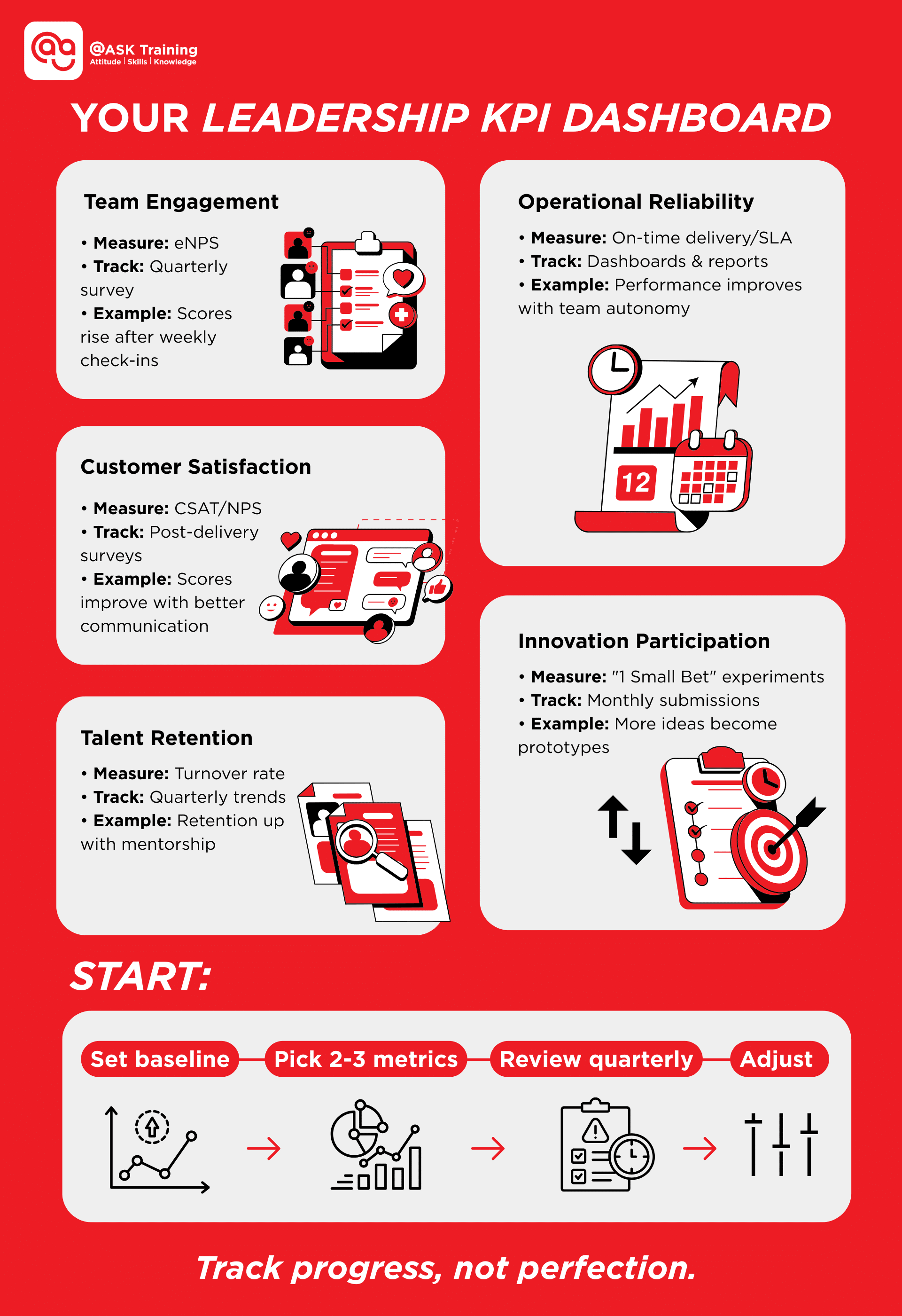
Your Practical KPI Dashboard
Forget complex analytics. Focus on these five categories to get a clear picture.
- Team Engagement
- What to measure: Employee pulse score or eNPS
- How to track: Quarterly survey: “How likely are you to recommend this company as a place to work?”
- Example: A marketing agency saw eNPS rise after starting weekly “wins + learnings” rounds.
- Customer Satisfaction
- What to measure: CSAT or NPS
- How to track: Short post-project or post-delivery surveys
- Example: A logistics SME checked CSAT after a new client communication process reduced delays.
- Talent Retention
- What to measure: Voluntary turnover rate
- How to track: Compare quarterly resignation trends
- Example: A services firm monitored turnover before/after introducing mentorship programs.
- Operational Reliability
- What to measure: On-time delivery or SLA compliance
- How to track: Internal dashboards or client SLA reports
- Example: A manufacturer measured on-time rate after empowering team leads to fix bottlenecks.
- Innovation Participation
- What to measure: Number of “1 Small Bet” experiments launched
- How to track: Monthly submissions or pilot runs
- Example: A software team logged how many ideas moved from proposal to prototype each quarter.
Download this to keep track of your progress:
How to Use These Metrics: A 4-Step System
Collecting data is useless without a process. Follow this simple system to make your KPIs work for you.
1. Establish Your Baseline
Before you make changes, record your current numbers for each chosen metric. You can’t measure progress without a starting point.
2. Mix Leading and Lagging Indicators
Choose 1-2 leading indicators (like eNPS and Innovation Participation) that predict future success, and 1-2 lagging indicators (like Retention and CSAT) that confirm long-term results.
3. Review Quarterly, Not Daily
Avoid micromanaging the data. Schedule a quarterly review to look for trends. Did the small bets lead to a CSAT improvement? Did engagement scores rise after the new rituals?
4. Close the Loop with Your Team
This is the most important step. Share the KPI outcomes in a team meeting. Discuss openly: Based on this data, what should we Continue, Stop, or Start doing? This turns metrics into a shared conversation about growth.
Template in Action
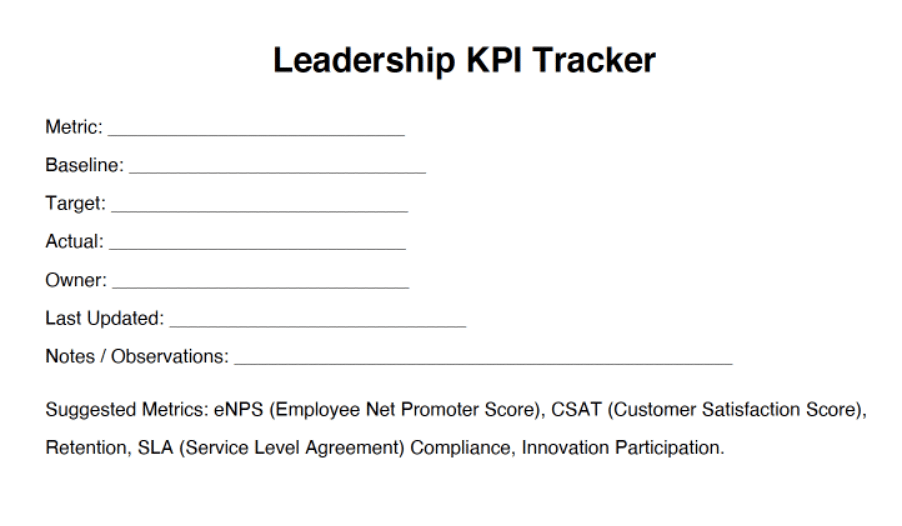
Use the Leadership KPI Tracker to consistently log your chosen metrics, making quarterly reviews fast and data-driven:
The Takeaway:
The goal is progress, not perfection. By tracking both the mindset (engagement) and the output (performance), you demonstrate that leadership is a shared responsibility for growth.
Don’t just discuss what improved—discuss why. This turns cold data into your team’s shared story of success.
Wrapping Up
Navigating Singapore’s competitive landscape requires more than just efficient management—it demands leadership that inspires.
As we’ve explored, transformational leadership in Singapore isn’t about discarding our strengths of structure and discipline. It’s about enhancing them. It’s the powerful blend of clarity with vision, discipline with experimentation, and respect with empowerment.
This approach is your strategic advantage in a world where talent retention, innovation, and adaptability define success. By embracing the four “I’s”—Idealised Influence, Inspirational Motivation, Intellectual Stimulation, and Individualised Consideration—you stop just managing performance and start building a culture that drives it.
The path forward is simple and starts today. Don’t aim for a complete overhaul overnight.
Your First Steps:
- Define a clear 12-month vision for your team using our simple template.
- Hold one Growth Chat this very week to connect with a team member on a deeper level.
- Launch one “Small Bet” experiment this month to unlock your team’s creative potential.
From there, measure your impact, reflect on what you learn, and refine your approach. This consistent practice will transform not just your team’s output, but its very spirit.
You’ll build more than a high-performing team—you’ll build a resilient, adaptive, and forward-leading workplace that people are proud to be part of.
Ready to Deepen Your Impact as a Leader?
The principles in this article are just the beginning. If you’re ready to build these skills into a lasting leadership capability for yourself or your management team, explore our expert-led programmes.
@ASK Training’s Leadership and Management Courses are specifically designed for the Singapore context, equipping you with practical tools to inspire your team, drive innovation, and achieve outstanding results.
Some of our popular courses include:
- People Centred Leadership – Motivating, Inspiring and Engaging Others
- Persuasive Communication for Leaders
- Effective Supervisory Skills for Management
- Sun Tzu’s Art of War for Modern Leaders
The journey to becoming a transformational leader begins with a single step. Take yours today!
Related Courses
- People Centred Leadership – Motivating, Inspiring and Engaging Others
- Persuasive Communication for Leaders
- Effective Supervisory Skills for Management
- Sun Tzu’s Art of War for Modern Leaders
◆◆◆
Related Articles
Article Topics
- What is Transformational Leadership?
- What Leadership Style is Common in SG Today
- The Four Parts of Transformational Leadership
- Transformational vs Transactional Leadership
- What Can We Learn From Famous Transformational Leaders
- How to Start Practising Transformational Leadership
- How to Tell If It’s Working
- Wrapping Up