
If you’ve ever wondered why some colleagues progress faster despite having similar technical qualifications, the answer often comes down to one thing: soft skills.
In simple terms, soft skills are how you work — they are the behavioural and interpersonal tools you use to communicate, collaborate, and navigate challenges within a professional environment. While your technical skills may get your foot in the door, it’s your soft skills that determine how far you go.
As we look toward 2026, Singapore’s highly competitive and fast-evolving economy has shifted the playing field; employers are placing greater emphasis on soft skills for professionals.
These capabilities are essential not only for effective daily interactions but also for long-term career growth and opportunities to assume leadership roles.
To help you stay ahead, this guide provides a structured soft skills list designed for immediate workplace application, complete with real-world examples and practical guidance tailored for the modern professional.
Before we dive into the specific skills, let's explore exactly what defines these capabilities and why they have become the ultimate career differentiators in the age of AI.
What Are Soft Skills (And Why They Matter in 2026)?
Think of soft skills as your professional "operating system". Unlike technical competencies (hard skills), which are tied to specific job functions, soft skills are the behavioural and interpersonal abilities that dictate how effectively you work with others and manage your tasks.
Because they are transferable across every role and industry, they serve as the foundation of long-term career agility.
As we navigate 2026, in-demand soft skills have shifted from "optional extras" to mechanical necessities for one clear reason: the rise of AI and automation.
While technology can now handle routine technical tasks with ease, it cannot replicate uniquely human traits like nuanced judgment, deep empathy, or complex communication. This makes your "human-centric" capabilities the ultimate safeguard against displacement.
According to SkillsFuture Singapore’s Skills Demand for the Future Economy report, employers increasingly require a combination of technical expertise and Critical Core Skills, such as communication, teamwork, and self-management — especially in PMET roles.
In short, your career leverage in 2026 depends less on what you know and more on how you apply that knowledge in real-world, high-stakes situations.
To help you build this competitive edge, we have categorised the most essential workplace soft skills into a structured list, covering everything from emotional intelligence to critical thinking.
Let’s start by breaking down the skill that underpins every successful interaction: effective communication.
Communication Skills
Strong communication is the foundation of almost every professional role. It directly affects how clearly your ideas are understood, how efficiently work gets done, and how others perceive your professionalism.
In 2026, communication goes beyond simply “speaking well.” They involve structuring your thoughts logically, selecting the right tone for your audience, and ensuring your message achieves the intended outcome.
In Singapore’s unique multicultural workplace, where teams are often cross-functional and diverse, high-level communication is a mechanical necessity. Even minor miscommunications can cause delays, errors, or unnecessary friction.
"The most important thing in communication is hearing what isn’t said." - Peter Drucker (Management Consultant)
Practical soft skills examples include:
- Draft clear, concise emails: Summarise key decisions, next steps, and deadlines immediately. Avoid long, ambiguous messages that create "inbox fatigue" and confusion.
- Present ideas confidently: When giving project updates, highlight outcomes and risks upfront. This demonstrates executive presence and respects your colleagues' time.
- Practice active listening: During discussions, paraphrase a colleague’s point to ensure alignment. For example: "Just to confirm, are you suggesting we shift the timeline to next Friday to accommodate the vendor's delay?"
- Adapt to your audience: Switch styles seamlessly, be concise and strategic with senior management, while providing more detailed coaching and guidance to junior team members.
- Navigate multicultural nuances: In Singapore’s diverse offices, remain mindful of different communication styles, from direct feedback to more indirect, high-context approaches.
Mastering these interactions builds immediate credibility and reduces workplace friction.
However, clear communication is only half the battle; the other half is managing the human emotions behind those interactions.
Emotional Intelligence and Relationship Management
While technical competence may get tasks done, Emotional Intelligence (EI) determines how smoothly work gets done with others.
EI involves recognising and managing your own emotions, understanding others’ feelings, and navigating interpersonal dynamics effectively.
In Singapore’s fast-paced and diverse workplaces, strong EI can make the difference between a high-performing team and one plagued by misunderstandings or conflict.
"People will forget what you said, people will forget what you did, but people will never forget how you made them feel." - Maya Angelou
Core Components of EI
- Self-awareness: Recognising how your stress or emotions influence your decision-making and team interactions.
- Empathy: Understanding a colleague’s perspective, especially in multicultural teams where expectations and professional backgrounds vary widely.
- Conflict Management: Resolving disagreements constructively to keep projects on track without damaging relationships.
Practical emotional intelligence examples include:
- Resolving misunderstandings calmly: Instead of reacting defensively, you acknowledge the other person’s concerns and suggest a compromise that keeps the project on track.
- Managing difficult conversations: Provide constructive feedback on missed deadlines by remaining supportive and focusing on future growth rather than past blame.
- Recognising when a team member is overwhelmed: Offering help or adjusting workload distribution before the situation affects overall team performance.
- Adapting your communication style across cultures: In Singapore’s multicultural offices, being mindful of different approaches to hierarchy and indirect communication can prevent friction.
- Supporting team morale during high-pressure periods: Celebrating small wins or checking in on colleagues during peak project cycles demonstrates empathy and strengthens relationships.
Strong emotional intelligence not only improves teamwork but also signals leadership potential. Managers notice professionals who handle complex interpersonal dynamics with grace, positioning them for future promotion.
Of course, maintaining this level of composure and clarity requires more than just empathy; it requires the ability to manage your most limited resource: time.
Adaptability and Resilience
Change is the only constant in today’s workplace. Whether it is a sudden shift in market trends or the integration of new AI tools, the ability to stay productive under pressure is a top-tier professional skill.
For Singapore professionals, particularly in fast-moving sectors such as fintech, logistics, and healthcare, resilience at workplace and adaptability are among the in-demand soft skills employers will actively seek in 2026.
Adaptability is your ability to pivot quickly when workflows or team structures change, while resilience is the mental toughness required to maintain a positive, effective mindset during periods of high stress.
Together, these skills enable professionals to thrive in dynamic environments rather than merely survive.
"It is not the strongest of the species that survive, nor the most intelligent, but the one most responsive to change." - Charles Darwin
Practical Soft Skills Examples
1. Handling organisational restructuring positively
When a company undergoes team realignment, an adaptable employee quickly learns new reporting lines, understands revised responsibilities, and maintains collaboration with new colleagues.
2. Managing high-pressure deadlines
For example, a project manager facing unexpected last-minute client changes will quickly reprioritise tasks, reallocate resources, and maintain team motivation to meet the revised schedule.
3. Rapidly learningnew technology
A marketing executive who adapts to AI-driven analytics tools or updated digital platforms demonstrates both flexibility and initiative, maintaining performance without disruption.
4. Maintainingcomposure during a crisis
During a supply chain disruption, an operations officer communicates calmly with vendors and colleagues, finds alternative solutions, and keeps stakeholders updated without panic.
5. Commit to continuous upskilling
Taking a SkillsFuture-supported course to acquire new capabilities in response to changing industry standards shows proactive adaptability.
Cultivating these skills turns "disruption" into "opportunity."
However, staying resilient over the long term is only possible if you have a system to manage your daily output and energy effectively.
Time Management and Personal Productivity
In Singapore’s "always-on" professional culture, it is easy to mistake being busy for being productive. To sustain high performance in 2026 without hitting a wall, you must master time management skills that prioritise impact over activity.
Effective time management involves more than just a calendar; it requires strategic prioritisation, focus management, and realistic goal setting.
When you master your personal productivity, you deliver consistent results while protecting your work-life balance, the key to a sustainable and successful career.
"The key is not to prioritise what’s on your schedule, but to schedule your priorities." - Stephen Covey (Author, The 7 Habits of Highly Effective People)
Practical Productivity Examples
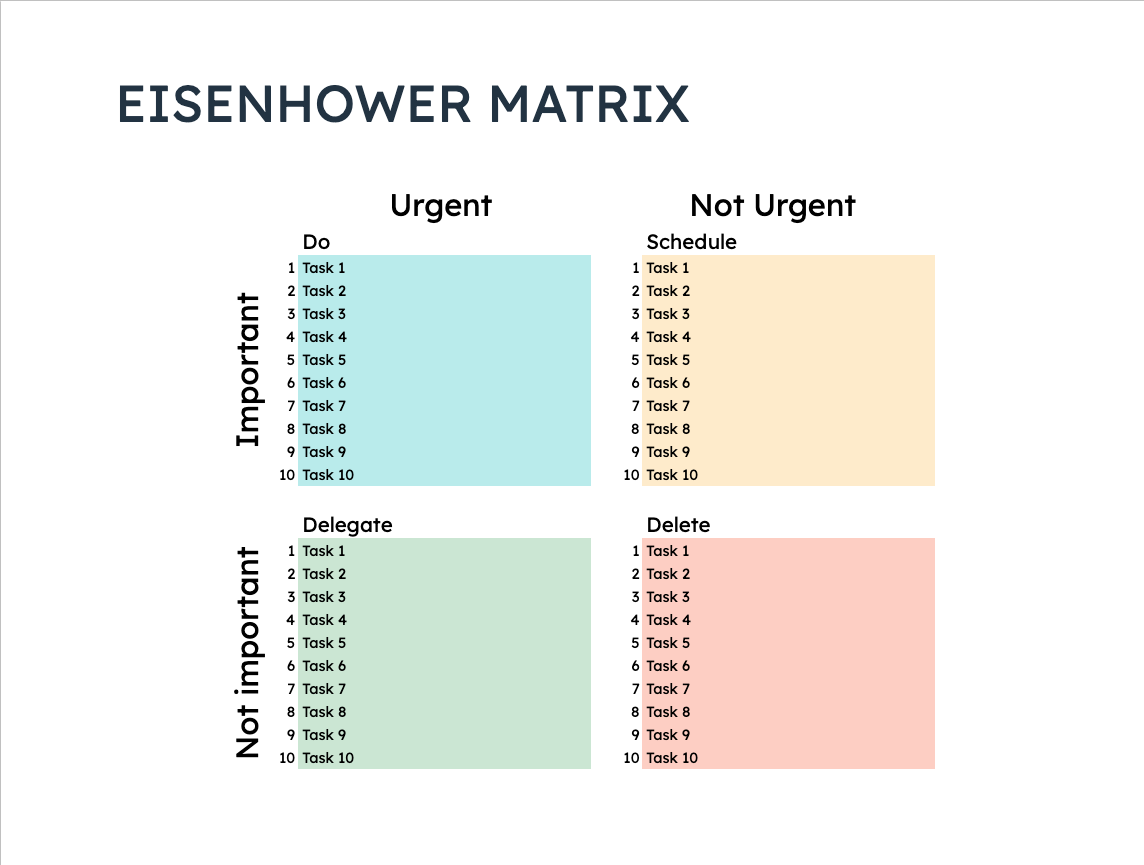
1. Prioritise High-Impact Tasks
(Source: HubSpot)
- Use frameworks like the Eisenhower Matrix to identify which tasks drive the most business value.
- Address "urgent and important" items first, rather than clearing easy, low-value emails.
2. ExecuteDeep Work Blocks
- Manage multiple projects without burnout by structuring your day into focused blocks.
- Dedicate 90-minute windows to complex tasks, turning off notifications to maintain absolute focus.
3. SetAnd Track Measurable Goals
- Move beyond a simple "to-do" list.
- Set weekly targets for your key deliverables and review your progress every Friday to adjust your plan for the coming week.
4. LeverageDigital Tools For Coordination
- Use project management platforms and task trackers to sync with your team, such as Trello, Monday.com, and many more.
- This reduces the need for "status update" meetings and keeps everyone aligned.
5. ProtectYour Sustainable Productivity
- Know when to block off time for focused individual work versus collaborative meetings.
- Ensuring you meet deadlines within office hours is a skill that prevents long-term exhaustion.
By refining your productivity, you signal to management that you are reliable, organised, and ready for greater responsibility.
This internal discipline provides the foundation you need to eventually step up and lead others.
Leadership and Influence
In 2026, Leadership today is no longer limited to formal job titles. Organisations in Singapore increasingly look for "everyday leaders", professionals who demonstrate initiative, decisive thinking, and the ability to influence others regardless of their rank.
Mastering leadership soft skills is one of the fastest ways to signal your readiness for promotion and expanded responsibilities.
Leadership is about taking ownership and motivating colleagues toward a shared goal, while influence is the art of gaining buy-in and aligning diverse stakeholders without relying on formal power.
"If your actions inspire others to dream more, learn more, do more, and become more, you are a leader." - John Quincy Adams (6th US President)
Practical Soft Skills Examples
1. Lead Project Discussions Proactively
- Even without a managerial title, take the initiative to coordinate tasks and facilitate consensus.
- Stepping up to clarify responsibilities during a meeting marks you as a high-potential contributor.
2. Influence Without Authority
- Instead of issuing directives, persuade colleagues to adopt a new workflow by presenting data-backed benefits.
- Showing how a change helps the team succeed is the hallmark of an influential professional.
3. MakeDecisions Under Uncertainty
- When faced with a client dilemma, don't just wait for instructions.
- Gather the available insights, weigh the pros and cons, and present a confident recommendation to your supervisor.
4. Mentor And Support Peers
- Share your expertise to help a junior teammate overcome a bottleneck.
- This "servant leadership" approach is highly valued by management when identifying future team leads.
5. Drive Cross-Department Collaboration
- Take the lead in aligning priorities between marketing and sales for a product launch.
- Resolving these inter-departmental frictions proactively demonstrates "big picture" thinking.
By consistently exercising influence, you increase your visibility with senior management and position yourself as a dependable anchor for strategic initiatives.
Of course, leading effectively also requires the ability to deconstruct complex hurdles through logical analysis.
Critical Thinking and Problem-Solving
Employers increasingly value professionals who can think independently, analyse complex situations, and propose effective solutions, rather than simply following instructions.
In Singapore’s key sectors, from finance and tech to healthcare, the ability to objectively analyse a situation and identify a "Plan B" is a vital career differentiator
Strong critical thinking involves identifying root causes and evaluating alternatives before taking action. It shifts your mindset from "What is the problem?" to "What is the most effective way to solve this?"
"We cannot solve our problems with the same thinking we used when we created them." - Albert Einstein
Practical Soft Skills Example
- Propose process improvements: Instead of escalating a recurring delay to your manager, analyse the workflow, identify the specific bottleneck, and present a revised process that saves time.
- Evaluate solutions under pressure: When a marketing analyst needs to choose between two campaign strategies, they should quickly review past data, assess potential risks, and recommend the path with the highest ROI.
- Anticipate risks before they happen: During an IT deployment, don't wait for a crash. Proactively suggest pre-emptive testing and backup plans to ensure zero downtime for the client.
- Apply data-driven reasoning: Use financial models or performance metrics to justify your suggestions. This moves the conversation from "opinion" to "evidence," making your contributions more authoritative.
- Encourage collaborative solving: In cross-functional projects, synthesise perspectives from different departments to ensure your proposed solution is practical for everyone involved.
Professionals who demonstrate strong critical thinking and problem-solving skills are often seen as reliable decision-makers and innovative contributors — qualities that accelerate career progression and increase their value to Singapore employers.
This independent thinking is especially crucial when navigating the diverse social fabric of the modern office.
Cultural Awareness and Workplace Professionalism
Singapore’s workforce is one of the most diverse in the world, with employees from multiple cultural, ethnic, and educational backgrounds working side by side.
To succeed here in 2026, you must pair your technical and analytical skills with a high degree of cultural awareness and workplace professionalism. These skills allow you to build trust, prevent misunderstandings, and maintain a credible "professional brand."
Cultural awareness is the ability to respect differences in communication styles and work habits, while professionalism encompasses your accountability, etiquette, and the consistent presence you bring to the office.
"We all should know that diversity makes for a rich tapestry, and we must understand that all the threads of the tapestry are equal in value, no matter their colour." - Maya Angelou
Practical Soft Skills Example
1. RespectDiverse Communication Styles
- In our multicultural offices, be mindful of "high-context" communication.
- Some colleagues may express disagreement gently to maintain harmony; actively listen for these subtle cues to ensure everyone is truly aligned.
2. DemonstrateImpeccable Etiquette
- Arriving on time for meetings and responding to emails promptly are more than just "manners".
- They are signals of reliability and respect for your colleagues' time.
3. MaintainA Polished Professional Presence
- Project confidence through your body language and use courteous, inclusive language.
- This enhances your personal credibility with both clients and senior stakeholders.
4. Navigate HierarchyWithGrace
- Understand different approaches to authority and decision-making within diverse teams.
- Adapting your style to match the cultural context of a meeting helps build faster cooperation.
5. Promote An Inclusive Environment
- Actively encourage contributions from quieter team members and acknowledge different perspectives.
- This strengthens team cohesion and fosters a culture of psychological safety.
Professionals who demonstrate strong cultural awareness and workplace professionalism are more likely to be trusted, respected, and considered for leadership opportunities.
In Singapore’s corporate sector, applying these skills effectively also improves daily interactions and reinforces your professional presence.
Now that we've identified the "what," the final step is understanding the "how", the practical steps to actually building these skills.
How to Develop These Soft Skills in 2026
Soft skills aren’t something you pick up passively — they require intentional practice, real-world application, and continual learning.
As the World Economic Forum’s Future of Jobs Report 2025 highlights, changing job demands are driving employers to invest heavily in workforce training, with 85 % of companies planning to prioritise upskilling their workforce and 70 % expecting to hire staff with new skills by 2030.
This makes proactive development a necessity rather than an option. In Singapore’s context, the most effective way to bridge the gap between "knowing" and "doing" is through structured, interactive learning.
Here is how you can effectively build your soft skills training in Singapore roadmap:
Structured Training and Skills Workshops
Attending formal courses or workshops, particularly those focused on communication, leadership, critical thinking, and collaboration, helps you practise soft skills in guided scenarios.
These programmes often include role-playing, group exercises, and feedback, which are more effective than self-study alone.
- Look for SkillsFuture-supported programmes on topics such as interpersonal communication, conflict management, and leadership foundations.
- Corporate training sessions or industry seminars often include modules on teamwork, emotional intelligence, and change management — all geared toward real workplace scenarios.
On-the-Job Practice
Soft skills improve fastest when you apply them regularly in your daily work:
- Volunteer to lead meetings or project briefings to strengthen presentation and facilitation skills.
- Take the initiative to mentor or support colleagues, building empathy and leadership capabilities.
- Use every feedback cycle (e.g., performance reviews) as a chance to refine behaviours like active listening, resilience, and adaptability.
Cross-Functional Projects and Collaboration
Working beyond your immediate team exposes you to diverse perspectives and work styles, which accelerates cultural awareness, teamwork, and problem-solving.
- Join cross-department task forces or interest groups within your organisation.
- Participate in inter-company collaborations where you can practise negotiation, influence, and multi-stakeholder coordination.
Coaching and Mentorship
Pairing up with a mentor or coach, formally through an organisation’s scheme or informally with a senior colleague, gives personalised guidance on interpersonal skills.
- A mentor can help you identify blind spots in workplace behaviours and suggest tailored strategies for growth.
- Regular check-ins encourage accountability as you work on skills like conflict management, resilience, or leadership presence.
Continuous Learning Culture
Make skill-building part of your long-term career practice. Set specific goals — for example, improving active listening or leading a workshop within six months — and map out steps to get there. Reflecting on successes and challenges deepens your ability to adapt and grow.
The Future of Jobs Report 2025 also notes that nearly 40 % of skills required on the job are expected to change by 2030, making lifelong learning and periodic reskilling essential.
By combining structured training, intentional practice, collaborative experiences, and mentorship, you not only sharpen your existing soft skills but also signal to employers that you’re proactive, a quality highly valued in Singapore’s shifting employment landscape.
Soft Skills Self-Assessment Checklist
Before you begin your training journey, it is essential to baseline your current capabilities.
Use this checklist to reflect on your strengths and identify where you can improve over the next six months.
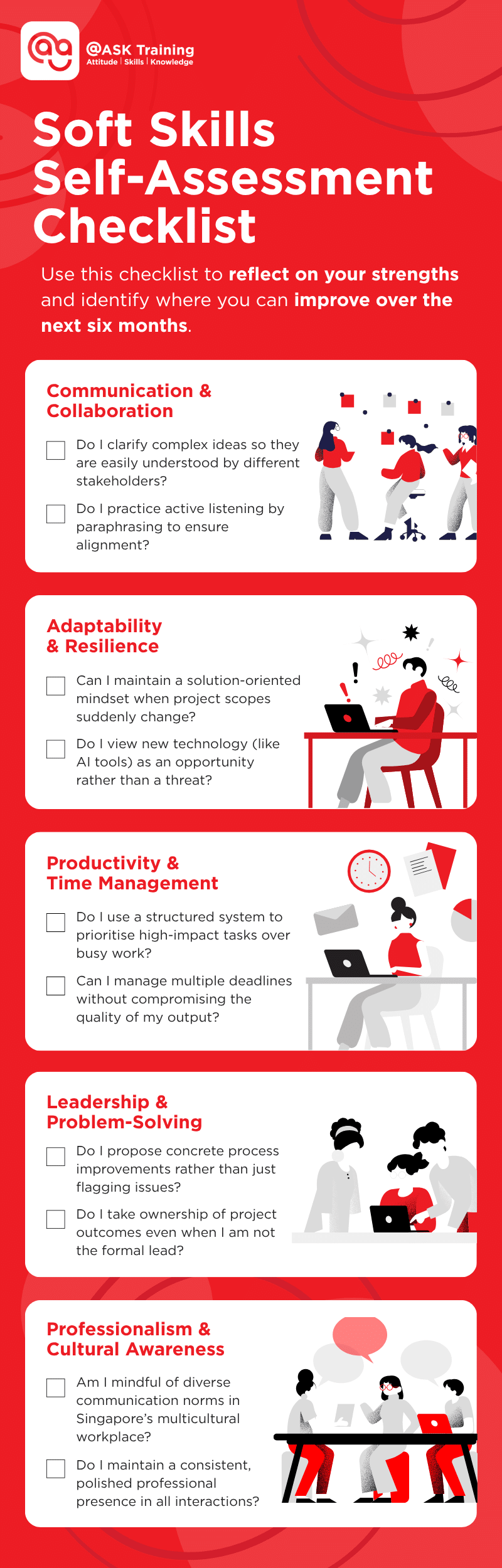
Your Next Step: Identify one skill from the list above. Dedicate the next six months to improving it through a combination of a structured workshop and on-the-job application.
Track progress through workshops, on-the-job practice, and mentorship opportunities to ensure measurable growth.
Wrapping Up
As we’re well into 2026, the divide between technical proficiency and professional success is growing. While your technical "hard skills" are essential for securing an interview, your workplace soft skills are what will sustain your career and drive your promotions.
In Singapore's fast-evolving economy, staying competitive requires a commitment to continuous growth. By being proactive, starting with self-awareness and reinforcing it through structured learning, you ensure that you remain an indispensable asset to any team.
Remember: your technical skills may open doors, but your soft skills determine how far you go once you’re inside.
Ready to Level Up Your Professional Edge?
Whether you are looking to refine your personal effectiveness or step into a high-impact leadership role, structured training is the fastest way to turn theory into habit.
Explore our curated suites designed for the 2026 workplace:
- Leadership and Management Courses: Transition from a functional expert to a strategic leader. Master the art of influence, conflict resolution, and high-performance team building.
- Personal Development Courses: Sharpen your daily output with courses such as Speaking and Presenting with Confidence and Master Your Message with Powerful Body Language.
For Organisations: Future-Proof Your Workforce
If you are an HR manager or business leader, you know that a high-performing team is built on more than just technical expertise; it’s built on a foundation of strong workplace soft skills.
In an era of rapid digital transformation, identifying the specific skill gaps within your team is the first step toward sustainable growth. We offer a comprehensive Corporate Training Needs Analysis (TNA) to help you:
- Identify critical skill gaps within your departments.
- Align training programmes with your 2026 business objectives.
- Maximise your training ROI through a targeted, SkillsFuture-supported curriculum.
Get Your Complimentary Corporate Training Needs Analysis here and let us help you build a resilient, future-ready workforce.
Related Courses
- Enhancing Your Emotional Intelligence: The Key To Effective Leadership
- The Five Behaviours of a Cohesive Team
- Building Personal Resilience and Wellbeing
◆◆◆