
We like to think we’re too sharp to fall for a scam. We see the news stories and think, “How could they send money without checking first?”
But here’s the uncomfortable truth the headlines don’t tell you: scams aren’t clumsy accidents. They are sophisticated, psychologically engineered operations designed to bypass your logic and trigger your instincts.
The message about a missed delivery, the urgent call from “the bank,” or the WhatsApp plea from a “friend” isn’t just annoying, it’s a targeted attempt to hack your trust.
In Singapore, where we are hyper-connected and digitally native, these attempts are now a daily reality. The question isn’t if you’ll encounter one, but whether you’ll have the right habits to spot it before it’s too late.
The numbers tell the story:
- In 2024, Singaporeans lost over S$1.1 billion to 51,501 scams, the highest on record (Source: The Straits Times).
- According to CSA’s Singapore Cyber Landscape 2024/2025 report, phishing cases alone rose 49% to 6,100.
This isn’t about fear. It’s about building a new kind of literacy. In this guide, we’ll move beyond just listing the online scams Singapore faces.
Here’s what we’ll cover:
- Understand the psychology behind why scams work; how they use urgency, authority, fear, and even our kindness to help a friend.
- Recognise the specific tactics used in scam calls, phishing messages, and WhatsApp impersonations that feel so real.
- See how fake job offers and identity theft schemes actually unfold, step by step.
- Learn what changes after a data breach and how to lock down your accounts without stress.
By the end, you’ll have a clear framework to master the modern life skill of “Cyber Hygiene.”
It starts with one simple rule: pause, verify independently, and refuse to act under pressure.
Online Scams Singapore: What’s Happening Right Now (And Why It Works)
Most of us imagine hacking as something technical, lines of code, dark rooms, and breaking through firewalls. But here’s the truth: the most successful online scams Singapore sees every day don’t hack computers. They hack human trust.
Scammers don’t need to break into your account; they can simply convince you to let them in.
They do this through a tactic security experts call the “channel hop” – phone calls leading straight to scam SMS messages – which are surging per the Singapore Police Force’s 2025 brief.
It starts in one place, then moves to another, keeping you off balance. A voice call creates urgency, telling you to expect an SMS scam Singapore-style message. The SMS arrives right on cue, containing a link.
The link opens a page that looks exactly like your bank’s website. By the time you realise something’s wrong, your details are already in their hands.
Prevention Habit
Here’s a simple rule to live by: treat every unexpected message as unverified until you check it yourself.
If someone reaches out, whether through call, SMS, or WhatsApp, don’t use the numbers or links they provide. You’re always in control of how you verify.
This “channel hop” often begins with a phone call, so let’s start there.
#1 Scam Calls Singapore: The Illusion of Authority
Your phone rings. The screen says “DBS Bank” or “Singapore Police Force.” The voice is calm, professional, a little urgent. They mention a compromised account or a suspicious transaction. It feels real because they’ve learned to sound real.
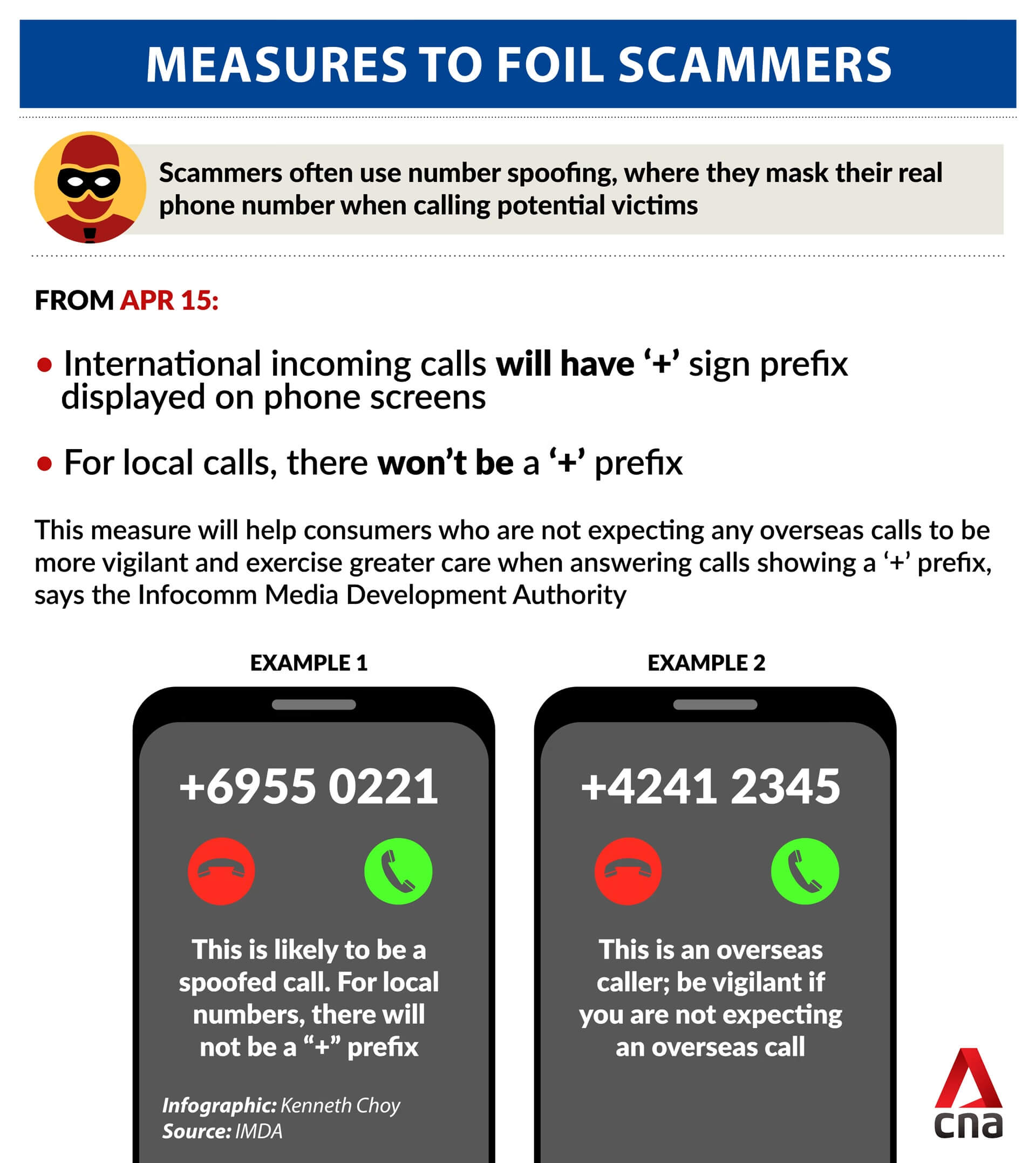
Scam Calls Awareness by IMDA (Source: CNA)
This is the classic scam call that Singapore residents report most often. They use a technique called spoofing, which makes any caller ID display whatever they want it to. That trusted name on your screen? It can be faked in seconds.
Example Script:
“We’ve detected a transfer to an account you don’t recognise. To help us stop it, we just need you to confirm your details and share the verification code sent to your phone.”
That code is the key to your account. The calm voice, the spoofed ID, the mention of your name; it’s all designed to make you comply before your brain catches up. Sometimes they’ll even mention details from past identity theft Singapore cases to sound more convincing.
Prevention Habit
Here’s your hard stop, and it’s beautifully simple: end the call. Just hang up. Then open your banking app, the one already on your phone, and use its secure chat or call the hotline listed inside the app.
A real bank will never ask you to share your one-time password (OTP), full password, or Singpass login details over the phone.
Once you hang up, the scammer’s next move is often a follow-up SMS or email. Let’s look at that next.
#2 Phishing Scams Singapore: The Trap in Your Inbox
You’re expecting a parcel. Right on cue, an SMS arrives: “We missed your delivery. Pay $1.50 to reschedule.” The link looks almost right. The page that loads looks exactly like SingPost’s. It’s quick, easy, and feels completely normal.
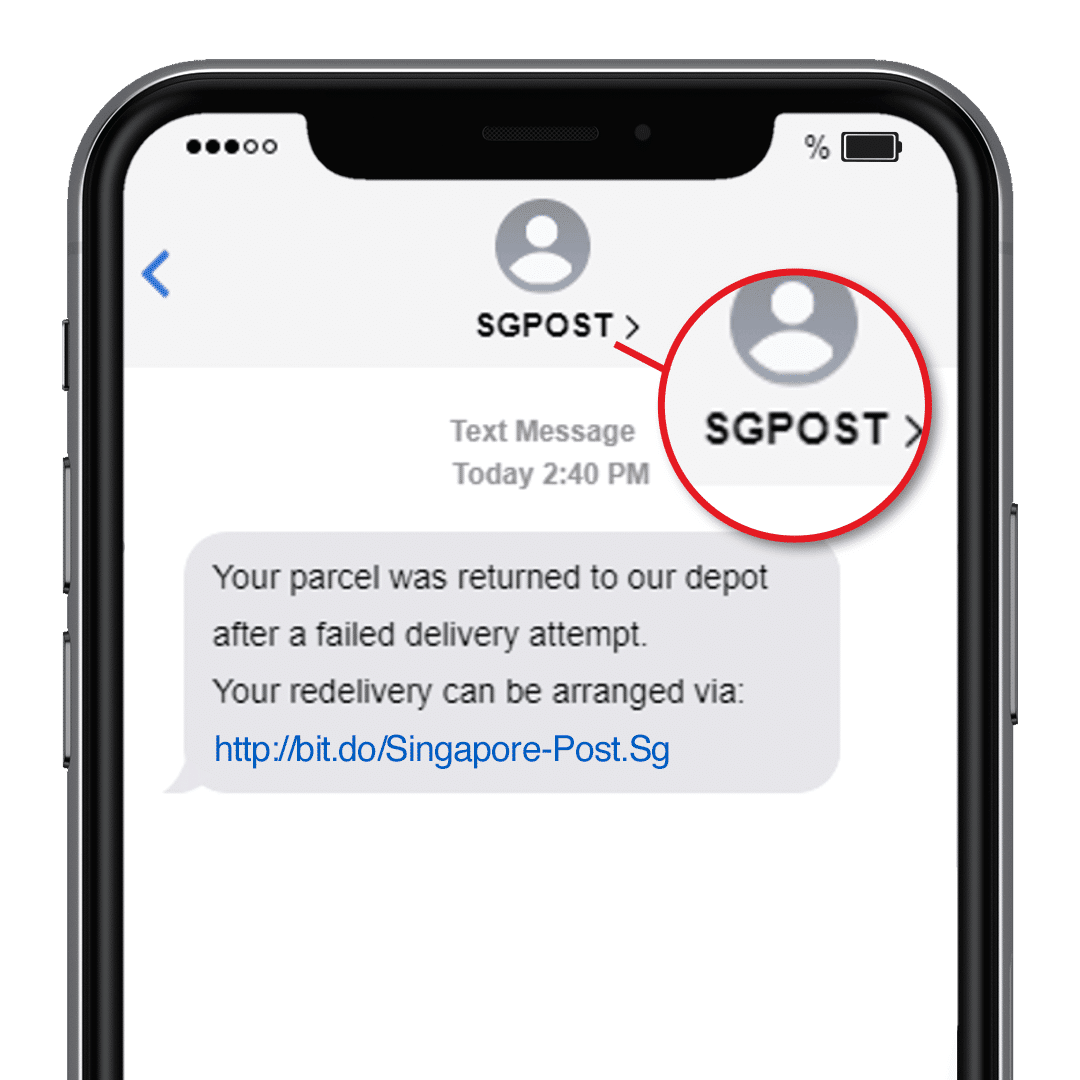
Example of Phishing Scams Impersonating SingPost (Source: Singapore Post)
This is the phishing scams Singapore playbook: a message creates a small problem, a link offers a quick solution, and a fake page quietly steals your details. No drama, no obvious red flags, just a smooth, believable interaction.
These scams are escalating fast. In the first half of 2025 alone, phishing losses hit $30.4 million; a 134% surge from the previous year, landing it among the top three scams of concern (Source: The Straits Times).
Common lures we all see include:
- “Your account will be suspended today.”
- “You have an outstanding bill to settle.”
- “Claim your rewards now before they expire.”
Many arrive as an SMS scam Singapore message, cleverly inserted into your existing message threads through spoofing, so they look like they’re part of a real conversation with SingPost or your bank.
Prevention Habit
Here’s a habit that blocks most phishing attempts instantly: type, don’t tap. If you’re expecting a parcel, manually open the courier’s official app or type their website address into your browser.
Never click a link from an unexpected SMS or email, no matter how convincing it looks.
While these messages cast a wide net, scammers also move into more personal spaces, like WhatsApp, where trust runs deeper.
#3 WhatsApp Scams Singapore: When a Friend Isn’t a Friend
“Hi, I lost my phone. This is my new number. Can you transfer $300 urgently? I’ll explain later.”
This scenario plays out daily. Scammers harvest data or take over accounts to impersonate someone you trust. This is the hallmark of WhatsApp scams in Singapore: they exploit your willingness to help a friend in trouble.
The other common pattern is the vague, emotional link: “Is this you in the video?” or “Please vote for my niece!”
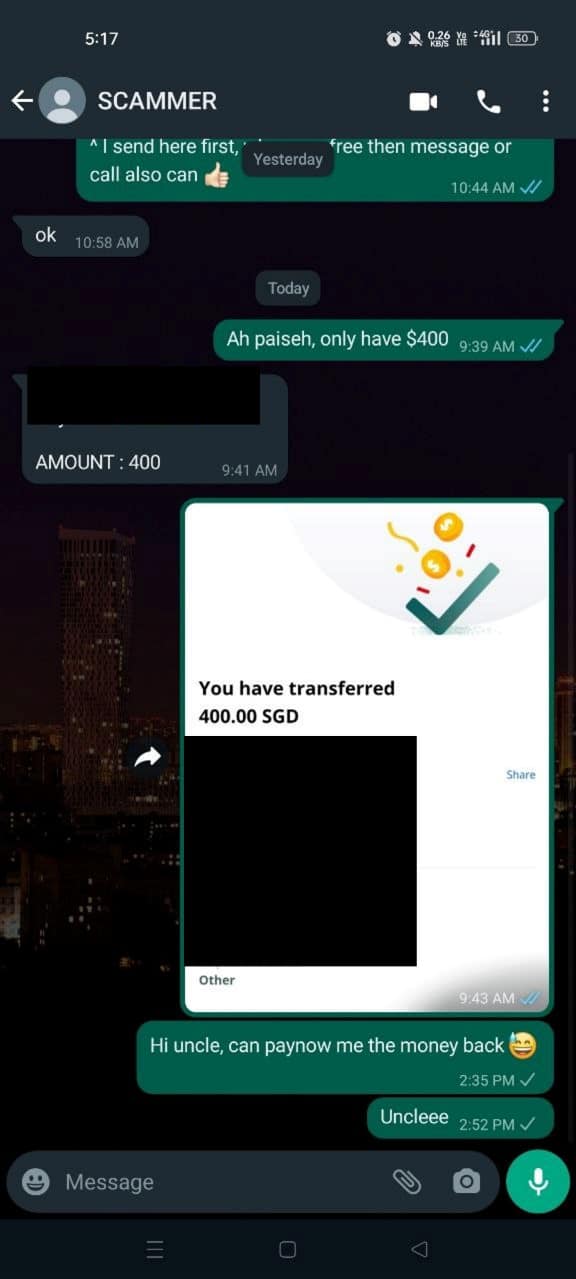
Example of Persistent Scam Involving Fake Friends (Source: Singapore Police Force)
These links lead to fake login pages designed to take over your WhatsApp account, often leading to further identity theft Singapore incidents.
Prevention Habit
Create a “proof question” known only to your real friend. If they can’t answer “What was our inside joke last week?” or send a voice note using a known number, do not send money. If a link creates urgency without context, do not click it.
Just as scammers weaponise your friendships, they are also quick to exploit your financial hopes, which brings us to one of the most financially devastating scams circulating today.
#4 Job Scams Singapore: The Trap of Easy Money
The message sounds like an opportunity: “Rate products and earn $50 a day. Simple tasks, flexible hours.“
It starts easily enough. You make a few dollars, and it feels legitimate. Then, to continue, you’re asked to “top up” a small amount to unlock higher-paying tasks.
This is the classic job scam Singapore trajectory. It starts real to earn your trust, then slowly asks for more until you’re locked out and your money is gone.
These scams share common patterns:
- You need to pay money to start work or withdraw what you’ve earned.
- You’re asked to use your personal bank account to move money for the company.
- There’s no real interview, just rushed onboarding via Telegram or WhatsApp.
Example Pattern: “Just pay a small fee to unlock your commission” becomes “Pay a larger fee to unlock the next tier,” and on it goes until you stop or run out of money.
Prevention Habit
Hold this rule close: any job that asks you to pay money is likely a scam. Full stop. Real employers pay you; they don’t ask you to pay them.
Take a moment to verify the company through official channels, search for their main line, call them, and ask if the recruiter actually works there.
Whether it’s a fake job or a phishing link, all these scams rely on one thing: your personal data. Once they have it, the game changes.
#5 Identity Theft Singapore: When They Know Your Name
When a service you use suffers a breach, your personal details, name, NRIC number, and even your home address can end up for sale online. For scammers, this is gold. They use this data to sound utterly convincing.
Recent incidents show just how serious this has become. In 2025, telco hacks by a group known as UNC3886 exposed massive amounts of customer network data, fuelling a new wave of highly personalised scam calls where scammers already know your NRIC (Source: The Straits Times). In response, Cyber Security Agency of Singapore (CSA) now requires telcos to report such advanced attacks within two hours.
Example: “I can see you live at [Your Address], so you know I’m really from the bank. Just confirm your account number so we can secure it.“
This is identity theft Singapore-style: using fragments of your real life to trick you into handing over more.
It often follows a data breach in Singapore, where massive amounts of information leak at once. Scammers then use that leaked data to make their phishing scams feel personal and real.
Prevention Habit
- Use unique passwords for important accounts. If your shopping site password leaks, it shouldn’t open your email, because your email controls password resets for everything else.
- Treat “I know your details” as a warning sign. It’s not proof they’re legitimate. It’s proof your data has been leaked.
- Turn on Two-Factor Authentication (2FA) for all critical accounts: banking, email, and Singpass. It’s an extra step that stops most account takeovers cold.
#6 Data Breach Singapore: What Changes and What to Do
When news breaks of another data breach in Singapore, it’s easy to feel numb. “Another company, another leak.”
But here’s what actually changes for you when your data ends up in the wrong hands: scams stop being generic and become deeply personal. The online scams Singapore residents face become laser-targeted to you.
Example:
A week after a breach, you receive an SMS scam message with your full name and partial NRIC number, warning you that your account is compromised.
It feels official because it contains your facts. That’s the weaponisation of a data breach.
This same data fuels sophisticated scam call Singapore operations, where the caller already knows your address or your bank, making their “officer” script far more believable.
Prevention Habit
Ignore any “check if you’re affected” message that arrives unexpectedly. Don’t click the link. Go directly to the official source yourself.
- Reset passwords strategically: Start with your email, because it controls password resets for everything else. This limits the damage from any single breach.
- Verify through official channels: Always type the website address yourself. Don’t trust links in messages, even if they use your real name.
Here’s a recap summary of Cybersecurity Threats in Singapore:
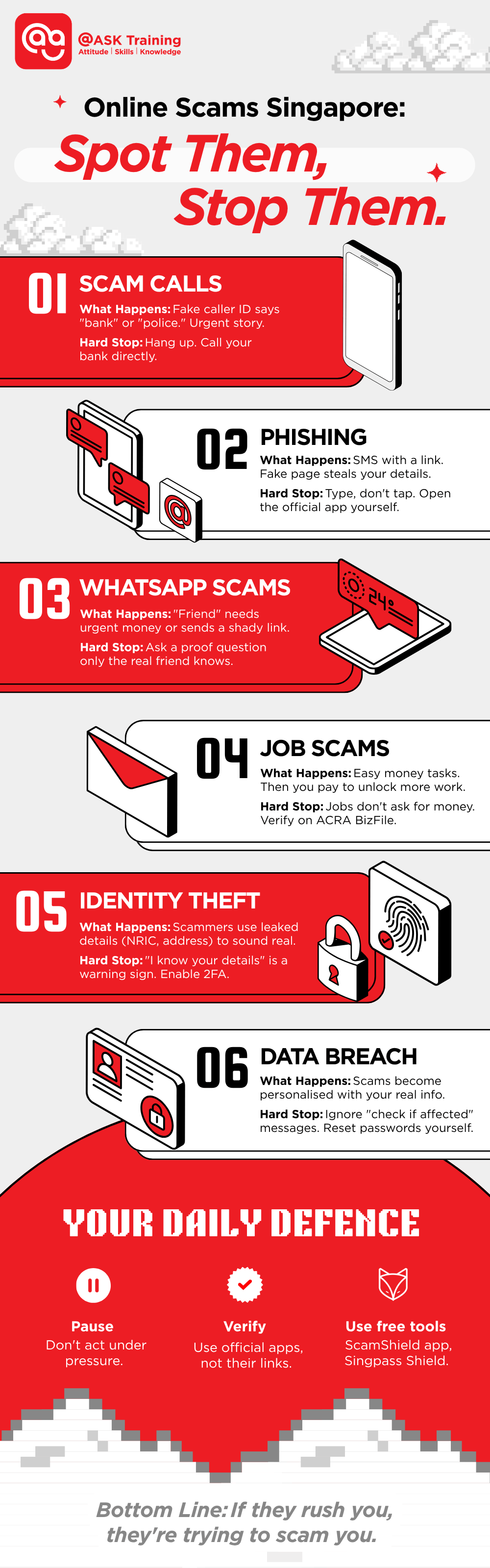
This isn’t about being paranoid, it’s about being prepared. Knowing what to do after a breach is important, but building good daily habits is what truly protects you.
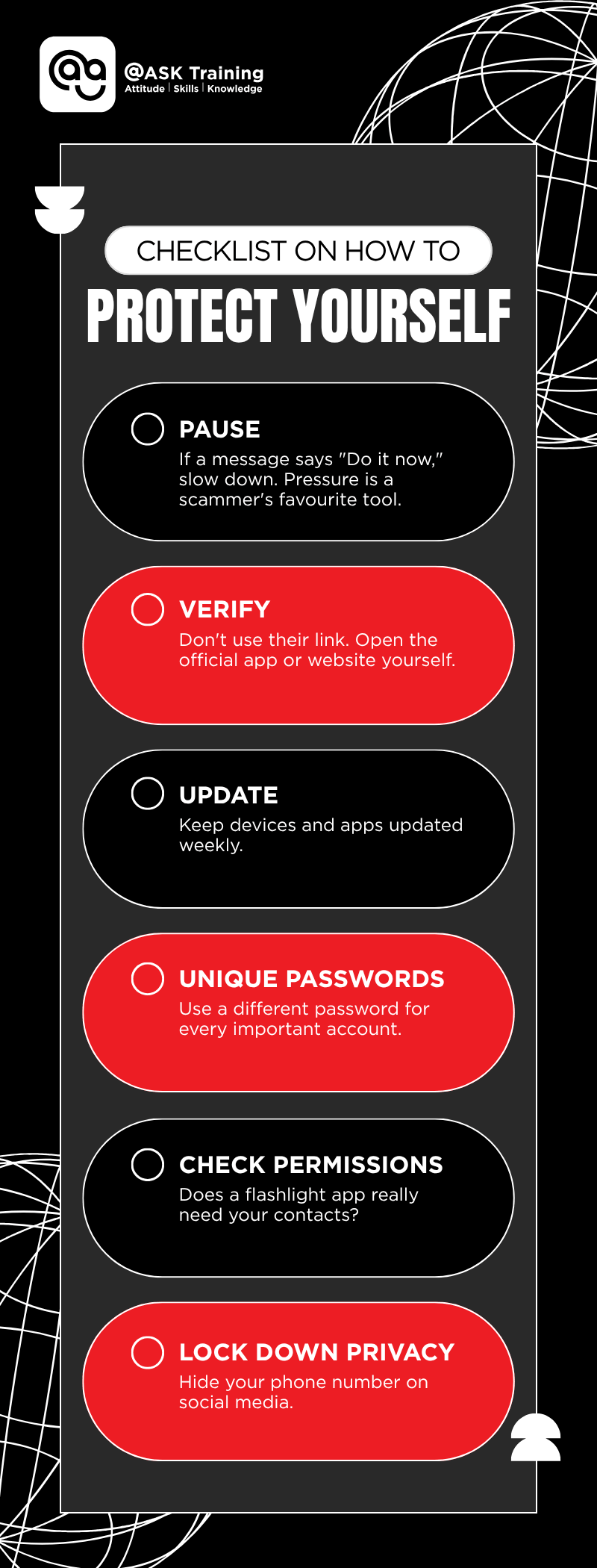
How To Protect Yourself: A Simple Daily Checklist
Protecting yourself doesn’t require tech expertise. It’s about small, consistent habits, think of it as digital hygiene, like brushing your teeth.
- Pause before you act: If a message says “Do it now,” treat that as your cue to slow down. Pressure is a scammer’s favourite tool.
- Verify independently: Don’t use the link they gave you. Open the app or website yourself, the way you always do.
- Keep your digital space tidy:
- Update your devices and apps weekly; those updates fix security gaps.
- Use a password manager to create strong, unique passwords without having to remember them all.
- Review app permissions occasionally. Does a flashlight app really need access to your contacts?
- Tighten privacy settings on social media. Hiding your phone number reduces the risk of identity theft.
Building these habits makes you a harder target. But if something does slip through, knowing where to turn for help is just as important.
Helpful Singapore Resources: Where to Report Scams & Get Support
If you encounter a suspicious call or fall victim to a scam, you’re not alone, and help is available through official channels:
- Singapore Police e-Services: Online scam reports; Anti-Scam Helpline 1799 for immediate guidance
- CSA Alerts: Real-time threats, e.g., recent telco hacks that leak your personal data for targeted scams.
- Singpass Shield: Free 2FA for government services, extra login protection.
- ScamShield App: Blogcks 95% of scam calls/texts automatically; filters WhatsApp and Telegram.
The Bottom Line: From Awareness to Action
From sophisticated scam calls to fake job offers, the pattern is always the same: create urgency, impersonate a trusted source, and push you to act before you think.
Whether it’s a WhatsApp message from a “friend in trouble” or an SMS about a parcel, the defence remains consistent: pause, verify independently, and never let anyone rush you.
Key Takeaways
- Pause. Verify. Refuse. If someone rushes you, they’re trying to scam you. This one habit stops most attacks.
- Caller ID can be faked. Hang up and verify through official channels you find yourself. Need help? Call 1799.
- Type, don’t tap. Never click links in unexpected messages. Manually open apps or websites instead.
- Jobs don’t ask for money. If you pay to work, it’s a scam. Verify employers on ACRA BizFile.
- Use free tools: ScamShield app (blocks 95% of scams) and Singpass Shield for 2FA.
Ready to Go Deeper?
This guide gives you the foundational habits to stay safe. But if you’re ready to move from being a target to being a defender, whether to protect your organisation, advance your career, or simply master the digital world with confidence, formal training is the next step.
At @ASK Training, our industry-relevant Cybersecurity Bundle Courses are designed for real-world impact. Learn from industry veterans, tackle evolving threats like ransomware and AI-powered phishing, and gain certified skills such as:
Stay safe, stay informed, and remember: in a hyper-connected world, the person who pauses is the person who stays secure!
Related Courses
- IT Courses
- Cybersecurity Essentials(offered as a 3-day Modular Course for those seeking focused training)
- Cybersecurity and Ethical Hacking
◆◆◆