
Here is a truth that many corporate hierarchies would rather not acknowledge: the best leaders are rarely the ones who were identified as “high-potentials” in their twenties.
There is a long-held belief in the professional world that leadership development is something best tackled early, ideally in the first few years of a career.
Graduate programmes, fast-track schemes, and early identification of “future leaders” have reinforced this notion, creating the impression that those who do not make the cut early on have somehow missed their window.
It is a compelling narrative. It is also not true.
The reality is that leadership is not a race won in the first lap. It is a deliberate skill set that can be cultivated, refined, and strengthened at any stage of a career.
In fact, mid-career professionals bring something uniquely valuable to the table: years of context, hard-won judgment, and the resilience that comes from navigating real-world complexity.
These are not disadvantages to overcome. They are the raw materials from which exceptional leadership is forged.
This article cuts through the noise to provide a clear, practical guide for those ready to take the next step. You’ll walk away with:
- A structured leadership skills list covering the competencies that matter most
- Practical leadership skills examples drawn from real workplace scenarios
- Immediate, actionable steps to begin strengthening leadership capabilities today
Because for those who have spent years building expertise, the next chapter is about stepping into the leader they were always meant to become.
Why Leadership Skills Matter More in Mid-Career
With that foundation in mind, the understanding that leadership is not about when one starts, but that one starts intentionally, the next question becomes: who does this matter to now, at the mid-career stage, more than at any other point?
The answer lies in the fundamental shift that occurs somewhere between year eight and year twenty of a professional journey.
From Technical Contributor to Strategic Influencer
Early in a career, success is measured by individual output. Meeting deadlines. Mastering technical tools. Executing tasks with precision. The professional who does these things well is valued, rewarded, and often promoted.
But somewhere along the way, the rules change.
Your organisation no longer needs just a skilled doer. It needs someone who can:
- See beyond the immediate task to the broader business context
- Make sound decisions when the path forward is unclear
- Influence outcomes across teams, departments, and stakeholders
This transition is one of the most significant shifts in a professional’s career, and it cannot be navigated without intentional leadership skills development.
What is Now Expected
Expectations evolve as you progress. The professional once celebrated for flawless execution is now expected to:
- Take initiative without waiting for instructions
- Make decisions with incomplete information and own the outcomes
- Influence peers, senior stakeholders, and external partners without relying on formal authority
These responsibilities do not come with a job title. They demand competencies you build, practice, and refine over time.
How Leadership Drives Promotion and Career Growth
Promotion panels rarely debate technical proficiency when evaluating candidates for senior roles. By this stage, they assume it. Instead, they focus on your strategic thinking, influence, judgment, and presence.
Without visible leadership skills at work, even the most technically brilliant professional can find themselves overlooked, watching as peers with less technical depth but stronger leadership presence move ahead.
The Risk of Standing Still
There is another, quieter risk: stagnation. It traps mid-career professionals in a cycle of increasing responsibility without increasing influence.
You take on more work. Manage larger workloads. Yet remain in roles that fail to reflect your experience or ambition.
Leadership skills for mid-career professionals do not represent a nice-to-have. They define the difference between continued growth and an extended plateau.
Core Leadership Skills Every Mid-Career Professional Should Build
Understanding why leadership matters at this stage is essential. But knowing what to build matters just as much,
Leadership is not a single trait. It is a collection of competencies; some you may already possess, others you will need to develop intentionally.
The most effective leaders combine mindset with behaviour, recognising that authority alone never makes a leader.
What follows is a structured leadership skills list to guide your development.
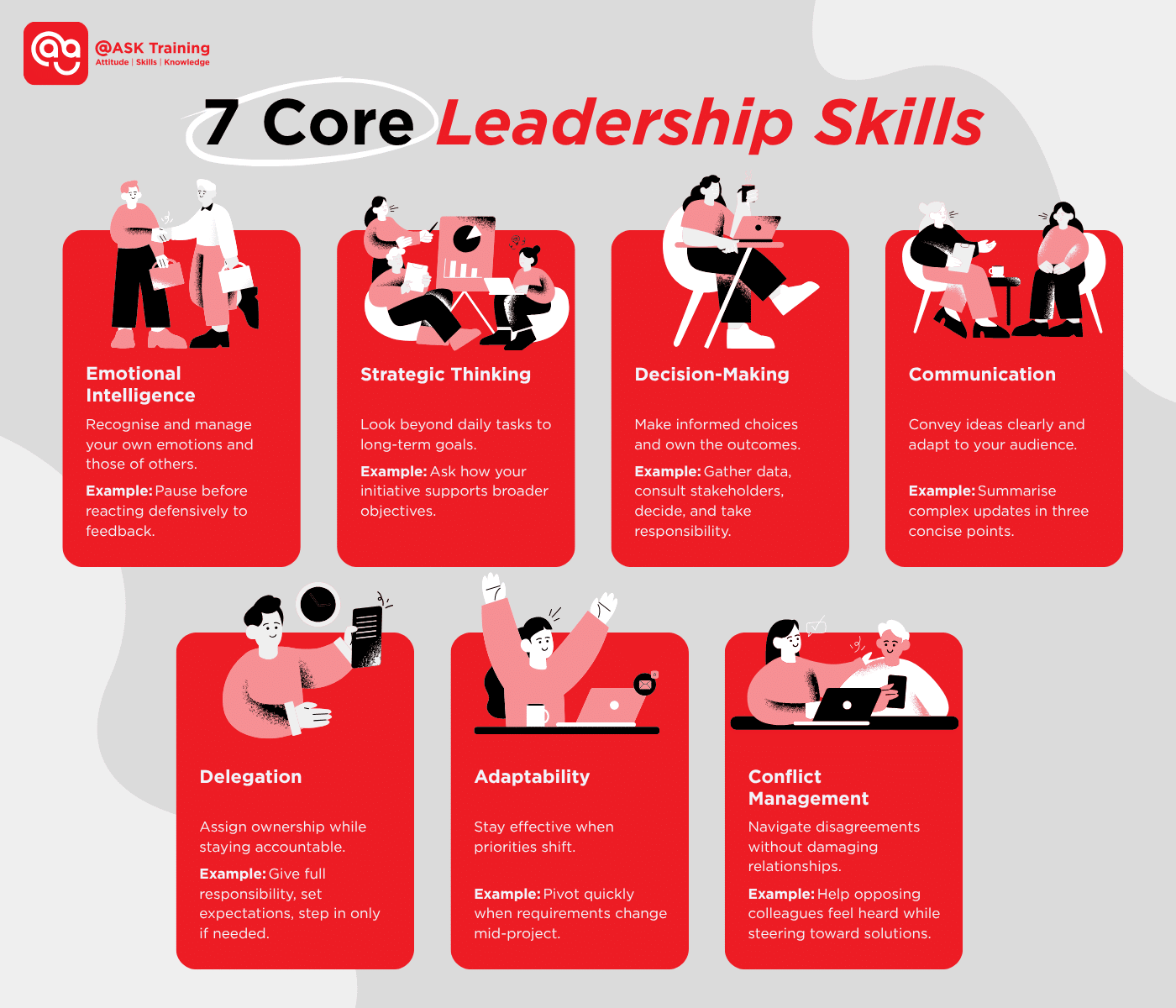
1. Emotional Intelligence
The ability to recognise and manage your own emotions while understanding and influencing the emotions of others.
Example: Catching yourself before reacting defensively to critical feedback, and instead pausing to process before responding constructively.
2. Strategic Thinking
Looking beyond daily tasks to understand long-term business goals and how your work aligns with them.
Example: Before launching a new initiative, ask how it supports the organisation’s broader objectives for the year, and adjust your approach accordingly.
3. Decision-Making
Making timely, informed choices and owning the outcomes, whether successful or not.
Example: Gathering the available data, consulting key stakeholders, and making a call when waiting would cause more harm than acting and taking responsibility for the result.
4. Communication
Conveying ideas clearly and adjusting your style to suit different audiences, from junior team members to the C-suite.
Example: Summarising a complex project update in three concise points for senior leadership, rather than walking through every detail.
5. Delegation
Assigning ownership of tasks while remaining accountable for the final outcome.
Example: Giving a team member full responsibility for a client presentation, providing clear expectations and support, but letting them own the execution—and stepping in only if needed.
6. Adaptability
Remaining effective when priorities shift or unexpected challenges arise.
Example: When a key stakeholder changes requirements midway through a project, pivoting quickly and recalibrating the team’s focus without losing momentum.
7. Conflict Management
Navigating disagreements constructively to reach a resolution without damaging relationships.
Example: Facilitating a conversation between two colleagues with opposing views, helping each feel heard while steering toward a mutually acceptable solution.
What ties these together
These competencies share a common thread. None of them require a formal leadership title. Each combines mindset, how you think about your role and responsibilities, with observable behaviour, what you actually do in the workplace.
Leadership is not about positional authority. It is about how you show up, how you influence, and how you enable others to succeed.
The professionals who internalise this distinction are the ones who earn the trust and respect that formal titles alone cannot command.
With a clear view of the skills that matter most, the next step is exploring the foundation upon which all others rest.
Emotional Intelligence as the Foundation of Leadership
With a clear view of the skills that matter most, the next question becomes: where do you start?
The answer lies in the competency that underpins all others. Before you can think strategically or lead effectively, you must first master yourself. Emotional intelligence leadership forms the foundation for everything that follows.
1. Develop Self-Awareness in High-Pressure Situations
Notice your triggers:
- A deadline slip
- A client pushes back
- A stakeholder questions your judgment
Instead of reacting on autopilot:
- Pause and recognise what you are feeling
- Choose your response rather than letting your impulse decide
In a tense project review, catching frustration before it spills out allows you to ask clarifying questions rather than criticising, keeping the discussion productive.
2. Practise Emotional Regulation During Difficult Conversations
Difficult conversations test everyone. Whether delivering tough feedback or navigating a disagreement, your ability to stay composed determines the outcome.
Before entering a challenging conversation:
- Clarify your objective
- Anticipate your triggers
- Commit to staying curious, not combative
If tension rises mid-conversation:
- Pause
- Breathe
- Ask clarifying questions
These small actions create space between impulse and response, space where leadership happens.
3. Demonstrate Empathy When Managing Team Members
When a team member misses a deadline, your first instinct might be to address the delay. An emotionally intelligent leader first asks why.
Empathy in action:
- Understand their perspective before jumping to solutions
- Uncover root causes rather than treating symptoms
- Strengthen the relationship for future collaboration
4. Build Trust Through Consistent and Respectful Communication
Trust accumulates through repeated interactions where your words and actions align.
Consistency means:
- Following through on commitments
- Communicating bad news transparently
- Treating junior colleagues with the same respect as senior leaders
Respect means:
- Listening actively
- Choosing words carefully
- Assuming positive intent, even when you disagree
When launching a new process that impacts another department, reaching out early, explaining the rationale, acknowledging the impact, and inviting feedback builds goodwill that lasts long after the launch.
Why This Matters
Emotional intelligence is not a soft skill. It is the hard currency of leadership.
Master these four elements and you earn the trust that makes everything else possible:
- Self-awareness
- Emotional regulation
- Empathy
- Consistent, respectful communication
With this foundation established, the next step is expanding your focus from daily execution to long-term impact.
Strategic Thinking and Decision-Making Skills
With emotional intelligence anchoring how you show up, the next frontier is how you think. This is where you shift from executive to shaping outcomes, and where organisations begin to see you as leadership material.
From daily execution to long-term outcomes
Early in your career, success means getting things done. Mid-career demands something different: seeing around corners.
Strategic thinking means:
- Looking beyond today’s to-do list
- Asking “what comes next?” before being asked
- Connecting your work to the organisation’s broader direction
Example:
When planning a project, do not stop at the timeline and budget. Consider how this work positions your team for future opportunities. What capabilities will it build? What relationships will it strengthen? What doors might it open?
Evaluate risks and trade-offs before committing
Every decision carries trade-offs. Strategic leaders evaluate them openly rather than ignoring them.
Before committing to a course of action:
- What are the upside and downside?
- What resources will this consume?
- What other priorities will this deprioritise?
- What happens if we delay or decline?
A senior manager in Singapore considering a new regional initiative might weigh:
- Potential market share gains against operational strain
- Short-term investment against long-term returns
- Team bandwidth against existing commitments
By surfacing these trade-offs upfront, you make better decisions and prepare stakeholders for what to expect.
Align team actions with organisational goals
Strategic thinking loses value if it stays in your head. The most effective leaders translate strategy into action for their teams.
Ask yourself:
- Does my team’s current work directly support the organisation’s priorities?
- Can each team member explain how their role connects to broader goals?
- Are we investing time in activities that do not move the needle?
When organisational priorities shift, strategic leaders pivot quickly. If leadership announces a renewed focus on customer retention, for example, you might:
- Reframe existing projects to highlight retention impact
- Repurpose resources toward retention-focused initiatives
- Help your team understand why the shift matters
Communicate the reasoning behind decisions clearly
Decisions made in isolation breed confusion and resistance. Strategic leaders bring stakeholders along by explaining the why behind the what.
When communicating a decision:
- State the decision clearly upfront
- Explain the rationale and trade-offs considered
- Acknowledge what this means for those affected
- Invite questions and feedback
Consider a decision to pause a popular project due to budget constraints. Instead of announcing it as a fait accompli, you might say:
“We are pausing Project X to redirect resources toward the regional expansion, our top priority this quarter. I know this is disappointing, especially given the team’s excellent work. Here is what informed this decision, and here is how we will resume once resources allow.”
This approach:
- Builds trust through transparency
- Reduces speculation and frustration
- Positions you as someone who considers the full picture
Why This Matters
Strategic thinking and decision-making signal readiness for senior roles. When you consistently demonstrate the ability to think beyond today, weigh trade-offs honestly, align actions with organisational goals, and communicate decisions clearly, you become the person leadership trusts with greater responsibility.
With the ability to think strategically established, the next step is ensuring you communicate with the presence and authority that decisions deserve.
Executive Presence and Communication at Work
Strategic thinking earns you a seat at the table. How you communicate once you are there determines whether people listen.
Executive presence skills are often misunderstood as charisma or authority. In reality, they come down to a set of observable behaviours anyone can develop.
Speak with clarity and confidence
In meetings, how you speak leaves a lasting impression:
- Enter with a point of view, not just an update
- State your main point first, then support it
- Stop when you have finished speaking
Too many professionals undermine themselves by over-explaining or trailing off. Instead, practice concise confidence.
If you have a recommendation: “I recommend we proceed with Option B. Here are the two reasons why.” Then pause. Let the weight of your words land.
Structure for the audience
Senior leaders value clarity over complexity. When presenting to decision-makers:
- Start with the conclusion
- Provide 2-3 supporting points
- End with a clear ask
This approach demonstrates confidence and respects your audience’s time.
Let your body language reinforce your message
Your non-verbal communication speaks before you do.
Do:
- Maintain steady eye contact
- Sit or stand with an open posture
- Use deliberate gestures to emphasise key points
Avoid:
- Crossing your arms defensively
- Fidgeting with pens or phones
- Glancing at screens while others speak
In virtual settings, look at the camera and stay visibly present.
Balance your communication
Avoid over-explaining or under-communicating
Two common communication pitfalls plague mid-career professionals: saying too much or saying too little.
Over-explaining often stems from a desire to be thorough or a fear of being misunderstood. It signals uncertainty. If you find yourself adding caveats, repeating points, or providing excessive background, stop. Trust your preparation. State your point and let it stand.
Under-communicating manifests as assumptions that others already know what you know. It creates confusion, misalignment, and rework. When in doubt, over-communicate context and expectations, just not the execution details.
A practical rule:
- State the what and why clearly
- Provide details only when requested
- Follow up in writing to confirm alignment
Why this matters
Executive presence skills remove the barriers between your capability and your visibility. Speak clearly, structure for impact, and let your body language reinforce your message.
With presence sharpened, the next step is learning to lead effectively without a formal title.
Leading Without a Formal Title
With executive presence sharpened, the next question is: how do you lead when you hold no authority over the people you need to influence?
The answer lies in behaviour, not hierarchy.
Influence through collaboration, not command
- Build relationships before you need them
- Understand what motivates your peers
- Frame requests around shared goals, not personal asks
Instead of: “You need to do this for me.”
Try: “Here’s how this helps us both hit our targets.”
Take initiative on cross-functional projects
- Volunteer for projects that span departments
- Coordinate across teams without waiting for permission
- Become the person who connects the dots
Mentor informally
- Share lessons learned with junior colleagues
- Offer guidance without being asked
- Build a reputation as someone who helps others succeed
Demonstrate accountability consistently
- Own mistakes openly
- Follow through on every commitment
- Be reliable, regardless of who is watching
Why this matters
Leadership without a title is how you earn the trust and respect that formal authority alone cannot buy.
When you consistently influence, initiate, mentor, and take ownership, you become the person others naturally turn to, and the one organisations naturally promote.
With the foundations of leadership in place, the final step is turning knowledge into action.
Practical Ways to Develop Leadership Skills Now
With a clear understanding of what leadership looks like and how it operates with or without a title, the final question is: where do you start?
The answer is simpler than you might think. Leadership development does not require a promotion or a complete career overhaul. It begins with intentional, consistent action.
1. Seek structured feedback
Generic feedback yields generic growth. Ask specific questions:
- “What could I have done differently in that presentation to be more persuasive?”
- “How could I have handled that stakeholder conversation more effectively?”
- “What one skill should I focus on developing this quarter?”
2. Volunteer for leadership opportunities
- Take the lead on a challenging project component
- Coordinate cross-functional initiatives
- Step up when teams need direction
3. Create a focused improvement plan
Identify one skill gap and build a six-month plan around it.
Example: If strategic thinking is the gap:
- Attend cross-departmental planning meetings
- Read one industry analysis per week
- Frame daily tasks in terms of business outcomes
4. Consider formal leadership training
For those seeking structured development, leadership training programmes offer:
- Frameworks you can apply immediately
- Peer learning from professionals at similar stages
- Accountability to turn skills into habits
In Singapore, where the business landscape moves quickly, investing in leadership training signals commitment to growth, both to yourself and to your organisation.
Wrapping Up
Leadership is not a trait reserved for those who started early. It is a deliberate skill set built through self-awareness, practice, and intentional action.
The core competencies: emotional intelligence, strategic thinking, executive presence, and the ability to lead without a title, are within your reach.
You already bring years of experience, hard-won judgment, and valuable context to the table. Now is the time to build on that foundation.
Start today. Seek sharper feedback. Volunteer for the stretch assignment. Enrol in leadership training. Take one intentional step.
For mid-career professionals ready to step into their next chapter, the opportunity to build meaningful leadership skills has never been more accessible.
Related Courses
- People Centred Leadership – Motivating, Inspiring and Engaging Others
- Persuasive Communication for Leaders
- Sun Tzu’s Art of War for Modern Leaders
◆◆◆