
You’ve successfully recruited your key talent. Now comes the essential work of a true leader: developing and deploying that talent to its full potential.
Even the most brilliant strategist cannot achieve organisational goals without a team where each member is in the right role, equipped with the right skills.
Consider Zhuge Liang’s approach. He never assigned the blunt but loyal Guan Yu to delicate diplomacy. Nor did he task the aggressive Zhang Fei with managing supply logistics.
His genius was in matching innate strengths to specific roles, then providing targeted training to forge a cohesive, high-performing unit.
This principle is modern talent optimisation. Misalignment between a person’s skills and their role leads to frustration, disengagement, and stalled progress.
As the second part in our series on building your organisation, this article moves from acquisition to talent activation.
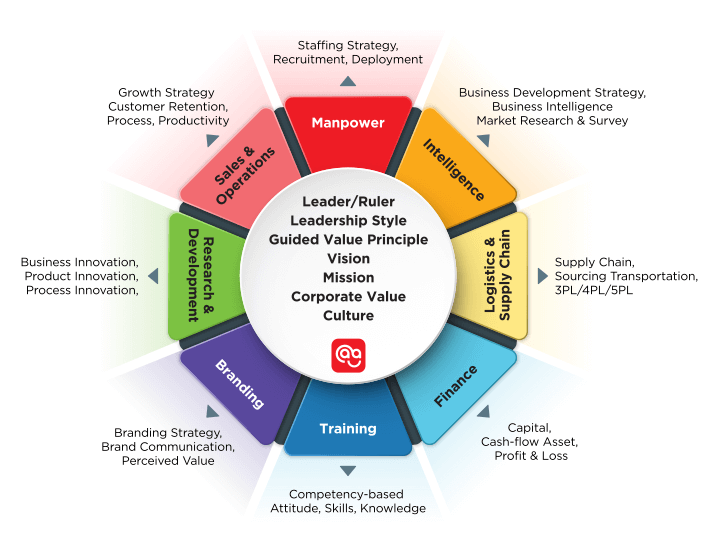
Guided by the Eight Trigrams Framework, we focus on the Training domain, demonstrating how purposeful development is inseparable from intelligent placement, providing you with the tools to ensure every team member contributes their best.
The fundamental lesson for every leader is this: effectiveness stems from putting the right person in the right role.
The Principle of Purposeful Placement: Romance vs Reality
To build an effective team, we must move beyond the myth of the ready-made hero and understand the practical art of aligning individual capability with organisational need.
The Romance of the Ready-Made Hero
The Romance of the Three Kingdoms paints its heroes with broad, legendary strokes.
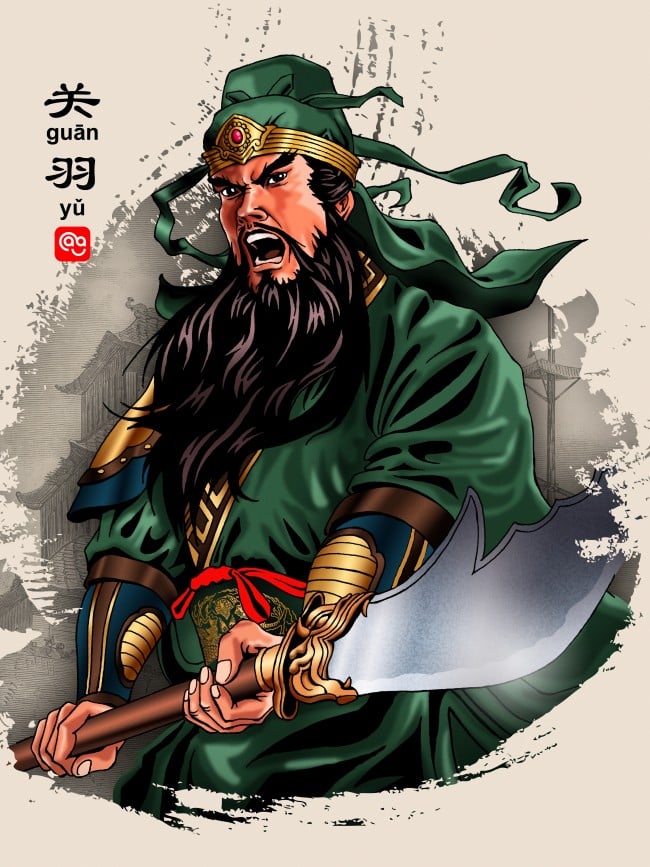
Guan Yu is the epitome of unwavering loyalty and martial might.
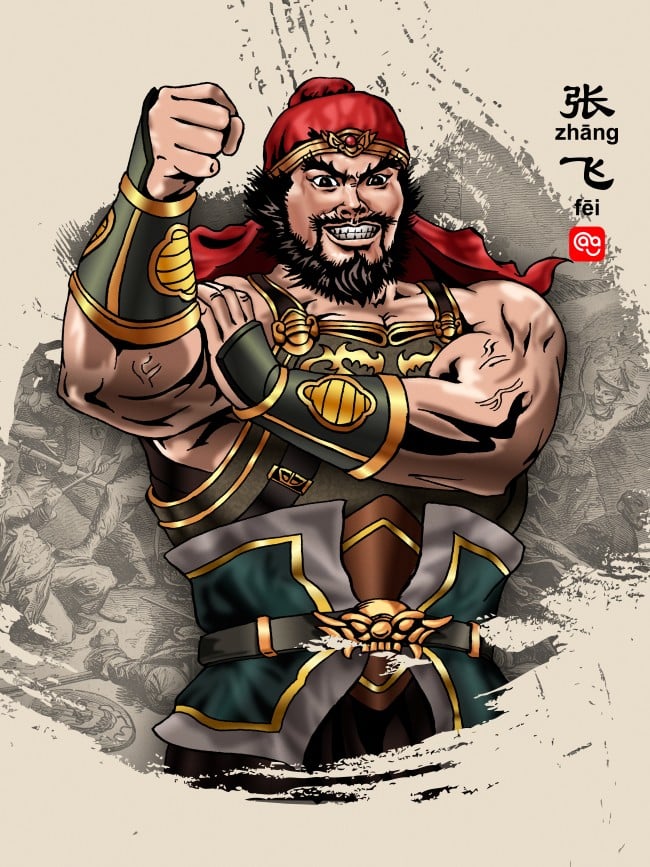
Zhang Fei is a pure, fearless force.
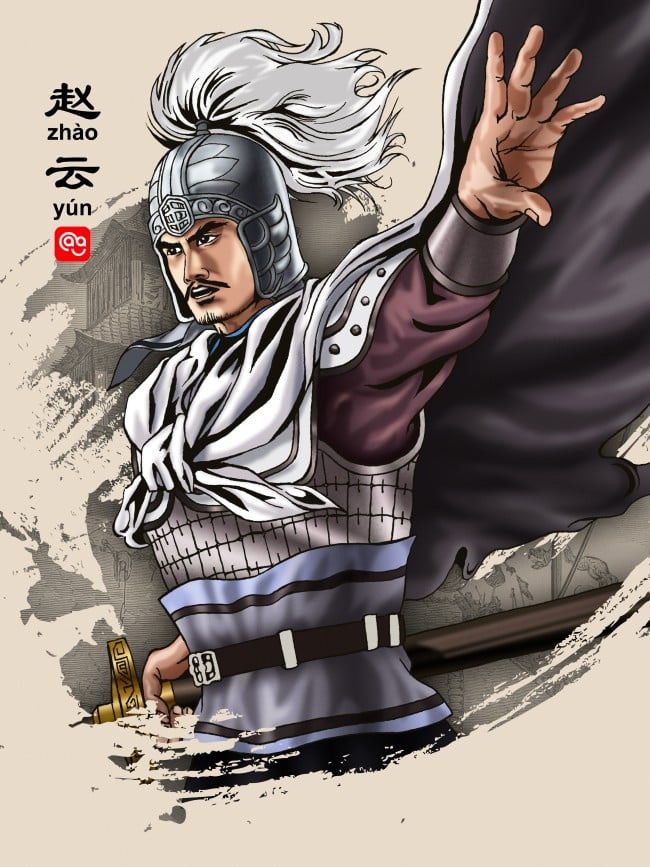
Zhao Yun is the flawless protector.
The narrative implies these figures emerged fully formed, their legendary roles destined and self-evident.
The Reality of Strategic Deployment
While these generals were exceptional, their success stemmed from a strategic analysis of human capability.
The True Strategy:
- Assessment Over Assumption: Zhuge Liang did not assign roles based on reputation alone. He acted as a masterful people strategist, analysing each general’s demonstrated strengths, behavioural patterns, and core motivations.
- Deliberate Alignment: Assignments were made by matching these observed competencies to mission requirements.
- Guan Yu’s Integrity & Reputation → Trust-critical missions and honour-bound negotiations.
- Zhang Fei’s Formidable Presence & Decisiveness → Objectives requiring shock momentum and forceful execution.
- Zhao Yun’s Blend of Courage & Tactical Acumen → Independent, complex operations demanding both bravery and sound judgment.
The Modern Translation for Leaders:
Your role is not to search for perfect, pre-formed heroes. It is to become an astute assessor of the real, observable capabilities within your team and align them precisely with the challenges you face.
- Ask Yourself: Is the brilliant analyst struggling in a public-speaking role? Is the charismatic presenter unsure of deep data work?
- The Leader’s Task: True leadership begins with seeing the person and their proficiencies, not just the position they hold. It requires moving from intuition to informed insight about where each individual’s potential can be best applied for collective success.
Once you’ve identified these proficiencies, the next challenge is developing them systematically.
The Modern Framework: Competency-Based Development
The era of generic training that feels disconnected from daily work is over. Modern, impactful development must be as targeted and practical as training an artisan in their specific craft.
What is Competency-Based Development?
This approach directly links learning to the specific skills and behaviours (competencies) a person needs to excel in their current or future role.
It shifts the question from “What should they know?” to “What do they need to be able to do to succeed and advance?”
Creating Your Focused Development Plan
Building an effective plan is a straightforward, three-step process for leaders:
Define the Objective
What is the specific business outcome or challenge? (e.g., “Improve project delivery efficiency by 20%,” “Increase client satisfaction scores in a new market”).
Identify The Gap
What competencies are currently present on the team versus those required to meet the objective?
Be precise. (e.g., “The team is technically proficient but lacks formal project management methodology,” “We need stronger consultative selling skills”).
Select the Intervention
Choose the most direct method to build the needed competency.
- For technical skills: Structured courses, certifications, guided peer-to-peer learning.
- For interpersonal skills: Role-playing workshops, targeted coaching, and feedback-intensive projects.
- For strategic thinking: Case study analysis, participation in strategy meetings, and mentorship from senior leaders.
The measure of success is not attendance, but observable application; a new skill actively improving performance and outcomes.
Having a framework for development is crucial, but to apply it effectively, you need a clear view of your team’s current landscape. This is where strategic visualisation becomes a leader’s most valuable tool.
To translate capability into action, leaders need a clear, visual system to map their team’s talents against organisational priorities. Let’s explore further.
The Team Deployment Matrix: Your Leadership Dashboard
Knowing skills is one thing; visualising how they fit together is another. Enter the Team Deployment Matrix, a simple but powerful tool to plot your team’s capabilities and align them with your strategic objectives.
How to Create Your Matrix
Create a two-axis grid. The vertical axis represents Individual Proficiency/Competency (from Developing to Expert).
The horizontal axis represents the Strategic Importance of the Role (from Low to High). This creates four distinct quadrants.
| High Strategic Importance | Low Strategic Importance | |
| Expert Proficiency |
Zone 1: Key Leaders Your core drivers. Empower with autonomy and invest in their growth. |
Zone 2: Valued Specialists Experts in niche areas. Protect their focus for deep, critical work. |
| Developing Proficiency |
Zone 3: Critical Growth Roles High-potential individuals in vital positions. Prioritise targeted training and support. |
Zone 4: Core Support Essential for stability. Focus on clarity, process, and recognition. |
Applying the Matrix for Strategic Decisions
Plot Your Team
- Place each team member in the quadrant that reflects their current proficiency in their current role’s context.
Conduct Your Analysis
- Are your Key Leaders (Zone 1) overburdened? This is a resilience risk.
- Are high-potential individuals languishing in Core Support (Zone 4)? This is a misalignment; your “cavalry leader” is stuck managing supplies.
- Is Zone 3 thinly populated? This may indicate a future leadership pipeline gap.
Take Informed Action
- Empower and Expand: Challenge your Valued Specialists (Zone 2) with broader responsibilities that edge them toward Zone 1.
- Invest and Develop: Create customised development plans to accelerate individuals in Critical Growth Roles (Zone 3) toward expertise.
- Stabilise and Systematise: Ensure Core Support (Zone 4) roles are well-defined and efficient, providing a stable foundation for the entire team.
Download this and try it yourself!
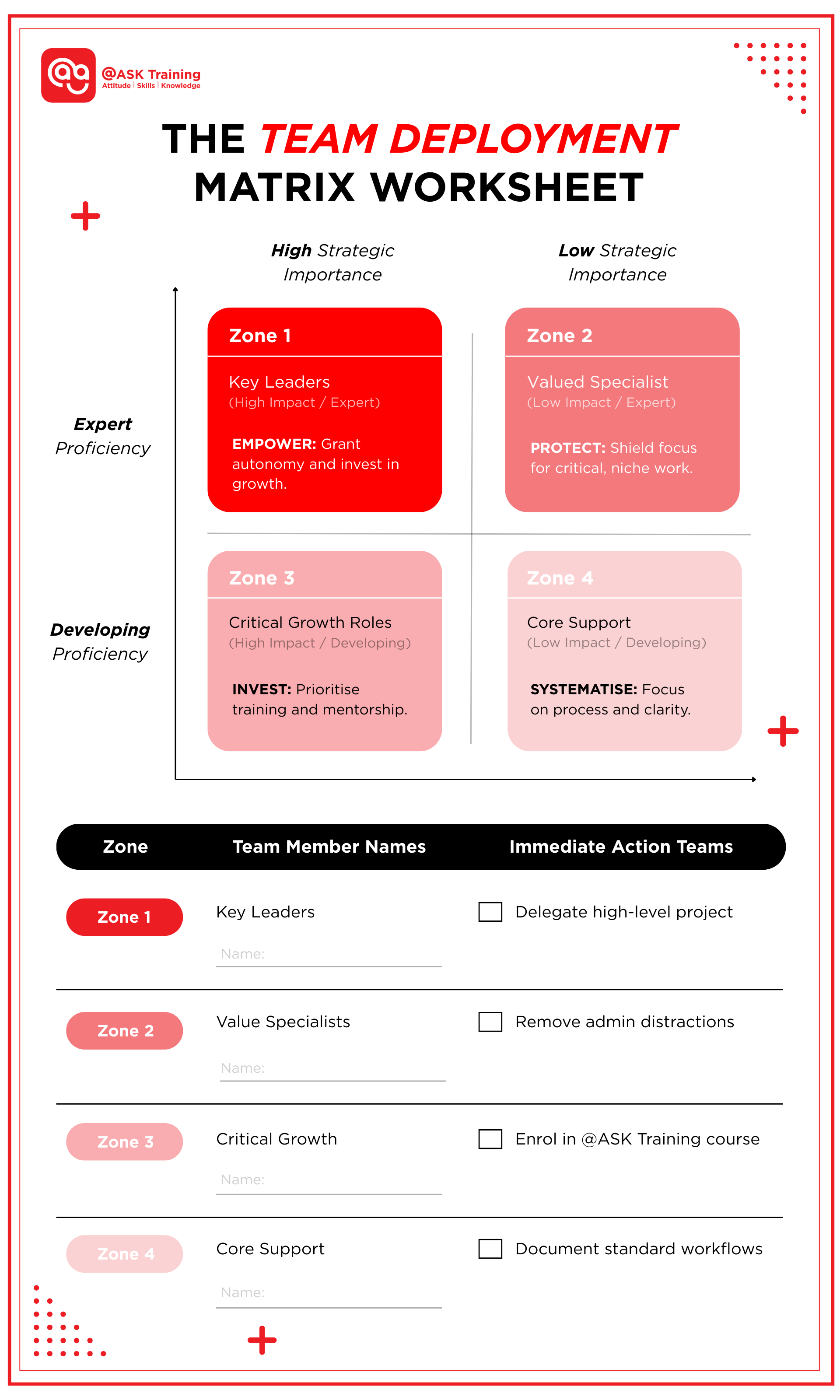
This tool transforms subjective opinion into a strategic blueprint for team development and deployment. With this clarity, you can now explore how these principles drive success in real-world scenarios.
Case Study: SkillsFuture Singapore – National Upskilling Initiative
This framework isn’t just theoretical; it’s being applied at a national level here in Singapore. Let’s examine how SkillsFuture Singapore (SSG) used this exact strategic thinking to address the nation’s digital skills gap.
The Challenge
Since 2015, Singapore’s rapid tech boom created critical skills gaps in areas like data analytics and cybersecurity. This left capable mid-career workers mismatched, while SMEs faced costly challenges filling high-importance digital roles.
The Strategic Deployment
SSG executed a nationwide competency deployment, treating the workforce as a national “team” for strategic training and placement via sector analyses.
Applying the Team Deployment Matrix
| Matrix Quadrant | SSG Application |
| Zone 1: Key Leaders (Expert/High Importance) | Retain & Empower: TechSkills Accelerator (TeSA) advanced tracks kept cybersecurity experts as core commanders. |
| Zone 2: Valued Specialists (Expert/Low Importance) | Protect & Focus: Credits funded niche upskilling for data analysts in support roles. |
| Zone 3: Critical Growth (Developing/High Importance) | Accelerate & Train: Place-and-Train hired mid-career switchers; Career Transition Programme reskilled high-potentials. |
| Zone 4: Core Support (Developing/Low Importance) | Stabilise & Systematise: Basic Credit courses upskilled admin roles for stability. |
The Results
SSG’s informed strategy delivered measurable outcomes:
- 192,000 Singaporeans used their Credits for targeted training in 2023 alone.
- Programmes like TeSA successfully placed professionals into tech roles, contributing to Singapore’s consistently low structural unemployment (~2–3%) despite economic shifts.
- SMEs gained a proven framework: by plotting their teams similarly, they could build internal resilience instead of relying solely on costly external hires.
(Sources: SSG, IndSights Research)
The Strategic Lesson: This proves the matrix scales from nation to team. SkillsFuture Singapore didn’t just offer courses, they strategically forged a national workforce by matching development to role importance and individual proficiency.
Your leadership challenge is the same: to forge your team with the same intentionality.
Your Leadership Action: This Week’s Focus
The case study provides the blueprint, but leadership is about action. This week, move from insight to implementation.
Your 3-Step Action Plan
Step 1: Plot Your Pilot Team
- Select one department, project team, or group of direct reports.
- Use the matrix to place each member based on their current proficiency and their role’s current strategic importance.
Step 2: Conduct Your One-Zone Analysis
Based on your plot, choose ONE of these actions to execute this week:
- For Zone 1 (Key Leaders): Have a 15-minute conversation with one “Zhuge Liang.” Ask: “What’s one thing I could do to better empower you or remove a barrier?“
- For Zone 3 (Critical Growth): Identify one high-potential individual. Commit to one specific training resource or mentoring session for them.
- For Zone 2 or 4: For one team member, clarify one ambiguous process or recognise one specific contribution they’ve made.
Step 3: Schedule Your Next Review
- Block 30 minutes one month from now to review the pilot team’s matrix.
- Ask: Has anyone’s position shifted? What was the impact of my action?
Why This Works
SkillsFuture Singapore built a national system step-by-step. Your leadership journey starts with one deliberate, strategic action informed by the matrix.
This single act begins the shift from passive management to active, strategic leadership of your talent.
Wrapping Up: The Leader as Team Architect
Liu Bei and Zhuge Liang did not build a kingdom by merely assembling a list of famous names. They built it by intentionally forging a cohesive unit, where each person’s trained capabilities were matched to a clear role within a unified strategy.
The synergy of Guan Yu’s steadfastness, Zhang Fei’s drive, and Zhao Yun’s versatile skill created an organisation far greater than the sum of its individuals.
Modern leadership demands the same architectural mindset. It requires you to see and develop the specific competencies within your people. It asks you to replace scattered training with purposeful skill-building.
And it is made possible by using practical tools, like the Deployment Matrix, to strategically place your talent where they can deliver maximum value.
Move beyond simply filling roles. Start building a team where everyone is in the right place, equipped for the right challenge, and fully engaged in advancing your collective mission.
Your Next Step: Create your first Team Deployment Matrix this week. Identify one opportunity for better alignment or development, and act on it.
Continue Your Leadership Development
Missed our previous articles? Catch up on our Three Kingdoms Series! For weekly insights, follow us on TikTok @3kingdomsacademy.
For deeper training, explore our Three Kingdoms Leadership courses designed to build your strategic capability:
- Three Kingdoms’ Leaders & Leadership (Cao Cao Chapter):
Master decisive, results-driven leadership. - Applying Three Kingdom Strategies in Your Organisation:
Turn ancient tactics into your modern competitive advantage. - Three Kingdoms’ Leadership in Today’s Context:
Learn to solve complex modern problems with timeless wisdom. - Sun Tzu’s Art of War for Modern Leaders:
Master the classic principles of strategy for today’s business battles.
Stay tuned for our next article, Chapter 3: Innovation, where we will explore how to lead with resourcefulness when budgets are tight.
Start forging your team today. The right talent, in the right role, is the foundation of a kingdom that lasts.
Related Courses
- Three Kingdoms’ Leaders & Leadership (Cao Cao Chapter)
- Applying Three Kingdom Strategies in Your Organisation
- Three Kingdoms’ Leadership in Today’s Context
- Sun Tzu’s Art of War for Modern Leaders
◆◆◆
Related Articles
Article Topics
- The Principle of Purposeful Placement: Romance vs Reality
- The Modern Framework: Competency-Based Development
- The Team Deployment Matrix: Your Leadership Dashboard
- Case Study: SkillsFuture Singapore – National Upskilling Initiative
- Your Leadership Action: This Week’s Focus
- Wrapping Up: The Leader as Team Architect