
Every leader faces the moment when the cupboard is bare. The budget is exhausted, the team is stretched thin, and the targets loom large.
In these moments, conventional wisdom says to retreat or plead for more. But history offers a different lesson—one of ingenious resourcefulness.
Recall the legendary stratagem during the Battle of Red Cliffs. Facing a critical arrow shortage, Zhuge Liang didn’t request supplies; he manufactured opportunity from constraint.
Under the cover of fog, he sent straw-stuffed boats toward the enemy camp. Cao Cao’s forces, fearing a night attack, unleashed a storm of arrows into the empty vessels.
By dawn, Zhuge Liang returned with 100,000 borrowed arrows, turning his enemy’s strength into his own supply. This wasn’t magic; it was strategic innovation under constraint.
In today’s terms, Zhuge Liang was the ultimate bootstrapper; he used creativity as capital and perception as a weapon.
As we progress to Chapter 3: Innovation in our series, we shift from building and training your team (Chapter 2) to empowering them to achieve more with less.
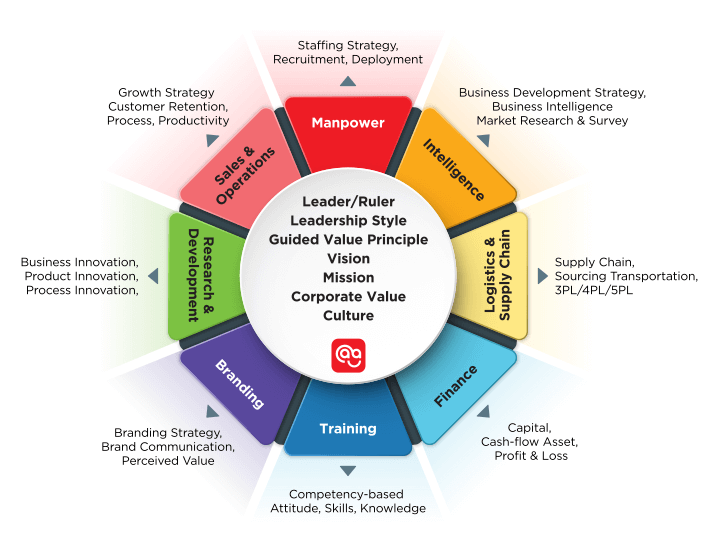
Guided by the Eight Trigrams Framework, we explore the Innovation domain. This article provides a blueprint for transforming limitations into launchpads, proving that the most powerful resource you have is not in your budget, but in your mindset.
Now, let’s examine the strategic thinking behind this legendary story to extract its timeless principles for modern leadership.
1. The “Borrowed Arrows” Mindset: Romance vs. Reality
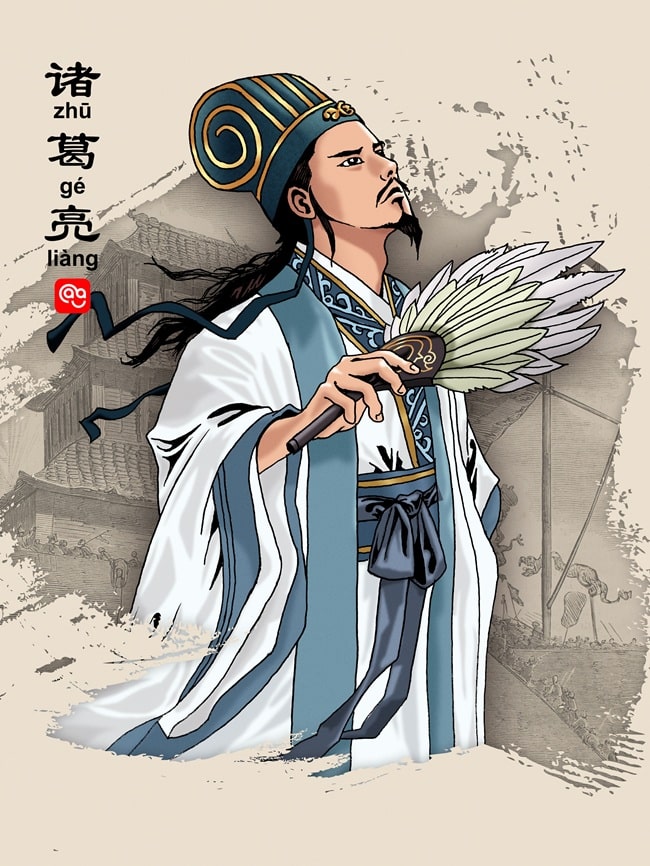
The Romance of the Empty Quiver
The tale is a masterclass in narrative drama. Zhuge Liang, having promised his ally Zhou Yu a seemingly impossible quota of arrows, appears to face certain disgrace. With quiet confidence, he prepares a fleet of boats adorned with straw figures.
As a thick fog blankets the river, he orders drums to beat and boats to advance. Cao Cao’s forces, blind and anxious, fill the air with arrows aimed at phantoms. Zhuge Liang retrieves a fortune in ammunition, his reputation as a mystical strategist secured.
The Reality of Constraint-Driven Innovation
While the fog and drums make for good theatre, the strategic core is profoundly practical. Zhuge Liang operated on several key principles:
- Reframe the Problem: The shortage wasn’t about “lacking arrows”; it was about “needing a method to acquire arrows without manufacturing them.” This shifted the solution space entirely.
- Leverage Asymmetric Assets: He had no arrows, but he had fog (a natural condition), straw (an abundant, worthless material), and an understanding of his enemy’s predictable behaviour (fear of a fog-bound attack).
- Turn Opponent’s Strength into Liability: Cao Cao’s vast supply of arrows and defensive posture became the very means of their depletion.
The Modern Translation
Innovation under constraint isn’t about wishful thinking. It’s a disciplined process of asset mapping, problem reframing, and leveraging systems (including competitors’ ecosystems) to achieve your goal.
Your “fog” might be a market trend; your “straw boats” might be a minimal viable product; your “enemy’s arrows” might be a competitor’s excess capacity or an overlooked open-source tool.
This mindset is the foundation, but it must be channelled into a structured process to move from inspiration to execution.
2. The Modern Arsenal: Frameworks for Constraint-Based Innovation
When resources are scarce, structure becomes your greatest ally. These frameworks replace capital with creativity—turning limitations into launchpads.
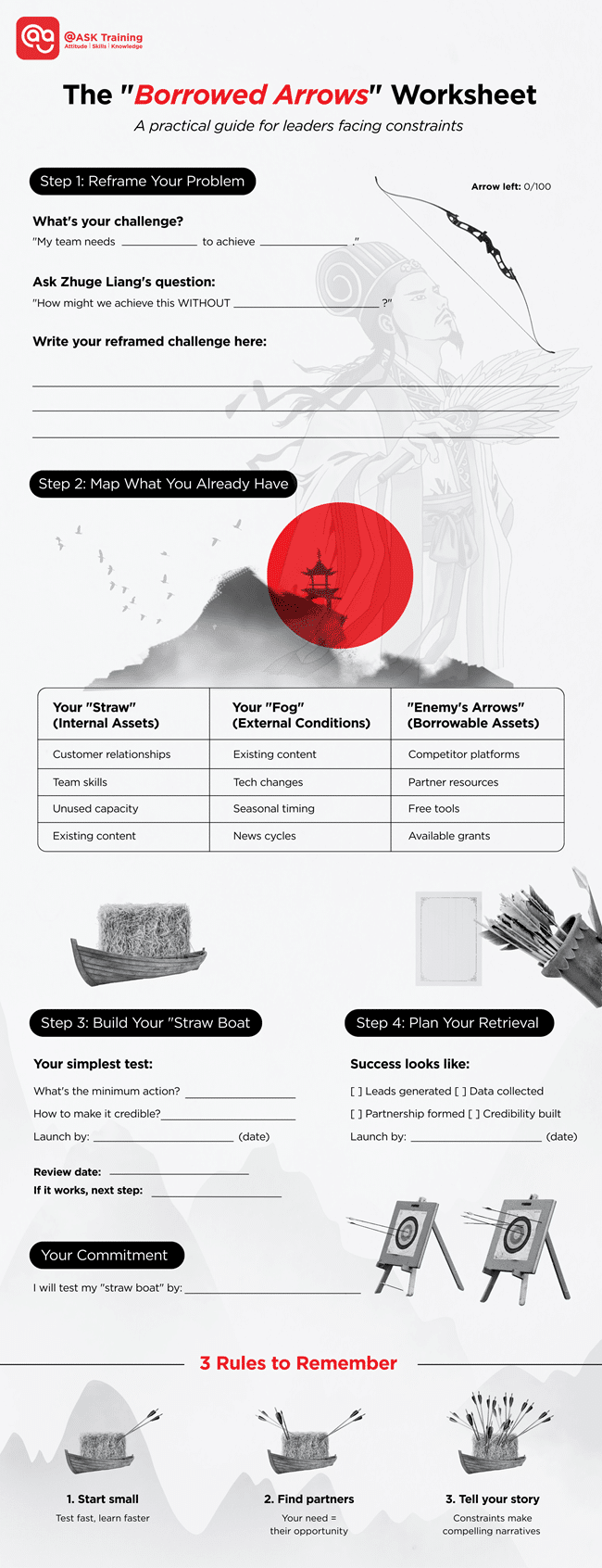
The “Borrowed Arrows” Brainstorm: A Worksheet for Resourceful Leaders
This isn’t a typical brainstorming session. It’s a systematic audit designed to uncover hidden assets and unconventional pathways when facing constraints.
Section A: Diagnose the True Constraint
- The Obvious Problem: (e.g., “We need $50,000 for marketing.”)
- Reframed Challenge: “How might we achieve [key goal] without the conventional resource?”
Section B: Map Your Hidden Assets (Your “Straw and Fog”)
- Underutilised Internal Assets: Existing customer relationships? Team skills? Downtime?
- External Conditions: What trends, events, or changes can you leverage? (Your strategic “fog”)
- Borrowable Assets: What do competitors, partners, or other industries have in excess that you could utilise?
Section C: Design Your “Straw Boat” (The Minimal Action)
- Lowest-Cost Test: What is the simplest version that could validate your approach?
- Perception Strategy: How can you make this simple action appear more substantial? (Through storytelling, partnerships, and presentation)
Section D: Plot the Retrieval (Measure & Capture Value)
- Success Signals: What measurable outcome will show your approach is working?
- Value Capture: How will you convert this experiment into tangible results? (Leads, data, partnerships, credibility)
Principles of Constraint-Based Innovation
- Simplify, Then Add: Start with the absolute minimum needed to test your assumption. Add complexity only after validation.
- Seek Symbiosis, Not Just Supply: Look for partnerships where your challenge solves someone else’s problem. Your constraint might be their opportunity.
- Narrative is a Resource: A compelling story about overcoming limitations can attract talent, attention, and support more effectively than a large budget.
Download our worksheet to start applying them to your business:
This framework provides the mental map for innovation under pressure, but its true power is revealed when applied to real-world challenges.
Let’s examine how these principles unfold in a modern business battleground.
III. Case Study: Sea Limited – The Singapore Startup that “Borrowed Arrows”
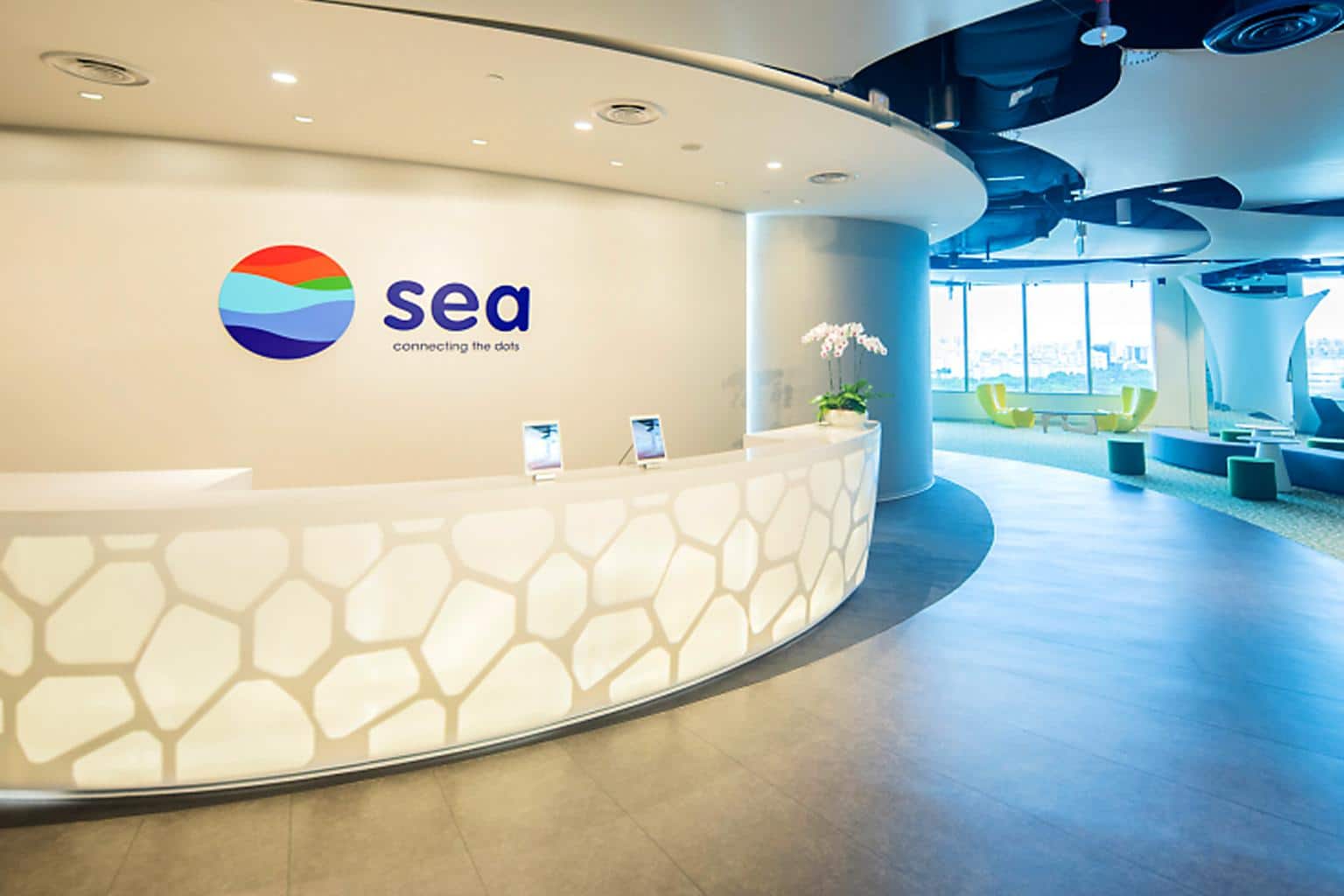
The Challenge
- In 2009, a fledgling Singapore gaming startup named Garena (later Sea Limited) faced a seemingly impossible market.
- Southeast Asia’s gaming landscape was dominated by giants like Tencent, with their blockbuster intellectual property (IP) and massive marketing budgets.
- Garena had a platform vision but lacked both the games and the financial firepower to compete directly.
The “Borrowed Arrows” Strategy
- Reframe the Problem
“We don’t need to create our own blockbuster games; we need to borrow the credibility and distribution of the giants.”
Asset Mapping & Execution
- The “Fog” (External Condition): The Southeast Asian smartphone boom of the early 2010s, coupled with cheap data plans, created a hungry, underserved mobile gaming market.
- The “Straw Boats” (Minimal Viable Platform): Instead of investing years and capital into game development, Garena launched a lightweight gaming aggregator and social platform. It was the conduit, not the content.
- The “Enemy’s Arrows” (Borrowed Asset): In a masterstroke, Garena secured exclusive Southeast Asian publishing rights to Tencent’s global hits—first League of Legends (2010) and later Arena of Valor (2016).
They turned their biggest rival’s most powerful assets (beloved IP and massive fan bases) into their own distribution and user acquisition engine, without the heavy development cost.
The Retrieval
The millions of players and troves of behavioural data from these borrowed games didn’t just build a gaming business—they provided the validation, user base, and capital to fuel the company’s ambitious pivot into e-commerce (Shopee, 2015) and fintech (SeaMoney).
The Result
- Garena became Southeast Asia’s dominant gaming platform, hitting 10 million daily active users by 2017.
- Sea Limited (the parent company) reached a peak market capitalisation of over US$231 billion in 2021.
- The company achieved its first profitable year in 2023 and secured digital banking licenses, building a formidable digital ecosystem.
- Its customer acquisition cost remained far below industry averages due to the powerful synergies within its “borrowed” ecosystem.
(Sources:
PR Newswire,
South China Morning Post,
Moomoo Tech,
Jeff Towson)
The Leadership Insight
Sea didn’t fight the battle on the resource-rich enemy’s terms (content creation). Like Zhuge Liang, it changed the battlefield. It identified the “fog” (market disruption), built the “straw boats” (a lean platform), and captured the “arrows” (its rival’s best assets) to fuel a kingdom.
This is the perfect blueprint for Singaporean and Southeast Asian SMEs today: use strategic partnerships and grants to access resources you cannot build alone, turning constraints into your most powerful strategic advantage.
A case study shows what’s possible, but leadership is defined by action. The final step is to translate this strategic insight into your immediate, personal practice.
Your Campaign of Resourcefulness: This Week’s Action
Theory and case studies illuminate the path, but your leadership is proven in action. This week, launch your own “Borrowed Arrows” campaign.
Your 3-Step Action Plan
Step 1: Host a 30-Minute “Constraint Reframe” Session
- Gather your core team. Pick one pressing resource constraint (budget, time, or manpower).
- Use the first question from the worksheet: “How might we achieve [key goal] WITHOUT [the assumed necessary resource]?“
- The rule: Ban the word “can’t.” Focus only on “how might we.”
Step 2: Identify One “Straw Boat” to Deploy
- From the ideas generated, select the one that is fastest to test with the least investment.
- Define: What does “launch” look like for this? (e.g., a single partnership conversation, a one-page landing page, a social media experiment).
- Commit to a launch date by the end of the week.
Step 3: Debrief and Capture
- After one week, spend 15 minutes reviewing: What did you learn? What value (arrows) did you retrieve? (Data, feedback, a new relationship?)
- Decide: Do you double down, adjust, or abandon this boat to build a new one?
Why This Works
Zhuge Liang didn’t overthink. He used the materials at hand and acted under the right conditions. Your first “straw boat” may not retrieve 100,000 arrows, but it will break the mindset of scarcity and unlock a cycle of creative, action-oriented problem-solving.
Wrapping Up: The Infinite Resource
Zhuge Liang’s lesson endures because it speaks to a fundamental truth: creativity operated strategically is an inexhaustible resource.
While budgets deplete and markets shift, the ability to see problems differently, to map hidden assets, and to execute with cunning simplicity becomes your permanent competitive advantage.
In the Eight Trigrams Framework, this is the essence of Innovation—not merely invention, but the adaptive intelligence to thrive within constraints. You have moved from building your team to now empowering them to achieve outsized results with undersized means.
The most successful modern leaders are not always the best funded; they are the most resourceful. They don’t see empty quivers; they see rivers thick with fog and opponents ripe for persuasion.
Your Next Move: Conduct your “Constraint Reframe” session this week. Identify your fog, build your straw boat, and see what arrows you retrieve.
Continue Your Leadership Campaign
Missed our previous chapters? Catch up on our Three Kingdoms Series to build your strategic foundation!
For weekly insights, follow us on TikTok @3kingdomsacademy.
For deeper training in strategic resourcefulness, explore our Three Kingdoms Leadership courses designed to build your innovative capability:
Applying Three Kingdom Strategies in Your Organisation
: Turn ancient tactics like “Borrowing Arrows” into your modern competitive advantage.
Three Kingdoms’ Leadership in Today’s Context
: Learn to solve complex, resource-constrained problems with timeless wisdom.
Three Kingdoms’ Leaders & Leadership (Cao Cao Chapter)
: Master decisive, pragmatic leadership for high-pressure situations.
Sun Tzu’s Art of War for Modern Leaders
: Master the classic principles of strategy, manoeuvre, and asymmetric advantage.
Stay tuned for our next instalment, Chapter 3, Part 2: R&D, where we will examine Zhuge Liang’s “Wooden Oxen” and master the art of process innovation to make your work easier, faster, and more efficient.
Start borrowing arrows today. Your constraints are not your limits; they are your most creative design brief!